
Investments in Debt Securities: Held-to-Maturity vs. Available-for-Sale vs. Trading

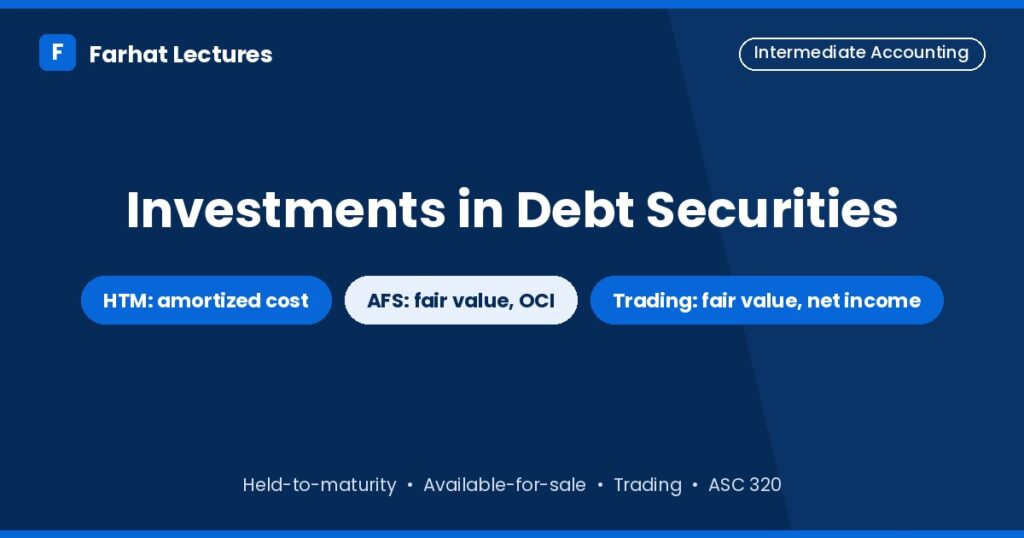
Investments in debt securities are bonds, notes, and similar instruments a company buys as an investor. U.S. generally accepted accounting principles (GAAP) classify each one as held-to-maturity, reported at amortized cost; available-for-sale, at fair value with unrealized gains and losses generally in other comprehensive income (OCI); or trading, at fair value with unrealized gains and losses in net income.
Why does this matter? The same bond can produce different carrying amounts and affect net income or other comprehensive income depending on its classification. This guide compares the three categories side by side, shows how to classify a security, and works one example all three ways. Each category also has its own detailed lesson: held-to-maturity securities, available-for-sale debt securities, and trading securities.
Watch: Debt securities accounting: HTM vs. trading vs. AFS (about 20 minutes, with journal entries for each category)
What are investments in debt securities?
A financial asset is cash, an ownership interest in another company (such as stock), or a contractual right to receive cash or another financial asset. Receivables and investments in debt and equity securities are all financial assets. A building is not, because its value comes from using it, not from a contract or an ownership claim.
A debt security makes the investor a creditor of the issuer. Common examples are U.S. government securities, municipal bonds, corporate bonds, convertible debt, and commercial paper. Preferred stock that the issuer must redeem, or that the investor can choose to redeem, also counts as a debt security under ASC 320. If you have studied bonds payable, an investment in debt securities is the same contract seen from the lender’s side: the issuer records interest expense, and the investor records interest revenue.
The three categories of investments in debt securities
At purchase, the company places each debt security in one of three categories (ASC 320, Investments in Debt Securities):
- Held-to-maturity (HTM): debt securities the company has the positive intent and the ability to hold until they mature.
- Trading: debt securities typically bought and held for near-term resale. ASC 320 also permits trading classification at acquisition for securities the company plans to hold longer.
- Available-for-sale (AFS): every debt security that is not classified as held-to-maturity or trading. It is the leftover category.
How to classify investments in debt securities
Work through three questions in order:
- Was it bought mainly to sell soon for a short-term profit? If yes, classify it as trading. A company may also classify a security as trading at acquisition if it plans to hold it longer.
- If the security is outside the trading category, does management plan to hold it to maturity, and can the company actually do so? Both must be true for held-to-maturity. A plan to sell if interest rates move or if cash runs short fails this test.
- Neither? Then it is available-for-sale.
Held-to-maturity vs. available-for-sale vs. trading: comparison table
| Feature | Held-to-maturity | Available-for-sale | Trading |
|---|---|---|---|
| Management intent | Hold until maturity (with the ability to do so) | Neither HTM nor trading; may sell | Usually sell in the near term. Classification at acquisition can also reflect a longer holding plan. |
| Balance sheet amount | Amortized cost | Fair value | Fair value |
| Unrealized holding gains and losses | Not recognized | Generally other comprehensive income, accumulated in stockholders’ equity. See the impairment rule below. | Net income |
| Interest revenue | Recognized when earned, with discount or premium amortization | Same | Same |
| Realized gain or loss on sale | Net income | Net income | Net income |
| Credit losses | Allowance for expected credit losses (ASC 326-20), with credit loss expense in net income | Credit-related decline goes to net income through an allowance capped at amortized cost minus fair value. If the sale criteria in the FAQ are met, write down the amortized cost basis to fair value (ASC 326-30). | No separate model; already included in the fair value changes reported in net income |
Amortized cost is what the company paid, adjusted for amortization of any discount or premium and for any principal collected. Under current GAAP, held-to-maturity securities are shown net of an allowance for expected credit losses, so the balance sheet reports the amount the company expects to collect. Fair value is the price that would be received to sell the asset in an orderly transaction between market participants at the measurement date. Our lesson on historical cost vs. fair value explains this difference in more depth.
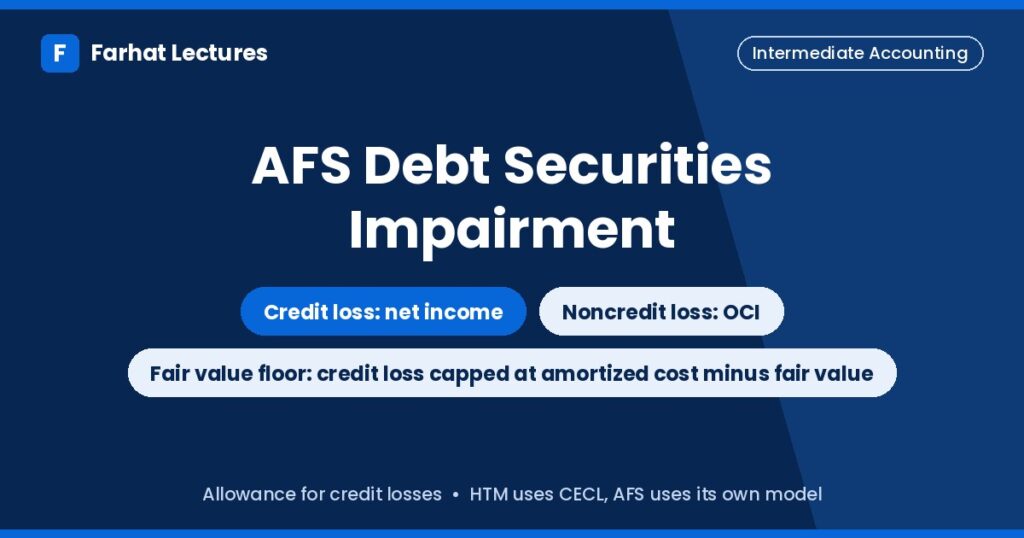
Want the full reporting picture, including what happens when a security is sold? See our available-for-sale vs. held-to-maturity vs. trading reporting summary. If an AFS bond runs into credit problems, the AFS debt securities impairment lesson walks through the entries.
Worked example: one bond, three classifications
Hypothetical example. On January 1, 2027, Northfield Co. buys $50,000 face value, 6% bonds at par. Interest of $3,000 is received each December 31. On December 31, 2027, the bonds’ fair value is $47,800 because market interest rates rose. To keep the focus on classification, assume Northfield expects to collect every payment, so there is no allowance for credit losses. The drop in fair value comes only from higher market rates.
| Classification | Balance sheet amount, Dec. 31, 2027 | Effect on 2027 net income | Effect on 2027 OCI |
|---|---|---|---|
| Held-to-maturity | $50,000 | Interest revenue $3,000 | None |
| Available-for-sale | $47,800 | Interest revenue $3,000 | Unrealized loss $(2,200) |
| Trading | $47,800 | Interest revenue $3,000 less unrealized loss $2,200 = $800 | None |
Under available-for-sale, the year-end adjusting entry uses a valuation account called Fair Value Adjustment:
| Date | Account | Debit | Credit |
|---|---|---|---|
| Dec. 31, 2027 | Unrealized Holding Gain or Loss—Equity | 2,200 | |
| Fair Value Adjustment | 2,200 |
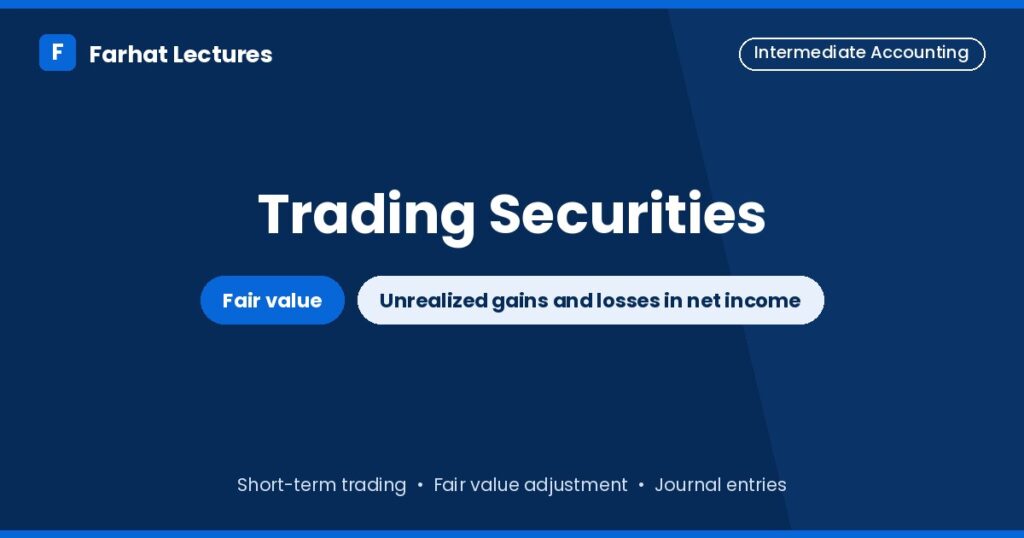
Under trading, the entry is the same except the loss account is Unrealized Holding Gain or Loss—Income, so it reduces net income. Under held-to-maturity, there is no fair value entry at all. The fair value is only disclosed in the notes.
CPA exam tip: When a question gives you a year-end fair value, identify the category before you do any math. For held-to-maturity, the fair value is a distractor for the balance sheet amount. For available-for-sale, the change goes to OCI, so net income is just the interest revenue. Only trading moves the fair value change into net income.
Common mistakes
- Treating AFS as “held for sale soon.” Trading is the near-term category. AFS is simply what is left after trading and HTM.
- Classifying common stock as held-to-maturity. Common stock has no maturity date, so it can never be HTM. The one twist: preferred stock that must be redeemed, or that the investor can redeem, is treated as a debt security.
- Forgetting the “ability” test. Intent alone is not enough for HTM. A company that may need to sell for liquidity cannot use it.
- Putting every AFS decline in OCI. Noncredit declines generally go to OCI, and credit losses go to net income. A sale decision or a likely required sale can trigger a write-down to fair value (see the FAQ below).
- Skipping amortization for fair value categories. AFS and trading securities still amortize discounts and premiums. Review the effective-interest method if this step is new to you.
Practice questions with answers
Question 1: Classify the investment
A bank buys 10-year Treasury notes. It has the positive intent and the ability to hold them until maturity. How should it classify them?
Answer:
Held-to-maturity.
Both conditions are met, so the notes are reported at amortized cost.
Question 2: A different purpose
A company buys corporate bonds to fund future expansion. It may sell them if it needs cash, but it is not trading them for short-term profit. How should it classify them?
Answer:
Available-for-sale.
The possible sale for liquidity rules out held-to-maturity, and there is no near-term trading intent, so the bonds fall into the leftover category.
Question 3: Compare the results
In its first year, a bond investment with an amortized cost of $40,000 earns $2,400 of interest revenue. Its year-end fair value is $41,000. Give the balance sheet amount and the net income effect under each category.
Answer:
HTM: $40,000 on the balance sheet; net income $2,400.
AFS: $41,000 on the balance sheet; net income $2,400, plus a $1,000 unrealized gain in OCI.
Trading: $41,000 on the balance sheet; net income $3,400 ($2,400 interest plus the $1,000 unrealized gain).
Debt Securities Practice: Held-to-Maturity, Available-for-Sale, and Trading
Choose one answer for each of the four interactive CPA FAR practice questions. Use the explanations to review how U.S. GAAP classifies debt securities, measures them on the balance sheet, and reports interest and gains or losses.
For more practice, work through the debt securities lessons in the Farhat Lectures Intermediate Accounting course, starting with debt securities held to maturity.
Key takeaways
- Investments in debt securities are classified at purchase as held-to-maturity, available-for-sale, or trading.
- HTM requires both positive intent and ability to hold to maturity, and it is reported at amortized cost, net of any allowance for credit losses.
- AFS and trading are reported at fair value. AFS unrealized changes generally go to OCI, subject to the impairment rules above. Trading changes go to net income.
- Interest revenue and amortization of discounts and premiums work the same way in every category.
- For the OCI side of the story, see our comprehensive income lesson.
Frequently asked questions
Can equity securities be classified as held-to-maturity or available-for-sale?
Not common stock. Common stock has no maturity date, so it can never be held-to-maturity. Preferred stock that must be redeemed by the issuer, or that the investor can redeem, is the exception, because ASC 320 treats it as a debt security. Under current U.S. GAAP, the three categories in this lesson apply to debt securities. Equity securities follow separate rules (ASC 321) and are generally measured at fair value through net income. See investments in equity securities for that next lesson.
Is interest revenue the same under all three categories?
Yes. In all three categories, interest revenue is recognized as it is earned, and any discount or premium is amortized, normally with the effective-interest method. Classification changes how fair value changes are reported, not how interest revenue is measured.
Can a company sell a held-to-maturity security before it matures?
Yes, but it should be rare. ASC 320 lists certain events, such as a significant decline in the issuer’s creditworthiness or a change in tax law, that allow a sale without questioning the company’s intent. Selling for other reasons calls into question the company’s intent to hold its other held-to-maturity securities, and the rest of the portfolio may no longer qualify. Our held-to-maturity securities lesson covers early sales in detail.
What happens if a debt security has a credit loss?
It depends on the category. Held-to-maturity securities use the current expected credit loss (CECL) model in ASC 326-20: the company records an allowance for credit losses, and the expense goes to net income. For available-for-sale securities, first ask whether the company intends to sell the security or is more likely than not to be required to sell it before recovering amortized cost. If either condition applies, write off any existing credit-loss allowance, write the amortized cost basis down to fair value, and recognize any additional impairment in net income. Otherwise, recognize the credit-related decline in net income through an allowance capped at the amount by which amortized cost exceeds fair value. Report the rest of the decline in OCI. Trading securities need no separate entry because every fair value change already goes to net income. See AFS debt securities impairment for worked examples.
What is the difference between a realized and an unrealized gain?
An unrealized holding gain or loss is a change in fair value on a security the company still owns. A realized gain or loss happens when the company sells the security and compares the selling price with its amortized cost. For available-for-sale securities, the gain or loss that was sitting in OCI is moved into net income through a reclassification adjustment.
How does IFRS classify investments in debt securities?
IFRS 9 does not use the held-to-maturity, available-for-sale, and trading labels. It measures debt investments at amortized cost, at fair value through other comprehensive income, or at fair value through profit or loss, based on the company’s business model and the instrument’s cash flows. See the IFRS 9 page from the IFRS Foundation.
Where are investments in debt securities reported on the balance sheet?
Trading securities are usually current assets. Held-to-maturity securities are usually noncurrent until they are within a year of maturity. Available-for-sale securities can be current or noncurrent, depending on when the company expects to sell or collect them.
Sources
- FASB Accounting Standards Codification, Topic 320: Investments—Debt Securities (ASC 320-10-25-1: classification as trading, available-for-sale, or held-to-maturity; ASC 320-10-35-1: subsequent measurement of trading and available-for-sale securities)
- KPMG Executive Summary: Investments (2026) (initial classification and reassessment under Topics 320 and 321)
- PwC Viewpoint: Loans and investments guide, 3.3 Classification of debt securities
- IFRS Foundation: IFRS 9 Financial Instruments
About the author
Mansour Farhat, CPA, CIA, DBA, is a veteran accounting educator and the founder of Farhat Lectures and the Farhat Lectures YouTube channel. He holds a Doctor of Business Administration from Temple University and a Master of Accountancy from Bloomsburg University, and he teaches accounting students and candidates preparing for the CPA, CMA, and EA exams.
Continue learning with Farhat Lectures
Strengthen your accounting understanding with clear explanations and guided practice.
Explore the free sample course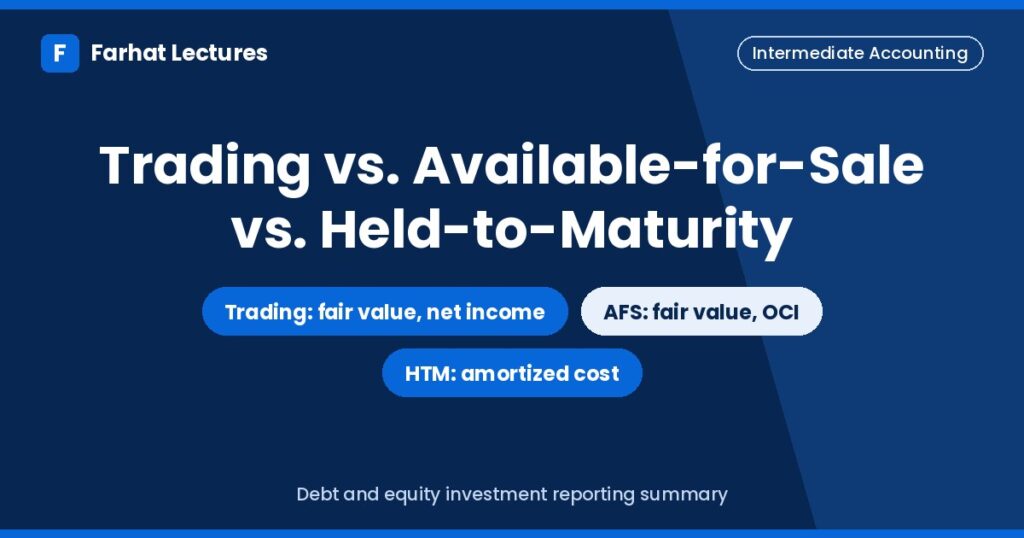

Responses