
Held-to-Maturity Securities: Amortized Cost, Interest Revenue, and Journal Entries

Held-to-maturity (HTM) securities are debt securities that a company has both the positive intent and the ability to hold until they mature. Under FASB ASC 320, they are reported at amortized cost: the purchase price adjusted for amortization of any discount or premium. Changes in fair value are not recognized; they are only disclosed in the notes.
This category matters most to banks and insurance companies, which often buy bonds to match long-term obligations. It keeps market-price swings out of earnings and equity. The catch is a strict test. Selling these securities early can damage the credibility of the whole portfolio. This lesson covers the test, the accounting, and a full worked example. For how this category compares with the other two, start with investments in debt securities: HTM vs. AFS vs. trading.
Watch: Held-to-maturity securities: amortized cost and journal entries (about 12 minutes, including an effective-interest amortization schedule)
When can a security be classified as held-to-maturity?
Only debt securities qualify. Common stock and most preferred stock are equity securities with no maturity date, so they can never be held-to-maturity. One exam trap: preferred stock that must be redeemed by the issuer, or that the investor can choose to redeem, counts as a debt security under ASC 320. The company must also have both of the following:
- Positive intent to hold the security until it matures.
- The ability to hold it that long, for example without needing the cash first.
A company should not use held-to-maturity classification if it might sell the security because interest rates change, because it needs liquidity, or for other asset-liability management reasons. In those cases, the security is available-for-sale.
There is one more limit. A security that can be prepaid or settled in a way that would keep the investor from recovering substantially all of its recorded investment cannot be held-to-maturity. Interest-only strips are the classic example.
How is held-to-maturity different from available-for-sale and trading?
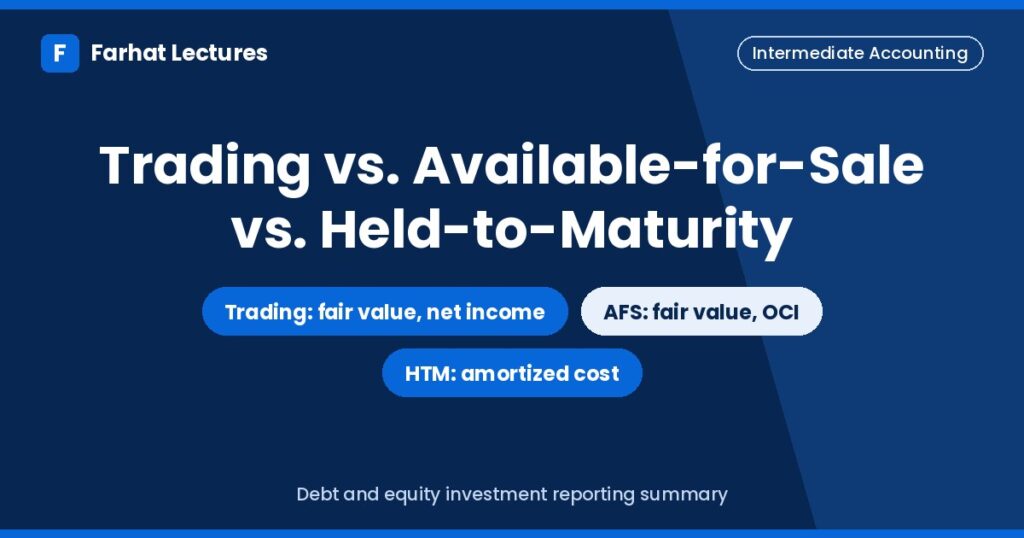
| Held-to-maturity | Available-for-sale | Trading | |
|---|---|---|---|
| Reported at | Amortized cost | Fair value | Fair value |
| Unrealized holding gains and losses | Not recognized; disclosed in the notes | Other comprehensive income | Net income |
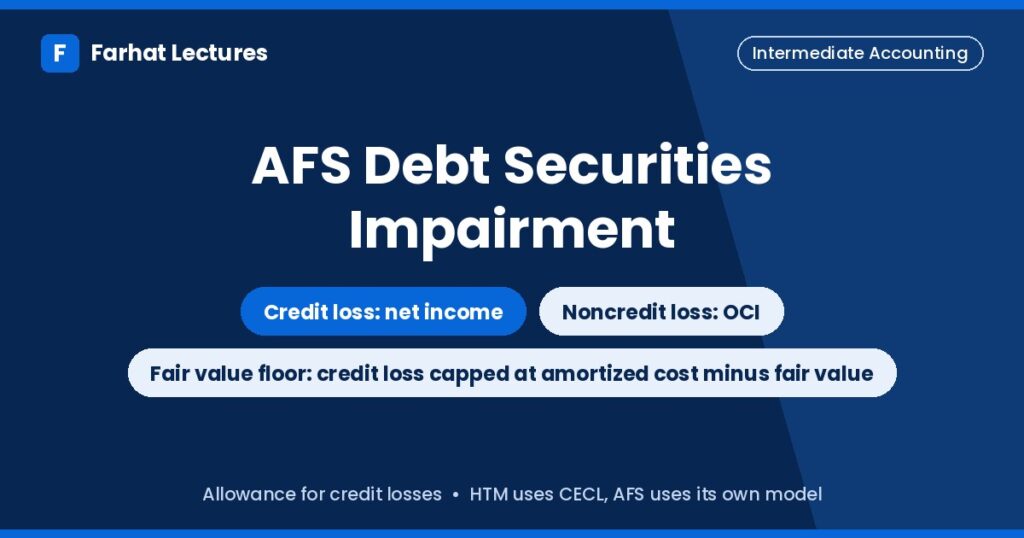
| Credit losses | Allowance under CECL (ASC 326) | Allowance, limited to the amount fair value is below amortized cost1 | No allowance; all fair value changes go to net income |
1 If management intends to sell an available-for-sale debt security, or is more likely than not required to sell it before recovering its amortized cost, it writes the security down to fair value through earnings.
For the full fair value treatment, see our lessons on available-for-sale debt securities and trading securities.
Why do companies use held-to-maturity securities?
- To earn a spread: collect interest on the investment that exceeds the interest paid on borrowed funds.
- To diversify with low-risk securities that are unlikely to default.
- To avoid volatility in reported earnings and capital, because fair value changes are not recognized.
How are held-to-maturity securities measured?
Most bonds are bought for more or less than face value. Bonds bought below face value have a discount, and bonds bought above face value have a premium. Over the bond’s life, that difference is amortized so the carrying amount reaches face value at maturity. The effective-interest method is required unless another method, such as straight-line, gives results that are not materially different.
Interest revenue = Carrying amount × Market (yield) rate × Time
Discount amortization = Interest revenue − Cash interest received
With a discount, interest revenue is larger than the cash received, and the carrying amount rises each period. With a premium, the opposite happens. If the method is new to you, read our effective-interest method lesson first.
Worked example: held-to-maturity securities at Ridgeway Insurance
Hypothetical example. On January 1, 2027, Ridgeway Insurance buys $200,000 face value, 5% bonds that mature on January 1, 2031. Interest is paid every July 1 and January 1. The market rate is 6%, so Ridgeway pays $192,980 (see bond pricing for how a price like this is computed). Ridgeway plans to hold the bonds to maturity and can do so.
Ridgeway records the bonds at their net cost, with no separate discount account:
| Date | Account | Debit | Credit |
|---|---|---|---|
| Jan. 1, 2027 | Debt Investments | 192,980 | |
| Cash | 192,980 |
Amortization schedule for the first two years
| Date | Cash received (2.5% × $200,000) | Interest revenue (3% × carrying amount) | Discount amortization | Carrying amount |
|---|---|---|---|---|
| 1/1/2027 | $192,980 | |||
| 7/1/2027 | $5,000 | $5,789 | $789 | 193,769 |
| 1/1/2028 | 5,000 | 5,813 | 813 | 194,582 |
| 7/1/2028 | 5,000 | 5,837 | 837 | 195,419 |
| 1/1/2029 | 5,000 | 5,863 | 863 | 196,282 |
Each period, interest revenue is the beginning carrying amount times the 3% semiannual market rate. For example, $192,980 × 3% = $5,789. The amortization of $789 is the excess over the $5,000 cash. The schedule continues until the carrying amount reaches $200,000 at maturity, with the final period adjusted for rounding.
Journal entries for 2027 and the January 1, 2028 collection
| Date | Account | Debit | Credit |
|---|---|---|---|
| July 1, 2027 | Cash | 5,000 | |
| Debt Investments | 789 | ||
| Interest Revenue | 5,789 | ||
| Dec. 31, 2027 | Interest Receivable | 5,000 | |
| Debt Investments | 813 | ||
| Interest Revenue | 5,813 | ||
| Jan. 1, 2028 | Cash | 5,000 | |
| Interest Receivable | 5,000 |
Financial statement presentation
At December 31, 2027, Ridgeway reports Debt investments (held-to-maturity) of $194,582 as a noncurrent asset and Interest receivable of $5,000 as a current asset. Its 2027 income statement shows interest revenue of $11,602 ($5,789 + $5,813).
Suppose the bonds’ fair value at year-end is $188,000. The $6,582 decline below amortized cost is due entirely to changes in market interest rates, and Ridgeway expects no credit losses. Ridgeway makes no journal entry for the fair value decline and discloses the unrealized holding loss in the notes.
What happens if a company sells held-to-maturity securities early?
If a company sells early, it first records interest and amortization up to the sale date. Then it compares the selling price, excluding accrued interest, with the amortized cost. The difference is a realized gain or loss reported in net income.
Early sales are risky for the classification. A sale can call into question management’s stated intent and “taint” the rest of the portfolio, which may then have to be reclassified as available-for-sale. ASC 320 allows only a few exceptions:
- A change in circumstances. The most important is evidence of a significant deterioration in the issuer’s creditworthiness, such as a credit rating downgrade. A tax law change that removes a bond’s tax-exempt status, a major business combination or disposal that forces a sale to keep the company’s interest rate or credit risk policy in place, and certain changes in regulatory or capital requirements also qualify.
- A sale so close to maturity, or to a call date when the call is probable, that interest rate risk is substantially gone. The standard gives three months as an example.
- A sale after the company has already collected at least 85% of the principal outstanding at acquisition, through prepayments or through scheduled equal payments of principal and interest.
- An isolated, nonrecurring, and unusual event that the company could not reasonably have anticipated. Very few events meet all of these conditions, so this exception is rarely available.
Any other sale or transfer can taint the portfolio.
Common mistakes
- Recording a fair value adjustment. Held-to-maturity securities have no Fair Value Adjustment account.
- Using the coupon rate for interest revenue. Interest revenue uses the market (yield) rate times the carrying amount; the coupon rate gives the cash received.
- Forgetting the year-end accrual. With a January 1 payment date, interest and amortization for July through December must be accrued on December 31.
- Ignoring amortization before a sale. Update amortization to the sale date before computing the gain or loss.
- Classifying with a “maybe sell” plan. Any expected sale for interest-rate or liquidity reasons rules out held-to-maturity.
- Assuming every early sale taints the portfolio. A sale after a significant drop in the issuer’s creditworthiness, or one very close to maturity, does not call the company’s intent into question.
Held-to-Maturity Securities Practice Exercise
Use this four-question CPA FAR exercise to practice classifying held-to-maturity (HTM) debt securities, calculating amortized cost, and evaluating the reporting effects of interest revenue, market price changes, and early sales.
Held-to-Maturity Debt Securities: Classification and Amortized Cost
Select one answer per question. Assume the change in Summit Bank’s bond market value reflects interest-rate movements and that there are no expected credit losses.
Practice questions with answers
Question 1: Does it qualify?
A company buys 7-year bonds. Management expects to hold them, but says it will sell if interest rates rise sharply. Can the bonds be held-to-maturity?
Answer:
No.
A plan to sell in response to interest-rate changes means there is no positive intent to hold to maturity. The bonds are available-for-sale.
Question 2: Premium amortization
A company buys $100,000 face value, 6%, 5-year bonds with semiannual interest for $104,376, a price that yields 5%. Compute the first interest revenue, the premium amortization, and the new carrying amount.
Answer:
Interest revenue $2,609; premium amortization $391; carrying amount $103,985.
Interest revenue = $104,376 × 5% × 6/12 = $2,609. Cash received = $100,000 × 6% × 6/12 = $3,000. Premium amortization = $3,000 − $2,609 = $391. Carrying amount = $104,376 − $391 = $103,985.
Question 3: A sale near maturity
Two months before maturity, a company sells a held-to-maturity bond for $99,900, excluding accrued interest. After updating amortization, the bond’s amortized cost is $99,820. What is the gain or loss, and does the sale taint the portfolio?
Answer:
Realized gain of $80; no taint.
Gain = $99,900 − $99,820 = $80, reported in net income. Because the sale happens so close to maturity (inside the three-month example in ASC 320), interest rate risk is substantially gone, so it is treated as a sale at maturity.
Want guided practice? Work through debt securities held to maturity in the Farhat Lectures Intermediate Accounting course.
Key takeaways
- Held-to-maturity securities are debt securities with positive intent and ability to hold until maturity.
- They are carried at amortized cost; fair value changes are disclosed, not recognized.
- Interest revenue = carrying amount × market rate, and discounts or premiums are amortized into Debt Investments.
- Early sales produce realized gains or losses and can taint the portfolio, unless an exception applies, such as significant credit deterioration of the issuer or a sale very close to maturity.
- If the security might be sold, see available-for-sale debt securities; if it is bought to trade, see trading securities.
Frequently asked questions
Why are held-to-maturity securities not reported at fair value?
Held-to-maturity securities are reported at amortized cost, which starts with the original cost and adjusts for the amortization of any purchase premium or discount. Ordinary changes in market interest rates do not alter that measurement. Fair value is disclosed in the notes, and expected credit losses are accounted for separately under ASC 326.
Do held-to-maturity securities ever lose value on the balance sheet?
Ordinary interest-rate-driven declines in fair value are not recorded. Expected credit losses are a separate matter: held-to-maturity securities carry an allowance for credit losses under ASC 326, the current expected credit loss (CECL) model. The allowance reflects the credit losses the company expects over the security’s life and is recorded through net income.
Are held-to-maturity securities current or noncurrent assets?
They are usually noncurrent. A security moves to current assets when it will mature within one year (or the operating cycle, if longer) of the balance sheet date.
Does the investor use a separate discount or premium account?
Usually not. Investors normally record the bond at its net purchase price in Debt Investments and amortize the discount or premium directly in that account. The issuer of bonds payable, by contrast, often uses a separate discount or premium account.
Can a callable bond be classified as held-to-maturity?
Yes, if the company intends and is able to hold it until maturity or until the issuer calls it. An issuer’s call is treated as an acceleration of maturity, not as a sale by the investor. The exception: if a call or prepayment could keep the investor from recovering substantially all of its recorded investment, the security cannot be held-to-maturity.
Is there a held-to-maturity category under IFRS?
No. IFRS 9 has no held-to-maturity label and no tainting rule. A debt instrument is measured at amortized cost when the company holds it to collect contractual cash flows and those cash flows are solely payments of principal and interest.
What happens if a company transfers a security out of held-to-maturity?
If a company moves a security from held-to-maturity to available-for-sale, it remeasures the security at fair value on the transfer date and reports the unrealized holding gain or loss in other comprehensive income. Unless one of the exceptions applies, the transfer can also taint the rest of the portfolio.
Are held-to-maturity securities tested on the CPA and CMA exams?
Yes. Classifying debt investments and measuring them at amortized cost is part of the CPA exam’s Financial Accounting and Reporting (FAR) section, and investment classifications also appear in CMA Part 1.
Sources
- FASB Accounting Standards Codification, Topic 320: Investments—Debt Securities (ASC 320-10-25-1(c): held-to-maturity classification; ASC 320-10-25-14: sales treated as at maturity; ASC 320-10-25-9: isolated, nonrecurring, and unusual events)
- PwC Viewpoint: Loans and investments guide, 3.3 Classification of debt securities (tainting and permitted transfers under ASC 320-10-25-18)
- KPMG Executive Summary: Investments (2026)
- Journal of Accountancy: Identifying and analyzing the risks of “risk-free” securities (unrecognized losses on held-to-maturity securities)
About the author
Mansour Farhat, CPA, CIA, DBA, is a veteran accounting educator and the founder of Farhat Lectures and the Farhat Lectures YouTube channel. He holds a Doctor of Business Administration from Temple University and a Master of Accountancy from Bloomsburg University, and he teaches accounting students and candidates preparing for the CPA, CMA, and EA exams.
Continue learning with Farhat Lectures
Strengthen your accounting understanding with clear explanations and guided practice.
Explore the free sample course
Responses