
AFS Debt Securities Impairment: The Fair Value Floor Explained

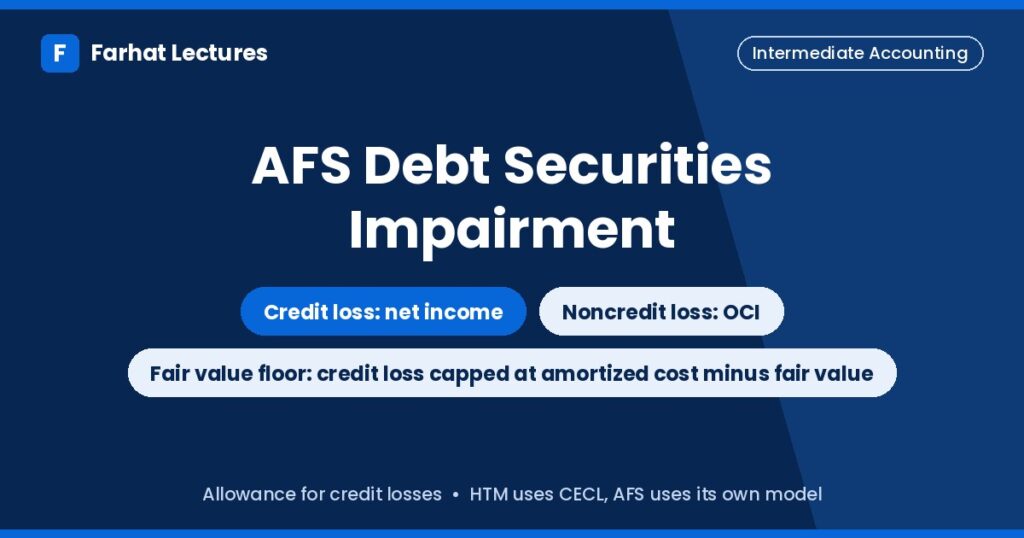
AFS debt securities impairment happens when an available-for-sale (AFS) debt security’s fair value falls below its amortized cost. Under the ASC 326-30 allowance approach, the credit loss goes to net income through an allowance capped at amortized cost minus fair value. This cap is called the fair value floor. Any remaining decline goes to other comprehensive income (OCI). If the company intends to sell or will more likely than not be required to sell before recovering amortized cost, it writes the security down to fair value.
New to the term? Amortized cost is what the company paid for the bond, adjusted over time for premium or discount amortization, principal collected, and write-offs. Think of it as the bond’s book value before any fair value adjustment or allowance.
This matters because AFS securities do not use the same model as held-to-maturity (HTM) securities and receivables. Those use the current expected credit loss (CECL) model, which has no fair value cap. Mixing up the two models is one of the most common exam errors in this chapter. For CECL on loans and receivables, see the credit loss journal entry lesson.
Watch: Credit losses on HTM and AFS debt investments (starts at 7:56, where the AFS credit loss section begins. If you watch from the beginning, the video description lists two corrections to the earlier HTM and trading segments.)
Which impairment model applies to each type of investment?
New to the three debt security categories? Start with investments in debt securities, then come back here.
| Investment | Impairment model | Where the loss goes |
|---|---|---|
| Receivables, loans, and HTM debt securities (amortized cost) | CECL (ASC 326-20): lifetime expected credit losses, no fair value cap | Net income, through an allowance |
| AFS debt securities (fair value through OCI) | ASC 326-30: credit loss only when fair value is below amortized cost, capped at that gap | Credit part: net income through an allowance. Noncredit part: OCI |
| Trading debt securities and equity securities (fair value through net income) | No separate impairment test (exception: equity securities without a readily determinable fair value that use the measurement alternative get a qualitative impairment review) | Fair value changes are already in net income |
Why do AFS debt securities have their own impairment model?
A company can get its money back from an HTM bond in only one way: by collecting the cash flows. An AFS bond gives two choices. The company can collect the cash flows, or it can sell the bond at fair value. If the expected credit loss is larger than the drop in fair value, selling is the cheaper exit. That is why the loss recognized is limited to amortized cost minus fair value.
How do you calculate AFS debt securities impairment? Step by step
These steps follow ASC 326-30, as summarized in the Deloitte credit losses roadmap.
| Step | Question | Result |
|---|---|---|
| 1 | Is fair value below amortized cost? | If no, there is no impairment. Record any unrealized gain in OCI. |
| 2 | Does the company intend to sell, or will it more likely than not have to sell, before recovery? | If yes, write off any existing allowance, write amortized cost down to fair value, and recognize any incremental impairment in earnings. Later increases in fair value go to OCI, not back to income. |
| 3 | What is the expected credit loss? | Compare the present value of expected cash flows with amortized cost. Discount the cash flows at the effective interest rate implicit in the security when it was bought, and test each security on its own, not as a pool. |
| 4 | Apply the fair value floor | Allowance = the smaller of the credit loss and (amortized cost − fair value). |
| 5 | Any decline left over? | The noncredit part, such as an interest rate effect, goes to OCI. |
Credit loss recognized = the smaller of (expected credit loss) and (amortized cost − fair value)
Worked example: Northgate Co., three fair values
Hypothetical example. Northgate Co. holds an AFS bond with an amortized cost of $500,000. It does not intend to sell the bond and is not likely to be forced to sell. Its estimated credit loss is $60,000. Assume no earlier fair value adjustments. Ignore income taxes for this example. Here are three possible year-end fair values:
| Item | Case A | Case B | Case C |
|---|---|---|---|
| Amortized cost | $500,000 | $500,000 | $500,000 |
| Fair value | $530,000 | $470,000 | $410,000 |
| Fair value floor (amortized cost − fair value) | None | $30,000 | $90,000 |
| Expected credit loss | $60,000 | $60,000 | $60,000 |
| Credit loss in net income | $0 | $30,000 | $60,000 |
| Unrealized holding gain (loss) in OCI | $30,000 | $0 | ($30,000) |
Case A: fair value is above amortized cost, so no credit loss is recorded even though cash flow problems are expected. The $30,000 unrealized gain goes to OCI.
| Account | Debit | Credit |
|---|---|---|
| Fair Value Adjustment | 30,000 | |
| Unrealized Holding Gain or Loss—Equity | 30,000 |
Case B: the $60,000 credit loss is capped at the $30,000 gap.
| Account | Debit | Credit |
|---|---|---|
| Credit Loss Expense | 30,000 | |
| Allowance for Credit Losses | 30,000 |
Case C: the total $90,000 decline splits into a $60,000 credit loss and a $30,000 noncredit loss.
| Account | Debit | Credit |
|---|---|---|
| Credit Loss Expense | 60,000 | |
| Unrealized Holding Gain or Loss—Equity | 30,000 | |
| Allowance for Credit Losses | 60,000 | |
| Fair Value Adjustment | 30,000 |
In Case C, the bond is reported at $410,000: $500,000 amortized cost, less the $60,000 allowance, less the $30,000 fair value adjustment.
What if Northgate plans to sell the bond?
Go back to Case C (fair value $410,000), but now assume Northgate has decided to sell the bond before its value recovers, and there is no existing allowance or fair value adjustment for the bond. The allowance approach no longer applies. Northgate writes the bond’s amortized cost down to fair value and reports the whole $90,000 decline in net income, both the credit part and the noncredit part.
| Account | Debit | Credit |
|---|---|---|
| Impairment Loss | 90,000 | |
| Debt Investments (AFS) | 90,000 |
The bond’s new amortized cost is $410,000. If an allowance had already been recorded, Northgate would write it off first. If fair value rises later, the increase goes to OCI. It does not reverse the $90,000 loss.
Same bond classified as HTM
If Northgate had classified the bond as held-to-maturity, it would record the full $60,000 credit loss under CECL in all three cases, because CECL has no fair value cap. The bond would be reported at $440,000 ($500,000 − $60,000), and no OCI would be recorded. For measuring expected losses with present values, see loan impairment calculation.
There is one more difference worth remembering for the exam. Under CECL, an HTM bond usually carries an allowance from the day it is bought, even when nothing has gone wrong, because CECL estimates lifetime expected losses right away. The exception is a bond with an expected loss of zero, such as a U.S. Treasury security. An AFS bond gets no allowance at all while its fair value stays at or above amortized cost.
How are AFS credit losses reversed and presented?
Because the credit loss sits in an allowance, it can be reversed if conditions improve, for example if the issuer’s credit rating recovers. The entry debits Allowance for Credit Losses and credits Credit Loss Expense. The allowance cannot go below zero.
On the balance sheet, AFS debt securities are reported at fair value, and the company shows the amortized cost and the allowance in parentheses. The Deloitte presentation guidance covers these requirements.
Common mistakes
- Using CECL for AFS. AFS securities have their own model with a fair value cap.
- Recording a credit loss when fair value exceeds amortized cost. No impairment exists in that case.
- Putting the whole decline in net income when the allowance approach applies. Recognize the credit portion in earnings and any remaining decline in OCI.
- Writing the bond down directly. Use the allowance unless the company intends to sell or is likely required to sell.
- Testing trading securities for impairment. Their losses are already in net income.
Exam tips for AFS impairment questions
Run through this quick checklist before you answer:
- Check the classification first. AFS, HTM, and trading securities each follow different rules.
- Look for the words “intends to sell” or “more likely than not will be required to sell.” If either appears, skip the allowance and write the bond down to fair value through net income.
- Compute the fair value floor (amortized cost minus fair value) first. The credit loss in net income is the smaller of the floor and the expected credit loss.
- Check your split. With no earlier fair value adjustments and no plan to sell, the credit loss plus the OCI loss should equal the total decline below amortized cost.
- Keep two accounts separate in the journal entry: Allowance for Credit Losses for the credit part and Fair Value Adjustment for the noncredit part.
Interactive AFS Debt Securities Impairment Practice
Available-for-Sale Debt Securities: Credit Losses and the Fair Value Floor
Use these three multiple-choice questions to review how a company recovers value from an available-for-sale debt security, calculates the fair value floor, and applies it to the allowance for credit losses under ASC 326-30. Then try the worked practice questions below.
Practice questions with answers
Question 1: Floor limits the loss
An AFS bond has an amortized cost of $250,000, a fair value of $238,000, and an expected credit loss of $20,000. The company does not plan to sell. How much is reported in net income and in OCI?
Answer:
$12,000 credit loss in net income; $0 in OCI
The fair value floor is $250,000 − $238,000 = $12,000, which is less than the $20,000 credit loss. The whole decline is credit-related, so nothing is left for OCI.
Question 2: Credit and noncredit parts
An AFS bond has an amortized cost of $400,000, a fair value of $352,000, and an expected credit loss of $18,000. Split the loss and give the entry.
Answer:
$18,000 credit loss in net income; $30,000 unrealized loss in OCI
The total decline is $48,000. The credit loss ($18,000) is below the $48,000 floor, so it is recognized in full, and the remaining $30,000 goes to OCI.
| Account | Debit | Credit |
|---|---|---|
| Credit Loss Expense | 18,000 | |
| Unrealized Holding Gain or Loss—Equity | 30,000 | |
| Allowance for Credit Losses | 18,000 | |
| Fair Value Adjustment | 30,000 |
Question 3: Reversal
Continue Question 1. A year later, the expected credit loss drops to $4,000, amortized cost is still $250,000, and fair value is $241,000. What happens to the $12,000 allowance?
Answer:
Reduce the allowance by $8,000, to $4,000
The new floor is $9,000 ($250,000 − $241,000), and the credit loss is $4,000, so the allowance should be $4,000. Debit Allowance for Credit Losses $8,000 and credit Credit Loss Expense $8,000. The other $5,000 of the decline is a noncredit loss, so record it in OCI: debit Unrealized Holding Gain or Loss—Equity $5,000 and credit Fair Value Adjustment $5,000. Check: $250,000 − $4,000 allowance − $5,000 fair value adjustment = $241,000, the new fair value. Notice that fair value went up by $3,000, yet OCI shows a new $5,000 loss. That happens because part of the decline moved out of the credit loss and into the noncredit part.
Want more practice like this? Work through the Impairment of Value of Debt Investments (CECL) lesson in the Farhat Lectures Intermediate Accounting course.
Key takeaways
- An AFS debt security is impaired only when its fair value is below amortized cost.
- Under the allowance approach, the credit loss goes to net income through an allowance capped at amortized cost minus fair value.
- Any remaining, noncredit decline goes to OCI when the allowance approach applies.
- HTM securities and receivables use CECL, with no fair value cap.
- An investment under the fair value option for investments reports all fair value changes in net income instead.
Frequently asked questions
Why is the credit loss on an AFS security limited by fair value?
An AFS security can be sold. If the company expects to lose more through collection than it would lose by selling at fair value, it can sell and limit the loss to the gap between amortized cost and fair value. So the credit loss recorded cannot exceed that gap.
What if the company plans to sell the AFS security?
If the company intends to sell, or will more likely than not be required to sell before recovering its amortized cost, it writes off any existing allowance, writes the security’s amortized cost down to fair value, and recognizes any incremental impairment in earnings. The allowance approach is used only when neither condition applies.
Can an AFS credit loss be reversed?
Yes. Because the loss is recorded in an allowance, it can be reduced if expected cash flows improve or fair value rises. The reversal credits Credit Loss Expense, but the allowance cannot go below zero.
Do trading debt securities and equity securities need an impairment test?
Generally no. They are already measured at fair value with changes in net income, so any decline in value is already in income. One exception: an equity security without a readily determinable fair value that a company carries under the measurement alternative (cost minus impairment, adjusted for observable price changes) needs a qualitative impairment review under ASC 321. Equity-method investments follow their own impairment rules under ASC 323.
Is the AFS impairment model the same as other-than-temporary impairment (OTTI)?
No. The current model in ASC 326-30, introduced by ASU 2016-13, replaced the older OTTI approach and is now effective for all entities. It uses an allowance for credit losses instead of a permanent write-down, and the allowance can be reversed.
Does an AFS debt security get an allowance for credit losses on the day it is bought?
Generally, an AFS debt security without purchased credit deterioration has no allowance at acquisition. For an AFS debt security purchased with credit deterioration, the company records an initial allowance for credit losses and adds it to the purchase price to establish the initial amortized cost basis. An HTM security under CECL usually carries an allowance from day one because CECL estimates lifetime expected losses at initial recognition.
What discount rate is used to measure an AFS credit loss?
The effective interest rate implicit in the security when it was acquired. The company compares the present value of the cash flows it expects to collect, discounted at that rate, with the security’s amortized cost.
Is AFS impairment assessed security by security or for a whole portfolio?
Security by security. CECL for loans and HTM securities often groups similar assets into pools, but the AFS model looks at each security on its own.
Sources
- Deloitte Roadmap: Credit Losses, Section 7.2 Identifying an Impairment (AFS debt securities) (ASC 326-30-35)
- Deloitte Roadmap: Credit Losses, Section 8.1 Presentation (ASC 326-30-45-1)
- FASB Accounting Standards Codification, Topic 326: Financial Instruments—Credit Losses
About the author
Mansour Farhat, CPA, CIA, DBA, teaches accounting and CPA exam review at Farhat Lectures and on the Farhat Lectures YouTube channel.
Continue learning with Farhat Lectures
Strengthen your accounting understanding with clear explanations and guided practice.
Explore the free sample course


Responses