
Reclassification Adjustment: How It Prevents Double Counting in Comprehensive Income

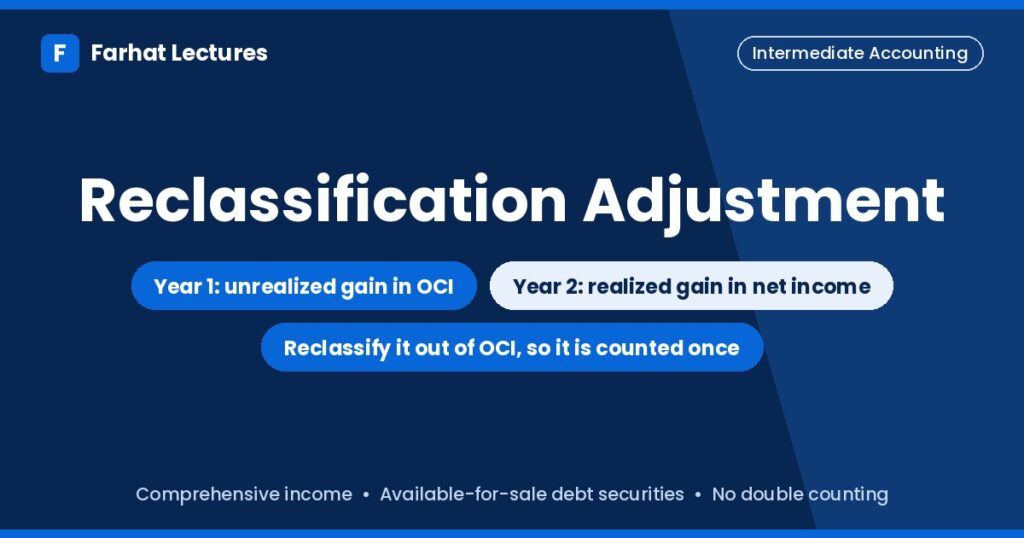
A reclassification adjustment is a line in other comprehensive income (OCI) that removes a gain or loss in the period it is realized and included in net income. Under US GAAP, ASC 220-10-45-15 requires it to prevent double counting. Example: an $8,000 bond gain reported in OCI last year is subtracted from OCI the year the bond is sold. Without it, a gain on an available-for-sale (AFS) debt security would be counted in comprehensive income twice: once in OCI while it was unrealized, and again in net income when the security is sold.
This matters because comprehensive income should show each dollar of gain or loss once. The available-for-sale debt securities component of accumulated other comprehensive income (AOCI) generally reflects cumulative unrealized holding gains and losses, net of applicable taxes. For the big picture of net income, OCI, and comprehensive income, see what is comprehensive income.
Watch: Comprehensive income and the reclassification adjustment (starts at 9:02, the multiple-period example and the reclassification adjustment)
What is a reclassification adjustment?
Start with three terms:
- Unrealized holding gain or loss: the change in fair value of a security the company still owns.
- Realized gain or loss: the difference between the sale price and the security’s amortized cost when it is sold. It goes in net income.
- Other comprehensive income (OCI): gains and losses that bypass net income, such as unrealized holding gains and losses on AFS debt securities. OCI for each year closes to accumulated other comprehensive income (AOCI), a separate part of stockholders’ equity.
When an AFS debt security is sold, part of its realized gain was already reported in OCI in earlier years. The reclassification adjustment takes that part back out of OCI, because net income now includes it. FASB ASC 220-10-45-15 requires these adjustments to avoid counting items twice in comprehensive income.
How does double counting happen?
Hypothetical example. A company buys an AFS bond for $50,000. At the end of Year 1, its fair value is $58,000. In Year 2 it sells the bond for $58,000, a realized gain of $8,000. The table compares comprehensive income with and without the adjustment.
| Item | Year 1 | Year 2 | Total |
|---|---|---|---|
| Gain in net income | $0 | $8,000 | $8,000 |
| Unrealized gain in OCI | $8,000 | $0 | $8,000 |
| Reclassification adjustment in OCI | $0 | ($8,000) | ($8,000) |
| Gain counted in comprehensive income | $8,000 | $0 | $8,000 |
Without the adjustment, comprehensive income would include $16,000 over the two years for a bond that gained only $8,000.
How do you compute OCI in the year of a sale?
OCI from AFS debt securities = Holding gains (losses) arising during the period − Realized gain (loss) reclassified to net income
The first term captures this year’s holding gain or loss before reclassifications. In the formula, subtract the realized amount using its sign. A gain is positive, and a loss is negative. When totaling the OCI section of a statement, add the reclassification line as displayed because it already carries the OCI sign. If a bond sells at its prior year-end fair value, the current-year holding gain on that bond is zero.
If the company has other OCI items, such as foreign currency translation or cash flow hedges, compute each one separately and add them together to get total OCI.
Exam tip: For the bonds in these examples, measure the realized gain or loss from amortized cost. Include any change in fair value during the year of sale in holding gains or losses before reclassification. Question 2 below shows this with a bond sold above last year’s fair value.
Worked example: Harlow Co.
Hypothetical example; income taxes ignored. Harlow Co. begins operations in Year 1 and buys two AFS bonds at par.
| Security | Amortized cost | Fair value | Unrealized gain (loss) |
|---|---|---|---|
| Bond A | $60,000 | $72,000 | $12,000 |
| Bond B | $90,000 | $96,000 | $6,000 |
| Total portfolio | $150,000 | $168,000 | $18,000 |
Harlow reports net income of $400,000 in Year 1 and OCI of $18,000, so comprehensive income is $418,000 and AOCI is $18,000.
In Year 2, Harlow sells Bond A for $72,000, a realized gain of $12,000 ($72,000 − $60,000). At the end of Year 2, Bond B’s fair value falls to $91,000, a holding loss of $5,000 for the year. Net income for Year 2 is $450,000, including the $12,000 gain.
| Statement of comprehensive income, Year 2 | Amount |
|---|---|
| Net income (includes $12,000 realized gain on Bond A) | $450,000 |
| Other comprehensive income: | |
| Unrealized holding loss arising during the period (Bond B) | ($5,000) |
| Less: reclassification adjustment for gain included in net income | ($12,000) |
| Other comprehensive loss | ($17,000) |
| Comprehensive income | $433,000 |
Check your answer: The AFS component of AOCI ends at $18,000 − $17,000 = $1,000, which equals Bond B’s remaining unrealized gain ($91,000 − $90,000). Over two years, comprehensive income totals $851,000: $850,000 of net income plus the $1,000 gain Harlow still holds. Without the adjustment, the total would be $863,000, overstated by the $12,000 gain.
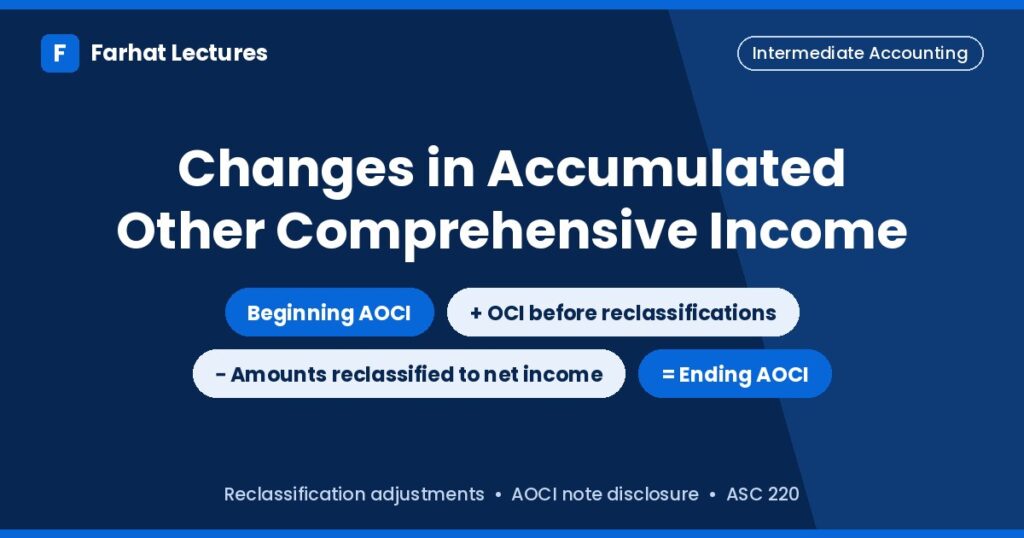
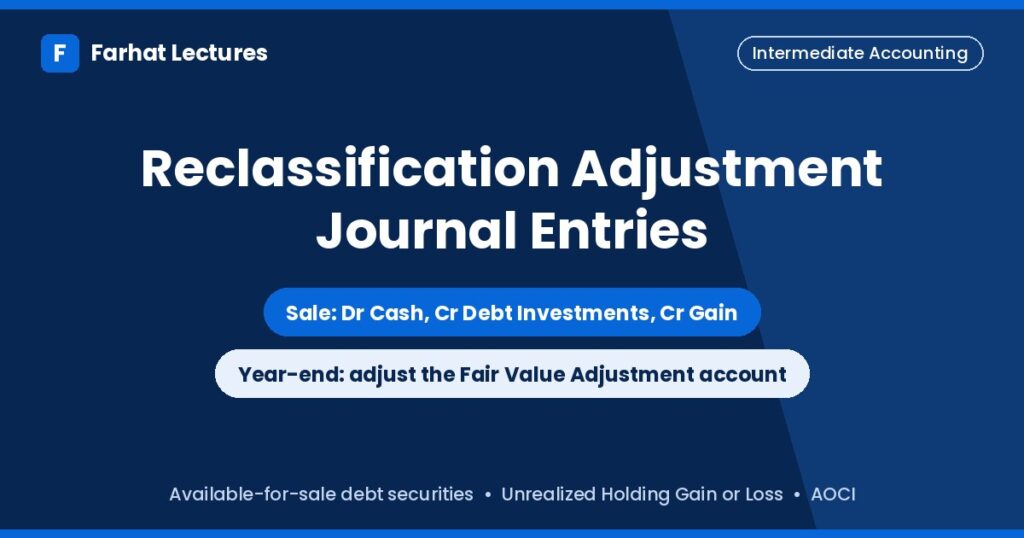
The entries behind these numbers are in reclassification adjustment journal entries, and the matching AOCI note is in changes in accumulated other comprehensive income.
What if income taxes apply?
The Harlow example ignores income taxes. Now assume a 25% tax rate. Each OCI line carries its own tax effect:
| OCI item, Year 2 | Before tax | Tax effect (25%) | Net of tax |
|---|---|---|---|
| Unrealized holding loss (Bond B) | ($5,000) | $1,250 | ($3,750) |
| Reclassification adjustment (Bond A) | ($12,000) | $3,000 | ($9,000) |
| Other comprehensive loss | ($17,000) | $4,250 | ($12,750) |
Check: $17,000 × 75% = $12,750. Under ASC 220-10-45-12, a company can show these tax effects on the face of the statement or in the notes.
Reclassification adjustments for losses
Losses work the same way with the signs flipped. If an unrealized loss was reported in OCI earlier and is realized in net income when the security is sold, the reclassification adjustment adds the loss back to OCI. Net income shows the loss once, and OCI no longer carries it.
| Realized in net income | Reclassification adjustment in OCI | Effect on OCI |
|---|---|---|
| Gain previously reported in OCI | Subtract the gain | Decreases OCI |
| Loss previously reported in OCI | Add back the loss | Increases OCI |
Where else do reclassification adjustments show up?
AFS debt securities are the classic example, but any OCI item that later moves into net income needs a reclassification adjustment.
| OCI item | When it is reclassified into net income | Guidance |
|---|---|---|
| Cash flow hedges | When the hedged transaction affects earnings | ASC 815 |
| Foreign currency translation adjustments | When the foreign entity is sold or substantially liquidated | ASC 830 |
| Pension and other postretirement items (prior service cost, net gains and losses) | As they are amortized into net periodic benefit cost | ASC 715 |
| AFS debt securities | When the security is sold | ASC 320 |
The logic is the same every time. The amount was already in OCI, so when it enters net income, OCI takes it back out.
Common mistakes
- Forgetting the adjustment. The realized gain then appears in both OCI (from earlier years) and net income.
- Subtracting it from net income. The adjustment goes in OCI. Net income keeps the realized gain.
- Using the wrong amount. The amount reclassified is the gain or loss realized in net income, measured from amortized cost, not just this year’s price change.
- Mixing up the sign. Gains are subtracted from OCI; losses are added back.
- Confusing it with transferring a security between categories. That is a different topic; see transfer of debt securities between categories, or Investment Reclassification in the course.
Practice questions with answers
Reclassification Adjustments for Available-for-Sale Debt Securities
Use Open Company’s year-end bond portfolio to calculate the unrealized holding gain and choose the fair value adjustment journal entry. Then explain how a bond sale affects other comprehensive income (OCI) and net income. Select one answer for each question.
| Investment | Amortized Cost | Fair Value |
|---|---|---|
| Lehman Inc. bonds (6%) | $80,000 | $105,000 |
| Woods Co. bonds (7%) | $120,000 | $135,000 |
The Fair Value Adjustment account had a $0 balance before the year-end entry.
Question 1: Sold at last year’s fair value
Kestrel Inc. bought an AFS bond for $40,000. Its fair value was $46,000 at the end of Year 1. Kestrel sold it in Year 2 for $46,000 and holds no other AFS securities. What is the reclassification adjustment, and what is Year 2 OCI?
Answer:
Reclassification adjustment of $6,000; OCI of ($6,000)
The realized gain is $46,000 − $40,000 = $6,000, included in net income. There is no holding gain in Year 2 because the sale price equals last year’s fair value. OCI = $0 − $6,000 = ($6,000), and the AFS component of AOCI falls to zero.
Question 2: Sold above last year’s fair value
Ridgeback Co. bought an AFS bond for $50,000. Fair value was $52,000 at the end of Year 1. Ridgeback sold it in Year 2 for $53,000. Compute the realized gain, the holding gain arising in Year 2, the reclassification adjustment, and Year 2 OCI.
Answer:
Realized gain $3,000; holding gain $1,000; reclassification ($3,000); OCI ($2,000)
Realized gain = $53,000 − $50,000 = $3,000. Holding gain during Year 2 = $53,000 − $52,000 = $1,000. OCI = $1,000 − $3,000 = ($2,000). Adding the ($3,000) reclassification line as it appears in OCI to the $1,000 holding gain gives the same result. The AFS component of AOCI goes from $2,000 to $0, and comprehensive income in Year 2 rises by only $1,000, the bond’s actual Year 2 increase in value.
Question 3: A realized loss
Pelham Corp. bought an AFS bond for $80,000. At the end of Year 1, fair value was $74,000, and Pelham reported a $6,000 unrealized loss in OCI. In Year 2 it sold the bond for $74,000. What is the reclassification adjustment?
Answer:
Add back $6,000 to OCI
Net income includes a $6,000 realized loss. The reclassification adjustment adds $6,000 to OCI so the loss is not counted twice. Comprehensive income for Year 2 is unaffected by the bond overall: −$6,000 in net income + $6,000 in OCI = $0.
Want more practice like this? Work through Statement of Comprehensive Income and Reclassification Adjustment in the Farhat Lectures Intermediate Accounting course.
Key takeaways
- A reclassification adjustment moves a realized gain or loss out of OCI in the period it enters net income.
- It prevents double counting in comprehensive income.
- OCI from AFS debt securities in the year of sale = holding gains (losses) arising during the period − realized gain (loss) reclassified to net income.
- The AFS component of AOCI generally reflects cumulative unrealized holding gains and losses, net of applicable taxes.
- Gains are subtracted from OCI; losses are added back.
- Reclassification adjustments also apply to cash flow hedges, foreign currency translation, and pension items, not just AFS debt securities.
Frequently asked questions
Is a reclassification adjustment the same as reclassifying an investment?
No. A reclassification adjustment moves a gain or loss out of OCI when it is realized in net income. Reclassifying an investment means transferring a security between categories, such as held-to-maturity to available-for-sale. They are separate topics; your course covers the second one in Investment Reclassification.
Does the reclassification adjustment change net income?
No. Net income already includes the realized gain or loss from the sale. The adjustment only reduces (for a gain) or increases (for a loss) other comprehensive income in the same period.
Is the reclassification adjustment shown before or after tax?
Either, as long as the tax effect is shown. ASC 220-10-45-12 requires the income tax allocated to each OCI component, including reclassification adjustments, to be shown on the face of the statement or in the notes. The main examples ignore income taxes. The Harlow extension shows how to present OCI net of tax.
Why is it sometimes called recycling?
Recycling is the informal name for moving an amount that was first reported in OCI into net income when it is realized. The gain is recycled out of accumulated other comprehensive income (AOCI) and into net income, so it ends up counted once. The formal US GAAP term is reclassification adjustment. You will also see the word recycling in IFRS discussions.
Do trading securities need a reclassification adjustment?
No. Unrealized gains and losses on trading securities already go through net income, never through OCI, so there is nothing to double count.
Do equity investments need a reclassification adjustment?
Usually not. Since ASU 2016-01 (ASC 321), most equity investments are measured at fair value with changes going straight to net income, so the gains never sit in OCI. That is why the available-for-sale category now applies only to debt securities. See investments in equity securities.
Where are reclassification adjustments disclosed?
ASC 220-10-45-17 and 220-10-50-6 require companies to disclose significant reclassifications by AOCI component. When all significant amounts are reclassified entirely to net income in the same reporting period, companies can show the affected income statement line items on the face of the income statement or in the notes. Otherwise, companies disclose the significant reclassifications in the notes and cross-reference the relevant disclosures for amounts that do not go entirely to net income in that period. See changes in accumulated other comprehensive income for the full layout.
Sources
- PwC Viewpoint: Financial statement presentation, 4.5 Accumulated other comprehensive income (reclassification adjustments, ASC 220-10-45)
- PwC Viewpoint: Loans and investments, 4.3 Available-for-sale debt securities (unrealized gains and losses in OCI; realized gains in earnings)
- FASB ASU 2013-02, Comprehensive Income (Topic 220), full text via PwC Viewpoint (includes ASC 220-10-45-12 on tax effects of reclassification adjustments)
- FASB Accounting Standards Codification, Topic 220: Comprehensive Income
About the author
Mansour Farhat, CPA, CIA, DBA, teaches accounting and CPA exam review at Farhat Lectures and on the Farhat Lectures YouTube channel. His lessons pair short explanations with worked examples and practice questions, like the ones on this page. Read more about Professor Farhat.
Continue learning with Farhat Lectures
Strengthen your accounting understanding with clear explanations and guided practice.
Explore the free sample course


Responses