
Investments in Equity Securities: How Ownership Level Sets the Accounting


Investments in equity securities are purchases of another company’s ownership interests, such as common stock, nonredeemable preferred stock, or warrants and options on shares. Under U.S. GAAP, the investor generally uses fair value through net income for a passive investment, the equity method when it has significant influence, and consolidation when it controls the investee. A 20% voting stake generally creates a rebuttable presumption of significant influence, and majority voting ownership usually indicates control.
Why does this matter? The same stock purchase can lead to three very different results on the investor’s financial statements. Under the fair value method, every change in the stock price flows into net income. Under the equity method, the investor reports its share of the investee’s profits instead. Picking the right method is the first question on almost every investments problem in intermediate accounting and on the FAR section of the CPA exam.
This guide supports the Investments in Equity Securities lesson of a typical intermediate accounting course. It covers what counts as an equity security, how to measure its cost, how ownership level sets the method, the fair value method in brief, and the exception for shares with no market price.
Watch: Accounting for Equity Investments
Watch this Farhat lesson on YouTube
In this 25-minute lesson, Professor Farhat explains the levels of influence, initial recognition at cost, dividend revenue, fair value adjustments, and the gain or loss on sale for passive equity investments.
What counts as an equity security?
An equity security is an ownership interest in a company, or a right to acquire or give up an ownership interest at a fixed or determinable price. The company buying the shares is the investor, and the company whose shares are bought is the investee.
| Instrument | Equity security? | Why |
|---|---|---|
| Common stock | Yes | A direct ownership interest |
| Preferred stock (nonredeemable) | Yes | An ownership interest with priority features |
| Redeemable preferred stock (must be redeemed, or the investor can force redemption) | No | Treated as a debt security, because the investor is assured of getting its money back |
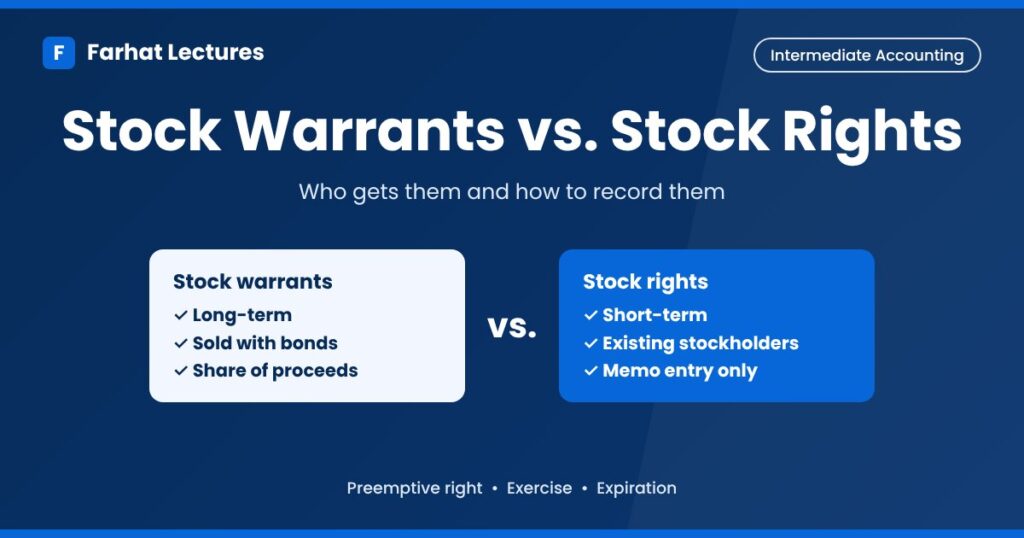
| Warrants, rights, and call or put options on stock | Yes | Rights to acquire or dispose of ownership at a set price |
| Convertible bonds | No | They are debt securities until converted, even though they may become stock later |
Measuring the cost of an equity investment
In the cost-based entry illustrated here, the initial recorded amount includes the purchase price and directly attributable transaction costs, such as a broker’s commission. For equity securities measured at fair value through net income, those transaction costs generally affect earnings in the acquisition period. If they are included in the initial entry, they reduce the gain or increase the loss when the investment is remeasured to fair value.
Example (hypothetical). Ridgeway Corp. buys 5,000 shares of Alder Inc. at $30 per share and pays a $750 commission. Using this cost-based entry, Ridgeway initially records (5,000 × $30) + $750 = $150,750. You can see a full set of journal entries, from purchase to sale, in fair value method journal entries.
Which accounting method applies to an equity investment?
Assess the investor’s significant influence or control before selecting a method. The table shows the usual outcomes for holdings of an investee’s voting stock.
| Typical voting ownership | Influence or control | Method | Unrealized holding gains or losses | Other income effects |
|---|---|---|---|---|
| Less than 20% | Generally presumed to lack significant influence | Fair value | Recognized in net income | Dividends declared; gains and losses on sale |
| 20% to 50% | Significant influence presumed if the investor lacks control | Equity method | Not recognized | Proportionate share of the investee’s net income |
| More than 50% | Usually indicates control | Consolidation | Not recognized | Not applicable (the investee is combined line by line) |
An investor with less than 20% of the voting stock can still have significant influence, such as through representation on the board. Evidence can also rebut the presumption of significant influence at 20% or more. Consolidation depends on whether the investor has a controlling financial interest. The equity method is covered in the next lesson, and equity method vs. consolidation compares those two methods side by side. One exception to know: a company can elect the fair value option for an investment that would otherwise use the equity method. In that case, changes in fair value go to net income. Deloitte’s equity method roadmap overview compares the three methods under U.S. GAAP.
Equity investment accounting practice
Equity Securities Accounting Methods by Voting Ownership
Equity securities include ownership interests such as common or preferred stock and may include rights to buy or sell those interests. Under U.S. GAAP, passive equity investments generally use fair value through net income, significant influence calls for the equity method, and control generally requires consolidation. Use the voting ownership and the stated level of influence or control to choose a method in each scenario.
Why companies invest in equity securities
- Higher expected returns. Over time, stocks have generally offered higher returns than bonds, through dividends and price increases.
- Liquidity. Shares of public companies can usually be sold within days if the investor needs cash.
- Diversification. Holding many different stocks spreads risk, so one weak company does not sink the whole portfolio.
The trade-off for holdings under 20% is volatility in reported earnings. Because unrealized gains and losses go straight to net income, a falling stock market can cut an investor’s profit even if it has not sold a single share.
Holdings under 20%: the fair value method in brief
An investor with less than 20% of the voting stock is generally presumed to lack significant influence. Under ASC 321 (Investments: Equity Securities), added by ASU 2016-01, passive equity investments within its scope are generally measured at fair value, with fair value changes reported in net income. Deloitte’s summary of ASU 2016-01 explains the rule.
- Record the purchase. The example below illustrates an initial entry that includes the broker’s commission.
- Record dividends as dividend revenue when the investee declares them.
- Do not record any share of the investee’s net income. With so little influence, the investor cannot make the investee pay out those profits.
- At each reporting date, adjust the portfolio to fair value and report the unrealized holding gain or loss in net income.
- When shares are sold, record a realized gain or loss.
Quick example: one year under the fair value method
Example (hypothetical). Ridgeway initially records its 5,000 Alder shares at $150,750, including the $750 commission. During the year, Alder declares a dividend of $0.80 per share. At year-end, Alder’s stock trades at $32 per share.
| Account | Debit | Credit |
|---|---|---|
| Purchase | ||
| Equity Investments | $150,750 | |
| Cash | $150,750 | |
| Dividend declared (5,000 × $0.80) | ||
| Dividend Receivable | $4,000 | |
| Dividend Revenue | $4,000 | |
| Year-end adjustment (5,000 × $32 = $160,000, less $150,750) | ||
| Fair Value Adjustment | $9,250 | |
| Unrealized Holding Gain or Loss, Income | $9,250 | |
Ridgeway’s net income for the year includes $13,250 from this investment: $4,000 of dividend revenue plus the $9,250 unrealized holding gain. The $9,250 gain is the $10,000 increase in the shares’ market value less the $750 commission included in the initial carrying amount.
Steps 1, 2, and 5 are worked in fair value method for equity investments. Step 4 uses a valuation account explained in fair value adjustment for equity securities.
Equity securities without a readily determinable fair value
Some equity securities, such as shares in a private company, have no quoted market price. For these nonmarketable equity securities, the textbook describes a practicability exception, which U.S. GAAP calls the measurement alternative. A company that elects it records the investment at cost, less any impairment, and adjusts it when an observable price change occurs in an orderly transaction for an identical or similar investment of the same issuer. Those price adjustments and any impairment losses go to net income right away. Dividends are recognized as income, and any remaining gain or loss is recognized when the shares are sold.
Example (hypothetical). Ridgeway pays $200,000 for 8% of a private software startup. No market price exists, so Ridgeway carries the shares at $200,000 rather than revaluing them every quarter. If the startup later sells identical shares to a new investor at a higher price, Ridgeway adjusts its carrying amount to reflect that observable price and reports the increase as a gain in net income.
Where do equity investments appear in the financial statements?
- Balance sheet: current or noncurrent assets, depending on whether management plans to sell them for short-term profit or hold them longer.
- Income statement: dividend revenue, realized gains and losses, and unrealized holding gains and losses appear under other revenues and gains or other expenses and losses.
Companies also disclose how they measured fair value. See fair value disclosures: Level 1, Level 2, and Level 3, and historical cost vs. fair value for why fair value is used here.
For guided practice, see the Accounting for Equity Securities lesson in the Farhat Lectures Intermediate Accounting course.
Key takeaways on investments in equity securities
- Equity securities include stock and rights to buy or sell stock, but not convertible bonds.
- When an initial entry includes transaction costs, the fair value adjustment generally brings those costs into earnings in the acquisition period.
- Fair value generally applies to passive investments, the equity method applies when the investor has significant influence, and consolidation generally applies when the investor has control.
- Under the fair value method, dividends, unrealized holding gains and losses, and realized gains and losses all go to net income.
- Shares with no readily determinable fair value may be carried at cost less impairment.
Common mistakes
- Classifying convertible bonds as equity securities.
- Including brokerage commissions in the reporting-date fair value of the shares.
- Recording a share of a passive investee’s net income.
- Reporting unrealized gains on equity securities in other comprehensive income. That treatment applies to available-for-sale debt securities; the old available-for-sale category for equity securities was removed by ASU 2016-01.
- Treating 20% as an absolute cutoff instead of a presumption about influence.
Practice questions with answers
1. An investor buys 2,000 shares at $45 per share and pays a $400 commission. What amount does the investor record initially using the cost-based approach illustrated above?
Answer: (2,000 × $45) + $400 = $90,400 under the cost-based approach.
2. A company owns 12% of an investee with no other signs of influence. The investee earns $1,000,000 and pays no dividends. How much of the investee’s earnings does the investor record?
Answer: $0 of the investee’s earnings. Any dividends or changes in the fair value of the shares are accounted for separately.
3. Which method generally applies to an investment of 35% of the investee’s voting stock?
Answer: The equity method generally applies. A 35% voting stake gives rise to a rebuttable presumption of significant influence, assuming the investor lacks control.
Frequently asked questions
What is an investment in equity securities?
It is a purchase of another company’s ownership interests, such as common or nonredeemable preferred stock, or rights like warrants and options to buy or sell stock. The investor generally applies fair value for a passive investment, the equity method where it has significant influence, or consolidation where it has control.
Is a convertible bond an equity security?
No. A convertible bond is a debt security until it is converted into stock, so it is accounted for as a debt investment.
Is redeemable preferred stock an equity security?
No. Preferred stock that must be redeemed by the issuer, or that the investor can force the issuer to redeem, is treated as a debt security. Only nonredeemable preferred stock is an equity security.
What is the 20% rule for equity investments?
For a voting-stock investment where the investor lacks control, a stake of 20% or more generally creates a rebuttable presumption of significant influence. A stake below 20% generally creates the opposite presumption. Other evidence, such as a board seat, can change the conclusion.
What is the measurement alternative for equity securities?
It is an election for equity securities that have no readily determinable fair value, such as shares in a private company. The investor carries them at cost minus impairment, adjusted up or down when an observable price change occurs for an identical or similar investment of the same issuer. Those adjustments go to net income.
Why do passive investors not record a share of the investee’s net income?
A passive investor lacks significant influence, so it does not pick up a share of the investee’s earnings under the equity method. For equity investments measured at fair value through net income, the investor generally recognizes dividends and changes in fair value in earnings.
What happened to available-for-sale equity securities?
ASU 2016-01 eliminated the available-for-sale category for equity securities. Equity investments that are not accounted for under the equity method or consolidated are now measured at fair value through net income, unless the measurement alternative applies.
How does IFRS treat equity investments?
Under IFRS 9, equity investments are generally measured at fair value through profit or loss. For an equity investment that is not held for trading, a company can make an irrevocable election at initial recognition to present fair value changes in other comprehensive income. Those amounts are never reclassified to profit or loss, even when the shares are sold.
About the author
Mansour Farhat, CPA, CIA, DBA, is the instructor behind Farhat Lectures, where he teaches intermediate accounting and CPA, CMA, and EA exam topics through video lessons, worked examples, and practice questions.
Continue learning with Farhat Lectures
Strengthen your accounting understanding with clear explanations and guided practice.
Explore the free sample course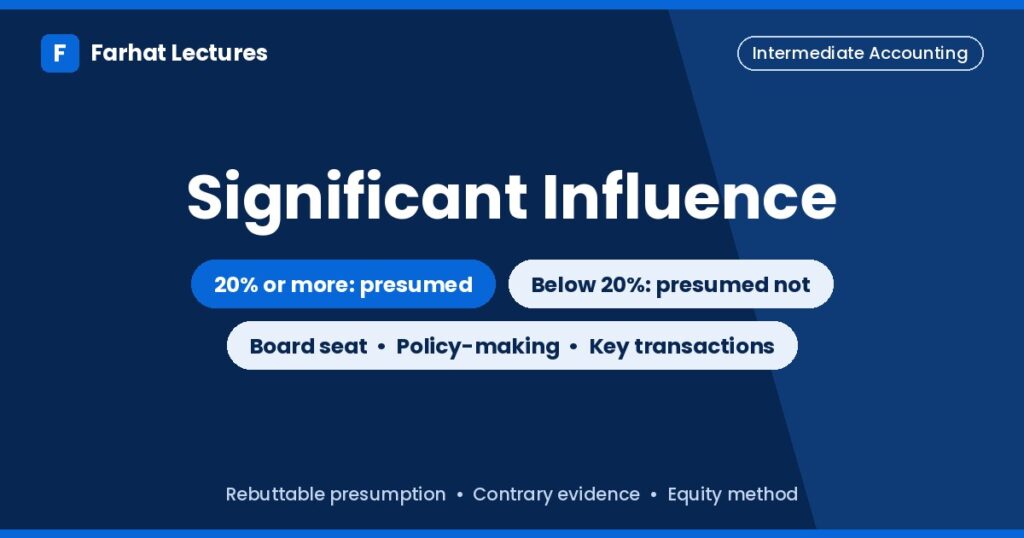


Responses