
Bonds with Detachable Warrants: Journal Entries Using the Proportional and Incremental Methods

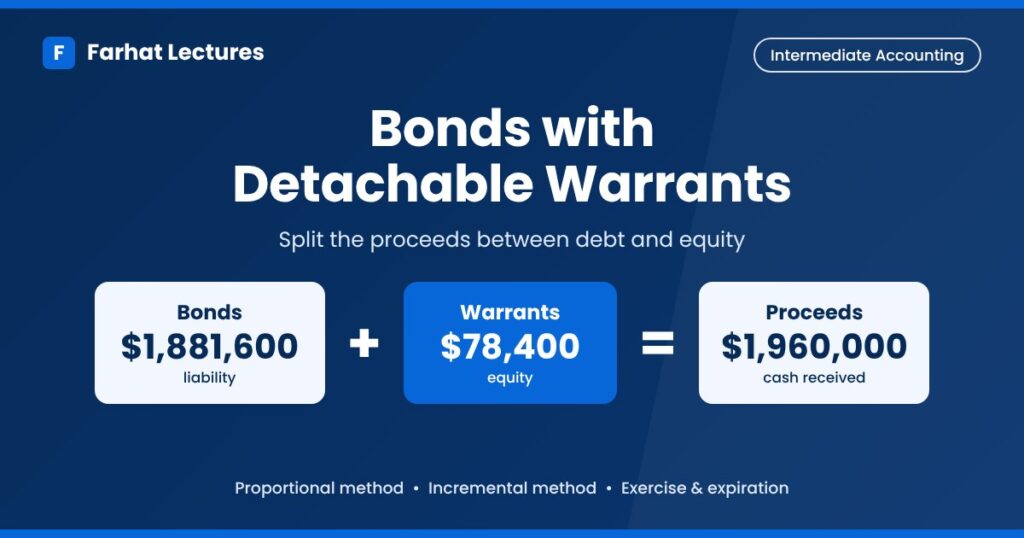
Bonds with detachable warrants are bonds sold together with stock warrants that investors can trade separately. When detachable warrants qualify for equity classification, ASC 470-20-25-2 calls for allocating the proceeds between the bonds and the warrants based on their relative fair values (the proportional method). The issuer records the bonds as a liability and credits the amount allocated to the warrants to Paid-in Capital—Stock Warrants.
In the incremental-method example below, only one fair value is provided. Assign that fair value to the security and allocate the remaining proceeds to the other security.
Companies attach warrants to a bond issue as a sweetener. Investors get a chance to share in future stock price growth, so they accept a lower interest rate. For you as a student, this topic matters because it tests three skills at once: relative fair value allocation, bond discounts, and equity entries. It is a classic journal entry question in intermediate accounting, and it falls under the debt topics in Area II (Select Balance Sheet Accounts) of the AICPA CPA FAR Blueprint.
If you are new to warrants, start with the stock warrants overview. This guide focuses on the issuer’s journal entries from issuance through exercise and expiration.
Journal entry for bonds with detachable warrants (at a glance)
This template shows an issuance at a discount.
| Account | Debit | Credit |
|---|---|---|
| Cash | Total proceeds received | |
| Discount on Bonds Payable | Face value minus the amount allocated to the bonds | |
| Bonds Payable | Face value | |
| Paid-in Capital—Stock Warrants | Amount allocated to the warrants |
If the amount allocated to the bonds is more than face value, credit Premium on Bonds Payable for the difference instead of debiting a discount. If the amount allocated to the bonds equals face value, omit both the discount and premium lines.
Watch: stock warrants, proportional vs. incremental method
In this Farhat Lectures video, Professor Farhat records bonds issued with warrants and the entries for exercise and expiration. Watch it, then work through the example below.
Key moments in the video:
- 2:05 Detachable vs. nondetachable warrants
- 3:49 When to use the proportional method
- 5:04 Relative fair value allocation
- 5:59 Bond and warrant issuance entries
- 6:57 Exercising warrants
- 8:08 Expired warrants
- 8:56 Incremental method example
The video uses its own numbers, so the amounts won’t match the Harbor Lane example below. The steps are exactly the same.
Why are bonds with detachable warrants split into two parts?
A stock warrant gives the holder the right to buy the company’s shares at a fixed price (the exercise or strike price) for a set period. A detachable warrant can be sold separately from the bond. The investor can keep the bond and sell the warrant, or the other way around.
Because the two pieces trade separately, the Financial Accounting Standards Board (FASB) treats them as two instruments. Accounting Standards Codification (ASC) 470-20-25-2 requires the issuer to allocate the proceeds based on the relative fair values of the bond without the warrants and of the warrants themselves at the time of issuance. The amount allocated to the warrants is paid-in capital, and the rest belongs to the bonds.
Nondetachable warrants work differently. If the warrant can only be sold with the bond, the whole price is recorded as debt, just like a convertible bond. That comparison is covered in convertible bonds vs. bonds with warrants.
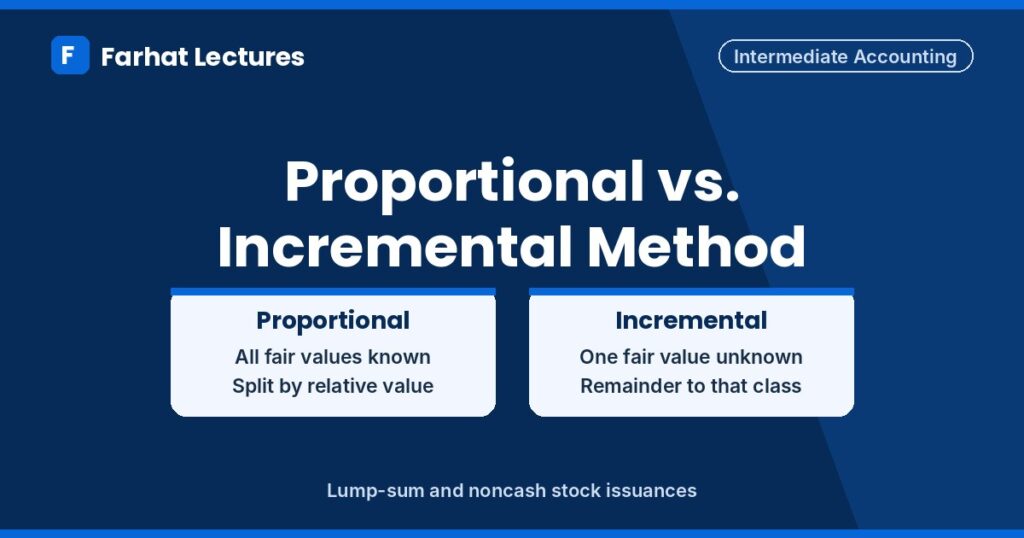
Proportional vs. incremental method: which one should you use?
| Proportional method | Incremental method | |
|---|---|---|
| When to use it | Fair value is known for both the bonds (without warrants) and the warrants | Fair value is known for only one of the two securities |
| How the proceeds are split | Each security gets (its fair value ÷ total fair value) × proceeds | The security with a known fair value gets that amount; the other gets what is left |
| Who absorbs any difference | Shared by the bonds and the warrants | Falls entirely on the security without a known fair value |
| Typical exam clue | “The bonds sold at 96 without the warrants, and each warrant traded at $4” | “The warrants are worth $80,000, but the bonds’ fair value cannot be determined” |
This is the same logic used for a lump-sum sale of common and preferred stock. If you want a refresher, see the proportional vs. incremental method for stock issuances.
Example: proportional method
Harbor Lane Inc. (hypothetical) issues 2,000 bonds with a face value of $1,000 each ($2,000,000 in total). Each bond comes with 10 detachable warrants, so 20,000 warrants are issued. Each warrant lets the holder buy one share of $1 par common stock for $30. The whole package sells at 98, so Harbor Lane receives $1,960,000. (Bond prices are quoted as a percentage of face value, so 98 means 98% of $2,000,000.)
Soon after the issue, the bonds trade at 96 without the warrants, and each warrant trades at $4.
| Security | Fair value | Fraction of total | Allocated proceeds |
|---|---|---|---|
| Bonds without warrants | $2,000,000 × 0.96 = $1,920,000 | 1,920/2,000 = 96% | $1,960,000 × 96% = $1,881,600 |
| Warrants | 20,000 × $4 = $80,000 | 80/2,000 = 4% | $1,960,000 × 4% = $78,400 |
| Total | $2,000,000 | 100% | $1,960,000 |
The bonds are recorded at face value with a discount for the difference between face value and the amount allocated to them ($2,000,000 − $1,881,600 = $118,400).
| Account | Debit | Credit |
|---|---|---|
| Cash | 1,960,000 | |
| Discount on Bonds Payable | 118,400 | |
| Bonds Payable | 2,000,000 | |
| Paid-in Capital—Stock Warrants | 78,400 |
Some textbooks show this as two entries, one for the bonds and one for the warrants. The totals are the same. The $118,400 discount is amortized over the life of the bonds as extra interest expense, as explained in bonds payable.
Right after issuance, Harbor Lane reports the bonds on the balance sheet at their carrying amount: Bonds Payable of $2,000,000 minus the $118,400 discount, or $1,881,600. The $78,400 of warrant capital appears in stockholders’ equity.
Example: incremental method
Now assume Harbor Lane knows the warrants are worth $80,000, but it cannot determine the fair value of the bonds without the warrants. Give the warrants their full fair value and the bonds the rest.
| Step | Amount |
|---|---|
| Total proceeds | $1,960,000 |
| Less: fair value of warrants (known) | (80,000) |
| Remainder allocated to bonds | $1,880,000 |
| Account | Debit | Credit |
|---|---|---|
| Cash | 1,960,000 | |
| Discount on Bonds Payable | 120,000 | |
| Bonds Payable | 2,000,000 | |
| Paid-in Capital—Stock Warrants | 80,000 |
The method works in either direction. If only the bonds’ fair value ($1,920,000) were known, the bonds would get $1,920,000 and the warrants would get the remaining $40,000.
How do you record the exercise of detachable warrants?
Two years later, Harbor Lane’s stock trades at $42. Paying $30 for a $42 share is a good deal, so holders exercise 15,000 of the 20,000 warrants. We continue with the proportional method, where the warrants were credited $78,400. Because 75% of the warrants are used (15,000 ÷ 20,000), 75% of that balance is removed: $78,400 × 75% = $58,800.
| Account | Debit | Credit |
|---|---|---|
| Cash (15,000 × $30) | 450,000 | |
| Paid-in Capital—Stock Warrants | 58,800 | |
| Common Stock (15,000 × $1) | 15,000 | |
| Paid-in Capital in Excess of Par—Common Stock | 493,800 |
The new shares are recorded at the cash received plus the warrant capital given up. The bonds are untouched and stay outstanding. For the basic par value split, see issuance of common stock.
How do you record expired warrants?
Later, Harbor Lane’s stock price falls below $30 and stays there until the warrants’ expiration date. Nobody wants to pay $30 for a share worth less than that, so the other 5,000 warrants expire unused. Their share of the warrant balance is $78,400 × 25% = $19,600. No cash changes hands and no gain is recorded. The amount simply moves to a separate equity account.
| Account | Debit | Credit |
|---|---|---|
| Paid-in Capital—Stock Warrants | 19,600 | |
| Paid-in Capital—Expired Stock Warrants | 19,600 |
Common mistakes with bonds with detachable warrants
- Allocating by face value or par value instead of by fair value.
- Recording the full proceeds as Bonds Payable. That is the treatment for nondetachable warrants, not detachable ones.
- Crediting Common Stock when the warrants are issued. No shares exist until the warrants are exercised.
- Removing the entire Paid-in Capital—Stock Warrants balance when only some warrants are exercised.
- Recording a gain when warrants expire. Expired warrant capital stays in equity.
- Forgetting that the allocation can create a bond discount even when the package sells near or above face value.
- Using the incremental method when both fair values are known. If you have both fair values, use the proportional method.
Practice questions with answers
Stock Warrants Issued with Bonds Practice
Test how detachable and nondetachable stock warrants differ, how warrant exercise compares with bond conversion, and how issuers record bond proceeds when the warrants are nondetachable.
1. Cove Systems (hypothetical) issues $500,000 of bonds at 102 with 5,000 detachable warrants. Soon after, the bonds trade at 99 without the warrants and each warrant trades at $3. Record the issuance.
Proceeds are $510,000. The fair values are $495,000 for the bonds and $15,000 for the warrants, a total of $510,000. Because total fair value equals the proceeds, each security gets exactly its fair value.
| Account | Debit | Credit |
|---|---|---|
| Cash | 510,000 | |
| Discount on Bonds Payable | 5,000 | |
| Bonds Payable | 500,000 | |
| Paid-in Capital—Stock Warrants | 15,000 |
Why: The package sold above face value, yet the bonds still carry a $5,000 discount once the warrants take their share.
2. A company receives $1,030,000 for $1,000,000 of bonds with detachable warrants. The warrants are worth $45,000, but the bonds’ fair value without warrants cannot be determined. How much goes to each security?
Answer: Use the incremental method. The warrants get $45,000 and the bonds get $1,030,000 − $45,000 = $985,000. The entry debits Cash $1,030,000 and Discount on Bonds Payable $15,000, and credits Bonds Payable $1,000,000 and Paid-in Capital—Stock Warrants $45,000.
3. A company has 4,000 warrants outstanding with a Paid-in Capital—Stock Warrants balance of $24,000. Each warrant buys one $2 par share for $20. Holders exercise 3,000 warrants, and the rest expire. Record both events.
| Account | Debit | Credit |
|---|---|---|
| Cash (3,000 × $20) | 60,000 | |
| Paid-in Capital—Stock Warrants (3/4 × $24,000) | 18,000 | |
| Common Stock (3,000 × $2) | 6,000 | |
| Paid-in Capital in Excess of Par—Common Stock | 72,000 |
| Account | Debit | Credit |
|---|---|---|
| Paid-in Capital—Stock Warrants | 6,000 | |
| Paid-in Capital—Expired Stock Warrants | 6,000 |
Why: Each warrant carries $6 of paid-in capital ($24,000 ÷ 4,000). Exercised warrants move their $18,000 into the new shares, and expired warrants move their $6,000 to the expired account.
Frequently asked questions
Are bonds with detachable warrants debt or equity?
Both. The bonds are a liability. The warrants are a separate equity instrument, so the part of the proceeds allocated to them is credited to Paid-in Capital—Stock Warrants. This assumes the warrants qualify as equity, which is the standard assumption in intermediate accounting and CPA exam problems.
Which fair values do you use for the allocation?
Use the fair value of the bonds without the warrants and the fair value of the warrants at the time of issuance. In practice these come from prices soon after the two securities start trading separately, or from an investment banker’s estimate.
Why do the bonds end up at a discount?
Part of the cash is assigned to the warrants, so less than the face amount is left for the bonds. The discount is amortized over the bond term, which raises interest expense.
What happens to the bonds when the warrants are exercised?
Nothing. The holder pays cash for the new shares and the bonds stay outstanding until they mature or are retired. That is the key difference from converting a convertible bond.
Do expired warrants create a gain?
No. The balance in Paid-in Capital—Stock Warrants is moved to Paid-in Capital—Expired Stock Warrants. The amount stays in equity and never passes through the income statement.
What is the difference between detachable and nondetachable warrants?
Detachable warrants can be sold separately from the bonds, so the proceeds are split between debt and equity. Nondetachable warrants can only be used together with the bond, so the whole price is recorded as debt, the same way a convertible bond is recorded.
How do detachable warrants affect diluted earnings per share?
While the warrants are outstanding, they are potential common shares. For diluted EPS, use the treasury stock method. If the average market price is above the exercise price, assume the warrants were exercised and the cash was used to buy back shares at the average price. The net new shares are added to the denominator.
How are bond issuance costs handled when warrants are attached?
A common approach is to split the issuance costs between the bonds and the warrants on the same relative fair value basis. Costs assigned to the bonds reduce the bonds’ carrying amount, and costs assigned to equity-classified warrants reduce paid-in capital.
Note: Some warrants must be classified as liabilities, for example when the company could be required to settle them in cash. Those cases follow a different allocation, described in PwC’s financing transactions guide (FG 8.4), and go beyond this lesson.
About the author
Mansour Farhat, CPA, CIA, DBA, is the instructor behind Farhat Lectures, where he teaches intermediate accounting and exam review for CPA, CMA, and EA candidates. His lessons focus on worked journal entries and the mistakes students make most often on exam questions. Learn more about Mansour.
Continue learning with Farhat Lectures
Strengthen your accounting understanding with clear explanations and guided practice. Start free, then move into the full course when you are ready.
Explore the free sample course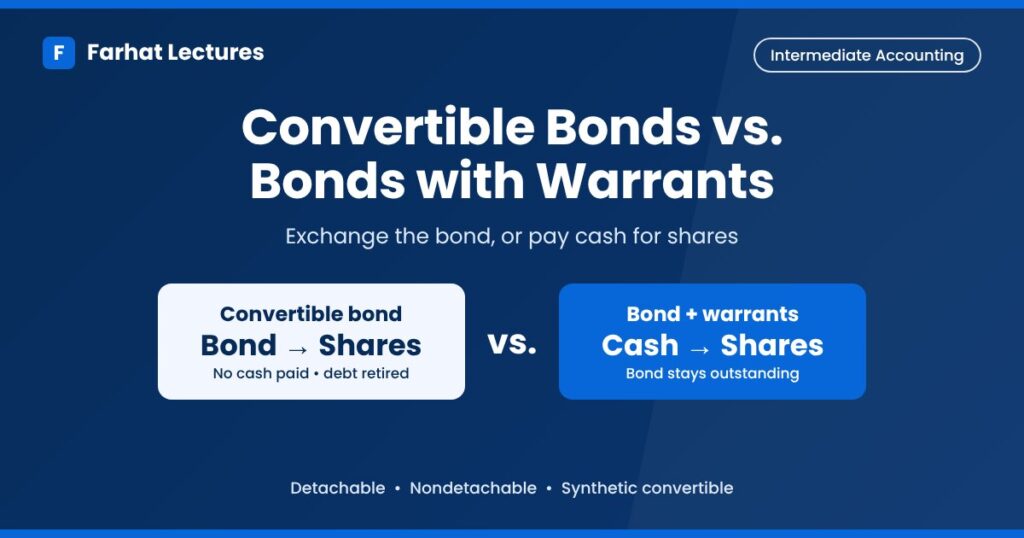
Responses