
Accounting for Convertible Bonds: Issuance, GAAP vs. IFRS, and Retirement

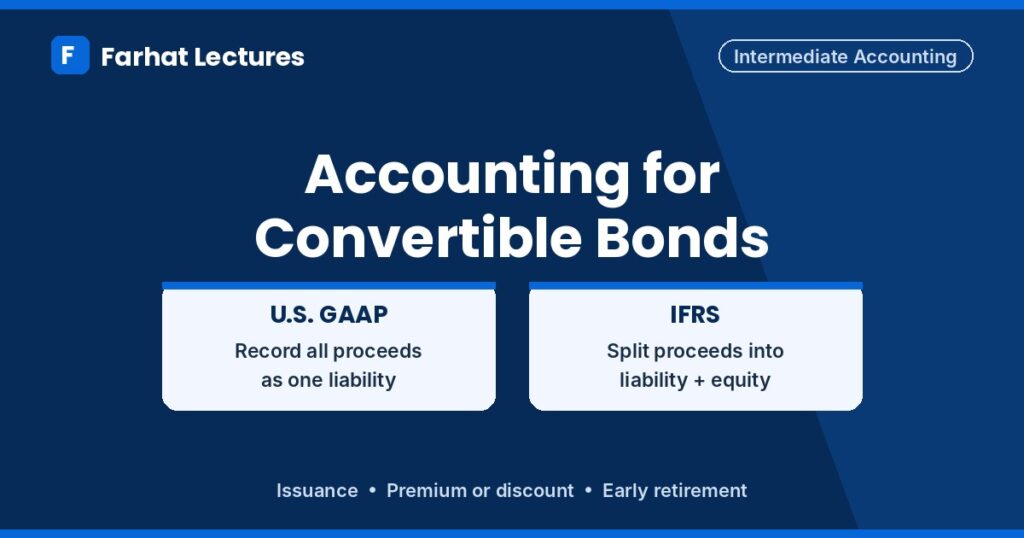
Under U.S. GAAP, issuers generally account for convertible bonds as a single liability, with any ordinary premium or discount included in the carrying amount. Under IFRS, the issuer splits the proceeds between liability and equity when the conversion option qualifies as equity under IAS 32. For bonds accounted for as a single liability, an early cash repurchase produces a gain or loss if the price paid differs from the carrying amount.
This matters because convertible bonds are a common way for companies to borrow, and the issuance entry drives everything after it: interest expense, the carrying amount, and the amount moved into equity if the bonds convert. On the CPA exam, FAR tests the U.S. GAAP treatment; the AICPA removed GAAP-versus-IFRS differences from FAR in July 2021. The IFRS split still shows up in intermediate accounting courses, so this guide covers both.
This guide covers the issuance entry under U.S. GAAP, why the equity piece is ignored, the IFRS split, and early retirement (extinguishment). For what dilution is and why companies issue convertibles at all, start with what dilutive securities are.
Watch: Convertible Bonds Accounting: Issuance, Conversion & Retirement
What is a convertible bond, and what is it worth?
A convertible bond is a bond that the holder can exchange for a fixed number of the issuer’s common shares, usually during a specified period. Its value has two parts:
| Component | What it represents |
|---|---|
| Debt component | The value of the interest and principal payments, like a straight bond |
| Equity component | The value of the option to convert into common stock |
Investors pay for both parts. The question in accounting for convertible bonds is whether the issuer records both parts or just one.
Accounting for convertible bonds under U.S. GAAP
Under U.S. GAAP, the issuer generally records convertible bonds as a single liability. Under this model, any ordinary premium or discount is included in the initial carrying amount and amortized over the term. The FASB’s Accounting Standards Update (ASU) 2020-06 reinforced this approach by removing two older models that required companies to split out certain conversion features.
Example (hypothetical). Harlow Tech issues 200 convertible bonds, each with a $1,000 face value and a 5-year life, at 103 (103% of face). Each bond converts into 25 shares of Harlow’s $2 par common stock. Assume the conversion option is worth $45 per bond.
| Account | Debit | Credit |
|---|---|---|
| Cash (200 × $1,000 × 1.03) | 206,000 | |
| Bonds Payable (200 × $1,000) | 200,000 | |
| Premium on Bonds Payable | 6,000 |
Notice what is missing. The $9,000 value of the conversion option (200 × $45) appears nowhere. The full $206,000 is debt. Harlow amortizes the $6,000 premium over five years. To keep the numbers simple, this lesson uses the straight-line method, which is $1,200 a year. U.S. GAAP calls for the effective interest method unless straight-line gives results that are not materially different. Either way, amortizing a premium lowers interest expense below the cash interest paid.
Why does U.S. GAAP ignore the equity piece?
ASC 470-20 generally treats convertible debt and its embedded conversion option as a single liability. The conversion option can have economic value even when the issuer records the entire instrument as debt.
There are two main exceptions. First, if a conversion feature must be accounted for separately as a derivative, it is recorded at fair value, usually as a liability. Second, if convertible bonds are issued at a substantial premium, U.S. GAAP presumes the premium is paid-in capital and records it in equity (ASC 470-20-25-13). Both are outside this lesson, and Harlow’s 3% premium is treated as an ordinary bond premium. For a typical convertible bond in an intermediate accounting problem, record it as straight debt.
Accounting for convertible bonds under IFRS
Under IAS 32 Financial Instruments: Presentation, a convertible bond is a compound financial instrument when the conversion option qualifies as equity, as it does in Harlow’s example. The issuer first measures the liability using the fair value of similar debt without the conversion option, then allocates the residual proceeds to equity.
Using the Harlow example under IFRS: suppose the present value of the bond’s cash flows, discounted at the market rate for similar bonds without a conversion feature, is $197,000. (Our bond pricing lesson shows how that present value is calculated.) That leaves $9,000 for the conversion option, the same value GAAP ignored.
| Step | Amount |
|---|---|
| Total proceeds | $206,000 |
| Less: liability component (present value of cash flows) | (197,000) |
| Equity component (residual) | $9,000 |
| Account | Debit | Credit |
|---|---|---|
| Cash | 206,000 | |
| Bonds Payable (liability component) | 197,000 | |
| Equity Component of Convertible Bonds | 9,000 |
The equity account name varies by company. What matters is that part of the proceeds sits in equity, and the liability starts below face value, so IFRS interest expense is higher.
U.S. GAAP vs. IFRS comparison
| U.S. GAAP | IFRS | |
|---|---|---|
| Initial recording | Entire proceeds as debt under the general rule | Split into liability and equity when the conversion option qualifies as equity |
| Conversion option | Included in the single liability under the general rule | Qualifying equity option recorded at the residual amount |
| Liability at issuance (Harlow) | $206,000 ($200,000 + $6,000 premium) | $197,000 |
| Interest expense | Lower | Higher, because the liability starts lower |
What happens if convertible bonds are retired early?
Under U.S. GAAP, when the issuer repurchases a convertible bond accounted for as a single liability, compare the cash repurchase price with the bond’s net carrying amount. A higher price creates a loss on extinguishment, and a lower price creates a gain on extinguishment. (The bonds payable guide reviews carrying amounts and premium amortization.)
U.S. GAAP example (hypothetical). At the end of Year 3, Harlow’s bonds have $2,400 of unamortized premium, so the carrying amount is $202,400. Harlow buys all of them back in the market for $205,000.
| Account | Debit | Credit |
|---|---|---|
| Bonds Payable | 200,000 | |
| Premium on Bonds Payable | 2,400 | |
| Loss on Extinguishment of Debt ($205,000 − $202,400) | 2,600 | |
| Cash | 205,000 |
Under IFRS, if the issuer repurchases a compound convertible bond early and the original conversion rights are unchanged, it allocates the consideration and any transaction costs between the liability and equity components using the same approach as at issuance. The issuer measures the liability’s fair value at the repurchase date and assigns the residual consideration to equity. The difference between the liability’s net carrying amount and the amount allocated to it goes to profit or loss. The amount allocated to equity is charged directly to equity.
Retirement for cash is different from conversion into stock. Converting bonds under their original terms does not create a gain or loss. Under U.S. GAAP, if a settlement qualifies for induced-conversion accounting, the issuer expenses the fair value of the additional consideration offered to induce conversion. See conversion of convertible bonds for those entries.
What happens when convertible bonds convert?
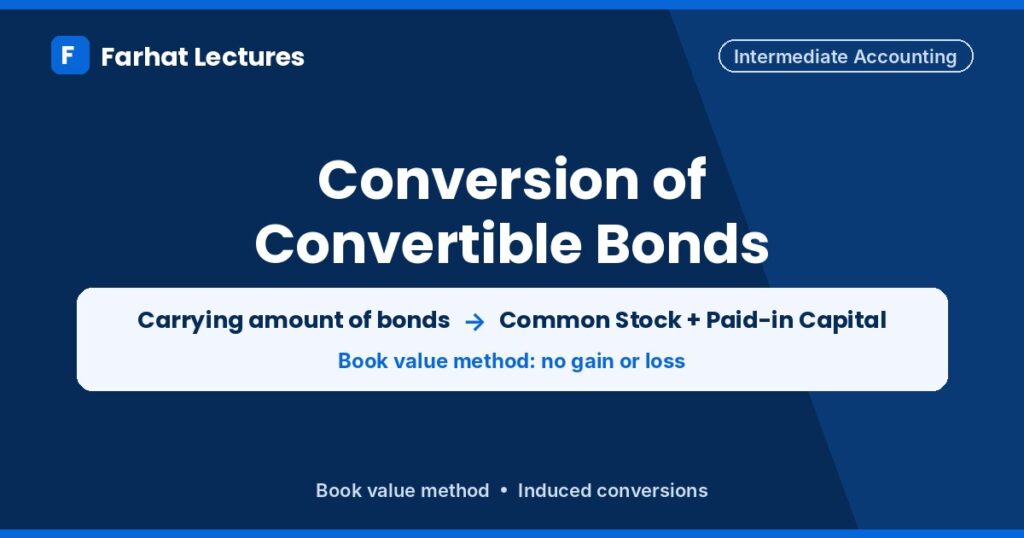
For a convertible bond accounted for as a single liability under U.S. GAAP, conversion into shares under the original terms uses the book value method. The bonds’ carrying amount is moved into equity, and no gain or loss is recorded.
Example (hypothetical). Suppose that instead of being bought back, all of Harlow’s bonds convert at the end of Year 3, when the carrying amount is $202,400. Each bond converts into 25 shares, so Harlow issues 5,000 shares (200 × 25) of $2 par stock.
| Account | Debit | Credit |
|---|---|---|
| Bonds Payable | 200,000 | |
| Premium on Bonds Payable | 2,400 | |
| Common Stock (5,000 × $2) | 10,000 | |
| Paid-in Capital in Excess of Par, Common ($202,400 − $10,000) | 192,400 |
When a compound convertible bond converts into shares under its original terms under IFRS, the liability’s carrying amount moves into equity and the original equity component stays in equity. It may be reclassified to another equity account, but no gain or loss arises.
For induced conversions and more examples, see conversion of convertible bonds.
How do convertible bonds affect diluted EPS?
Convertible bonds can lower earnings per share even before anyone converts. Since ASU 2020-06, U.S. GAAP requires the if-converted method for convertible instruments. For Harlow’s share-settled bonds, assume conversion at the beginning of the period or on the issue date, whichever is later. Add back the after-tax interest expense to the applicable earnings numerator and add the weighted incremental common shares to the denominator. Include the effect only if it is dilutive. If discontinued operations are reported, test dilution using income from continuing operations available to common shareholders as the control number. Harlow would add 5,000 shares for a full period if the bonds were dilutive and outstanding throughout that period. For the full calculation, see earnings per share.
Key takeaways: accounting for convertible bonds
- Under U.S. GAAP, generally record convertible bonds as one liability. Check whether the conversion feature requires separate derivative accounting or the bonds were issued at a substantial premium.
- Under IFRS, when the conversion option qualifies as equity, measure the liability first and recognize the residual proceeds in equity.
- Amortize any premium or discount included in the debt carrying amount over the bond’s life.
- Under U.S. GAAP, for debt accounted for as a single liability, the gain or loss on a cash repurchase is the difference between the price paid and the net carrying amount.
- Under IFRS, when a compound convertible bond is repurchased early and its conversion rights are unchanged, allocate the consideration between liability and equity. The gain or loss relates to the liability component.
- In Harlow’s original-term conversion, the debt carrying amount moves into equity with no gain or loss.
Common mistakes
- Crediting equity for a conversion option that falls under the U.S. GAAP single-liability model.
- Using the GAAP entry on an IFRS question, or the reverse.
- Forgetting to remove the unamortized premium or discount when bonds are retired.
- Calling a cash retirement a conversion, or recording a gain on a conversion.
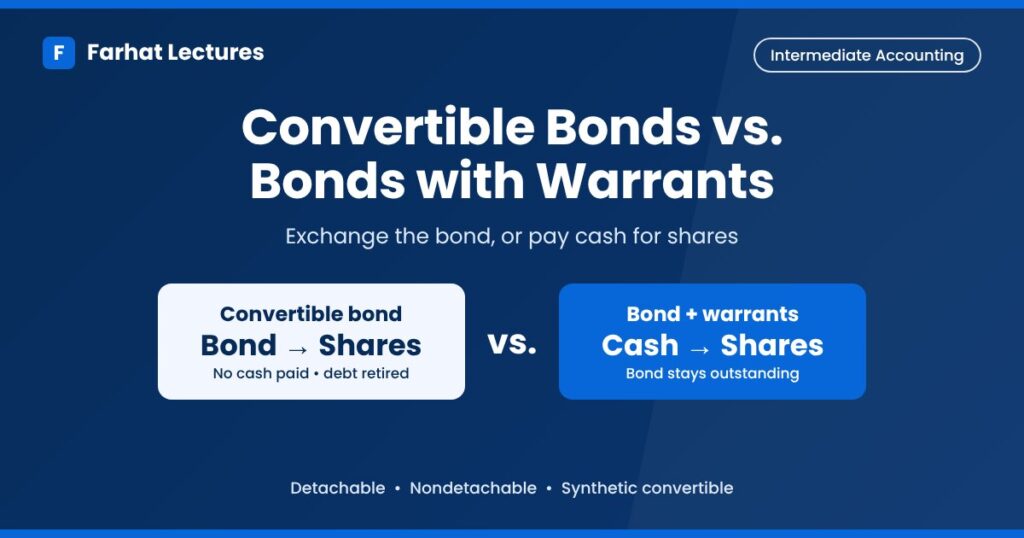
- Treating convertible bonds like bonds issued with detachable stock warrants. Under U.S. GAAP, proceeds are allocated to detachable warrants. Equity-classified warrants are credited to equity.
Interactive Convertible Bonds Practice
Test how the conversion option affects the bond’s interest rate and value, then apply the single-liability accounting model for a typical convertible bond under U.S. GAAP. Select an answer for each of the four questions and review the explanations before moving on to the practice questions below.
Practice questions with answers
1. A U.S. company issues 100 convertible bonds, $1,000 face each, at 98. Record the issuance under U.S. GAAP.
| Account | Debit | Credit |
|---|---|---|
| Cash (100 × $1,000 × 0.98) | 98,000 | |
| Discount on Bonds Payable | 2,000 | |
| Bonds Payable | 100,000 |
Why: Under GAAP the whole issue is debt, recorded at face with a discount for the shortfall.
2. An IFRS company receives $515,000 for convertible bonds with an equity-classified conversion option. The present value of the cash flows at the rate for similar nonconvertible bonds is $488,000. How much goes to equity?
Answer: $515,000 − $488,000 = $27,000. IFRS measures the liability first and assigns the residual to equity.
3. Under U.S. GAAP, an issuer repurchases convertible bonds accounted for as a single liability for $297,000. The bonds have a $300,000 face value and $1,500 of unamortized premium. What is the gain or loss?
Answer: The carrying amount is $301,500. Paying $297,000 creates a $4,500 gain on extinguishment, reported in other gains and losses.
Frequently asked questions
Why doesn’t U.S. GAAP record the conversion option in equity?
Under ASC 470-20, an embedded conversion option generally stays with the debt for accounting purposes. The issuer accounts separately for a conversion feature that must be separated as a derivative or for a substantial premium that is presumed to be paid-in capital.
Did ASU 2020-06 change the accounting for convertible bonds?
Yes. It removed the separate models for beneficial conversion features and cash conversion features. As a result, most convertible debt is now recorded as a single liability at amortized cost. The exceptions are a conversion feature that must be separated as a derivative and bonds issued at a substantial premium.
How does IFRS account for a convertible bond?
Under IAS 32, a convertible bond is a compound instrument when its conversion option qualifies as equity. Measure the liability first at the fair value of comparable debt without the equity conversion option, then recognize the residual proceeds in equity.
Is the premium on a convertible bond amortized?
Yes. An ordinary premium or discount included in the debt carrying amount is amortized over the bond’s life. The amortization affects interest expense and the bond’s carrying amount.
Where is a gain or loss on retiring convertible bonds reported?
The issuer recognizes a gain or loss on debt extinguishment in the income statement for the period of retirement. For U.S. GAAP convertible debt accounted for as one liability, compare the cash repurchase price with the net carrying amount.
Is the conversion option ever recorded separately under U.S. GAAP?
Only in limited cases. If the bonds are issued at a substantial premium, U.S. GAAP presumes the premium is paid-in capital and records it in equity. If the conversion feature must be separated as a derivative, it is recorded at fair value, usually as a liability. A typical convertible bond has neither.
When did ASU 2020-06 take effect?
For SEC filers that are not smaller reporting companies, it took effect for fiscal years beginning after December 15, 2021. For all other entities, including private companies, it took effect for fiscal years beginning after December 15, 2023. So it now applies to everyone.
What happens to the IFRS equity component when the bonds convert or mature?
The original equity component stays in equity. On conversion under the original terms, the liability’s carrying amount also moves into equity. At scheduled cash maturity, the issuer settles the liability and may reclassify the expired conversion option within equity.
Is the GAAP vs. IFRS difference tested on the CPA exam?
The AICPA removed differences between IFRS and U.S. GAAP from the FAR blueprint effective July 2021. For this topic, focus on the U.S. GAAP single-liability model and its exceptions.
About the author
Mansour Farhat, CPA, CIA, DBA, teaches the accounting and CPA exam courses on Farhat Lectures. The examples, exam tips, and common mistakes in this lesson come from his classroom and video lessons on intermediate accounting.
Continue learning with Farhat Lectures
Strengthen your accounting understanding with clear explanations and guided practice.
Explore the free sample course

Responses