
Dilutive Securities: What They Are and How Dilution Works


Convertible bonds, convertible preferred stock, stock warrants, and stock options are potentially dilutive securities because they can create additional common shares. When new common shares are issued, stockholders who keep the same number of shares own a smaller percentage of the company. The effect on earnings per share (EPS) depends on the additional shares and any adjustment to the earnings numerator.
This matters because dilutive securities are everywhere in modern financing. Fast-growing companies use convertible bonds to borrow cheaply, and many companies pay employees partly in stock options. As an accounting student, you need to know what each security is, whether it is debt or equity, and how it can shrink an existing owner’s stake.
This guide covers the first topic in the dilutive securities and earnings per share chapter of intermediate accounting, a topic that also shows up in the FAR section of the CPA exam. It explains dilution, the main types of dilutive securities, the debt-versus-equity question, and why companies and investors both like convertible debt.
Watch: Optionlike Securities: Stock Warrants, Convertible Bonds, and Preferred Stock
Watch this Farhat lesson on YouTube
In this 22-minute Farhat Lectures lesson, you will see stock warrants, convertible bonds, and convertible preferred stock explained step by step. It pairs well with the types and debt-or-equity sections below.
What does dilution mean?
In chemistry, you dilute a drink by adding water. In accounting, a company dilutes its owners by adding shares. Each stockholder keeps the same number of shares, but the total grows, so each person’s slice gets smaller.
Example (hypothetical). Pinecrest Corp. has 200,000 common shares outstanding. Investor A owns 50,000 of them. Pinecrest’s convertible bondholders then convert their bonds into 50,000 new common shares.
| Before conversion | After conversion | |
|---|---|---|
| Total shares outstanding | 200,000 | 250,000 |
| Investor A’s shares | 50,000 | 50,000 |
| Investor A’s ownership | 25% (50,000 ÷ 200,000) | 20% (50,000 ÷ 250,000) |
| Earnings per share if net income stays at $500,000 | $2.50 | $2.00 |
Investor A did nothing, yet now owns 20% instead of 25%. EPS also falls, because the same income is divided among more shares. (Real diluted EPS calculations for convertible bonds also add back the after-tax interest the company no longer pays. That approach is called the if-converted method. Options and warrants use the treasury stock method instead. Both are covered in the basic and diluted EPS guide.)
Are all dilutive securities actually dilutive?
Not always. A security may create additional common shares and still be excluded from diluted EPS. Under ASC 260, a security is dilutive if including it lowers earnings per share or increases loss per share on the measure used to test dilution. If it raises earnings per share or reduces loss per share on that measure, it is antidilutive and is excluded.
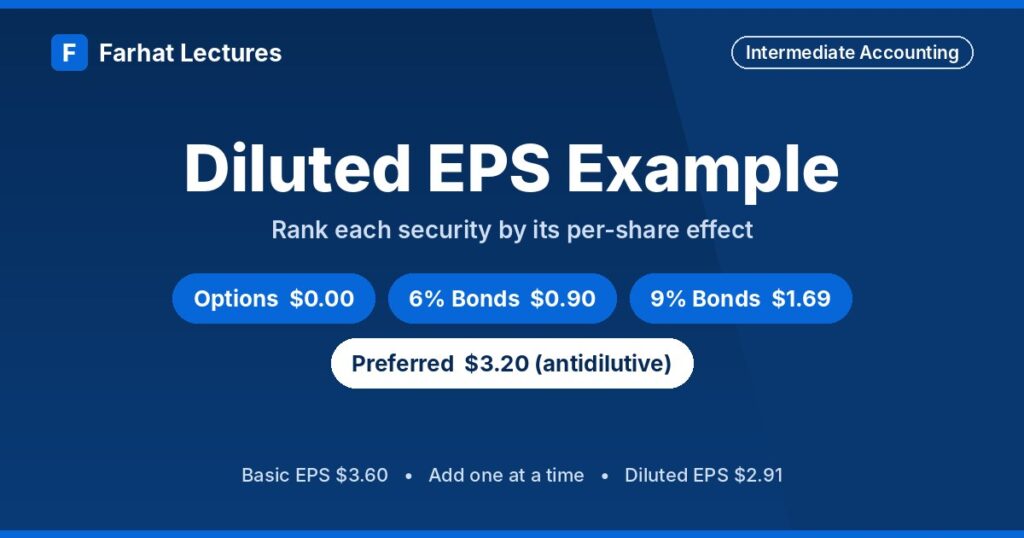
Example (hypothetical). A company earns $500,000 and has 200,000 common shares, so basic EPS is $2.50. Its convertible bonds would add 20,000 shares, and converting them would save $90,000 of after-tax interest. EPS including the bonds would be $590,000 ÷ 220,000 = $2.68. That is higher than $2.50, so the bonds are antidilutive and are excluded. See the antidilutive securities guide for the full ranking process.
Interactive Practice: Ownership Dilution
Ownership dilution occurs when a company issues additional common shares and an existing stockholder’s share of the company decreases. Calculate ownership percentage by dividing the stockholder’s common shares by the total common shares outstanding and multiplying by 100.
Dilution of Ownership After a Common Stock Issuance
Use the share balances and employee stock compensation issuance below to compare ownership percentages before and after the issuance. Round each ownership percentage to the nearest whole percent.
What are the main types of dilutive securities?
| Security | What it is | Usually reported as |
|---|---|---|
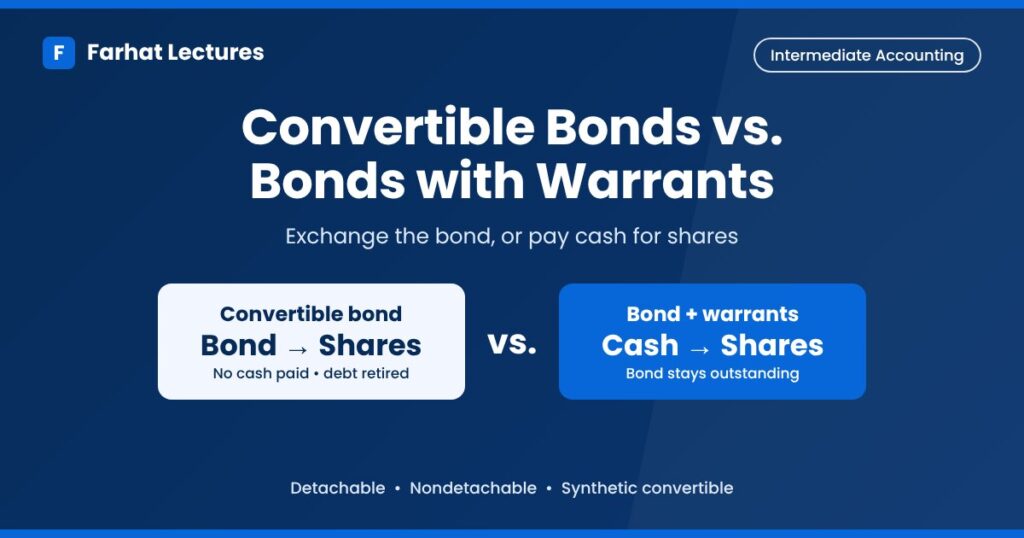
| Convertible bonds | Bonds the holder can exchange for a set number of common shares | Liability (until converted) |
| Convertible preferred stock | Preferred shares the holder can exchange for common shares | Stockholders’ equity |
| Stock warrants | Rights to buy common shares at a fixed price for a set period | Stockholders’ equity |
| Stock options and other employee plans | Rights given to employees to buy shares as part of their pay | Stockholders’ equity (compensation) |
The U.S. Securities and Exchange Commission (SEC) investor site describes a convertible security as a bond or preferred stock that can be exchanged for another security, usually the company’s common stock. Warrants are covered in detail in the stock warrants guide. This cluster focuses on convertible securities.
Debt or equity? The big debate
The main accounting controversy around dilutive securities is classification. Should they be reported as debt, as equity, or partly as each?
The key test is the definition of a liability. Under FASB Concepts Statement No. 8, a liability is a present obligation of an entity to transfer an economic benefit. A convertible bond promises interest and principal, so it is a liability until it converts. Convertible preferred stock usually carries no such promise, so it is equity.
What about preferred stock with a set redemption date? Under ASC 480, preferred stock that the company must unconditionally redeem for cash on a fixed or determinable date is generally a liability. A substantive option that lets the holder convert the preferred shares into common stock before redemption makes the cash redemption conditional while the option remains in effect. If the option expires unexercised and redemption becomes mandatory, the issuer reclassifies the shares as a liability. SEC filers present otherwise equity-classified shares in temporary equity when redemption is outside the issuer’s sole control.
The conversion option itself looks like equity, because it gives the holder a path to ownership. U.S. GAAP and IFRS handle that option differently when a convertible bond is issued. See accounting for convertible bonds at issuance for the entries under each framework.
Why do companies issue convertible debt?
- Lower interest cost. Investors value the chance to become owners, so they accept a lower interest rate than on ordinary (straight) bonds. Some convertibles pay little or no interest.
- Control over capital structure. Many convertibles carry a call feature that lets the issuer redeem them. If the stock price has risen, calling the bonds pushes holders to convert, which turns debt into equity and lowers the debt-to-equity ratio.
- Delayed equity at a higher price. The conversion price is usually set above today’s stock price, so the company effectively sells shares later at a premium.
Why do investors buy convertible debt?
- Equity upside. If the stock price climbs well above the conversion price, holders convert and share in the gain.
- Downside protection. If the stock falls, holders simply keep the bonds and collect interest and principal, as long as the issuer stays solvent.
That combination of upside and protection is exactly why investors accept a lower interest rate.
Convertible bonds vs. convertible preferred stock
Students often mix these two up because both convert into common stock. Their classification and their accounting are different.
| Convertible bonds | Convertible preferred stock | |
|---|---|---|
| Balance sheet | Liability | Stockholders’ equity (unless mandatorily redeemable) |
| Payments to holders | Interest, an expense | Dividends, a distribution of earnings |
| At issuance (U.S. GAAP) | Recorded like straight bonds | Recorded like other preferred stock |
| On conversion | Book value method, no gain or loss | Book value method, no gain or loss |
| Extra payment to induce conversion | Debt conversion expense | Charged to retained earnings, not an expense |
The conversion of preferred shares, including the case where Retained Earnings is debited, is worked through in the preferred stock features guide. The bond side is in conversion of convertible bonds.
Key takeaways on dilutive securities
- Issuing additional common shares can reduce an existing stockholder’s ownership percentage. Diluted EPS reflects potential common shares that pass the ASC 260 dilution test and any related earnings adjustments.
- The main types are convertible bonds, convertible preferred stock, stock warrants, and stock options.
- Convertible bonds are liabilities; convertible preferred stock, warrants, and options are generally equity.
- Companies issue convertibles to borrow cheaply and manage capital structure; investors buy them for upside with protection.
Common mistakes
- Classifying convertible bonds as equity because they might become stock.
- Assuming dilution changes the number of shares an existing owner holds. It changes the percentage, not the count.
- Treating preferred dividends like interest expense.
- Forgetting that, for convertible bonds and convertible preferred stock, diluted EPS adjusts the numerator too (adding back after-tax interest or preferred dividends), not just the share count.
Exam tip: When a FAR question gives you several convertible securities and options, work in two steps. First, classify each one as debt or equity. Then decide whether each one is actually dilutive for EPS. Many students lose points by including a security just because it can create new shares, even when it is antidilutive.
Practice questions with answers
1. A company has 80,000 common shares outstanding. You own 12,000. Warrants are exercised for 20,000 new shares. What is your ownership before and after?
Answer: Before, 12,000 ÷ 80,000 = 15%. After, 12,000 ÷ 100,000 = 12%. Your share count did not change, but your stake was diluted.
2. Classify each item: (a) 6% bonds convertible into common stock, (b) convertible preferred stock with no redemption date.
Answer: (a) Liability, because the company must pay interest and principal. (b) Stockholders’ equity, because there is no obligation to pay the holder.
3. Why might a convertible bond pay 1% interest when a similar straight bond pays 5%?
Answer: Investors give up interest in exchange for the conversion option, which lets them share in a rising stock price while keeping the protection of a bond.
Frequently asked questions
What are dilutive securities in simple terms?
They are instruments that can create new common shares, such as convertible bonds, convertible preferred stock, stock warrants, and stock options. Issuing those shares can reduce an existing stockholder’s ownership percentage. Their effect on EPS depends on the dilution test.
Are dilutive securities always bad for stockholders?
Not necessarily. Convertible bonds usually carry a lower interest rate, and options can attract and keep good employees. The cost is possible dilution later, so investors weigh both.
Is a convertible bond debt or equity?
Under U.S. GAAP, a convertible bond is generally recorded entirely as a liability until it is converted, a result reinforced by ASU 2020-06. IFRS (IAS 32) usually splits it into a liability part and an equity part.
Is convertible preferred stock a liability?
Usually not. Under ASC 480, a substantive option that lets the holder convert into common stock before a scheduled cash redemption makes the redemption conditional. If the option expires unexercised and redemption becomes mandatory, the shares generally become a liability. SEC filers present otherwise equity-classified shares in temporary equity when redemption is outside the issuer’s sole control.
How do dilutive securities affect EPS?
ASC 260 includes potential common shares that lower EPS or increase loss per share on the measure used to test dilution. When a company reports discontinued operations, income from continuing operations available to common stockholders is the control number. The same potential shares carry through to the other diluted EPS calculations, so diluted EPS for net income can be higher than basic EPS for net income.
What is the difference between dilutive and antidilutive securities?
Both can lead to the issuance of common shares. Including a dilutive security lowers earnings per share or increases loss per share on the measure used to test dilution. Including an antidilutive security would raise earnings per share or reduce loss per share on that measure, so it is excluded.
Sources and standards referenced: FASB ASC 260, Earnings per Share; FASB ASC 470-20, Debt with Conversion and Other Options; FASB ASC 480, Distinguishing Liabilities from Equity; FASB Concepts Statement No. 8, Chapter 4, Elements of Financial Statements; and the SEC’s Investor.gov glossary entry on convertible securities.
Continue learning with Farhat Lectures
Strengthen your accounting understanding with clear explanations and guided practice.
Explore the free sample course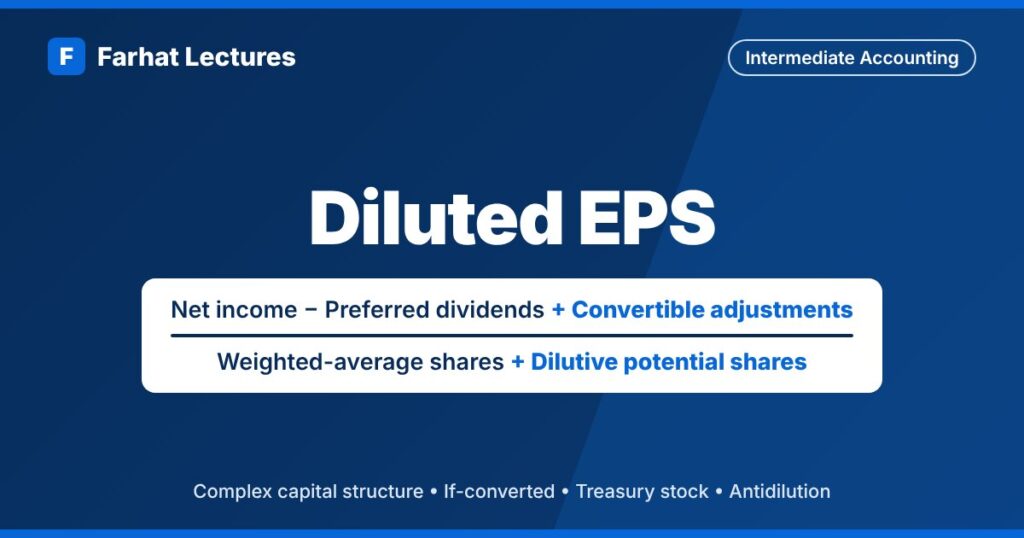
Responses