
Treasury Stock Method: How Options and Warrants Affect Diluted EPS

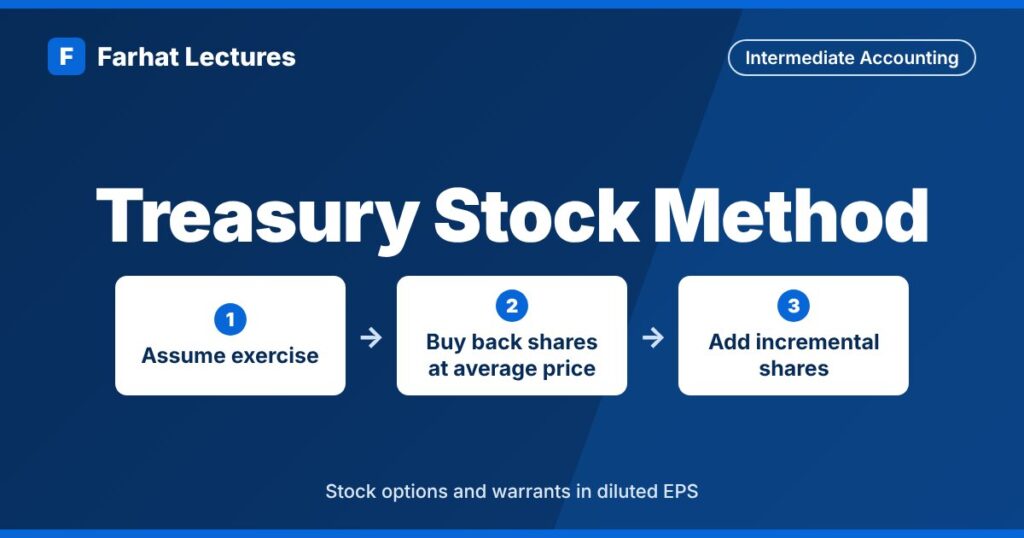
The treasury stock method is the FASB ASC 260 approach for including stock options and warrants in diluted earnings per share (EPS). Assume the options are exercised, use the assumed proceeds to buy back shares at the average market price, and add only the net new shares (incremental shares) to the denominator. In most cases, the numerator does not change.
This matters because options and warrants bring cash into the company when they are exercised. That cash could be used to buy back some of the new shares, so counting every option as a full new share would overstate dilution. The treasury stock method nets the two effects. It is the method behind every diluted EPS question involving employee stock options or stock warrants. How options are recorded as compensation is a separate topic, covered in accounting for stock options.
This guide supports the diluted earnings per share lesson in intermediate accounting and the EPS questions in the Financial Accounting and Reporting (FAR) section of the CPA exam. Despite the name, it is not about recording treasury stock purchases. That topic is covered in what is treasury stock.
Watch: Treasury Method: Diluted Earnings Per Share
Watch this Farhat lesson on YouTube
In this 7-minute lesson, Professor Farhat shows how options and warrants add incremental shares to the diluted EPS denominator under the treasury stock method.
How does the treasury stock method work? 3 steps
| Step | What you do | Calculation |
|---|---|---|
| 1. Assume exercise | Treat all dilutive options and warrants as exercised at the start of the year (or at issuance, if later) | Cash exercise proceeds = number of options × exercise price |
| 2. Assume a buyback | Use the assumed proceeds to buy back common shares at the average market price while the instruments were outstanding | Shares repurchased = proceeds ÷ average market price |
| 3. Add the incremental shares | Add the net new shares to the diluted EPS denominator | Incremental shares = shares issued − shares repurchased |
When exercise cash is the only assumed proceeds, use this shortcut for dilutive options: incremental shares = number of options × (average market price − exercise price) ÷ average market price. For employee stock options with remaining compensation cost, add the average unrecognized cost for future service to assumed proceeds before calculating the shares repurchased.
Why the average market price? It reflects share prices while the options or warrants were outstanding. If they were outstanding for only part of the reporting period, use the average price over that shorter window and weight the incremental shares for the time outstanding. A simple average of weekly or monthly closing prices is usually adequate when prices are relatively stable.
Worked example: options in diluted EPS
Example (hypothetical). Cascade Corp. reports net income of $750,000 and weighted-average common shares of 300,000, so basic EPS is $2.50. It has 30,000 stock options outstanding all year with an exercise price of $36. The average market price of its stock was $45.
| Step | Calculation | Result |
|---|---|---|
| Shares issued on assumed exercise | 30,000 options | 30,000 |
| Assumed proceeds | 30,000 × $36 | $1,080,000 |
| Shares repurchased | $1,080,000 ÷ $45 | (24,000) |
| Incremental shares | 30,000 − 24,000 | 6,000 |
Check with the shortcut: 30,000 × ($45 − $36) ÷ $45 = 6,000 shares.
Diluted EPS: $750,000 ÷ (300,000 + 6,000) = $750,000 ÷ 306,000 = $2.45. Net income stays at $750,000, because options carry no interest or dividends to add back.
When are options antidilutive? Only in-the-money options count
Assumed exercise only makes sense when the average market price is above the exercise price. Those options are “in the money.”
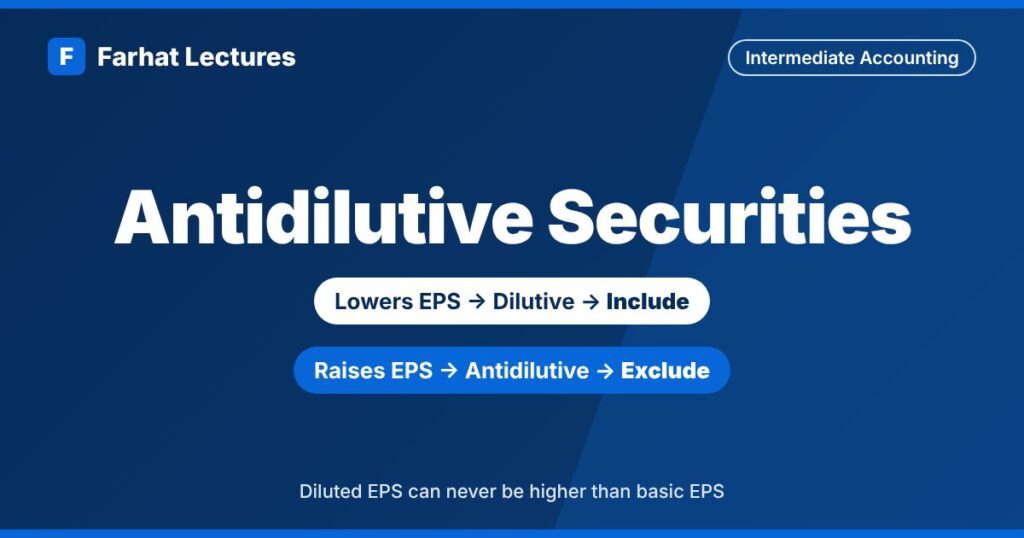
If the exercise price is above the average market price, the options are “out of the money.” The assumed proceeds would buy back more shares than the options create, which would reduce the share count and raise EPS. Such options are antidilutive securities and are left out.
Example (hypothetical). Cascade also has 10,000 warrants with an exercise price of $50. With an average price of $45, the assumed proceeds of $500,000 would buy back about 11,111 shares, more than the 10,000 issued. The warrants are excluded from diluted EPS and disclosed instead.
An employee option can be in the money and still add zero incremental shares if total assumed proceeds buy back at least as many shares as assumed exercise issues. An option that becomes exercisable next year can still count this year if its effect is dilutive.
Options issued during the year
If options are granted partway through the year, assume exercise on the grant date and weight the incremental shares for the time outstanding.
Example (hypothetical). On April 1, a company grants 12,000 options with an exercise price of $20. The average market price from April 1 to December 31 is $30. Incremental shares are 12,000 × ($30 − $20) ÷ $30 = 4,000. Because the options were outstanding for 9 months, the denominator increases by 4,000 × 9/12 = 3,000 shares.
Treasury stock method vs. if-converted method
| Treasury stock method | If-converted method | |
|---|---|---|
| Used for | Stock options and warrants | Convertible bonds and convertible preferred stock |
| Cash received on assumed exercise? | Yes, used for an assumed buyback | No |
| Numerator change | None for ordinary equity-classified options and warrants | Add after-tax interest or preferred dividends |
| Denominator change | Incremental shares only | All shares issuable on conversion |
| Antidilutive when | For ordinary options and warrants, the exercise price exceeds the average market price or incremental shares reduce the loss per share from continuing operations | Effect per added share is above EPS before adding it |
The if-converted method guide covers the convertible side, and how to calculate diluted EPS puts both methods together in one example. Deloitte’s roadmap to FASB ASC 260, Earnings per Share, explains how the treasury stock method applies under U.S. GAAP, and IAS 33 applies a similar approach under IFRS.
For more practice, see the Treasury Method for Options and Warrants lesson in the Farhat Lectures Intermediate Accounting course.
Treasury stock method on the CPA exam
Diluted EPS is tested in the Financial Accounting and Reporting (FAR) section of the CPA exam. Keep these four points in mind when options and warrants show up.
Ordinary equity-classified options and warrants generally rank first
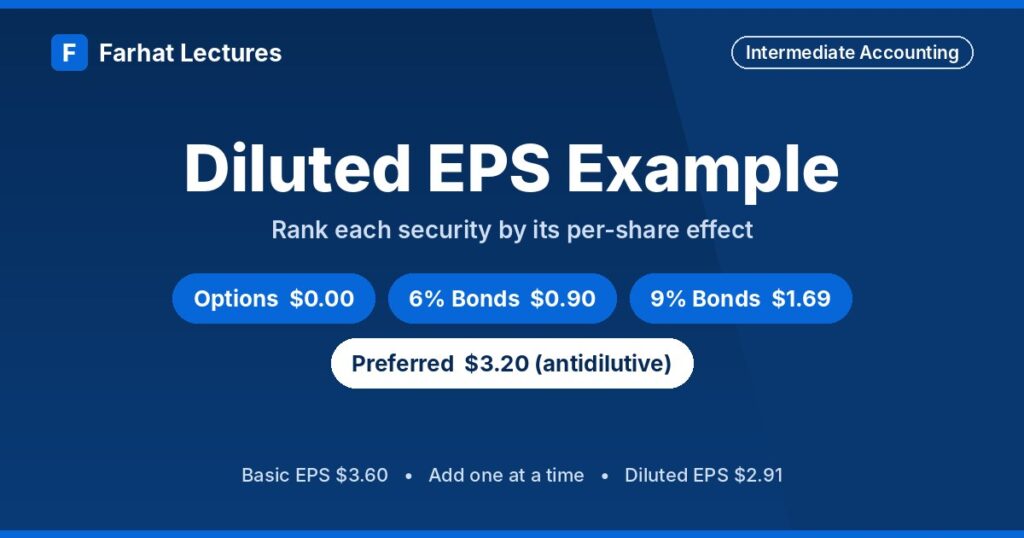
When a company has several dilutive securities, add them one at a time, from the lowest to the highest earnings per incremental share. Ordinary equity-classified options and warrants generally rank first because they add shares without changing the numerator, giving them $0 of earnings per incremental share.
A loss from continuing operations makes ordinary options and warrants antidilutive
The EPS control number is income or loss from continuing operations available to common shareholders. When that amount is a loss, including incremental shares from ordinary options and warrants would make the loss per share smaller. Exclude those instruments because they are antidilutive.
Example (hypothetical). A company has a net loss of $120,000, all from continuing operations, and 100,000 weighted-average shares. Basic loss per share is $1.20. Adding 6,000 incremental shares would give $120,000 ÷ 106,000 = $1.13, a smaller loss. Because that is antidilutive, diluted loss per share is also $1.20.
Use the average price, not the year-end price
A question may give you both the year-end market price and the average market price. Use the exercise price to measure the cash received and the average market price to measure the shares bought back.
Options exercised during the year
If options are exercised during the year, use the average market price over the portion of the reporting period that the options were outstanding before exercise. Weight the incremental shares for that portion of the period. From the exercise date onward, include the actual shares issued in the weighted-average share count for both basic and diluted EPS.
Key takeaways on the treasury stock method
- The treasury stock method applies to stock options and warrants.
- Assume exercise, assume the proceeds buy back shares at the average market price, and add only the incremental shares.
- For ordinary options and warrants, the numerator does not change. Only the denominator does.
- Test the effect on EPS even when the average market price exceeds the exercise price.
- Weight the incremental shares for options granted during the year.
- Exclude ordinary options and warrants when continuing operations show a loss available to common shareholders.
Common mistakes
- Adding every option as a new share instead of only the incremental shares.
- Using the year-end market price instead of the average market price.
- Including out-of-the-money options.
- Changing the numerator for ordinary equity-classified options and warrants.
- Confusing the treasury stock method with the accounting for actual treasury stock purchases.
Practice questions with answers
Practice diluted EPS with options and warrants
In this five-question treasury stock method exercise, use the exercise price to calculate assumed cash proceeds and the average market price to calculate assumed share repurchases. Then apply the net increase in common shares to diluted earnings per share (EPS).
1. A company has 8,000 warrants outstanding all year with an exercise price of $15. The average market price was $24. How many incremental shares are added?
Answer: Assumed proceeds are $120,000 (8,000 × $15), which buy back 5,000 shares at $24. Incremental shares are 8,000 − 5,000 = 3,000.
2. A company has 5,000 options with an exercise price of $40, and the average market price was $32. How do they affect diluted EPS?
Answer: They are left out. The exercise price is above the average market price, so the options are antidilutive. They are disclosed as securities excluded from diluted EPS.
3. Net income is $260,000 and weighted-average shares are 100,000. There are 10,000 options with an exercise price of $10, and the average market price was $25. What are basic and diluted EPS?
Answer: Basic EPS is $260,000 ÷ 100,000 = $2.60. Assumed proceeds of $100,000 buy back 4,000 shares at $25, so 6,000 incremental shares are added. Diluted EPS is $260,000 ÷ 106,000 = $2.45.
Frequently asked questions
Why is it called the treasury stock method?
Because it assumes the company uses the cash from exercise to buy back its own shares, and shares a company buys back are called treasury stock. The buyback is only assumed for the EPS calculation; no journal entry is made.
Does the treasury stock method change net income?
For ordinary equity-classified options and warrants, the diluted EPS numerator stays the same. A liability-classified warrant can affect the numerator when diluted EPS assumes share settlement. Reverse the related fair value gains or losses and include the incremental shares if their combined effect is dilutive.
Why use the average market price instead of the year-end price?
The assumed buyback uses the average market price while the options or warrants were outstanding. If they were outstanding for only part of the reporting period, use the average price during that shorter window and weight the incremental shares for the time outstanding.
Are options that are not yet exercisable included?
Yes. Options and warrants are included in diluted EPS whether or not they are currently exercisable, as long as they are dilutive.
Is anything else added to the assumed proceeds for employee stock options?
Yes. Under U.S. GAAP, the assumed proceeds for employee stock options also include the average compensation cost that has not yet been recognized for future service. Introductory intermediate accounting problems usually use only the exercise price, as this guide does.
Do restricted stock units use the treasury stock method?
Yes. Nonvested shares and restricted stock units are treated like options with an exercise price of zero. Under U.S. GAAP, the assumed proceeds are the average compensation cost not yet recognized, and those proceeds buy back shares at the average market price.
Is the treasury stock method used under IFRS?
Yes. IAS 33 uses the same idea. The cash from assumed exercise is treated as if it were used to issue shares at the average market price, and only the remaining shares, which are treated as issued for no cash, are added to diluted EPS.
About the author
Mansour Farhat, CPA, CIA, DBA, is the instructor behind Farhat Lectures. He teaches intermediate accounting along with CPA and CMA exam review, and his YouTube lessons walk through topics like diluted EPS step by step. Read more about Professor Farhat.
Continue learning with Farhat Lectures
Strengthen your accounting understanding with clear explanations and guided practice.
Explore the free sample course

Responses