
Antidilutive Securities: When to Exclude Them from Diluted EPS

Intermediate Accounting course
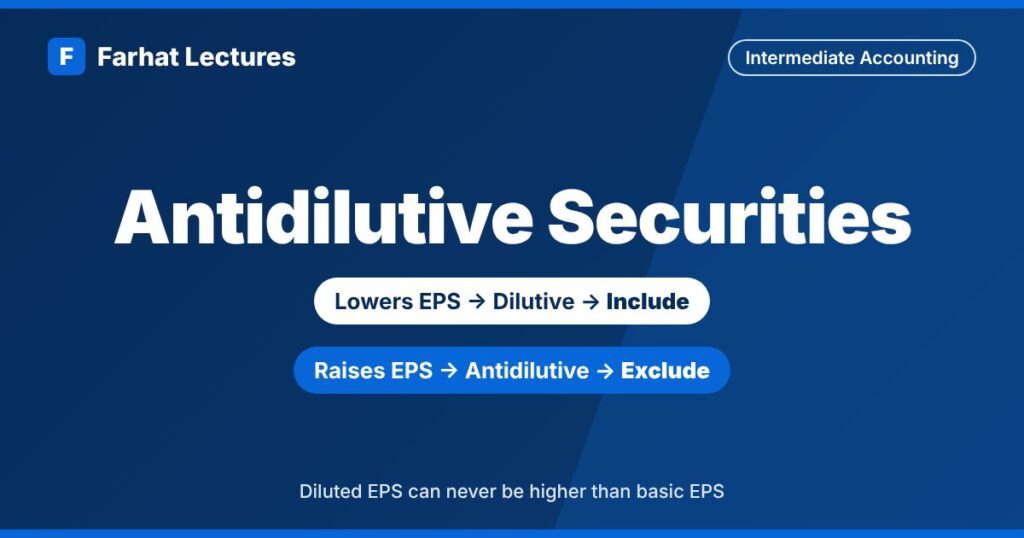
Antidilutive securities are potential common shares, such as convertible bonds, convertible preferred stock, options, and warrants, that would increase earnings per share (EPS) or reduce a loss per share if converted or exercised. Under ASC 260, they are left out of diluted EPS, but companies must still disclose them in the notes.
Why exclude them? Diluted EPS exists to show investors the worst realistic case for per-share earnings. A security that would make EPS look better does not belong in a worst-case number, which is why diluted EPS from continuing operations is never higher than basic EPS. Testing for antidilution is the step students most often skip, and it is where many diluted EPS answers go wrong.
This guide supports the diluted earnings per share lesson in intermediate accounting and the EPS topics tested in the CPA exam’s FAR section. It shows how to test each type of security, what happens when a company has a loss, and how to handle several securities at once.
Watch: How to Rank EPS Effects from Convertible Securities
Watch this Farhat lesson on YouTube
In this 31-minute lesson, Professor Farhat ranks several convertible securities by their per-share effect and adds them one at a time to find which are dilutive and which are antidilutive.
Dilutive vs. antidilutive securities
| Dilutive security | Antidilutive security | |
|---|---|---|
| Effect if converted or exercised | Lowers EPS (or increases a loss per share) | Raises EPS (or reduces a loss per share) |
| Included in diluted EPS? | Yes | No |
| Disclosed? | Yes, in the EPS reconciliation | Yes, as securities excluded from diluted EPS |
| Typical example | Options with an exercise price below the average market price | Options with an exercise price above the average market price |
The same security can be dilutive one year and antidilutive the next. It depends on that year’s earnings, share price, and share count, so the test is repeated every period. Under U.S. GAAP, each issue or series is evaluated separately, as Deloitte’s ASC 260 roadmap explains. IAS 33 applies the same idea under IFRS.
When are options and warrants antidilutive?
Under the treasury stock method, options and warrants are antidilutive whenever the exercise price is above the average market price. The assumed proceeds would buy back more shares than the options create, so the share count would fall.
Example (hypothetical). 6,000 options have an exercise price of $55, and the average market price was $48. Proceeds of $330,000 would buy back about 6,875 shares, more than the 6,000 issued. The options are antidilutive and excluded.
Exam trap: unvested employee options. For options that have not vested yet, the assumed proceeds include the exercise price and the average unrecognized compensation cost for the reporting period. That extra amount can make options antidilutive even when the exercise price is below the average market price.
Example (hypothetical). 10,000 unvested options have a $20 exercise price and average unrecognized compensation cost of $8 per option for the period, so assumed proceeds are 10,000 × $28 = $280,000. At an average market price of $25, that buys back 11,200 shares, more than the 10,000 issued. The options are antidilutive and excluded.
One more case: options a company buys on its own stock (purchased puts and calls) are never included in diluted EPS, because including them would always be antidilutive.
When are convertible securities antidilutive?
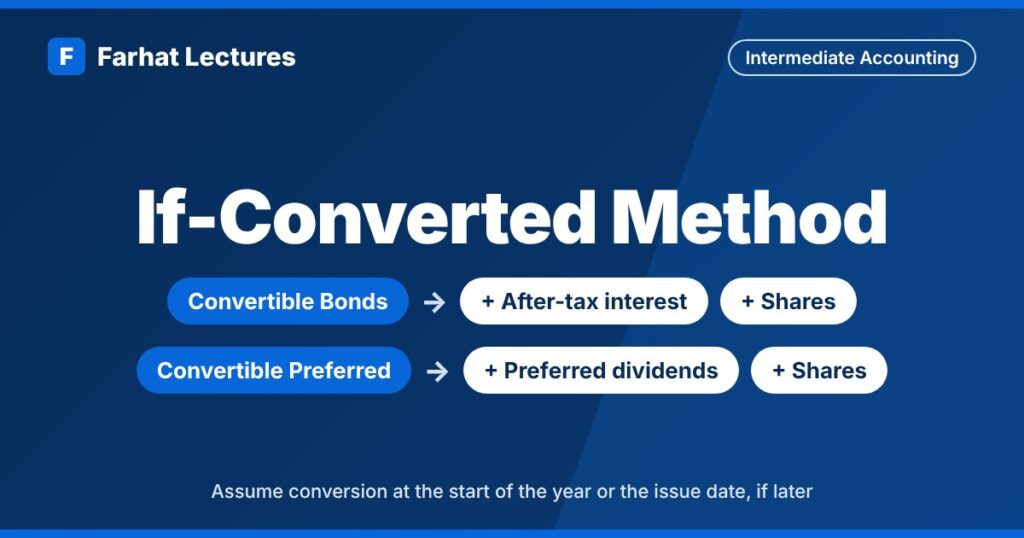
For convertible bonds and convertible preferred stock, compute the effect per added share: the numerator increase under the if-converted method divided by the shares added. If that amount is greater than the EPS you are adding it to, the security is antidilutive.
Example (hypothetical). Lakeview Corp. reports net income of $240,000 and 120,000 weighted-average shares, so basic EPS is $2.00. It has $1,000,000 of 7% bonds, convertible into 12,000 shares, and a 20% tax rate.
| Item | Calculation | Result |
|---|---|---|
| After-tax interest added to income | $1,000,000 × 7% × 80% | $56,000 |
| Shares added | 12,000 | |
| Effect per added share | $56,000 ÷ 12,000 | $4.67 |
| EPS if the bonds were included | $296,000 ÷ 132,000 | $2.24 |
The bonds add $4.67 of income for each new share, which is more than the $2.00 each existing share earns. Including them would raise EPS from $2.00 to $2.24, so the bonds are antidilutive. Lakeview’s diluted EPS is $2.00, the same as basic EPS.
Many textbooks phrase the same test another way: convertible debt is antidilutive if adding the after-tax interest increases income by a larger percentage than conversion increases the shares. Here income would rise by 23.3% ($56,000 ÷ $240,000) while shares rise by only 10% (12,000 ÷ 120,000).
Why a loss makes securities antidilutive
When a company reports a loss from continuing operations available to common shareholders, adding shares without changing the numerator reduces the loss per share. That effect is antidilutive, so those shares are excluded. Diluted loss per share generally equals basic loss per share in this situation.
U.S. GAAP update. FASB ASU 2025-12 clarifies that certain contracts can change both the numerator and denominator. Evaluate their combined effect even when continuing operations show a loss. Include the adjustments if they increase the loss per share from continuing operations. This update applies to annual reporting periods beginning after December 15, 2026, and interim periods within those years. Early adoption is permitted.
U.S. GAAP calls the amount used for this test the control number. It is income from continuing operations (after preferred dividends), not net income. If a company has income from continuing operations but a net loss because of discontinued operations, the securities that are dilutive based on continuing operations are still included in every diluted per-share line.
Several securities: rank and add one at a time
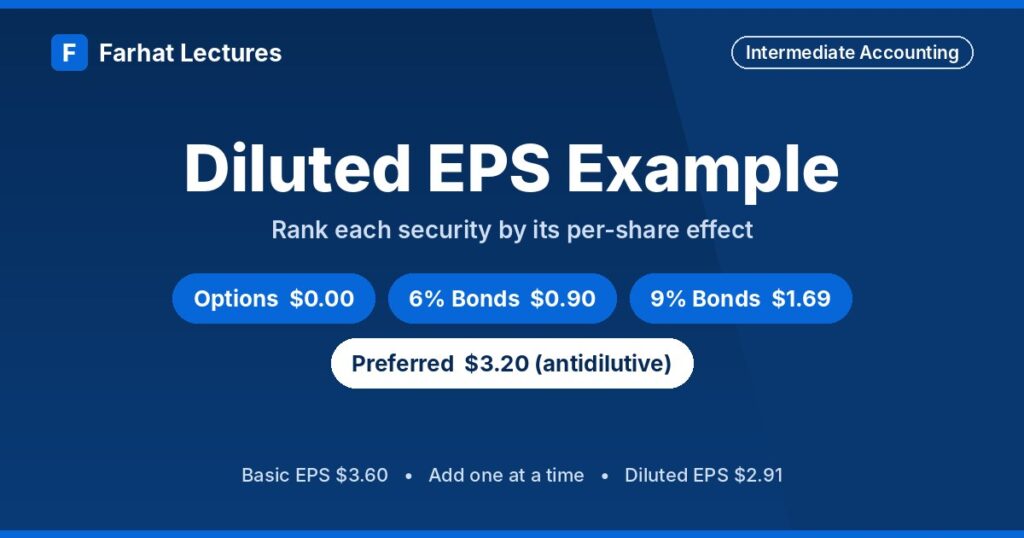
A security can be dilutive on its own yet antidilutive once other securities have already pulled EPS down. That is why companies with several securities rank them and add them in order, starting with the lowest effect per added share. Intermediate accounting textbooks often work this sequencing in a chapter appendix. Here is a short version.
Example (hypothetical). Westbrook Co. has net income of $1,000,000, 400,000 weighted-average common shares, and a 25% tax rate. Its convertible preferred stock pays $120,000 of dividends, so basic EPS is ($1,000,000 − $120,000) ÷ 400,000 = $2.20.
| Security | Numerator increase | Shares added | Effect per share | Rank |
|---|---|---|---|---|
| Options: 40,000 at $30; average price $40 | $0 | 10,000 | $0.00 | 1 |
| 6% bonds, $1,000,000, convertible into 30,000 shares | $45,000 | 30,000 | $1.50 | 2 |
| Convertible preferred, into 60,000 shares | $120,000 | 60,000 | $2.00 | 3 |
| 9% bonds, $2,000,000, convertible into 62,500 shares | $135,000 | 62,500 | $2.16 | 4 |
| Step | Income | Shares | EPS | Result |
|---|---|---|---|---|
| Basic EPS | $880,000 | 400,000 | $2.20 | |
| + Options | 880,000 | 410,000 | $2.15 | Dilutive |
| + 6% bonds | 925,000 | 440,000 | $2.10 | Dilutive |
| + Convertible preferred | 1,045,000 | 500,000 | $2.09 | Dilutive |
| + 9% bonds | 1,180,000 | 562,500 | $2.10 | Antidilutive: stop |
Westbrook reports diluted EPS of $2.09. Look at the 9% bonds. Tested alone against basic EPS of $2.20, their $2.16 effect per share looks dilutive. But once the other securities have pulled EPS down to $2.09, adding the bonds would raise it to $2.10, so they are excluded. The earnings per share guide has another ranking walk-through, and the course lesson on how to rank the EPS effects from convertible securities adds more practice.
Disclosing antidilutive securities
Excluded does not mean ignored. In the notes, companies must disclose securities that could dilute basic EPS in the future but were left out of diluted EPS because they were antidilutive for the periods presented. A typical note reads like this (hypothetical):
Options to purchase 250,000 common shares at $62 per share were outstanding during the year but were not included in diluted EPS because their exercise price was greater than the average market price of the common shares. The options expire in 2031.
Investors use this note to see dilution that could appear later if the stock price rises. The full set of EPS disclosures is listed in how to calculate diluted EPS.
Key takeaways on antidilutive securities
- An antidilutive security would raise EPS or reduce a loss per share, so it is excluded from diluted EPS.
- Options and warrants are antidilutive when the exercise price exceeds the average market price.
- A convertible is antidilutive when its effect per added share exceeds the EPS it is being added to.
- With a loss from continuing operations, potential common shares are generally excluded. If a contract adjusts both parts of the EPS calculation, test their combined effect.
- With several securities, rank them and add them one at a time, stopping when EPS would rise.
- Excluded securities are disclosed in the notes.
Common mistakes
- Comparing a convertible’s effect per share with basic EPS only, instead of with the EPS reached after more dilutive securities were added.
- Including potential common shares that reduce the loss per share from continuing operations.
- Using net income instead of income from continuing operations as the control number.
- Forgetting to disclose antidilutive securities that were excluded.
- Assuming a security stays antidilutive every year.
Practice questions with answers
Antidilutive Securities in Diluted EPS
Test how the treasury stock method, the if-converted method, and the continuing operations control number determine which securities to exclude from diluted EPS.
Choose one answer for each question.
Worked problems. Prefer to work the numbers? Try each problem on paper first, then check the answer below it.
1. Warrants to buy 12,000 shares have an exercise price of $55. The average market price was $48. Are they dilutive?
Answer: No. The exercise price is above the average market price, so the warrants are antidilutive and excluded from diluted EPS.
2. Net income is $300,000 and weighted-average shares are 100,000. Convertible bonds would add $40,000 of after-tax interest and 10,000 shares. Are they dilutive?
Answer: No. Their effect per added share is $40,000 ÷ 10,000 = $4.00, which is above basic EPS of $3.00. Including them would raise EPS to $340,000 ÷ 110,000 = $3.09, so they are antidilutive.
3. A company has a net loss of $200,000 (all from continuing operations), 50,000 weighted-average shares, and 10,000 in-the-money options. What is diluted loss per share?
Answer: $(4.00), the same as basic loss per share ($200,000 ÷ 50,000). Adding the option shares would shrink the loss per share, which is antidilutive.
Frequently asked questions
What does antidilutive mean?
A security is antidilutive if assuming its conversion or exercise would increase earnings per share or decrease a loss per share. Antidilutive securities are excluded from diluted EPS.
Are antidilutive securities ignored completely?
They are left out of the diluted EPS calculation, but companies must disclose securities that could dilute EPS in the future and were excluded because they were antidilutive.
Can a security be dilutive one year and antidilutive the next?
Yes. The test depends on each period’s earnings, share count, and average share price, so it is performed every period.
How does a loss from continuing operations affect diluted EPS?
Adding shares to a loss from continuing operations without changing the numerator reduces the loss per share. That is antidilutive, so diluted loss per share generally equals basic loss per share. For certain contracts that change both the numerator and denominator, test whether the combined effect increases the loss per share.
In what order should securities be tested?
Compute each security’s effect per added share, rank them from lowest to highest, and add them one at a time. Stop when the next security would increase EPS.
About the author
Mansour Farhat, CPA, CIA, DBA, teaches accounting and exam-prep courses at Farhat Lectures, including the Intermediate Accounting course this lesson supports. His lessons focus on the steps students most often get wrong on exams, like the antidilution test covered here.
Continue learning with Farhat Lectures
Strengthen your accounting understanding with clear explanations and guided practice.
Explore the free sample course
Responses