
If-Converted Method: Convertible Bonds and Preferred Stock in Diluted EPS

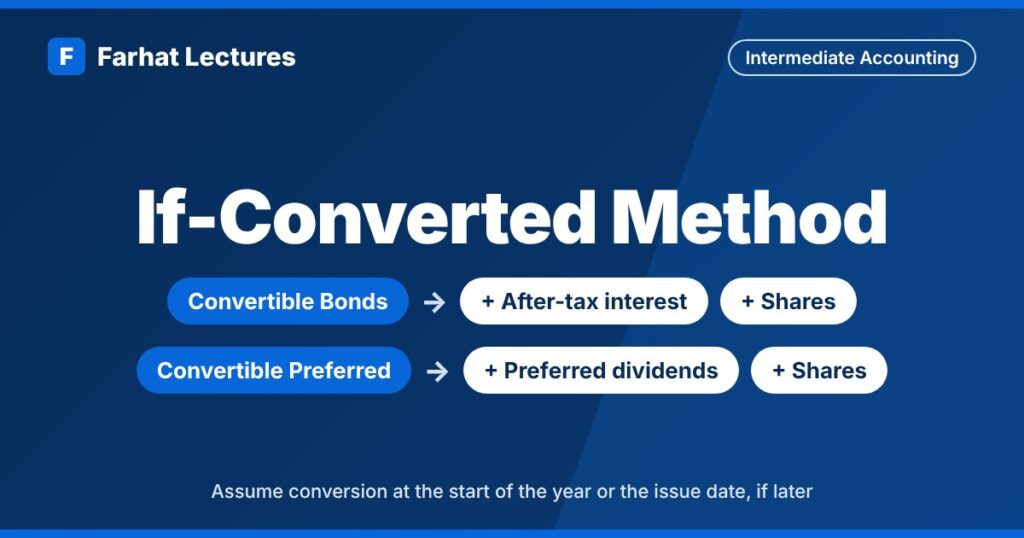
The if-converted method is how you include convertible bonds and convertible preferred stock in diluted earnings per share (EPS). You assume conversion into common stock at the start of the year, or on the issue date if later. Then add the conversion shares to the denominator, and add the after-tax interest or preferred dividends the company avoids to the numerator.
Diluted EPS shows what earnings per share would be if the dilutive securities that can become common stock actually did. The logic of the if-converted method is simple. Once a bond is converted, the company stops paying interest on it, so its income goes up. At the same time, there are more shares to share that income. Diluted EPS has to capture both effects. Students who remember only the extra shares get the wrong answer, and that is exactly the trap exam questions set.
This guide supports lesson 15.5 (Diluted Earnings per Share), part of the dilutive securities and EPS chapter in intermediate accounting. Diluted EPS also shows up in the FAR section of the CPA exam. For the full five-step process, see how to calculate diluted EPS.
Watch: Diluted EPS: If-Converted Method for Bonds and Preferred Stock
Watch this Farhat lesson on YouTube
In this 14-minute lesson, Professor Farhat applies the if-converted method to both convertible bonds and convertible preferred stock and shows how each one changes the numerator and the denominator.
Jump to the part you need: 2:29 assumed conversion date and after-tax interest, 4:26 two convertible bonds example, 10:29 convertible preferred stock example, and 13:08 an antidilutive preferred stock result.
What the if-converted method assumes
This formula assumes that any convertible bond principal is settled in common shares.
Diluted EPS = (Net income − Preferred dividends + After-tax interest on convertible bonds + Preferred dividends on convertible preferred stock) ÷ (Weighted-average common shares + Shares from assumed conversion)
Only include securities that are dilutive, meaning they lower EPS.
| Security | Numerator (income) | Denominator (shares) |
|---|---|---|
| Convertible bonds | Add back interest expense, net of tax | Add the common shares issuable on conversion |
| Convertible preferred stock | Add back the preferred dividends subtracted in basic EPS (no tax effect) | Add the common shares issuable on conversion |
| Timing | For the part of the year the security was outstanding | Weighted for the part of the year the security was outstanding |
Before any conversion happens in real life, the convertible bonds sit on the balance sheet as debt. The accounting for that debt, and for an actual conversion, is covered in accounting for convertible bonds and conversion of convertible bonds. The if-converted method is only a “what if” calculation for EPS. It does not change the balance sheet.
Convertible bonds: worked example
Example (hypothetical). Harborview Inc. reports net income of $480,000 and weighted-average common shares of 120,000, so basic EPS is $4.00. The tax rate is 25%. Two convertible bond issues were sold at par:
- Bond A: $800,000 of 4% bonds issued in a prior year, convertible into 24,000 shares.
- Bond B: $600,000 of 6% bonds issued on July 1 of this year, convertible into 18,000 shares.
| Bond A (all year) | Bond B (from July 1) | |
|---|---|---|
| Interest expense | $800,000 × 4% = $32,000 | $600,000 × 6% × 6/12 = $18,000 |
| After-tax interest added to income | $32,000 × 75% = $24,000 | $18,000 × 75% = $13,500 |
| Shares added | 24,000 | 18,000 × 6/12 = 9,000 |
| Effect per added share | $24,000 ÷ 24,000 = $1.00 | $13,500 ÷ 9,000 = $1.50 |
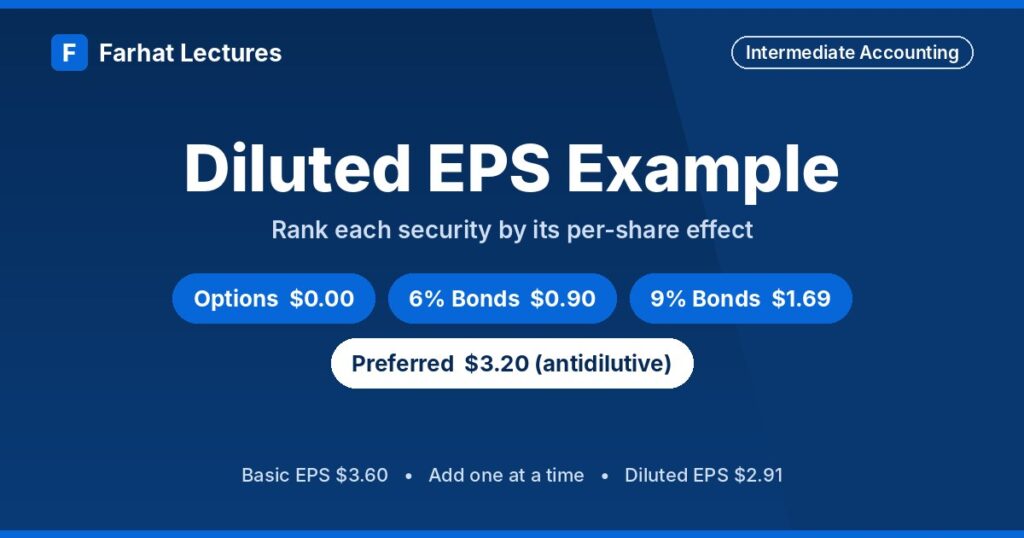
With more than one convertible, rank them from the smallest effect per added share to the largest and add them one at a time. Bond A ($1.00) goes first: ($480,000 + $24,000) ÷ (120,000 + 24,000) = $504,000 ÷ 144,000 = $3.50. Bond B’s $1.50 is below $3.50, so it is dilutive too, and you add it next. Bond B was outstanding for only half the year, so both its interest and its shares are counted for six months.
Diluted EPS: ($480,000 + $24,000 + $13,500) ÷ (120,000 + 24,000 + 9,000) = $517,500 ÷ 153,000 = $3.38.
Bonds issued at a premium or discount
Add back interest expense, not the cash interest paid. Interest expense equals cash interest plus discount amortization, or minus premium amortization.
Example (hypothetical). A company has $500,000 of 6% convertible bonds issued at a discount. Cash interest is $30,000 and discount amortization for the year is $4,000, so interest expense is $34,000. At a 25% tax rate, the numerator increases by $34,000 × 75% = $25,500, not $22,500.
When the conversion rate changes
Some bonds let holders convert into a different number of shares at different times. For diluted EPS, the textbook rule is to use the most dilutive conversion rate available to the holder.
Example (hypothetical). A company has 2,000 convertible bonds. Each converts into 20 shares for the first three years and 24 shares after that. Use 24 shares per bond, so the denominator increases by 48,000 shares (2,000 × 24), not 40,000.
Bonds converted during the year
When bondholders actually convert during the year, weight the common shares issued from the conversion date in both basic and diluted EPS. If the bonds are dilutive, diluted EPS also reflects assumed conversion for the period before actual conversion, beginning at the start of the reporting period or on the issue date, whichever is later.
Example (hypothetical). A company has $1,000,000 of 6% convertible bonds issued at par in a prior year, convertible into 40,000 shares. Holders convert on April 1. The tax rate is 25% and the year ends December 31.
| Basic EPS | Diluted EPS adjustment | |
|---|---|---|
| Shares | 40,000 × 9/12 = 30,000 weighted-average shares from actual conversion | 40,000 × 3/12 = 10,000 weighted-average shares from assumed conversion |
| Income | Net income already includes interest expense of $1,000,000 × 6% × 3/12 = $15,000 for January through March | Add back $15,000 × 75% = $11,250 |
The 30,000 weighted-average shares from actual conversion enter both basic and diluted EPS. If the assumed conversion passes the dilution test, add 10,000 weighted-average shares to the diluted EPS denominator and $11,250 of after-tax interest to the numerator. In that case, diluted EPS reflects all 40,000 weighted-average shares from actual and assumed conversion combined. For the journal entry on an actual conversion, see conversion of convertible bonds.
Convertible preferred stock
For convertible preferred stock, you assume the preferred shares became common stock at the start of the year. That means no preferred dividends would have been owed, so you do not subtract them in the diluted EPS numerator. There is no tax adjustment, because preferred dividends generally are not tax-deductible.
Example (hypothetical). Summit Co. reports net income of $900,000 and has 200,000 common shares outstanding all year. It also has 20,000 shares of 5%, $100 par cumulative convertible preferred stock, and each preferred share converts into 4 common shares.
| Basic EPS | Diluted EPS | |
|---|---|---|
| Net income | $900,000 | $900,000 |
| Less preferred dividends (20,000 × $100 × 5%) | (100,000) | Not subtracted |
| Income available to common stockholders | $800,000 | $900,000 |
| Shares | 200,000 | 200,000 + 80,000 = 280,000 |
| EPS | $4.00 | $3.21 |
The effect per added share is $100,000 ÷ 80,000 = $1.25, which is below $4.00, so the preferred stock is dilutive. If the preferred stock were noncumulative and no dividend was declared, nothing would be subtracted in basic EPS, and nothing would be added back in diluted EPS. Only the shares would change. The preferred features themselves are explained in preferred stock features.
The ASU 2020-06 update
Under current U.S. GAAP, convertible instruments are included in diluted EPS using the if-converted method. FASB Accounting Standards Update (ASU) 2020-06 removed the option some companies had used to apply the treasury stock method to certain convertible debt. For diluted EPS, assume share settlement for the portion that may be settled in either cash or shares. If the bond principal must be settled in cash, skip the interest add-back. Include any incremental shares attributable to the conversion premium if they are dilutive. Deloitte’s summary of ASU 2020-06 explains the change, and its ASC 260 roadmap covers the diluted EPS methods in detail. Options and warrants still use the treasury stock method.
For more worked problems, see the If-Converted Method lesson in the Farhat Lectures Intermediate Accounting course.
Key takeaways on the if-converted method
- Assume conversion at the beginning of the year, or at issuance if later.
- Convertible bonds: add after-tax interest expense to the numerator and the conversion shares to the denominator.
- Convertible preferred stock: add back the preferred dividends (no tax effect) and add the conversion shares.
- Weight both adjustments for the time the security was outstanding.
- Include the security only if its effect per added share is below the EPS it is being added to.
- With several convertibles, add them one at a time, starting with the smallest effect per added share.
Common mistakes
- Adding back interest before tax.
- Using cash interest instead of interest expense when bonds were issued at a premium or discount.
- Applying a tax adjustment to preferred dividends.
- Counting a full year of shares and interest for bonds issued during the year.
- Including a convertible security without first checking whether it is antidilutive.
- Comparing every convertible with basic EPS when there are several. Rank them by effect per added share and test each one against the running diluted EPS.
- Testing dilution against net income when the company has discontinued operations. Use income from continuing operations available to common stockholders, after adjusting for applicable preferred dividends, as the control number.
Interactive If-Converted Method Practice
Under the if-converted method, assume conversion at the start of the reporting period or on the bond’s issue date, whichever is later. In this quiz, assume the full bond principal is convertible into common shares. For dilutive bonds under this assumption, add back after-tax interest expense and include the common shares from assumed conversion, weighted from that date.
Select one answer per question, then use the worked practice questions below to apply the same rules.
Practice questions with answers
1. A company has $2,000,000 of 5% bonds issued at par in a prior year, convertible into 50,000 shares. The tax rate is 20%. Assume the bonds are dilutive. What adjustments does the if-converted method make?
Answer: Interest expense is $100,000 ($2,000,000 × 5%). Add $80,000 ($100,000 × 80%) to the numerator and 50,000 shares to the denominator.
2. On October 1, a company issued $400,000 of 9% bonds at par, convertible into 16,000 shares. The tax rate is 25% and the year ends December 31. Assume the bonds are dilutive. What are the adjustments?
Answer: The bonds were outstanding for 3 months. Interest expense is $400,000 × 9% × 3/12 = $9,000, so the numerator increases by $9,000 × 75% = $6,750. The denominator increases by 16,000 × 3/12 = 4,000 shares.
3. Net income is $300,000 and 100,000 common shares are outstanding. There are 10,000 shares of noncumulative convertible preferred stock, each convertible into 3 common shares, and no preferred dividends were declared. What are basic and diluted EPS?
Answer: Basic EPS is $300,000 ÷ 100,000 = $3.00, since no dividends on noncumulative preferred stock were declared. Diluted EPS is $300,000 ÷ 130,000 = $2.31. There is nothing to add back to the numerator; only 30,000 shares are added.
Frequently asked questions
What is the if-converted method in simple terms?
It is a “what if” calculation for diluted EPS. You pretend convertible bonds or convertible preferred stock became common stock at the start of the year, add the new shares, and add back the interest or preferred dividends the company would no longer pay.
Why is interest added back net of tax?
Interest expense reduces taxable income. If the bonds had been converted, the company would save the interest but pay more income tax, so net income rises only by the after-tax amount.
Why is there no tax effect for convertible preferred stock?
Preferred dividends generally are not tax-deductible, so removing them does not change income tax. You add back the full dividend amount.
Which securities use the if-converted method?
Convertible bonds and convertible preferred stock. Stock options and warrants use the treasury stock method instead.
What if the bonds were issued during the year?
Assume conversion on the issue date. Add only the interest expense for the months the bonds were outstanding, net of tax, and weight the conversion shares for the same months.
What if the bonds were converted during the year?
Weight the shares actually issued from the conversion date in both basic and diluted EPS. For dilutive bonds that convert fully into shares, also include the assumed conversion shares and add back after-tax interest for the period from the start of the year or the issue date, if later, up to the actual conversion date.
What happens if a convertible security is antidilutive?
Leave it out. If its effect per added share is higher than the EPS it is being added to, including it would raise EPS, so it is antidilutive and excluded from diluted EPS. See antidilutive securities for more.
Does the if-converted method change the balance sheet?
No. It is only a calculation for diluted EPS. The bonds stay on the balance sheet as debt, and the preferred stock stays in equity, until holders actually convert.
About the author
Mansour Farhat, CPA, CIA, DBA, is the instructor behind Farhat Lectures. He teaches intermediate accounting and CPA exam topics through video lessons, worked examples, and practice questions built around the mistakes students make most often.
Continue learning with Farhat Lectures
Strengthen your accounting understanding with clear explanations and guided practice.
Explore the free sample course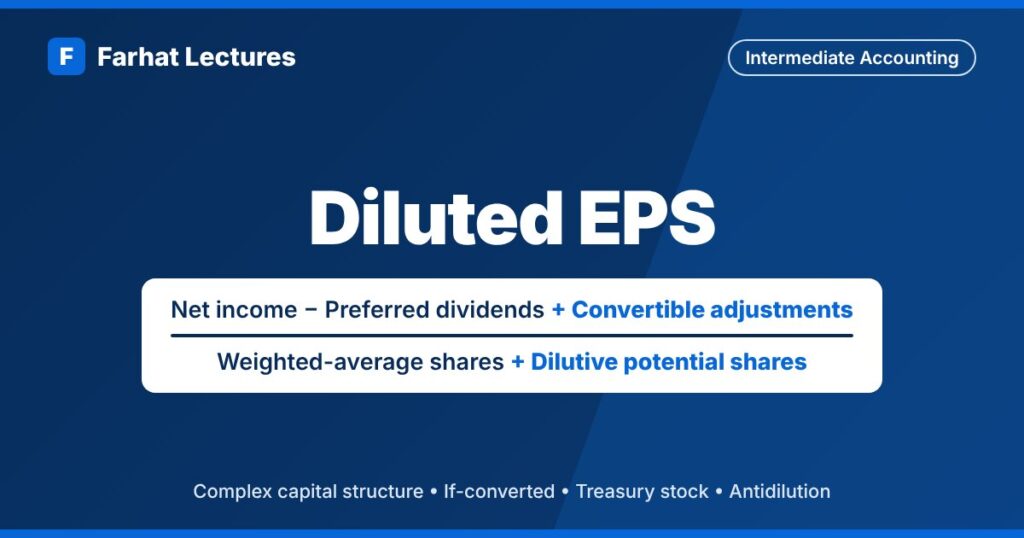

Responses