
What Is Treasury Stock? Why Companies Buy Back Shares

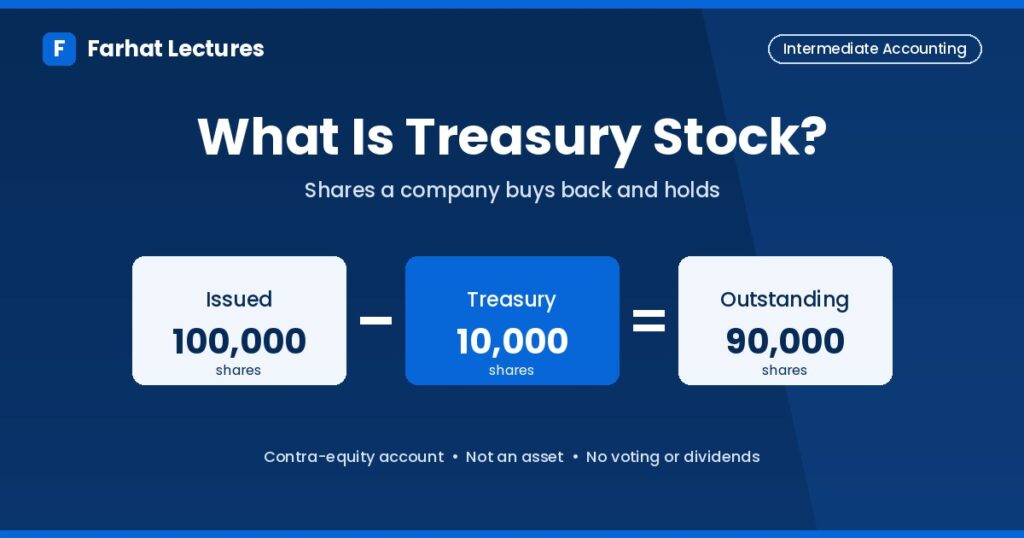
Treasury stock is a corporation’s own stock that it issued, later bought back, and now holds instead of cancelling. It is not an asset. It is a contra-equity account, a debit-balance account that reduces total stockholders’ equity, and the shares it represents are still issued but no longer outstanding.
Companies spend enormous amounts on buybacks, and the accounting shows up on almost every intermediate accounting exam and in the Financial Accounting and Reporting (FAR) section of the CPA exam. Once you understand what treasury stock is and why it sits in equity, the journal entries in the next lessons make much more sense.
This guide explains the definition, why companies buy back shares, how treasury stock is reported, and the two methods allowed for recording it. All examples use hypothetical numbers. It supports the Chapter 14 (Stockholders’ Equity) treasury stock lessons in the Farhat Lectures Intermediate Accounting course.
Watch: Treasury Stock
This Farhat Lectures lesson (about 11 minutes) explains why companies buy back their own shares and how treasury stock is recorded under the cost method. Watch it first for the big picture, or come back to it after reading.
What is treasury stock?
After a company reacquires its own shares, it has two choices. It can retire them, which cancels the shares, or it can hold them for possible reissue later. Shares held this way are called treasury stock or treasury shares.
A buyback is also called a share repurchase. In accounting terms, treasury stock is stock that was issued, fully paid, and then reacquired by the same corporation. Shares that were never issued are not treasury stock.
Why companies buy back shares
Companies repurchase shares for several reasons. The table summarizes the five most common ones.
| Reason | What it means |
|---|---|
| Stock is undervalued | Management believes the share price is below the company’s true worth, so buying now benefits the remaining owners. |
| Flexible distributions | A buyback returns cash to owners without committing to a higher regular dividend that would be hard to cut later. |
| Avoid dilution | Reacquired shares can be given to employees in stock compensation plans instead of issuing new shares. |
| Maintain control | Fewer shares in public hands can make a hostile takeover harder. |
| Improve performance measures | Fewer outstanding shares raise earnings per share and return on equity, even if earnings are unchanged. |
Whether a buyback is good for investors depends on why it was done. A repurchase at a fair price can reward owners. Heavy buybacks that crowd out research or investment can hurt the business over time.
Practice: identify why each company is buying back shares
Why treasury stock is not an asset
An asset must give the company rights to future economic benefits from something outside itself. A corporation cannot own part of itself, so its own shares do not qualify. Keep three points in mind:
- The company may resell treasury shares to raise cash later, but that possibility does not make them an asset. Unissued shares can also be sold, and no one reports those as assets.
- A buyback uses cash, so it reduces both assets and stockholders’ equity. Net assets go down.
- Treasury shares lose the main rights of ownership while the company holds them. They cannot vote, do not receive cash dividends, and do not share in assets if the company liquidates.
For where treasury stock fits among the other equity components, see Stockholders’ Equity Explained.
Issued vs. outstanding shares
Treasury stock creates a gap between two share counts that students often mix up.
| Term | Meaning | Effect of a buyback |
|---|---|---|
| Authorized shares | The maximum number of shares the charter allows the company to issue | No change |
| Issued shares | Shares the company has issued (for cash, property, services, or as stock dividends) and not retired | No change |
| Treasury shares | Issued shares the company has reacquired and holds | Increase |
| Outstanding shares | Issued shares minus treasury shares, owned by stockholders | Decrease |
Cost method vs. par value method
U.S. GAAP (ASC 505-30, the FASB Codification topic on treasury stock) permits two ways to record treasury stock. The cost method is more common and is the method used in most intermediate accounting courses.
| Feature | Cost method | Par (stated) value method |
|---|---|---|
| Amount debited to Treasury Stock | The price paid to reacquire the shares | The par or stated value of the shares |
| Balance sheet presentation | Deducted from total paid-in capital and retained earnings | Deducted from capital stock only |
| Original issue price | Ignored when shares are bought back | Used to remove the original paid-in capital at purchase |
| Total stockholders’ equity | Reduced by the cost paid | Reduced by the cost paid |
Both methods reduce total equity by the same amount; they differ only in which equity accounts carry the reduction. The step-by-step cost method entries, including resales above and below cost, are covered in Treasury Stock Journal Entries.
Treasury stock example: the equity section
Harbor Lane Corp. (hypothetical) issued 50,000 shares of $1 par common stock at $12 per share and has $400,000 of retained earnings. It then buys back 5,000 of its shares at $15 each, paying $75,000. Under the cost method, its equity section looks like this:
| Stockholders’ equity | Amount |
|---|---|
| Common stock, $1 par, 50,000 shares issued, 45,000 outstanding | $50,000 |
| Paid-in capital in excess of par | 550,000 |
| Total paid-in capital | 600,000 |
| Retained earnings | 400,000 |
| Total paid-in capital and retained earnings | 1,000,000 |
| Less: Treasury stock (5,000 shares at cost) | (75,000) |
| Total stockholders’ equity | $925,000 |
Notice what did not change: Common Stock and paid-in capital still reflect all 50,000 issued shares. The original $12 issue price has no effect on the buyback. Only the Treasury Stock deduction is new.
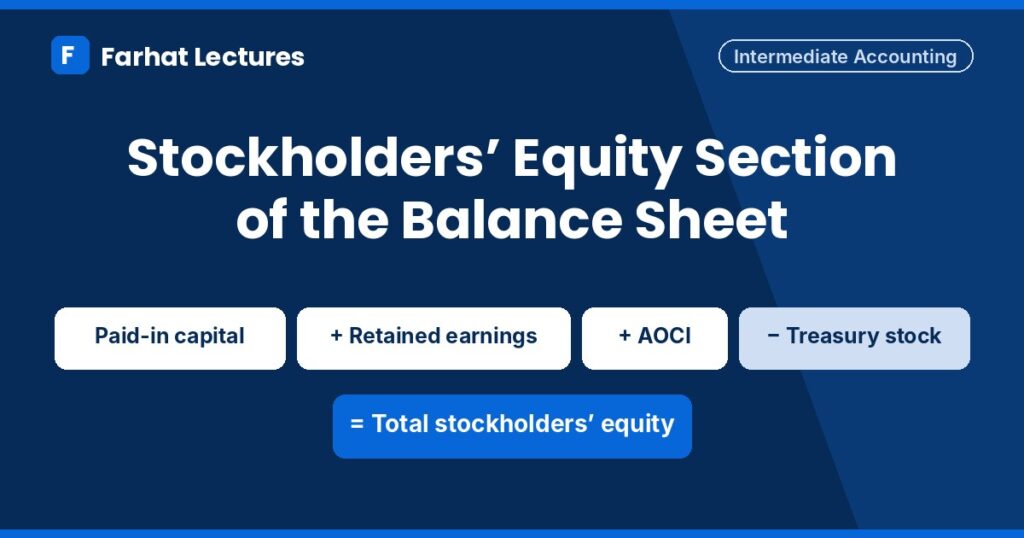
To see how this deduction fits into a complete balance sheet, see Stockholders’ Equity Section of the Balance Sheet.
Depending on state law, a company may also have to restrict retained earnings equal to the cost of the treasury stock it holds. If that applies here, $75,000 of retained earnings would be unavailable for dividends until the shares are resold or retired, and the restriction is usually disclosed in the notes.
What is the journal entry to buy treasury stock?
Under the cost method, buying treasury stock takes one simple entry. Here is Harbor Lane’s purchase of 5,000 shares at $15 each:
| Account | Debit | Credit |
|---|---|---|
| Treasury Stock | $75,000 | |
| Cash | $75,000 |
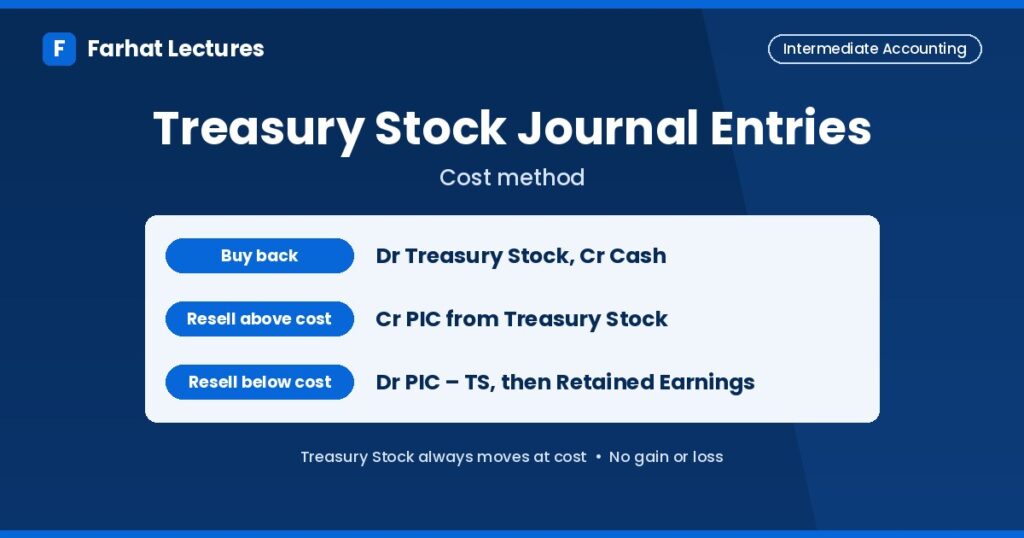
No gain, loss, or expense is recorded, and Common Stock and Paid-in Capital in Excess of Par stay exactly the same. If the shares are resold later, any amount above cost is credited to paid-in capital. A resale below cost first reduces paid-in capital from earlier treasury stock gains, then retained earnings. The income statement is never affected.
For resales above and below cost, step by step, see Treasury Stock Journal Entries.
How a buyback changes earnings per share
Earnings per share (EPS) divides net income available to common stockholders (net income minus any preferred dividends) by the weighted-average number of common shares outstanding. Suppose Harbor Lane has no preferred stock, earns $90,000, and the 5,000-share buyback happened on the first day of the year, so 45,000 shares are outstanding all year.
| Before buyback | After buyback | |
|---|---|---|
| Net income | $90,000 | $90,000 |
| Shares outstanding | 50,000 | 45,000 |
| Earnings per share | $1.80 | $2.00 |
EPS rises by 20 cents even though earnings did not change. If the buyback happened partway through the year, you would weight the shares for the part of the year they were outstanding. See Earnings Per Share: Basic and Diluted for the full method.
Common mistakes
- Listing treasury stock as an asset. It is a deduction within stockholders’ equity.
- Reducing issued shares at purchase. Issued shares fall only when shares are retired; buying them back reduces outstanding shares.
- Using the original issue price. Under the cost method, Treasury Stock is debited for what the company paid, not what it originally received.
- Treating treasury stock and retired stock as the same. Retired shares are cancelled; see Retirement of Treasury Stock.
Exam tip
On multiple-choice questions, read the share counts carefully. A buyback changes outstanding shares, not issued shares. If a question gives you the original issue price, it is often there as a distractor, because the cost method ignores it when shares are bought back.
Key takeaways
- Treasury stock is a company’s own issued shares that it bought back and still holds.
- It is a contra-equity account, never an asset.
- A buyback lowers outstanding shares but leaves issued shares unchanged.
- Under the cost method, Treasury Stock is debited for the price paid, and the original issue price is ignored.
- Buying or reselling treasury stock never creates a gain or loss on the income statement.
- Fewer outstanding shares can raise EPS even when net income does not change.
Practice questions with answers
1. A company has 80,000 shares issued and holds 6,000 treasury shares. How many shares are outstanding?
Answer: 74,000 shares. Outstanding shares equal issued shares minus treasury shares: 80,000 − 6,000 = 74,000.
2. A student classifies $40,000 of treasury stock as a current asset because the company plans to resell it soon. Is that correct?
Answer: No. The intent to resell does not create an asset. The $40,000 is deducted in stockholders’ equity, and total equity is $40,000 lower than it would be without the buyback.
3. Net income is $120,000 and 60,000 shares are outstanding. The company buys back 12,000 shares at the start of the year. What is EPS before and after?
Answer: $2.00 before and $2.50 after. Before: $120,000 ÷ 60,000 = $2.00. After: $120,000 ÷ 48,000 = $2.50. Net income is unchanged; only the share count fell.
Frequently asked questions
Do treasury shares receive dividends or voting rights?
No. While the company holds them, treasury shares cannot vote, do not receive cash dividends, and have no claim on assets in a liquidation. Only outstanding shares carry those rights.
Where does treasury stock appear on the balance sheet?
Under the cost method, it appears inside stockholders’ equity as a deduction after paid-in capital and retained earnings. It never appears in the asset section.
Does buying treasury stock affect net income?
No. A buyback is a transaction with owners, so it changes balance sheet accounts only. It reduces cash and total stockholders’ equity, but no revenue, expense, gain, or loss is recorded.
Are treasury shares included in earnings per share?
No. Earnings per share (EPS) uses shares outstanding, and treasury shares are not outstanding. That is why a buyback can raise EPS even when net income is unchanged.
What is the difference between treasury stock and retired stock?
Treasury stock is still issued and can be resold. Retired stock is cancelled, so the issued share count falls. Retired shares usually return to authorized but unissued status, although state law or the corporate charter can reduce the authorized count instead.
Where does a stock buyback appear on the statement of cash flows?
In the financing activities section, as a cash outflow. Buying back shares is a transaction with owners, just like paying dividends, so it is not an operating or investing activity.
Is treasury stock treated the same way under IFRS?
The idea is the same. Under IFRS (IAS 32), reacquired shares are called treasury shares and are deducted from equity. No gain or loss is recognized in profit or loss when they are bought, sold, issued, or cancelled.
Do companies pay tax when they buy back stock?
Publicly traded U.S. corporations generally do. Since 2023, Internal Revenue Code Section 4501 has imposed a 1% excise tax on the fair market value of stock they repurchase, reduced by the fair market value of stock they issue during the same year. Private companies are not subject to it. Under U.S. GAAP, including this tax in the cost of the treasury stock is an acceptable approach.
Sources
- Deloitte DART: Repurchases, Reissuances, and Retirements of Common Stock (ASC 505-30)
- PwC Viewpoint: Treasury stock (Financing transactions guide, 9.3)
- Investor.gov (SEC): Stock buyback
About the author
Mansour Farhat, CPA, CIA, DBA, teaches accounting and CPA exam topics at Farhat Lectures through video lessons, practice questions, and step-by-step explanations like this one.
Continue learning with Farhat Lectures
Strengthen your accounting understanding with clear explanations and guided practice.
Explore the free sample course
Responses