Return on Common Stockholders’ Equity, Trading on the Equity, and the Payout Ratio

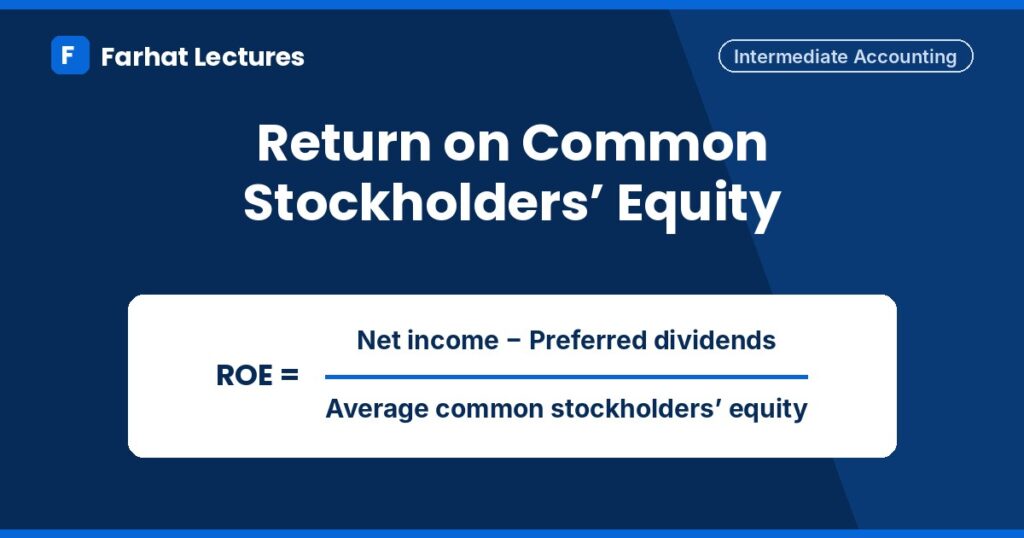
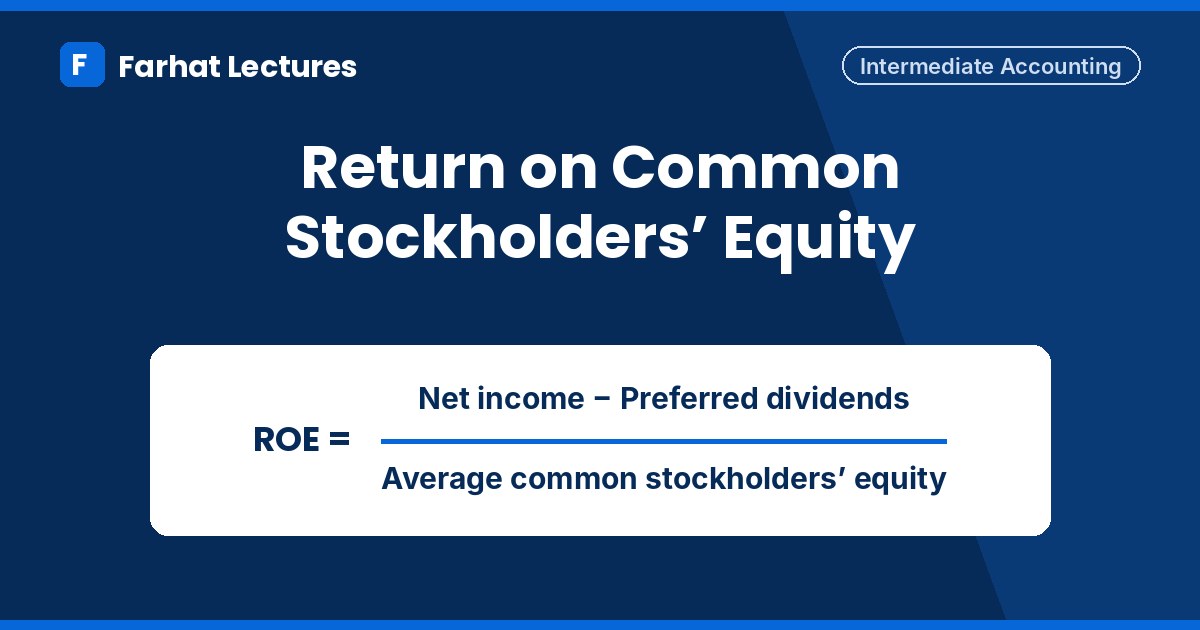
Return on common stockholders’ equity (ROE) shows how much profit a company earns for its common stockholders on each dollar of their equity. The formula is ROE = (Net income − Preferred dividends) ÷ Average common stockholders’ equity. For example, $1,200,000 of income available to common stockholders on $8,000,000 of average common equity is a 15% ROE.
This lesson also covers two ideas that travel with ROE: trading on the equity, which explains how debt or preferred stock can raise or lower ROE, and the payout ratio, which shows how much of the income available to common stockholders is paid out as cash dividends.
Why it matters: ROE is one of the first numbers analysts check when judging profitability from the common stockholders’ point of view. A ratio means little on its own, though. Compare it with the same company’s past results and with other companies in the same industry.
Watch: Profitability Ratios: Financial Ratios Explained, ROE and ROA
Watch this Farhat lesson on YouTube
In this 25-minute lesson, you’ll see how ROE and ROA are calculated and how leverage connects them. It pairs well with the trading on the equity section below.
What is the return on common stockholders’ equity formula with preferred stock?
ROE looks at returns to common stockholders, so both parts of the ratio remove the preferred stockholders’ share:
| Part of the ratio | What to use | Why |
|---|---|---|
| Numerator | Net income − preferred dividends for the year | Preferred dividends are not available to common stockholders |
| Denominator | Average common stockholders’ equity: (beginning + ending) ÷ 2 | Income is earned over the whole year, so use an average balance |
| Common equity | Total stockholders’ equity − preferred stock (par value in the basic textbook version) | Removes the preferred stockholders’ claim |
Two details that trip students up:
- Cumulative preferred stock: subtract one year’s preferred dividend even if the board did not declare it, because that dividend belongs to preferred stockholders whether or not it is paid this year. Do not subtract dividends in arrears from earlier years again. For noncumulative preferred stock, subtract only dividends actually declared. See Dividends in Arrears.
- The preferred stockholders’ claim: the basic textbook version removes preferred stock at par value. If a problem also gives paid-in capital in excess of par on preferred stock, or a liquidation value, follow the method the problem or your textbook specifies. See Preferred Stock Features.
If a company has no preferred stock, the formula simplifies to net income ÷ average stockholders’ equity. For ROE next to the other margin and return measures, see Profitability Ratios: 6 Essential Formulas.
How do you calculate return on common stockholders’ equity? A worked example
Ridgeline Outfitters (hypothetical) reports the following for 2026:
| Item | Jan. 1, 2026 | Dec. 31, 2026 |
|---|---|---|
| Total stockholders’ equity | $8,600,000 | $9,400,000 |
| Less: preferred stock (par) | (1,000,000) | (1,000,000) |
| Common stockholders’ equity | $7,600,000 | $8,400,000 |
Net income is $1,250,000 and preferred dividends are $50,000.
- Income available to common stockholders: $1,250,000 − $50,000 = $1,200,000
- Average common equity: ($7,600,000 + $8,400,000) ÷ 2 = $8,000,000
- ROE: $1,200,000 ÷ $8,000,000 = 15.0%
Ridgeline’s return on common stockholders’ equity is 15%: it earned 15 cents for common stockholders on each dollar of common equity.
Exam tip: Whether you see ROE in an intermediate accounting course, the CPA exam’s BAR section, or CMA Part 2, watch two adjustments. Remove the preferred stockholders’ share from both parts of the ratio, and average beginning and ending equity. The wrong choices in the Cedar Harbor case below are built from skipping exactly these steps. For more ratio practice, work through the Financial Ratio Analysis lesson in the Intermediate Accounting course or the CMA Part 2 profitability ratios lesson.
What is trading on the equity?
Trading on the equity means financing assets with borrowed money or preferred stock in the hope of earning more on those assets than the financing costs. It is also called financial leverage.
- At a gain: if assets earn more than the cost of the debt or preferred dividends, the excess goes to common stockholders, and ROE rises above the rate the assets earn (the return the company would get with no debt or preferred stock).
- At a loss: if the financing costs more than the assets earn, common stockholders absorb the shortfall, and ROE falls below the rate the assets earn.
Hypothetical comparison (taxes ignored to keep the math simple): two companies each hold $1,000,000 of assets. Company A uses only equity. Company B borrows $400,000 at 6% ($24,000 interest) and has $600,000 of equity.
| Scenario | Company A ROE | Company B ROE | Result for B |
|---|---|---|---|
| Assets earn 10% ($100,000) | $100,000 ÷ $1,000,000 = 10.0% | $76,000 ÷ $600,000 = 12.7% | Trading on the equity at a gain |
| Assets earn 4% ($40,000) | $40,000 ÷ $1,000,000 = 4.0% | $16,000 ÷ $600,000 = 2.7% | Trading on the equity at a loss |
Leverage magnifies return on common stockholders’ equity in both directions, which is why a high ROE can signal either strong performance or higher risk.
Watch the wording on exams. Return on assets (ROA) usually means net income ÷ average total assets, and that net income is already after interest. When a company with debt and no preferred stock earns a profit, its ROE is always higher than that ROA, even when leverage hurts. Company B at 4% shows this: its ROA is $16,000 ÷ $1,000,000 = 1.6%, below its 2.7% ROE, yet leverage cut its return from Company A’s 4.0% to 2.7%. So judge trading on the equity by comparing the rate the assets earn with the cost of financing.
The table above ignores taxes to keep the math simple. In practice, interest is tax deductible, so compare the assets’ return with the after-tax interest rate. Preferred dividends are not tax deductible, so they cost their full rate.
How is ROE related to return on assets? (DuPont analysis)
Return on assets (ROA) measures net income relative to average total assets: ROA = Net income ÷ Average total assets. ROE starts from similar income but divides by common equity only, which is a smaller base when a company uses debt or preferred stock.
DuPont analysis splits ROE into three drivers so you can see why it moved:
ROE = Profit margin × Asset turnover × Equity multiplier
| Driver | Formula | What it tells you |
|---|---|---|
| Profit margin | Income available to common stockholders ÷ Net sales | How much profit each dollar of sales produces (net sales are sales after returns and discounts) |
| Asset turnover | Net sales ÷ Average total assets | How hard the assets work to generate sales |
| Equity multiplier | Average total assets ÷ Average common stockholders’ equity | How many dollars of assets each dollar of common equity supports, a measure of leverage |
Ridgeline example, continued. Assume Ridgeline had net sales of $10,000,000 and average total assets of $16,000,000 in 2026.
- Profit margin: $1,200,000 ÷ $10,000,000 = 12%
- Asset turnover: $10,000,000 ÷ $16,000,000 = 0.625 times
- Equity multiplier: $16,000,000 ÷ $8,000,000 = 2.0 times
- ROE: 12% × 0.625 × 2.0 = 15%, the same answer as before
Ridgeline’s ROA is $1,250,000 ÷ $16,000,000 = 7.8%. Its ROE is almost twice as high because half of its assets are financed by sources other than common equity. If ROE rises only because the equity multiplier climbed, the company is earning more for its owners by taking on more financing risk, not by running the business better.
Using income available to common stockholders in the profit margin makes the three pieces multiply back to ROE. When there is no preferred stock, plain net income works. Practice it in the DuPont Analysis lesson.
What is the payout ratio?
The payout ratio compares cash dividends paid to common stockholders with the income available to them:
Payout ratio = Cash dividends to common stockholders ÷ (Net income − Preferred dividends)
Ridgeline paid $360,000 of cash dividends to common stockholders: $360,000 ÷ $1,200,000 = 30%. The company kept the other 70% of income available to common stockholders to reinvest. You can find dividend amounts in the statement of stockholders’ equity or the retained earnings statement.
Why keep 70%? Companies hold back income to fund growth, repay debt, or build a cushion for weaker years. See Dividend Policy for the reasons behind the choice.
How do you calculate book value per share?
The third equity ratio in this lesson looks at the balance sheet instead of income. Book value per share = Common stockholders’ equity ÷ Common shares outstanding, using year-end amounts. It estimates what each common share would receive if the company were liquidated at its balance sheet amounts.
If Ridgeline has 600,000 common shares outstanding at year-end, its book value per share is $8,400,000 ÷ 600,000 = $14.00. A market price above $14 means investors value the net assets above their recorded amounts, which is common because book value relies largely on historical cost.
For preferred stock adjustments such as liquidation value and dividends in arrears, see Book Value per Share with Preferred Stock.
Common mistakes
- Forgetting to subtract preferred dividends from net income.
- Leaving preferred stock in the denominator.
- Using only ending equity when the question gives both beginning and ending balances.
- Including preferred dividends in the payout ratio’s numerator.
- Assuming a higher ROE is always better. Heavy leverage or a shrinking equity base can inflate it. Share buybacks shrink equity too; see What Is Treasury Stock?
- Dividing book value by shares issued instead of shares outstanding.
- Subtracting dividends in arrears from earlier years. Only the current year’s cumulative preferred dividend reduces this year’s numerator.
- Judging trading on the equity by comparing ROE with net-income-based ROA. Compare the rate the assets earn with the cost of financing instead.
Practice questions
1. Net income is $900,000, preferred dividends are $60,000, and average common stockholders’ equity is $5,600,000. What is ROE?
Answer: 15%. ($900,000 − $60,000) ÷ $5,600,000 = $840,000 ÷ $5,600,000.
2. Using the same company, cash dividends to common stockholders are $210,000. What is the payout ratio?
Answer: 25%. $210,000 ÷ $840,000. Preferred dividends are excluded from both parts.
3. A company’s assets earn 8%, and its new debt costs 9%. Is it trading on the equity at a gain or a loss?
Answer: at a loss. The financing costs more than the assets earn, so ROE will be lower than the 8% it would be without the new debt.
Ready for a full problem? The Cedar Harbor Insurance case below asks you to calculate ROE, compare it with last year and with an industry peer, and decide when trading on the equity creates a gain. Choose your answers, select Check answers, then open the worked solution to see each step.
Return on Common Stockholders’ Equity (ROE) Practice
Return on common stockholders’ equity measures how much income a company earns for common stockholders per dollar of average common equity. Use the data below to calculate ROE, compare it with two benchmarks, and assess the effect of financing on common stockholders.
| Financial measure | Amount or rate |
|---|---|
| Current-year net income | $936,000 |
| Current-year preferred dividends | $56,000 |
| Beginning common stockholders’ equity | $5,400,000 |
| Ending common stockholders’ equity | $6,200,000 |
| Prior-year ROE | 16.40% |
| Current-year ROE of an industry peer | 18.80% |
Select one answer per question.
How the answer was derived
-
Income available to common stockholders is net income minus preferred dividends. Subtract $56,000 from $936,000 to get $880,000.
Average common stockholders' equity is ($5,400,000 + $6,200,000) ÷ 2 = $5,800,000.
ROE is ($880,000 ÷ $5,800,000) × 100 = 15.17%, rounded to two decimal places.
-
The current-year ROE of 15.17% is below the prior-year ROE of 16.40% and the peer's current-year ROE of 18.80%. The first comparison shows a decline over time. The second compares profitability across companies in the same industry.
-
Subtract the par value of preferred stock from total stockholders' equity at each reporting date. Average the two resulting common equity balances for the ROE denominator. Preferred dividends reduce the numerator.
-
Trading on the equity produces a gain when the assets earn more than the related interest or preferred dividends. The excess return benefits common stockholders.
Frequently asked questions
What is a good return on common stockholders’ equity?
There is no single cutoff. Compare ROE with the company’s own history and with competitors in the same industry.
What is the difference between ROE and return on assets?
ROE measures income available to common stockholders relative to average common stockholders’ equity. Return on assets (ROA) measures net income relative to average total assets, however they are financed. When a company with debt and no preferred stock earns a profit, its ROE is higher than its ROA because common equity is a smaller base than total assets. DuPont analysis shows the link through the equity multiplier.
Why subtract preferred dividends?
Preferred stockholders are paid first, so that income is not available to common stockholders.
Can the payout ratio exceed 100%?
Yes. If dividends to common stockholders exceed the income available to them, the ratio tops 100%.
What is DuPont analysis?
DuPont analysis breaks ROE into profit margin, asset turnover, and the equity multiplier. Multiplying the three gives ROE, and comparing them shows whether a change came from profitability, efficiency, or leverage.
Do you subtract dividends in arrears when calculating ROE?
Subtract only the current year’s dividend on cumulative preferred stock, whether or not it was declared. Dividends in arrears from earlier years belong to those years, so they are not subtracted again.
Can ROE be negative?
Yes. If the company has a net loss, or preferred dividends exceed net income, the numerator is negative and so is ROE. If common equity itself is negative, the ratio is not meaningful.
Is ROE tested on the CPA and CMA exams?
Yes. Ratio analysis, including profitability ratios such as ROE, appears in the CPA exam’s Business Analysis and Reporting (BAR) section and in the financial statement analysis section of CMA Part 2.
Sources
- SEC: Beginners’ Guide to Financial Statements
- Investor.gov (SEC): book value
- CFA Institute: Financial Analysis Techniques (return on equity and leverage)
About the author: Mansour Farhat, CPA, CIA, DBA, teaches the Farhat Lectures accounting courses and YouTube lessons for CPA, CMA, and EA candidates and accounting students.
Continue learning with Farhat Lectures
Strengthen your accounting understanding with clear explanations and guided practice.
Explore the free sample course