
Dividend Policy: Types, Factors, and Why Companies Retain Earnings

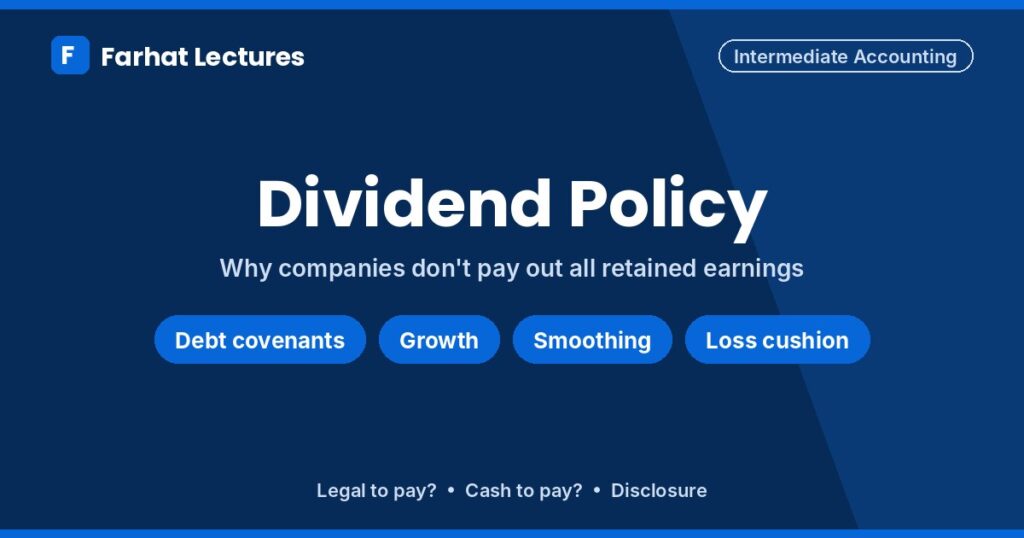
Dividend policy is a company’s plan for how much of its earnings to pay stockholders as dividends and how much to reinvest. The main approaches are residual, stable, and constant payout ratio. Most companies pay out far less than their retained earnings allow, because loan agreements, state law, growth plans, and cash needs limit what they can safely distribute.
Dividend policy matters to accounting students for two reasons. First, every dividend you record starts as a board decision shaped by that policy. Second, exam questions often test the difference between whether a company may legally pay a dividend and whether it can afford to. Retained earnings answers the first question. Cash and liquidity answer the second.
This guide covers the main types of dividend policy, why companies retain earnings, how legal limits and cash affect a dividend decision, what companies disclose, and how each type of dividend affects the financial statements. It ends with exam tips, practice questions, and an interactive exercise.
Watch: Cash Dividend Policy Explained
This CMA Part 2 lesson explains how companies set a cash dividend policy and how stockholders earn returns through dividends and a rising share price. Watch this Farhat lesson on YouTube
Why does dividend policy matter?
A dividend is a distribution to stockholders, usually in proportion to the shares they own. Investors often read dividends as a signal. A company that can keep paying, and sometimes raising, its dividend shows that at least part of its reported profit is backed by real cash.
That signal works in both directions. Companies that pay dividends are very reluctant to cut or stop them, because the market may react badly. So a dividend payer usually sets a level it believes it can sustain, even in weaker years.
The type of stockholder also shapes the policy. Retail investors are individuals who are not investment professionals and trade in small amounts. Institutional investors are large professional fund and portfolio managers that trade in much larger amounts. A company whose owners rely on steady income will lean toward regular cash dividends. A company whose owners want growth may pay little or nothing.
| Income-oriented company | Growth-oriented company | |
|---|---|---|
| Typical dividend policy | Regular, steady cash dividends, often for many years in a row | Little or no cash dividends |
| Use of earnings | Pays a predictable share to stockholders | Reinvests earnings to expand as quickly as financing allows |
| How stockholders expect to profit | Dividend income plus some price growth | Mainly a rising share price |
| When it would cut the dividend | Only under a sustained earnings decline or a serious cash shortage | Not applicable; there is little or nothing to cut |
What are the main types of dividend policy?
Most companies follow one of five broad approaches. The right one depends on how steady the company’s earnings are and how much cash it needs for new projects.
| Policy | How it works | Main drawback |
|---|---|---|
| Residual dividend policy | Fund every worthwhile investment project first, using the company’s target mix of debt and equity. Pay out whatever earnings are left. | Dividends can swing a lot from year to year. |
| Stable (regular) dividend policy | Pay a steady dollar dividend per share and raise it only when management believes the higher level can last. | Stockholders may see little increase in a strong year. |
| Constant payout ratio policy | Pay the same percentage of earnings every year. | The dollar dividend rises and falls with earnings. |
| Low regular dividend plus extras | Pay a small regular dividend that is easy to keep up, then add a special (extra) dividend in strong years. | Investors may start to count on the extra dividend. |
| No dividend | Reinvest all earnings and reward stockholders through a rising share price or share buybacks. | Investors who want income may avoid the stock. |
The dividend payout ratio shows how much of its profit a company pays out:
Dividend payout ratio = Dividends ÷ Net income
A related measure, dividend yield, compares the annual dividend per share with the stock’s market price per share.
Example: residual dividend policy
Ridgeline Tools Inc. (a hypothetical company) earned net income of $500,000 this year. It plans $400,000 of new investment and finances projects with 60% equity and 40% debt.
- Equity needed for the projects: $400,000 × 60% = $240,000
- Residual dividend: $500,000 − $240,000 = $260,000
- Dividend payout ratio: $260,000 ÷ $500,000 = 52%
Now suppose Ridgeline’s investment budget grows to $900,000. It would need $540,000 of equity ($900,000 × 60%). That is more than its $500,000 of net income, so under a residual policy it would pay no dividend at all.
Compare a constant payout ratio. At a 40% payout, a company that earns $200,000 pays $80,000. If earnings fall to $120,000 the next year, the dividend drops to $48,000. A company with a stable dividend policy would more likely keep paying $80,000 and ride out the dip.
Does dividend policy affect a company’s value?
Finance researchers have argued about this for decades. These five ideas come up most often in textbooks and on exams.
| Theory | Main idea | What it suggests |
|---|---|---|
| Dividend irrelevance (Modigliani and Miller, 1961) | In a perfect market with no taxes or transaction costs, dividend policy does not change a company’s value. An investor who wants cash can sell a few shares, sometimes called a homemade dividend. | In theory, the payout level does not matter. |
| Bird-in-the-hand (Gordon and Lintner) | Investors value a certain dividend today more than an uncertain capital gain later. | Higher payouts can support a higher share price. |
| Tax preference | Tax on a capital gain is usually not due until the shares are sold, so it can be deferred. | Some investors prefer companies that pay little and reinvest. |
| Signaling | Managers know more than outside investors, so dividend changes send a message. | Raising the dividend signals confidence; cutting it signals trouble. |
| Clientele effect | Investors choose companies whose payout matches their needs. | A sudden policy change can drive away existing stockholders. |
Why don’t companies pay out all their retained earnings?
Retained earnings is a company’s total net income since it started, minus net losses and the dividends it has declared. In other words, it is the profit the company has kept rather than distributed. Even when that balance is large, a company usually pays out only part of it. The main reasons are summarized below.
| Reason | What it means |
|---|---|
| Debt covenants | Loan agreements may require the company to keep a certain level of earnings (and the assets behind them) in the business to protect lenders. |
| State corporation law | Some states require the company to restrict retained earnings equal to the cost of treasury shares it has bought back, so those earnings cannot fund dividends. |
| Financing growth | Keeping earnings lets the company pay for expansion without borrowing or issuing new shares. This is called internal financing or “plowing back” profits. |
| Smoothing dividends | Saving earnings in good years lets the company keep paying a steady dividend in bad years. |
| Cushion against losses | Retained earnings acts as a buffer against future losses or errors in measuring profit. |
The state-law reason connects to legal capital. Some state laws restrict the company’s legal capital from being distributed to stockholders, so creditors have a layer of protection. The law of the state of incorporation determines whether a particular dividend is legal. For why that state matters, see the advantages and disadvantages of a corporation.
Legal to pay vs. able to pay
Management has to ask two separate questions before declaring a dividend.
| Question | What answers it | Why it matters |
|---|---|---|
| Is the dividend legal? | State law, the corporate charter, and contracts such as debt covenants | An illegal dividend can expose directors to liability and violate loan agreements. |
| Can the company afford it? | Cash, liquidity, and expected future cash needs | Paying cash the business needs for operations can damage the company even when the dividend is legal. |
The key point is that retained earnings is not cash. It is an equity balance that measures earnings kept in the business. Those earnings may already be invested in equipment, inventory, or receivables. A company should not pay a dividend unless both its current and expected future financial position support it. A quick way to check liquidity is the current ratio. See what a current ratio less than 1 tells you.
Example: retained earnings without cash
Northgate Bakery Inc. (a hypothetical company) reports the following balance sheet.
| Assets | Amount | Liabilities and equity | Amount |
|---|---|---|---|
| Cash | $6,000 | Accounts payable | $20,000 |
| Ovens and equipment, net | $294,000 | Common stock | $200,000 |
| Retained earnings | $80,000 | ||
| Total assets | $300,000 | Total liabilities and equity | $300,000 |
Northgate has $80,000 of retained earnings, so a dividend may be legal under its state’s law. But it has only $6,000 of cash and owes suppliers $20,000. To pay even a $30,000 dividend, it would have to borrow or sell ovens it needs to operate. A sensible board would pay no dividend now and revisit the decision once cash flow improves.
Restrictions and disclosure
When debt covenants or laws limit the dividends a company can pay, it usually makes no journal entry. Instead, it discloses the restriction in the notes to the financial statements, so readers know how much of retained earnings is actually available. A few companies go a step further and appropriate (set aside) part of retained earnings, showing it as a separate line within stockholders’ equity. Either way, total retained earnings does not change. For public companies, the Securities and Exchange Commission (SEC) requires this disclosure in Regulation S-X Rule 4-08(e), which calls for a description of the most significant dividend restrictions and the amount of retained earnings that is restricted or free of restriction.
The SEC also encourages two kinds of dividend policy disclosure under Regulation S-K Item 201(c)(2):
- A company that pays no cash dividends, even though its earnings suggest it could, is encouraged to say whether it plans to pay them in the foreseeable future. If it has no such plan, it should say so.
- A company with a history of cash dividends is encouraged to say whether it expects to keep paying comparable dividends and, if not, how the amount or rate is expected to change.
Types of dividends at a glance
Companies base dividends either on retained earnings or, less often, on another capital item such as additional paid-in capital. The table shows how each type affects the company. Each one has its own lesson in this series.
| Type | What stockholders receive | Effect on total stockholders’ equity | Learn more |
|---|---|---|---|
| Cash dividend | Cash | Decreases | Cash dividend journal entry |
| Property dividend (dividend in kind) | Noncash assets, usually securities of other companies | Decreases | Property dividend journal entry |
| Liquidating dividend | Assets that return part of their paid-in capital | Decreases | Liquidating dividends |
| Stock dividend | Additional shares of the company’s own stock | No change | Small vs. large stock dividend |
| Stock split (not a dividend) | More shares at a lower par value | No change | Stock dividend vs. stock split |
How do share repurchases compare with dividends?
A share repurchase, or buyback, is another way to return cash to stockholders. The company buys back its own shares. Stockholders who sell get cash, and those who keep their shares now own a larger percentage of the company.
Buybacks are more flexible than a regular dividend because investors do not expect them every quarter. In the accounting records, repurchased shares the company still holds are called treasury stock. Treasury stock is a contra-equity account (an account that reduces equity), so it lowers total stockholders’ equity. See how it is presented in the stockholders’ equity section of the balance sheet.
Is dividend policy tested on the CPA and CMA exams?
Yes, from two different angles.
- CMA Part 2: In the IMA (Institute of Management Accountants) content outline effective September 1, 2024, dividend policy sits in Section B.3, Raising Capital. You should be able to identify the factors that influence a company’s dividend policy, define cash dividends, stock dividends, and stock splits, explain how dividends are paid to common and preferred stockholders, and explain why companies repurchase shares.
- CPA FAR (Financial Accounting and Reporting): The focus is the accounting. Expect questions on how dividends and stock splits are recorded and how each one affects stockholders’ equity.
Exam tip: when a question gives you both retained earnings and cash, ask two questions. Is the dividend legal? Can the company afford it? Many wrong answer choices treat retained earnings as if it were cash.
Key takeaways on dividend policy
- Dividend policy decides how much of earnings goes to stockholders and how much stays in the business.
- Companies retain earnings for debt covenants, legal requirements, growth, smoother dividends, and a buffer against losses.
- A dividend must be both legal and affordable. Retained earnings shows the first; cash and liquidity show the second.
- Dividend restrictions are disclosed in the notes rather than removed from retained earnings.
- Cash, property, and liquidating dividends reduce total equity. Stock dividends and stock splits do not.
- The main dividend policies are residual, stable, constant payout ratio, low regular plus extras, and no dividend.
- The dividend payout ratio (dividends ÷ net income) shows how much of its profit a company pays out.
Common mistakes
- Treating retained earnings as if it were a pile of cash available for dividends.
- Assuming a large retained earnings balance means a company must pay large dividends.
- Thinking a restriction on retained earnings reduces the retained earnings balance.
- Calling a stock split a dividend. It distributes nothing and needs no journal entry.
- Assuming a company with no dividends is unprofitable. Many profitable growth companies choose to reinvest.
- Mixing up a stable dividend policy (a steady dollar amount per share) with a constant payout ratio policy (a steady percentage of earnings).
Practice questions with answers
1. A company has retained earnings of $500,000. A loan agreement requires it to keep $200,000 of retained earnings unavailable for dividends. What is the maximum dividend the covenant allows, and what happens to the retained earnings balance?
Answer: The covenant allows dividends of up to $300,000 ($500,000 − $200,000). Retained earnings stays at $500,000. The $200,000 restriction is disclosed in the notes; it does not change the balance.
2. A company has $90,000 of retained earnings and $4,000 of cash. Its board wants to declare a $40,000 cash dividend. Is this a good decision?
Answer: Probably not. The dividend may be legal because retained earnings exceeds $40,000, but the company lacks the cash. It would have to borrow or sell operating assets. Management should consider liquidity, not only legality.
3. Which of these reduce total stockholders’ equity: a cash dividend, a property dividend, a 10% stock dividend, a 2-for-1 stock split?
Answer: Only the cash dividend and the property dividend, because they distribute assets. The stock dividend moves amounts within equity, and the stock split changes only the number of shares and the par value per share.
4. A company follows a constant 30% dividend payout ratio. It earns net income of $250,000 this year and $400,000 next year. How much will it pay in dividends each year, and how would a stable dividend policy differ?
Answer: This year it pays $75,000 ($250,000 × 30%). Next year it pays $120,000 ($400,000 × 30%). The dividend moves with earnings. Under a stable dividend policy, the company would more likely keep its dividend near the usual level and raise it only if management believed the higher earnings would last.
Interactive exercise: why companies limit cash dividends
Put the five reasons to work. Read each scenario below and choose the main reason the company is paying less than its retained earnings would allow: a debt covenant, a state law restriction, financing growth, stabilizing dividends, or building a cushion against losses. Use each reason once, then select Check my work to see how each answer is derived. Want a refresher first? Go back to why companies don’t pay out all retained earnings.
Frequently asked questions
What is dividend policy in accounting?
Dividend policy is a company’s approach to deciding how much of its earnings to distribute to stockholders and how much to keep in the business. Accounting records the result: on the declaration date, cash, property, and stock dividends reduce retained earnings. A liquidating dividend is the exception because it reduces paid-in capital instead.
What are the main types of dividend policy?
The main types are residual (pay what is left after funding good projects), stable (a steady dollar dividend per share), constant payout ratio (a fixed percentage of earnings), low regular plus extras (a small base dividend with special dividends in strong years), and no dividend (reinvest everything).
What is a residual dividend policy?
Under a residual dividend policy, a company first uses its earnings to fund planned investments at its target mix of debt and equity, then pays out whatever is left. For example, with $500,000 of net income, a $400,000 investment budget, and a 60% equity target, the residual dividend is $500,000 minus $240,000, or $260,000.
Can a company pay dividends if it has retained earnings but little cash?
It may be legally allowed, but it should not pay unless it can afford to. Retained earnings are not cash. A company with a large retained earnings balance can still lack the cash needed to pay a dividend and its bills.
Does a retained earnings restriction change the balance of retained earnings?
No. A restriction limits how much of retained earnings is available for dividends. Total retained earnings stays the same, and the restriction is usually disclosed in the notes.
Why do some profitable companies pay no dividends?
Many growth companies reinvest all their earnings to expand. Their stockholders expect to profit from a rising share price instead of from dividend checks.
Is a stock split a type of dividend?
No. A stock split increases the number of shares and reduces par value per share, but it distributes no assets and needs no journal entry. It is often discussed with stock dividends because both increase the number of shares outstanding.
About the author
Mansour Farhat, CPA, CIA (Certified Internal Auditor), DBA (Doctor of Business Administration), teaches accounting at Farhat Lectures, where he helps students and exam candidates prepare for the CPA, CMA, and EA exams. Learn more about Mansour Farhat.
Continue learning with Farhat Lectures
Strengthen your accounting understanding with clear explanations and guided practice.
Explore the free sample course
Responses