
Property Dividend Journal Entry: Recording Dividends in Kind at Fair Value

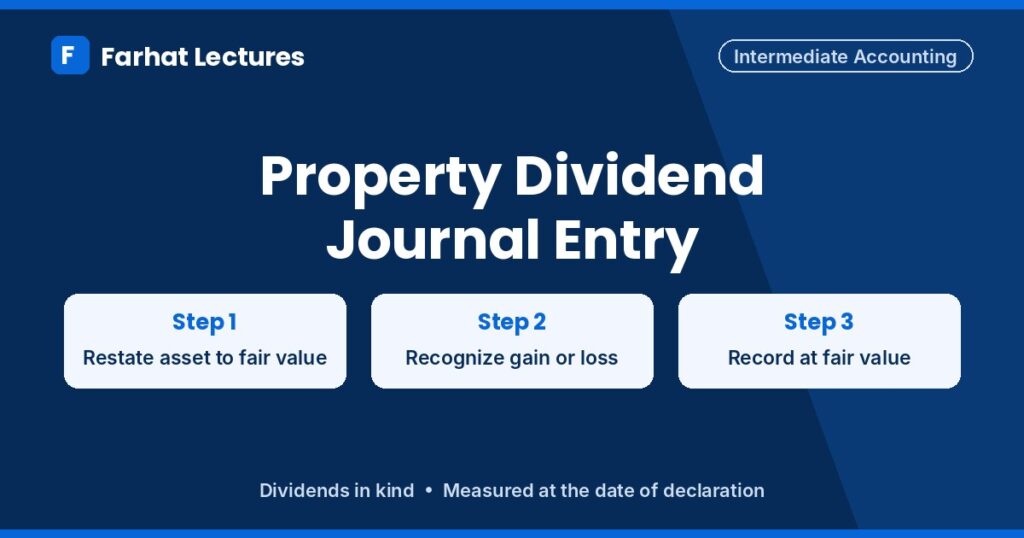
A property dividend, also called a dividend in kind, is a dividend paid with noncash assets, usually shares of another company, instead of cash. To record it, the company restates the asset to fair value on the date of declaration and recognizes any gain or loss. It then debits Retained Earnings and credits Property Dividends Payable for that fair value.
Property dividends test whether you understand fair value. Students often record the dividend at the asset’s carrying amount (the amount the asset is recorded at on the books), which misses the gain or loss and misstates both net income and retained earnings. The fix is to think of the transaction as a sale at fair value followed by a cash dividend of the proceeds.
This guide covers what property dividends are, the three-step journal entry, examples with a gain and a loss, the cash flow and tax treatment, a comparison with liquidating dividends, and a short quiz to check your understanding.
Watch: Property Dividend Example
This short video (about three and a half minutes) walks through a property dividend example step by step, so you can watch each journal entry being built.
Watch this Farhat lesson on YouTube
Want the full lesson with more examples? Property and liquidating dividends are covered in the Farhat Lectures Intermediate Accounting course.
What is a property dividend?
A property dividend, or dividend in kind, is a distribution of corporate assets other than cash. In principle the board can choose almost any asset: merchandise, real estate, or investments. In practice, physical assets are hard to divide evenly and deliver to thousands of stockholders. That is why the most common property dividend is shares of another company that the distributing corporation holds as an investment.
Distributing securities as a dividend can also help a company exit a large holding without selling a huge block of shares on the market, which could push the share price down.
Under U.S. GAAP, most distributions of nonmonetary assets (assets such as securities, land, or inventory, whose value is not fixed in dollars) to owners are measured at fair value when that value is objectively measurable and could clearly be realized in an outright sale near the time of the distribution. This guidance is in Accounting Standards Codification (ASC) 845-10-30-10 in the FASB Accounting Standards Codification. (Spin-offs of a business follow a different, carrying-amount rule, which is beyond this lesson.)
How do you record a property dividend? Three steps
| Step | When | Entry |
|---|---|---|
| 1. Restate the property to fair value | Date of declaration | Debit (or credit) the asset; credit a gain (or debit a loss) for the difference between fair value and carrying amount |
| 2. Record the dividend | Date of declaration | Debit Retained Earnings (or Property Dividends Declared); credit Property Dividends Payable at fair value |
| 3. Distribute the property | Date of distribution | Debit Property Dividends Payable; credit the asset at its restated fair value |
As with a cash dividend, no entry is made on the date of record. That date simply identifies which stockholders will receive the property.
Example: property dividend with a gain
Redwood Holdings (a hypothetical company) owns shares of another company carried at $640,000. On November 15, it declares a property dividend of those shares, distributable December 20 to stockholders of record December 1. The shares’ fair value on November 15 is $900,000.
November 15: restate to fair value
| Account | Debit | Credit |
|---|---|---|
| Investments | 260,000 | |
| Gain on Appreciation of Investments | 260,000 |
The gain is $900,000 − $640,000 = $260,000, and it is reported in income.
Exam tip: If the shares are equity securities that the company already measures at fair value through net income (under ASC 321), they are remeasured at every reporting date. In that case, the gain on the declaration date is only the change in fair value since the last remeasurement.
November 15: declare the dividend
| Account | Debit | Credit |
|---|---|---|
| Retained Earnings (or Property Dividends Declared) | 900,000 | |
| Property Dividends Payable | 900,000 |
December 20: distribute the shares
| Account | Debit | Credit |
|---|---|---|
| Property Dividends Payable | 900,000 | |
| Investments | 900,000 |
The investment account is now zero ($640,000 + $260,000 − $900,000), and retained earnings fell by the $900,000 fair value. Net income rose by the $260,000 gain, which flows into retained earnings when the books are closed.
Example: property dividend with a loss
Suppose instead Redwood distributes a parcel of land carried at $450,000 with a fair value of $380,000 on the date of declaration.
| Account | Debit | Credit |
|---|---|---|
| Loss on Distribution of Land | 70,000 | |
| Land | 70,000 |
| Account | Debit | Credit |
|---|---|---|
| Retained Earnings | 380,000 | |
| Property Dividends Payable | 380,000 |
| Account | Debit | Credit |
|---|---|---|
| Property Dividends Payable | 380,000 | |
| Land | 380,000 |
Using fair value means stockholders are charged for what they actually receive ($380,000), and the $70,000 decline in value shows up as a loss rather than being hidden in retained earnings.
How does a property dividend affect the statement of cash flows?
No cash leaves the company, so a property dividend is not reported as a financing cash outflow. Instead, it is disclosed as a noncash financing activity, either in a separate schedule or in the notes to the financial statements.
If you prepare the operating section with the indirect method, subtract the gain from net income (Redwood would subtract $260,000), or add back a loss (the land example would add back $70,000). The gain or loss came from restating the asset, not from cash, so it has to be removed from operating cash flow.
The net effect on total stockholders’ equity equals the asset’s carrying amount. In the Redwood example, retained earnings falls by the $900,000 dividend and rises by the $260,000 gain once it is closed, a net decrease of $640,000. In the land example, the $380,000 dividend plus the $70,000 loss reduces equity by $450,000.
Property vs. liquidating dividends
A liquidating dividend is any dividend not based on retained earnings. Because it comes from paid-in capital, it returns part of the stockholders’ investment instead of distributing profits. Companies should state the source of every dividend so stockholders do not mistake a return of capital for a sign of profitable operations.
Quick example. A mining company (hypothetical) declares a $500,000 cash distribution and states that $350,000 comes from earnings and $150,000 is a return of capital.
| Account | Debit | Credit |
|---|---|---|
| Retained Earnings | 350,000 | |
| Paid-in Capital in Excess of Par—Common Stock | 150,000 | |
| Dividends Payable | 500,000 |
For more examples, including why extractive companies pay dividends that include depletion, read Liquidating Dividends: Simple Examples and Journal Entries.
| Cash dividend | Property dividend | Liquidating dividend | |
|---|---|---|---|
| What is distributed | Cash | Noncash assets | Usually cash |
| Amount recorded | Cash declared | Fair value at declaration | Amount declared |
| Account debited at declaration | Retained Earnings | Retained Earnings | Paid-in capital (and Retained Earnings for any part from earnings) |
| Gain or loss? | No | Yes, on restating the asset | No, when cash is distributed |
| Total stockholders’ equity | Decreases | Decreases | Decreases |
For the basic three-date pattern, see the cash dividend journal entry. To see why boards choose noncash or no dividends at all, read how dividend policy works.
How is a property dividend treated for tax purposes?
The tax rules look similar to the book rules, but they are not the same. That difference is a favorite trap on the CPA REG and EA exams.
For the corporation: Under Internal Revenue Code (IRC) Section 311(b), a corporation that distributes appreciated property recognizes gain as if it sold the property to the shareholder at its fair market value (FMV). Under Section 311(a), it does not recognize a loss when the property is worth less than its tax basis.
For the shareholder: Under Section 301, the amount of the distribution is the property’s FMV, measured on the date of distribution (not the date of declaration used for the books). That amount is a taxable dividend to the extent of the corporation’s earnings and profits (E&P), and the shareholder’s basis in the property is its FMV.
Book vs. tax in one example: In the land example above, Redwood reports a $70,000 loss on its income statement. If its tax basis in the land is also $450,000, it gets no tax deduction for that loss.
Read the code sections: IRC Section 311 and IRC Section 301.
Key takeaways on the property dividend
- A property dividend distributes noncash assets, most often securities of other companies.
- Restate the property to fair value on the date of declaration and recognize the gain or loss in income.
- Record the property dividend payable at that fair value, and remove the asset on the distribution date.
- A liquidating dividend is defined by its source (paid-in capital), not by what is distributed.
- Tax rules differ: the corporation recognizes gain on appreciated property under IRC Section 311(b) but no loss under Section 311(a).
Common mistakes
- Recording the dividend at the asset’s carrying amount instead of fair value.
- Using the fair value on the date of record or distribution instead of the date of declaration.
- Crediting the gain to Retained Earnings instead of reporting it in income.
- Forgetting that a decline in value creates a loss.
- Treating every distribution as a return of profits when part of it may be a return of capital.
- Assuming the tax rules match the books. For tax, the corporation recognizes a gain on appreciated property but no loss on property that has declined in value.
Property dividend quiz: check your understanding
Before the numerical practice below, test yourself on the property dividend journal entry with four quick multiple-choice questions. They cover what counts as a dividend in kind, remeasuring the asset to fair value, and the entries on the declaration and distribution dates. Each answer comes with a short explanation.
Practice questions with answers
1. A company declares a property dividend of equity securities carried at $300,000. Their fair value is $345,000 on the date of declaration and $360,000 on the date of distribution. What gain is recognized, and at what amount is the dividend recorded?
Answer: A $45,000 gain ($345,000 − $300,000), and the dividend is recorded at $345,000. Fair value is measured on the date of declaration.
2. Using question 1, record the entry on the date of distribution.
| Account | Debit | Credit |
|---|---|---|
| Property Dividends Payable | 345,000 | |
| Equity Investments | 345,000 |
Why: The asset was restated to $345,000 at declaration, so the payable and the asset are both removed at that amount.
3. A company distributes equipment with a carrying amount of $120,000 and a fair value of $95,000 as a property dividend. What is the effect on net income and on retained earnings?
Answer: Net income decreases by the $25,000 loss. Retained earnings decreases by the $95,000 dividend, and also by the $25,000 loss once net income is closed, for a total decrease of $120,000.
4. A corporation distributes land with a tax basis of $200,000 and a fair market value of $260,000 to its only shareholder. The corporation has $500,000 of earnings and profits. What gain does the corporation recognize for tax purposes, and what are the shareholder’s dividend and basis in the land?
Answer: The corporation recognizes a $60,000 gain ($260,000 fair market value minus $200,000 basis) under IRC Section 311(b). The shareholder reports a $260,000 dividend, because earnings and profits are large enough to cover it, and takes a $260,000 basis in the land.
Frequently asked questions
What is a property dividend?
A property dividend, also called a dividend in kind, is a distribution of assets other than cash to stockholders. The most common example is shares of another company that the distributing corporation holds as an investment.
At what amount is a property dividend recorded?
At the fair value of the property on the date of declaration. The company first restates the asset from its carrying amount to fair value and recognizes the difference as a gain or loss.
Why does a property dividend create a gain or loss?
Accounting treats the distribution as if the company sold the asset at fair value and paid the proceeds to stockholders. The gain or loss on that imagined sale belongs in income.
Is the gain on a property dividend reported in net income?
Yes. The gain or loss from restating the asset to fair value is recognized in income, even though the dividend itself reduces retained earnings directly.
How is a liquidating dividend different from a property dividend?
A property dividend describes what is distributed (noncash assets). A liquidating dividend describes the source: it is based on paid-in capital rather than retained earnings, so it returns part of the stockholders’ investment.
Does a property dividend reduce total stockholders’ equity?
Yes, by the asset’s carrying amount. The dividend reduces retained earnings at fair value, and the gain (or loss) from restating the asset adds back (or takes away) the difference once net income is closed. In the Redwood example, equity falls by a net $640,000.
Is a property dividend taxable?
Usually, yes. The corporation recognizes gain on appreciated property as if it sold it at fair market value (IRC Section 311(b)) but recognizes no loss on property that has dropped in value (Section 311(a)). The shareholder treats the property’s fair market value as a dividend to the extent of the corporation’s earnings and profits, and that value becomes the shareholder’s basis.
How does a property dividend appear on the statement of cash flows?
It is not a cash outflow, so it is disclosed as a noncash financing activity. Under the indirect method, the gain from restating the asset is subtracted from net income in operating activities, and a loss is added back.
Continue learning with Farhat Lectures
Strengthen your accounting understanding with clear explanations and guided practice.
Explore the free sample course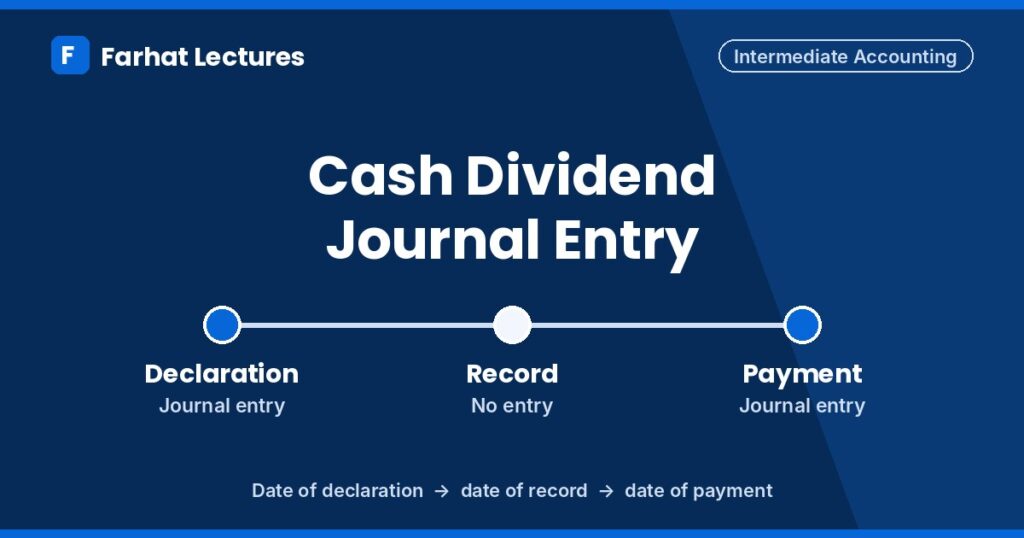



Responses