
Debits and Credits: A Simple Guide to Normal Balances


Debits and credits are the two sides of every accounting entry: a debit (Dr.) goes on the left side of an account and a credit (Cr.) goes on the right. Debits increase assets, expenses, and dividends. Credits increase liabilities, equity, and revenue. In every transaction, total debits must equal total credits.
You’ll use these rules in every accounting course, from your first Financial Accounting class through Intermediate Accounting and the CPA exam. Instead of guessing from whether a transaction sounds good or bad, this guide shows you the reason behind each side, so the rules actually stick.
Watch Professor Farhat explain the concept
7:22–12:34: double entry, T-accounts, balances, and dividends.
Watch this Farhat Lectures lesson on YouTube.
Quick note while you watch: at 11:07, remember that Common Stock increases with a credit, just like the other equity accounts in the table below.
What debits and credits mean
Debit is commonly abbreviated Dr.; credit is abbreviated Cr. These words describe position, not whether a transaction is good or bad. A cash receipt normally debits Cash, but that does not mean every debit records money received.
An account is a record of changes in one item, such as Cash or Accounts Payable. A T-account is a simplified way to display it: account name above, debits on the left, and credits on the right. The same positions apply to every account.
The IRS discussion of double-entry bookkeeping in Publication 583 confirms the left/right convention and the requirement that total debits equal total credits. Keep in mind that these rules tell you how to record a transaction. They don’t tell you when something should be recorded in the first place. That decision, called recognition, comes from accounting standards.
How Does the Accounting Equation Explain Debits and Credits?
Every debit and credit rule comes from one simple equation:
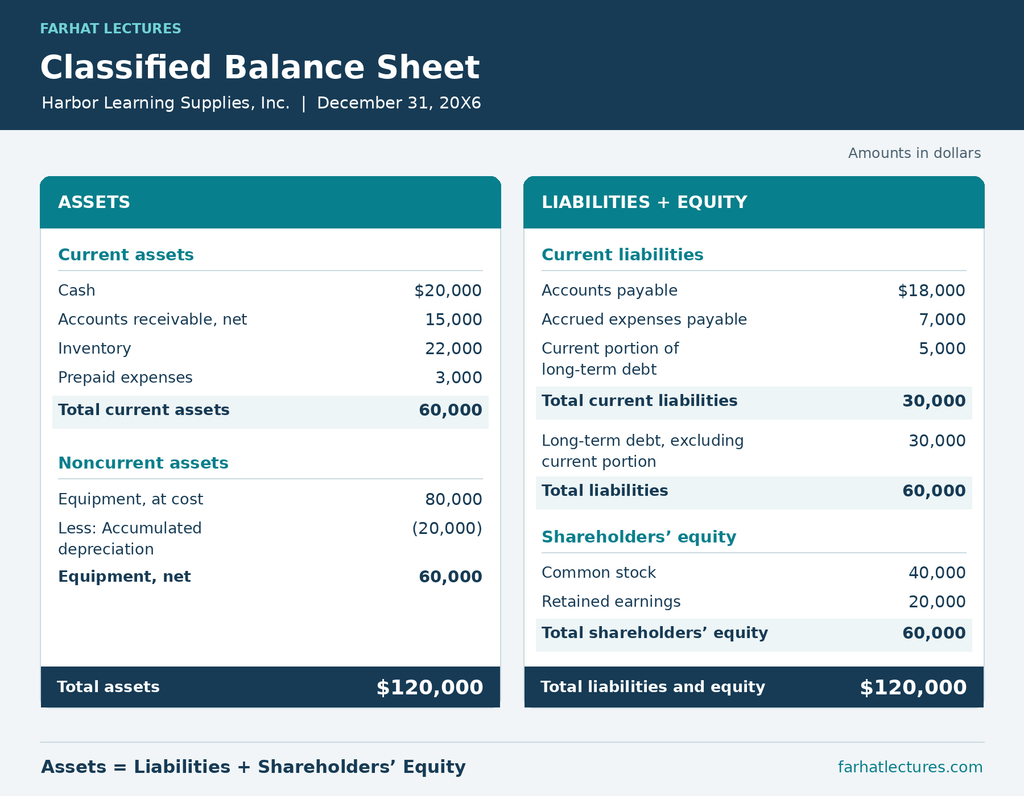
Assets = Liabilities + Equity
Assets sit on the left side of the equation, so asset accounts increase on their left side, with a debit. Liabilities and equity sit on the right side, so they increase on their right side, with a credit.
Equity then breaks into smaller accounts. Revenue adds to equity, so it behaves like equity and increases with a credit. Expenses and dividends take away from equity, so they work in the opposite direction and increase with a debit.
Here’s a quick check. If a business borrows $6,000, Cash (an asset) goes up by $6,000 and Notes Payable (a liability) goes up by $6,000. Both sides of the equation rise by the same amount, so it stays in balance. That’s exactly why the debit and the credit in every entry must be equal.
For more practice, see the accounting equation guide.
Debits and credits by account type
| Account | Increase | Decrease | Normal balance |
|---|---|---|---|
| Assets, such as Cash | Debit | Credit | Debit |
| Expenses, such as Rent Expense | Debit | Credit | Debit |
| Dividends or Owner’s Drawings | Debit | Credit | Debit |
| Liabilities, such as Accounts Payable | Credit | Debit | Credit |
| Common Stock or Owner’s Capital | Credit | Debit | Credit |
| Retained Earnings | Credit | Debit | Credit |
| Revenue, such as Service Revenue | Credit | Debit | Credit |
A normal balance is the side normally used to increase the account. It is a useful expectation, not a guarantee that every actual balance will appear on that side. A debit balance in Retained Earnings, for example, represents an accumulated deficit, which means the company’s total losses and dividends over time have been larger than its total profits.
This table covers the basic accounts in the lesson. Contra accounts are exceptions to the usual category pattern and are studied separately. So don’t stretch the table into a rule that every account listed with the assets must have a debit balance. For example, Accumulated Depreciation is reported with the assets, but it is a contra asset account (an account that reduces a related account), so its normal balance is a credit.
One popular memory aid is DEALER. The first three letters, D-E-A (Dividends, Expenses, Assets), increase with debits. The last three, L-E-R (Liabilities, Equity, Revenue), increase with credits. The underlying explanation comes from the accounting equation and equity relationships.
Why expenses and dividends have debit balances
Revenue increases profit and, ultimately, retained earnings. Because increases in retained earnings are credits, revenue increases are credits. Expenses reduce profit and ultimately reduce retained earnings, so expenses increase with debits.
Dividends also reduce retained earnings, but they are distributions to owners rather than costs of earning revenue. Therefore, dividends are not expenses and do not reduce net income. A separate Dividends account can collect the distributions during the year, and then it’s closed to Retained Earnings at year-end. See how closing entries work.
Similarly, a sole proprietor’s withdrawal increases Drawings with a debit. It does not become a business expense merely because cash leaves the business. The account names change from one type of business to another, but the idea stays the same: owner withdrawals and dividends are distributions, not business expenses.
Original examples: choose the accounts first
Hypothetical examples. Maple Studio uses double-entry accounting. For each event, identify the accounts, classify them, determine their increase or decrease, and then select the debit or credit.
| Event | Debit | Credit | Reason |
|---|---|---|---|
| Borrow $6,000 cash | Cash $6,000 | Notes Payable $6,000 | An asset and a liability increase. |
| Pay $700 for current-month rent | Rent Expense $700 | Cash $700 | Expense increases; cash decreases. |
| Earn $1,200 for completed services on account | Accounts Receivable $1,200 | Service Revenue $1,200 | The customer owes the studio; a receivable and revenue increase. |
| Collect $500 of that receivable | Cash $500 | Accounts Receivable $500 | One asset increases and another decreases. |
The collection does not create revenue again. Revenue was already recorded when the services were completed in the stated facts. “On account” means payment is deferred; it does not mean that no transaction occurred.
A transaction can involve more than two accounts. If Maple buys equipment for $4,500, pays $1,500 immediately, and owes the rest, it debits Equipment $4,500 and credits Cash $1,500 and Accounts Payable $3,000. Total credits are $4,500, matching total debits.
Double entry requires equal amounts, not an equal number of debit and credit lines. The accounting information system guide shows how these entries move into records and reports.
How to calculate an account balance
Add the amounts on each side of the account. Subtract the smaller total from the larger total. The balance belongs on the side with the larger total.
Suppose Cash has debit entries totaling $8,400 and credit entries totaling $2,900. Cash has a $5,500 debit balance: $8,400 − $2,900. This says more cash was recorded on the debit side than on the credit side; it does not say the business earned $5,500 of profit.
If Accounts Payable has $3,000 of credits and $800 of debits, its balance is $2,200 credit. The credits increased obligations; the debits reduced them. Always calculate the balance within each account before combining balances in a trial balance.
Here’s how all of Maple Studio’s cash activity from the examples above looks in one T-account. Assume Cash begins with a zero balance and these are the only cash transactions.
| Cash: Debit (left) | Cash: Credit (right) |
|---|---|
| $6,000 borrowed | $700 rent paid |
| $500 collected from a customer | $1,500 paid toward equipment |
| Total debits: $6,500 | Total credits: $2,200 |
Debits are larger, so Cash has a $4,300 debit balance ($6,500 − $2,200).
Common mistakes with debits and credits
Debit always means increase. Debiting a liability decreases it. Account classification must come before the direction rule.
Credit always means cash received. A credit sale can increase revenue without increasing Cash. The customer may owe Accounts Receivable instead.
A balanced entry must be correct. Recording the wrong account, omitting an entire transaction, or entering the same wrong amount on both sides can leave totals equal.
Bank-statement wording controls your books. A bank describes activity from its own point of view. Suppose a customer pays $500 directly into the business bank account to settle an existing receivable. The bank credits your account because the deposit increases the amount it owes you, which is a liability on the bank’s books. In the business’s books, record a $500 debit to Cash and a $500 credit to Accounts Receivable. Depositing cash that is already recorded in the books does not increase total Cash again. Always apply the rules to the business whose records you are preparing.
Key Takeaways
- Debit means left and credit means right. Neither word means good or bad.
- Assets, expenses, and dividends increase with debits.
- Liabilities, equity, and revenue increase with credits.
- Every entry needs equal total debits and credits, but it can have more than two lines.
- An account’s balance sits on whichever side has the larger total.
- Equal totals don’t prove an entry is correct. You still need the right accounts and amounts.
Debits and Credits: Interactive Exercise
Test your understanding of debit and credit entries, account balances, and equal debits and credits in double-entry accounting with eight questions and answer explanations.
Complete this knowledge check before the applied practice questions below. For a review, return to the normal-balance table or the account balance examples.
Choose one answer for each question, then select Check answers. You can revise your answers and check again. Open the answer guide below whenever you need a reminder.
Choose your answers, then select Check answers.
Debits and credits: answer guide
- What is a debit?
- A debit (Dr.) is an entry on the left side of an account.
- What is a credit?
- A credit (Cr.) is an entry on the right side of an account.
- Do debit and credit mean increase and decrease?
- No. Debit and credit mean left and right, respectively. They describe where a company makes entries in the recording process.
- When does an account have a debit balance?
- An account has a debit balance when total debit amounts exceed total credit amounts.
- When does an account have a credit balance?
- An account has a credit balance when total credit amounts exceed total debit amounts.
- Does the left-and-right rule apply to every account?
- Yes. Placing debits on the left and credits on the right is a globally adopted accounting custom that applies to all accounts.
- What is double-entry accounting?
- Double-entry accounting, also called double-entry bookkeeping, records the dual, or two-sided, effect of each transaction in appropriate accounts. The equality of debits and credits provides its basis.
- Why must total debits equal total credits?
- When every transaction is recorded with equal debits and credits, the sum of all debits to the accounts must equal the sum of all credits.
Applied practice questions with explanations
1. A business pays $950 of an existing account payable. What is the entry?
Answer: debit Accounts Payable $950; credit Cash $950. The liability and asset both decrease. Paying the existing obligation does not automatically create a new expense.
2. Which normally increase with a debit: Service Revenue, Equipment, Rent Expense, or Dividends?
Answer: Equipment, Rent Expense, and Dividends. They represent an asset, an expense, and an owner distribution. Service Revenue normally increases with a credit.
3. An account has debits of $4,700 and credits of $6,100. What is its balance?
Answer: $1,400 credit. Credits exceed debits by $6,100 − $4,700. You can determine the balance’s side even without knowing the account name.
Frequently asked questions
Does double entry mean exactly two accounts?
No. At least two accounts are affected, but an entry can contain several accounts as long as total debits equal total credits.
Is a debit balance always a positive result?
No. Debit identifies an accounting side, not business performance. Cash and an accumulated deficit can both have debit balances for different reasons.
Why are dividends debited if equity normally has a credit balance?
Dividends reduce equity. Increasing the separate Dividends account with a debit records that reduction without treating it as an operating expense.
Is cash a debit or a credit?
Cash is an asset, so it increases with a debit and decreases with a credit. Its normal balance is a debit. If Cash shows a credit balance in your books, that usually signals an overdraft or a recording error worth checking.
Why does my bank say it credited my account when I made a deposit?
To the bank, your deposit increases the amount it owes you, so the bank credits a liability. If a customer pays $500 directly into your business bank account to settle a receivable, your business debits Cash $500 and credits Accounts Receivable $500. Depositing cash already recorded in your books does not increase total Cash again.
What is a contra account?
A contra account is linked to another account and reduces it, so it carries the opposite normal balance. Accumulated Depreciation is a contra asset account with a credit balance. Sales Returns and Allowances is a contra revenue account with a debit balance.
Why do debits and credits matter for the CPA exam?
FAR questions and task-based simulations often ask you to prepare or evaluate journal entries, and every entry depends on these rules. If you have to stop and think about which side an account goes on, you lose time you need for the harder parts of the question.
Learning scope: Intermediate Accounting, Section 2.1, Accounting Information System.
About the author: Mansour Farhat, CPA, CIA, DBA, teaches the accounting courses on Farhat Lectures, where students prepare for college accounting classes and the CPA, CMA, and EA exams. His lessons pair video explanations with worked examples and practice questions like the ones in this guide.
CONTINUE LEARNING
Explore the connected lessons
View the full Intermediate Accounting course
New to accounting? Start with the free first chapter of the Financial Accounting course.



Responses