
Balance Sheet Explained: Format, Example, and How to Read It

A balance sheet is a financial statement that shows what a company owns or has the right to use (assets), what it owes (liabilities), and what belongs to the owners (shareholders’ equity) on a specific date. It always follows the accounting equation: Assets = Liabilities + Shareholders’ Equity. It is also called the statement of financial position.
Investors, lenders, and managers use it to judge liquidity, which is the ability to pay bills that are due soon, and solvency, which is the ability to meet long-term obligations.
This guide explains the three sections, presents a classified balance sheet example, and shows how transactions and liquidity measures connect. The discussion follows an introductory U.S. GAAP (generally accepted accounting principles) approach. If you are new to the subject, begin with Farhat Lectures’ introduction to accounting.
Key takeaways
- A balance sheet shows assets, liabilities, and shareholders’ equity at one moment in time, not over a period.
- Total assets always equal total liabilities plus shareholders’ equity.
- A classified balance sheet splits assets and liabilities into current (expected to be collected, used up, or paid within one year or the operating cycle, whichever is longer) and noncurrent.
- Shareholders’ equity is the owners’ remaining claim on assets, not a pile of cash.
- Working capital, the current ratio, and the quick ratio use balance sheet totals to measure short-term liquidity.
- Preparing a classified balance sheet from a trial balance is a representative task in the CPA exam’s FAR blueprint.
What Is the Balance Sheet Equation?
Assets = Liabilities + Shareholders’ Equity
Rearranging the equation gives Shareholders’ Equity = Assets − Liabilities. For example, a company with $120,000 in assets and $60,000 in liabilities has $60,000 in equity.
The equation expresses the relationship between the company’s resources and the claims against those resources. It does not establish that every recorded amount is correct: omitted transactions and classification errors can leave the totals equal.
For additional background, review Farhat Lectures’ elements of financial statements, which distinguishes amounts reported at a date from changes reported over a period.
What Are the Three Components of a Balance Sheet?
1. Assets: Rights to Economic Benefits
The FASB (Financial Accounting Standards Board, the group that sets U.S. GAAP) defines an asset as a present right of an entity to an economic benefit in its Conceptual Framework (Concepts Statement No. 8, Chapter 4, issued in December 2021). In plain terms, an asset is something the business has a right to that can bring in cash or other value. Concepts Statements guide how the FASB writes standards, but they are not authoritative GAAP themselves. Examples include cash, amounts receivable from customers, inventory, and equipment. Legal ownership alone is not a complete definition; a recognized right to use an asset can also be an asset.
In a classified presentation, current assets generally include cash available for current use and assets expected to be realized in cash (turned into cash), sold, or consumed within one year or the normal operating cycle, whichever is longer. This rule comes from FASB Accounting Standards Codification (ASC) Topic 210, Balance Sheet, the authoritative source for current and noncurrent classification. Common examples are accounts receivable, inventory, and prepaid expenses.
The operating cycle covers acquiring or producing inventory, selling it, and collecting the related cash. For example, if a business’s normal operating cycle is 18 months, inventory it expects to sell within that cycle is still a current asset, even though selling it may take more than 12 months. A business with no clearly defined operating cycle uses the one-year rule. Equipment used in operations is generally noncurrent; it is not inventory moving through that cycle.
Noncurrent assets include property, plant, and equipment, long-term investments, and recognized intangible assets. Depreciable equipment is commonly presented at cost less accumulated depreciation.
2. Liabilities: Existing Obligations
The same FASB chapter defines a liability as a present obligation of an entity to transfer an economic benefit. In plain terms, a liability is something the business owes and must settle with cash, goods, or services. They include amounts owed to suppliers, employees, and lenders.
Current liabilities generally include obligations expected to be settled using current assets or by creating other current liabilities within one year or the normal operating cycle, whichever is longer. Examples include accounts payable, accrued wages, and the current portion of long-term debt.
Noncurrent liabilities include the remaining long-term portion of borrowings and other obligations classified outside current liabilities. For an introductory example, separate the principal due during the next year from the principal due later. More complex situations, including refinancing and covenant violations, require additional analysis.
3. Shareholders’ Equity: The Owners’ Residual Interest
Equity is the amount remaining after liabilities are deducted from assets. Common corporate components include:
- Contributed capital: amounts invested by shareholders, commonly presented as common stock (and preferred stock, if any) plus additional paid-in capital, which is the amount shareholders paid above the stock’s par or stated value.
- Retained earnings: accumulated earnings less losses and dividends, subject to any applicable adjustments.
- Treasury stock: reacquired shares held by the corporation, presented as a reduction of equity.
- Accumulated other comprehensive income or loss (AOCI): the running total of certain gains and losses that skip the income statement, such as unrealized gains and losses on available-for-sale debt securities and foreign currency translation adjustments.
Not every company reports every component. Equity is not a separate cash account. Farhat Lectures’ stockholders’ equity explanation provides further discussion of these categories.
Business type changes the labels. A sole proprietorship shows a single owner’s capital account, and a partnership shows a capital account for each partner. Corporations use the components listed above.
Watch: Classified Balance Sheet
In this Farhat Lectures lesson, Professor Farhat explains current and noncurrent classifications, shareholders’ equity, the current portion of long-term debt, and the current ratio. Watch the lesson to reinforce the three components, then apply the concepts to the worked example below.
Watch Classified Balance Sheet on the Farhat Lectures YouTube channel.
Jump to a section of the video:
- 0:00 Why classifying the balance sheet makes liquidity and solvency easier to judge
- 1:41 Current vs. noncurrent assets
- 5:56 Current vs. noncurrent liabilities
- 8:15 Shareholders’ equity: common stock, additional paid-in capital, retained earnings, and treasury stock
- 10:30 Splitting out the current portion of long-term debt
- 13:24 Calculating the current ratio
How to Prepare a Balance Sheet in 6 Steps
Here is the process you would follow to build Harbor’s statement below from its accounting records.
- Start with an adjusted trial balance. A trial balance lists every general ledger account and its balance. Use the balances after adjusting entries, such as depreciation and accrued expenses, so the amounts are complete.
- Write the heading. Include the company name, the statement title, and a single date, such as “December 31, 20X6.” A balance sheet never says “for the year ended.”
- Sort each account into assets, liabilities, or equity. Revenue, expense, and dividend accounts do not appear on the balance sheet by themselves. Their effect reaches the balance sheet through retained earnings.
- Classify assets and liabilities as current or noncurrent. Use one year or the operating cycle, whichever is longer. Split long-term debt into the principal due within the next year and the rest.
- Calculate ending retained earnings. Ending retained earnings equals beginning retained earnings plus net income (or minus a net loss) minus dividends declared.
- Total each section and check the equation. Total assets must equal total liabilities plus shareholders’ equity. If they do not, look for a contra account in the wrong place (a contra account reduces a related account, such as accumulated depreciation reducing equipment) or a retained earnings balance that was never updated.
Exam tip: Preparing a classified balance sheet from a trial balance is a representative task in the AICPA’s (American Institute of Certified Public Accountants) 2026 FAR blueprint. It fits naturally into task-based simulations, the case-style questions on the CPA exam, so practice it until the sorting feels automatic.
Classified Balance Sheet Example
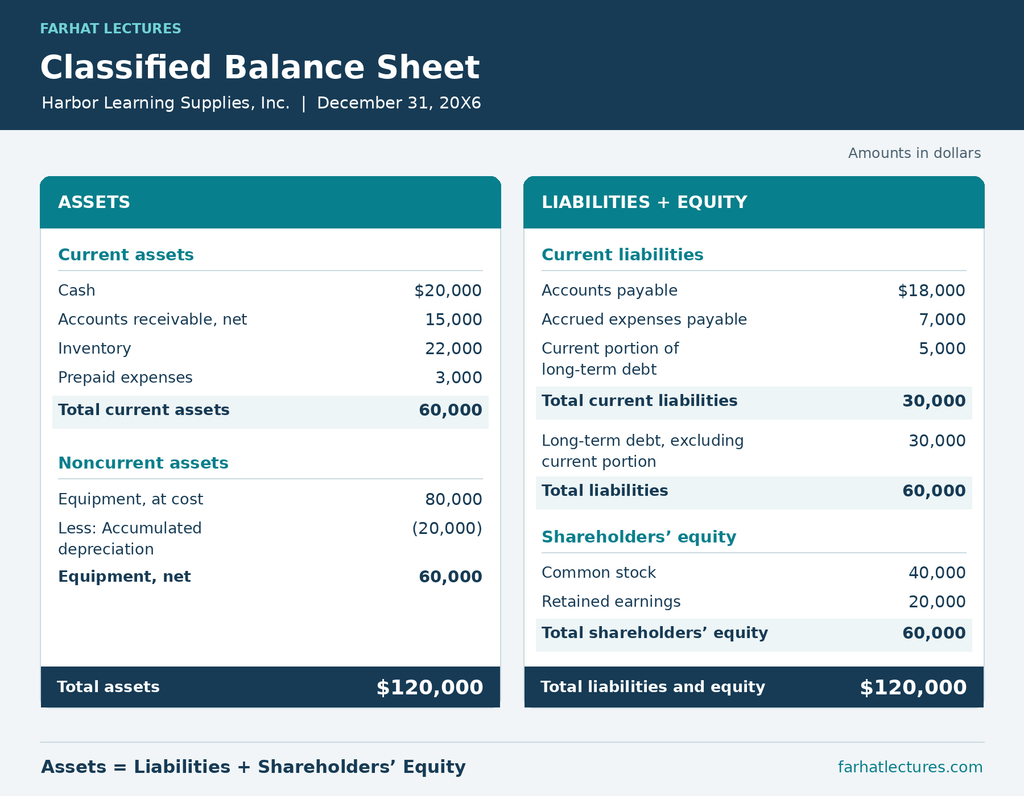
Assume Harbor Learning Supplies, Inc., a hypothetical retailer, has a normal operating cycle shorter than one year. The following simplified statement uses its adjusted account balances at December 31, 20X6. The company has no equity components other than common stock and retained earnings.
| Account | Amount |
|---|---|
| Current assets | |
| Cash | $20,000 |
| Accounts receivable, net | 15,000 |
| Inventory | 22,000 |
| Prepaid expenses | 3,000 |
| Total current assets | 60,000 |
| Noncurrent assets | |
| Equipment, at cost | 80,000 |
| Less: Accumulated depreciation | (20,000) |
| Equipment, net | 60,000 |
| Total assets | $120,000 |
| Current liabilities | |
| Accounts payable | $18,000 |
| Accrued expenses payable | 7,000 |
| Current portion of long-term debt | 5,000 |
| Total current liabilities | 30,000 |
| Long-term debt, excluding current portion | 30,000 |
| Total liabilities | 60,000 |
| Shareholders’ equity | |
| Common stock | 40,000 |
| Retained earnings | 20,000 |
| Total shareholders’ equity | 60,000 |
| Total liabilities and shareholders’ equity | $120,000 |
Check the totals: $60,000 of current assets + $60,000 of net equipment = $120,000 of total assets. On the other side, $60,000 of liabilities + $60,000 of equity = $120,000.
Accumulated depreciation reduces the carrying amount of equipment; it is not a liability. The $5,000 current debt portion is already included in current liabilities, so do not include it again in the $30,000 long-term balance.
Balance Sheet Format: Report Form vs. Account Form
The same numbers can be laid out in two common formats.
- Report form: sections are stacked vertically, with assets first, then liabilities, then shareholders’ equity. Harbor’s statement above uses the report form.
- Account form: assets appear on the left, and liabilities plus shareholders’ equity appear on the right, mirroring the two sides of the accounting equation.
Both formats contain the same information and must balance. The format changes the layout, not the amounts.
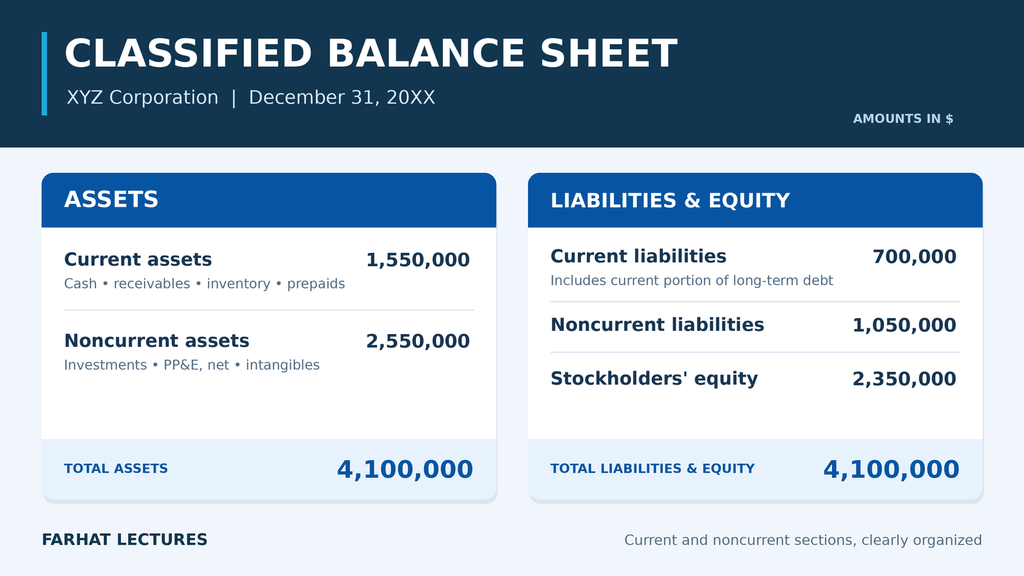
Classified vs. unclassified. A classified balance sheet, like Harbor’s, groups assets and liabilities into current and noncurrent categories with subtotals. An unclassified balance sheet lists them without those groupings. Some industries, such as banks and insurance companies, usually present unclassified balance sheets.
Order of items. U.S. companies usually list assets in order of liquidity, meaning how quickly they turn into cash: cash first, then receivables, inventory, and prepaid expenses, followed by long-term assets. Companies that report under IFRS (International Financial Reporting Standards) often call the statement the statement of financial position, and many list noncurrent assets before current assets.
How Do Transactions Affect the Balance Sheet?
Consider each transaction below independently, starting with Harbor’s original $120,000 of assets, $60,000 of liabilities, and $60,000 of equity. Assume no fees or other simultaneous transactions.
- Borrow $10,000 in cash: cash and liabilities each increase by $10,000. The equation becomes $130,000 = $70,000 + $60,000. Borrowing does not create revenue.
- Buy equipment for $8,000 cash: equipment increases and cash decreases by $8,000. Total assets remain $120,000; liabilities and equity are unchanged at purchase.
- Collect $6,000 of existing receivables: cash increases and receivables decrease by $6,000. Total assets remain $120,000, and collection does not create additional revenue.
- Pay $4,000 of accounts payable: cash and liabilities each decrease by $4,000. The equation becomes $116,000 = $56,000 + $60,000.
Identify the affected accounts first, determine whether each increases or decreases, and then check the equation. This approach explains why cash receipts and cash payments do not automatically equal revenue and expense.
How to Read a Balance Sheet: Liquidity and Solvency Measures
Working Capital
Working capital = Current assets − Current liabilities
Harbor’s working capital is $60,000 − $30,000 = $30,000. This is the excess of current assets over current liabilities, not an additional cash balance.
Current Ratio
Current ratio = Current assets ÷ Current liabilities
Harbor’s current ratio is $60,000 ÷ $30,000 = 2.0 to 1. It reports $2 of current assets for each $1 of current liabilities at the statement date.
A 2.0 ratio does not guarantee prompt payment. Receivables must be collected, inventory must be sold, and the timing of obligations matters. Compare results across periods and with similar businesses; there is no single ideal ratio for every company. Continue with Farhat Lectures’ liquidity ratios lesson for further study. Course access may be required.
Quick Ratio (Acid-Test Ratio)
Quick ratio = (Cash + Short-term investments + Net receivables) ÷ Current liabilities
The quick ratio is a stricter test because it leaves out inventory and prepaid expenses, which take longer to turn into cash or are used up instead of collected. Harbor has no short-term investments, so its quick ratio is ($20,000 + $15,000) ÷ $30,000 = 1.17 to 1 (rounded). Harbor reports approximately $1.17 of quick assets per $1 of current liabilities. Actual payment capacity depends on when receivables are collected and obligations become due.
Creditors also consider long-term repayment capacity, and investors evaluate financing and resource use. These decisions require earnings, cash flows, debt terms, and disclosures alongside the reported balances.
Debt-to-Equity Ratio
Debt-to-equity ratio = Total liabilities ÷ Total shareholders’ equity
This ratio measures solvency by comparing what creditors have provided with what owners have provided. Harbor’s ratio is $60,000 ÷ $60,000 = 1.0, so creditors and owners finance its assets equally.
Exam tip: some textbooks and analysts put only interest-bearing debt in the numerator. Using that definition, Harbor’s ratio is ($5,000 + $30,000) ÷ $60,000 = 0.58 (rounded). Always check which definition a question uses.
Try it yourself: Harbor pays $5,000 of its accrued expenses in cash. What happens to working capital and the current ratio?
Answer: Current assets fall to $55,000 and current liabilities fall to $25,000. Working capital stays at $30,000 ($55,000 − $25,000), but the current ratio rises from 2.0 to 2.2 ($55,000 ÷ $25,000). When the current ratio is above 1, paying a current liability with cash raises the ratio even though working capital does not change.
Balance Sheet vs. Income Statement vs. Cash Flow Statement: What’s the Difference?
| Statement | Time focus | Main question |
|---|---|---|
| Balance sheet | At a specific date | What assets, liabilities, and equity are reported? |
| Income statement | Over a period | What revenues, expenses, gains, losses, and net income are reported? |
| Statement of cash flows | Over a period | How did operating, investing, and financing activities change cash, cash equivalents, and restricted cash? |
These statements connect. For example, Harbor’s $20,000 of retained earnings could arise from $12,000 of beginning retained earnings + $10,000 of net income − $2,000 of dividends declared, assuming no other changes. The ending retained earnings balance appears within equity, while net income is reported for the period.
Common Balance Sheet Mistakes and Limitations
- Confusing cash with profit: borrowing increases cash without increasing net income; a credit sale can increase revenue before collection.
- Treating equity as cash: Harbor has $60,000 of equity but only $20,000 of cash. Its resources also include receivables, inventory, prepayments, and equipment.
- Using a 12-month rule without considering the operating cycle: evaluate the relevant classification criteria before labeling an item current.
- Assuming equal totals prove accuracy: omitting a purchase on account can understate both assets and liabilities while leaving the equation balanced.
- Equating book amounts with market value: historical costs, depreciation, estimates, and recognition rules mean reported equity is not necessarily the business’s sale price.
- Reading one date in isolation: seasonal changes and later transactions may change liquidity. Review comparative periods, the other statements, and accompanying notes.
How the Balance Sheet Shows Up on the CPA, CMA, and EA Exams
- CPA (FAR): The AICPA’s 2026 CPA Exam blueprint for Financial Accounting and Reporting lists balance sheet tasks in Area I, Financial Reporting. They include preparing a classified balance sheet from a trial balance, adjusting it to correct errors, and agreeing its amounts to supporting documents.
- CMA (Part 1): The IMA’s (Institute of Management Accountants) CMA Part 1 exam includes External Financial Reporting Decisions, worth 15% of the exam, which covers the balance sheet along with the other financial statements. Part 2 builds on this with financial statement analysis, including liquidity ratios.
- EA: Enrolled agent candidates meet the balance sheet on business tax returns. Schedule L, Balance Sheets per Books, appears on Forms 1120, 1120-S, and 1065.
Watch for this trap: a question lists a mix of accounts, including revenues, expenses, and accumulated depreciation, and asks for total assets or total current liabilities. Leave out income statement accounts, subtract contra assets, and move the current portion of long-term debt into current liabilities before you add anything up.
Frequently Asked Questions
What are the three main parts of a balance sheet?
Assets, liabilities, and shareholders’ equity. Together, they describe the company’s resources and the claims against those resources.
Why is a balance sheet dated at a point in time?
It reports balances at a specific date. Use a heading such as “December 31, 20X6,” rather than “for the year ended.”
Why does a balance sheet always balance?
Double-entry accounting preserves Assets = Liabilities + Equity. Equal totals do not rule out omitted transactions or classification errors.
What is a classified balance sheet?
It separates assets and liabilities into current and noncurrent groups so readers can assess short-term liquidity more easily.
What is the difference between a balance sheet and an income statement?
The balance sheet reports financial position at a date; the income statement reports financial performance over a period. Net income increases retained earnings, assuming no other changes.
How do you calculate shareholders’ equity from a balance sheet?
Subtract total liabilities from total assets: $120,000 − $60,000 = $60,000 in Harbor’s example.
Is a balance sheet the same as a statement of financial position?
Yes. They are two names for the same statement. U.S. companies usually say balance sheet, while IFRS standards use the term statement of financial position.
Can shareholders’ equity be negative?
Yes. If reported liabilities exceed reported assets, the residual equity amount is negative. Understanding the reason requires examining accumulated losses, owner transactions, and other changes in equity.
Continue Learning with Farhat Lectures
Practice by classifying each account in Harbor’s example, rebuilding the totals, and explaining each transaction without looking at the solution. Then explore the Financial Accounting course for foundational lessons and exercises, or the Intermediate Accounting course for more detailed financial reporting instruction. The examples in this article are original hypothetical teaching illustrations.
New to Farhat Lectures? Try the free sample course to see how Professor Farhat teaches before you commit. Preparing for an exam? FAR candidates can practice balance sheet questions in the FAR test bank, and CMA candidates can continue with the CMA Part 1 course.
About the author
Mansour Farhat, CPA, CIA, DBA, is the founder of Farhat Lectures and its YouTube channel. He holds a Doctor of Business Administration from Temple University (2025) and a Master of Accountancy from Bloomsburg University (2004), and he teaches accounting students and CPA, CMA, and EA candidates. Learn more about Professor Farhat.
Last reviewed for accuracy: October 2026.

Responses