
Elements of Financial Statements: 10 Essential Definitions

Last updated:
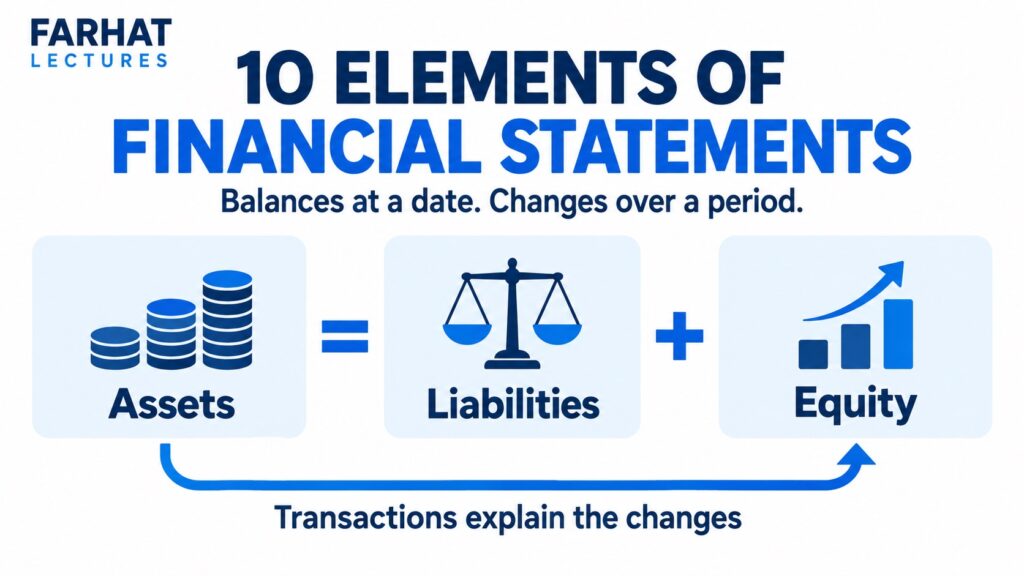
The elements of financial statements are the ten building blocks FASB uses to describe a company’s financial position and the changes in it. FASB Concepts Statement No. 8, Chapter 4 names them: assets, liabilities, equity, investments by owners, distributions to owners, comprehensive income, revenues, expenses, gains, and losses. Three describe position at a date; seven describe changes over a period.
That split matters. It helps you avoid calling every cash receipt revenue and every cash payment an expense. FASB issued this list in Concepts Statement No. 8, Chapter 4 (December 2021), which replaced the older Concepts Statement No. 6. If your textbook still quotes Concepts Statement 6, the ten names are the same, but the definitions of assets and liabilities were updated.
Practice as you learn: Try the Elements of Financial Statements Interactive Exercise — match six FASB elements with their definitions.
Watch: Elements of Financial Statements
In this video, Professor Farhat walks through all ten elements of financial statements. He shows why three elements describe a position at a date while seven describe changes over a period, and why money from an owner is never revenue. Watch it first, then use the table below to review each definition and example.
This lesson is part of the Intermediate Accounting course. If you want to see more lessons like this before enrolling, start with the free sample course.
What are the ten elements of financial statements?
The table below paraphrases the concepts in FASB Concepts Statement 8, Chapter 4. The illustrations are hypothetical learning examples, not a replacement for transaction-specific accounting standards.
| Element | Plain-language meaning | Simple illustration |
|---|---|---|
| 1. Assets | Existing rights to economic benefits | A right to collect cash from a customer |
| 2. Liabilities | Existing obligations to transfer economic benefits | An amount owed to a supplier |
| 3. Equity | What remains after liabilities are deducted from assets (called net assets for not-for-profit entities) | Owners’ residual interest |
| 4. Investments by owners | Contributions received in exchange for ownership interests | An owner contributes cash for shares |
| 5. Distributions to owners | Transfers to owners that reduce their equity | A cash dividend |
| 6. Comprehensive income | Nonowner changes in equity over the period | Net income plus other comprehensive income (for example, an unrealized gain on certain investments) |
| 7. Revenues | Increases in assets or reductions of liabilities from providing goods, services, or other activities | Fees from completed repair services |
| 8. Expenses | Assets used or obligations incurred in providing goods, services, or other activities | Wages for services received |
| 9. Gains | Other increases in equity, excluding revenues and owner investments | A gain on selling used office equipment |
| 10. Losses | Other decreases in equity, excluding expenses and owner distributions | A loss on selling used office equipment |
Which financial statement reports each element?
Each element has a home. Knowing where it lands helps you see why FASB separates balances from changes.
| Element | Where it appears |
|---|---|
| Assets, liabilities, equity | Balance sheet (also called the statement of financial position) |
| Revenues, expenses, gains, losses | Income statement |
| Comprehensive income | Statement of comprehensive income (net income plus other comprehensive income) |
| Investments by owners, distributions to owners | Statement of changes in stockholders’ equity |
Notice that net income is not on the list. Net income is a subtotal that collects revenues, expenses, gains, and losses. It is not one of the ten elements. The same goes for cash and retained earnings. They are accounts that fit inside an element (cash is an asset, retained earnings is part of equity), not elements themselves.
Which elements describe financial position at a date?
These three elements answer a snapshot question: “What is the entity’s position now?” The familiar equation is Assets = Liabilities + Equity. Rearranging it gives Equity = Assets − Liabilities.
Hypothetical example: Willow Services reports $75,000 of assets and $28,000 of liabilities at December 31. Its equity is $47,000. That residual is not a separate pile of cash. The assets may include several kinds of resources.
An asset is not simply any valuable thing associated with a business. Identify the present right. Employees may be highly skilled, but calling them valuable does not by itself establish an asset the company can recognize.
Likewise, a liability is an existing obligation, not merely management’s intention to spend money someday. The definition matters before you debate the amount.
Why are owner transactions not revenue or expenses?
If an owner contributes $8,000 in exchange for an ownership interest, the company’s cash and equity increase. That increase is an investment by an owner, not revenue earned from a customer.
If the company later distributes $2,000 to owners in their capacity as owners, equity decreases. That distribution is not an expense of earning revenue. Always identify why the company received or transferred resources.
Revenues, expenses, gains, and losses describe nonowner effects that contribute to comprehensive income. Comprehensive income is an inclusive measure of nonowner equity changes; it should not be added again on top of its components.
What is the difference between revenue and gain, expense and loss?
Students sometimes use “revenue” for every positive amount and “expense” for every negative amount. The right label depends on what the business was actually doing.
Hypothetical example: A repair business earns $3,000 by fixing customers’ equipment. That illustrates service revenue. If it sells an old office desk with a carrying amount of $200 for $260, the $60 difference illustrates a gain; the $260 proceeds are not all gain.
If the same desk sells for $170, the $30 difference illustrates a loss. By contrast, wages for the repair work illustrate an expense. We are building vocabulary here. The journal entries for disposals come later in the course.
The labels “usual” and “unusual” can be clues, but do not use frequency as the only test. Ask what the transaction represents in the entity’s activities and apply the relevant definitions.
How do the financial statements connect? (Articulation)
Articulation means related figures connect across financial statements. Period changes help explain the movement between beginning and ending balances.
Hypothetical example: Willow begins the year with $47,000 of equity. Owners invest $8,000, the business has $12,000 of comprehensive income, and it distributes $2,000 to owners. Assuming no other changes, ending equity is $65,000:
$47,000 + $8,000 + $12,000 − $2,000 = $65,000
Do not call the full $18,000 increase in equity comprehensive income. The net $6,000 from owner transactions explains part of that increase. Separating owner and nonowner changes is the key.
This connection illustrates why the conceptual framework defines both balances and changes. The statements describe one entity from related perspectives.
Why is meeting a definition not the same as recognition?
Knowing that an item fits a definition starts the analysis. It does not automatically settle when or at what amount the item appears in financial statements. Recognition and measurement add those questions.
Also avoid counting cash twice in your thinking. A loan receipt increases cash but creates an obligation. A customer payment may settle an existing receivable. Neither fact alone proves new revenue arose at the moment cash arrived.
Clear classification supports faithful representation and comparability. Readers need to distinguish performance from financing and owner transactions.
Common exam traps with the elements of financial statements
These are the mistakes that cost students points on this topic.
- Picking net income as an element. Net income is a subtotal. Comprehensive income is the element.
- Calling a dividend an expense. A cash dividend is a distribution to owners. It reduces equity but is never an expense, so it never touches net income.
- Treating the whole sale price as a gain. If equipment with a carrying amount (the asset’s cost minus accumulated depreciation) of $9,000 sells for $7,500, the loss is $1,500, not $7,500.
- Using frequency as the only test for revenue versus gain. A car dealer selling a car earns revenue. A law firm selling its old office car records a gain or loss. The activity, not how often it happens, decides.
- Quoting the old asset definition. Older notes say an asset is a “probable future economic benefit.” The current definition in Concepts Statement 8, Chapter 4 is “a present right of an entity to an economic benefit.” Read the question to see which wording it uses.
- Assuming equity is cash. Equity is a residual, which means what is left after liabilities are subtracted from assets. It is not a bank balance.
Practice questions with explanations
1. Assets are $92,000 and liabilities are $37,000. What is equity?
Answer: $55,000. Equity is the residual: $92,000 − $37,000. It does not necessarily equal the company’s cash balance.
2. An owner contributes $15,000 for shares. Is that revenue?
Answer: No. It is an investment by an owner. Cash and equity increase through an ownership transaction rather than earnings.
3. Equity increases by $11,000, including $4,000 of owner investment and no distributions. What is comprehensive income?
Answer: $7,000, assuming no other owner changes. Remove the owner contribution from the total equity increase: $11,000 − $4,000.
4. Which of the following is not one of FASB’s ten elements: comprehensive income, net income, distributions to owners, or losses?
Answer: Net income. It is a subtotal of revenues, expenses, gains, and losses, not an element. The other three are all elements.
5. Equipment with a carrying amount of $9,000 sells for $7,500. What is reported?
Answer: A $1,500 loss. The loss is the carrying amount minus the proceeds: $9,000 − $7,500. The $7,500 is cash received, not a loss.
Key takeaways
- FASB Concepts Statement No. 8, Chapter 4 defines ten elements of financial statements.
- Assets, liabilities, and equity describe financial position at a date. The other seven describe changes during a period.
- Investments by owners and distributions to owners are owner transactions. They are never revenue or expenses.
- Revenues and expenses come from the entity’s activities. Gains and losses are the other nonowner changes in equity.
- Comprehensive income equals net income plus other comprehensive income. Net income itself is not an element.
- Fitting a definition is the first step. Recognition and measurement decide when and at what amount an item appears.
Frequently asked questions
Are elements the same as financial statements?
No. Elements are categories such as assets and expenses. Statements organize information about those categories.
Is comprehensive income always net income?
No. Net income is a subtotal. Comprehensive income is the element, and it equals net income plus other comprehensive income (OCI). OCI holds items that bypass net income, such as unrealized gains and losses on available-for-sale debt securities, foreign currency translation adjustments, certain pension adjustments, and the effective portion of cash flow hedges.
Why are there ten elements if I learned five before?
Introductory textbooks and the IASB’s Conceptual Framework for Financial Reporting use five elements: assets, liabilities, equity, income, and expenses. Under IFRS, income includes both revenues and gains, and expenses include losses. FASB’s framework splits those and adds investments by owners, distributions to owners, and comprehensive income, which gives ten. This lesson follows the FASB list because that is what U.S. GAAP and the CPA Exam use. For more on the two boards, see FASB vs IASB.
Which financial statement reports each element?
Assets, liabilities, and equity appear on the balance sheet. Revenues, expenses, gains, and losses appear on the income statement. Comprehensive income appears on the statement of comprehensive income, which adds other comprehensive income to net income. Investments by owners and distributions to owners appear on the statement of changes in stockholders’ equity.
What is the difference between revenue and a gain?
Revenue comes from delivering goods, rendering services, or carrying out the entity’s other activities. A gain is any other increase in equity that is not revenue and not an investment by owners, such as selling old equipment for more than its carrying amount. Only the difference between the proceeds and the carrying amount is the gain, never the full sale price.
Did Concepts Statement 8, Chapter 4 replace Concepts Statement 6?
Yes. FASB issued Concepts Statement No. 8, Chapter 4, Elements of Financial Statements, in December 2021. It replaced Concepts Statement No. 6. The ten element names did not change, but the definitions of assets and liabilities now use “present right” and “present obligation” instead of “probable future economic benefits” and “probable future sacrifices.”
Are the elements of financial statements tested on the CPA exam?
Yes. The FAR section of the CPA Exam covers the conceptual framework in Area I, Financial Reporting. Typical questions ask you to identify which item is or is not an element, to separate revenues from gains, or to compute comprehensive income from changes in equity. The elements also underpin the external financial reporting topics in CMA Part 1.
About the author
Professor Mansour Farhat, CPA, CIA, DBA, is the founder of Farhat Lectures and its YouTube channel. He earned a Doctor of Business Administration from Temple University (2025) and a Master of Accountancy from Bloomsburg University (2004). He teaches intermediate accounting, auditing, and CPA, CMA, and EA exam review. Read more about Professor Farhat.



Responses