
FASB Conceptual Framework: 8 Chapters Made Simple

Written by Professor Mansour Farhat, DBA, CPA, CIA · Last updated: October 2026
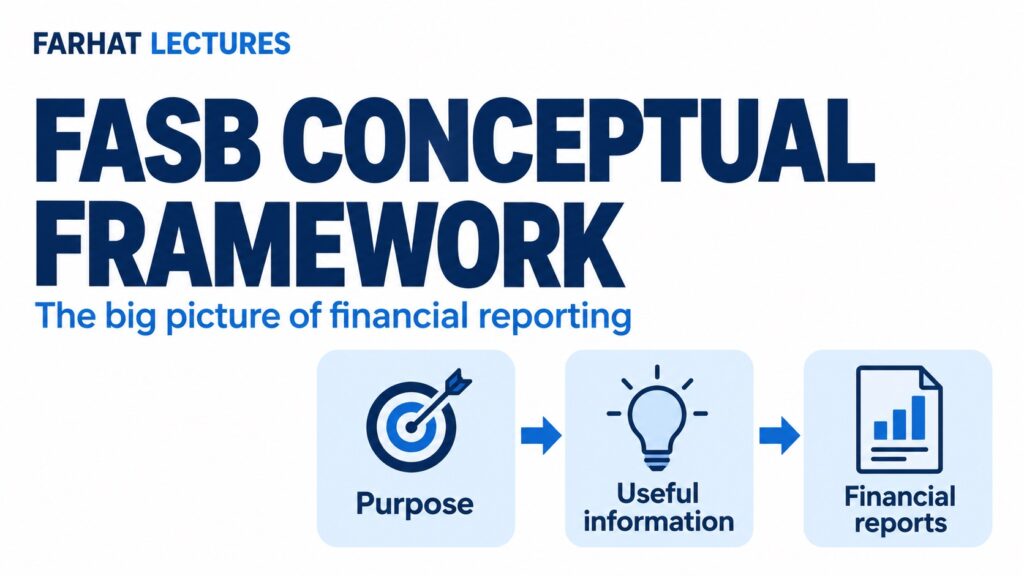
The FASB conceptual framework is the set of connected ideas the Financial Accounting Standards Board (FASB) uses to develop financial reporting standards. It is published as FASB Concepts Statement No. 8 and has eight chapters: objective, reporting entity, qualitative characteristics, elements, recognition and derecognition, measurement, presentation, and notes. It guides standard setting, but it is not itself GAAP.
Watch: FASB conceptual framework with Farhat
Watch Professor Farhat explain the purpose of the FASB conceptual framework, the objective of financial reporting, and the qualities that make accounting information useful. Use this introductory lesson alongside the eight-chapter guide below.
Watch Farhat’s FASB conceptual framework lesson on YouTube · About 13 minutes
In this video, Professor Farhat covers:
- The objective of financial reporting and who the users are
- The qualitative characteristics that make information useful, including relevance and faithful representation
- The elements of financial statements
Study connection: As you watch, identify who uses financial information and what makes it useful. Then apply those ideas to the Cedar Repair example and practice questions below.
Why does the FASB conceptual framework matter?
Imagine learning every journal entry as a separate rule. A new transaction would leave you guessing. A framework gives you a common starting point: identify the economic event, the information users need, and the qualities that make its depiction useful.
It also helps standard setters work consistently across different issues. Without shared concepts, one standard might favor useful information while another favors a convenient result for a particular industry. The framework provides a reasoned basis for discussing those choices.
However, a concept is not permission to ignore a specific standard. FASB explicitly describes its framework as a foundation for setting standards, rather than a direct replacement for existing GAAP. When a homework question supplies a specific accounting requirement, apply that requirement. Specific requirements live in the Codification and change through an Accounting Standards Update, not through the framework.
Who are financial reports for, and which entity do they describe?
General-purpose financial reporting helps existing and potential investors, lenders, and other creditors decide whether to provide resources to an entity. Investors may consider buying or holding shares. Lenders may assess whether a borrower can make future payments.
These users need help assessing future cash flows: how much cash may be available, when it may arrive, and how uncertain it is. Financial reports supply evidence for those assessments; they do not guarantee future outcomes.
The reporting entity is the entity whose activities and resources the reports describe. Start by asking, “Whose financial information am I reading?” That question prevents mixing the company’s financial picture with the personal finances of an investor.
General-purpose reports address common information needs. They cannot provide a custom report answering every question for every reader. Users are expected to bring reasonable business knowledge and study the information with care.
What are the 8 chapters of the FASB conceptual framework?
| Chapter | Learning question |
|---|---|
| 1. Objective | Why provide financial information, and for whom? |
| 2. Reporting entity | Which entity is being described? |
| 3. Qualitative characteristics | What makes information useful? |
| 4. Elements | What kinds of resources, claims, and changes are represented? |
| 5. Recognition and derecognition | When should an item enter or leave the statements? |
| 6. Measurement | What numerical amount should describe it? |
| 7. Presentation | How should line items and totals communicate it? |
| 8. Notes | What additional explanation does the reader need? |
The chapter numbers identify FASB framework chapters, not eight separate textbook lessons. They are parts of one system. The FASB Concepts Statement 8 collection is the primary reference.
The FASB built these chapters over many years and finished the job in July 2024, when it issued Chapter 6, Measurement. Concepts Statement No. 8 replaced the earlier Concepts Statements over time, so if your textbook cites Concepts Statement No. 2 or No. 6, you are looking at older labels for the same ideas.
What does each chapter of the FASB conceptual framework say?
The table above gives you the question each chapter answers. Here is the short version of each answer.
Chapter 1: The objective of general-purpose financial reporting
The objective is to provide financial information about the reporting entity that is useful to existing and potential investors, lenders, and other creditors when they decide whether to provide resources to the entity. Those users need information that helps them assess the amount, timing, and uncertainty of the entity’s future cash flows.
Chapter 2: The reporting entity
A reporting entity is the entity whose economic activities the financial reports describe. It can be a single legal entity, a group of entities presented together in consolidated statements, or a portion of an entity, as long as the resulting information is useful to users.
Chapter 3: Qualitative characteristics of useful financial information
Two fundamental characteristics make information useful. Relevance means the information can make a difference in a decision because it has predictive value, confirmatory value, or both. Materiality is the company-specific side of relevance. Faithful representation means the information is complete, neutral, and free from error. Neutral means the information is not slanted to make the company look better or worse than it is.
Four enhancing characteristics make useful information even more useful: comparability, verifiability, timeliness, and understandability. All of this is subject to the cost constraint: the benefits of reporting should justify the cost of producing it.
Chapter 4: Elements of financial statements
The elements are the building blocks of the statements. There are ten: assets, liabilities, equity (also called net assets), investments by owners, distributions to owners, comprehensive income, revenues, expenses, gains, and losses. An asset is a present right of an entity to an economic benefit. A liability is a present obligation of an entity to transfer an economic benefit. Our elements of financial statements guide walks through all ten.
Chapter 5: Recognition and derecognition
Recognition is the process of including an item in the financial statements in both words and numbers. An item should be recognized when it meets the definition of an element, can be measured, and the resulting information is relevant and faithfully represented. Derecognition is the removal of a recognized item when it no longer meets those criteria, for example when a company sells an asset or settles a liability. Putting an amount in the notes is not a substitute for recognizing it in the statements.
Chapter 6: Measurement
Measurement answers what amount to attach to a recognized asset or liability. Chapter 6 describes two measurement systems that can produce relevant and faithfully represented amounts: an entry price system, based on what the entity paid or would pay to acquire the item, and an exit price system, based on what the entity would receive to sell the asset or pay to transfer the liability. It also discusses how to choose between them. Chapter 6 was issued in July 2024 and completed the framework.
Chapter 7: Presentation
Presentation covers how recognized items are grouped and displayed in the financial statements: which line items appear, how they are classified, and which subtotals and totals are shown so that users can see the relationships between items.
Chapter 8: Notes to financial statements
Notes explain and supplement the amounts in the statements. They describe the reporting entity, the accounting policies and judgments behind the numbers, and other information that helps users understand the line items. Notes are a required part of a complete set of financial statements, not an optional extra.
A simple example connecting the framework
Hypothetical example: Cedar Repair buys equipment for $12,000 in cash. A student wants to understand how this purchase fits into financial reporting. Assume the transaction qualifies for the ordinary equipment accounting used in the assignment.
First, identify Cedar as the reporting entity. An outside lender may care about Cedar’s available cash and productive resources. The purchase changes the mix of its assets: it gives up cash and receives equipment, a resource it now controls and expects to use to earn future benefits.
Next, distinguish the questions. Whether equipment belongs in the statements is a recognition question. The amount assigned to it is a measurement question. Where it appears and how it is grouped are presentation questions. An explanation of the accounting policy belongs in the notes.
A useful report must also describe the purchase faithfully and provide relevant information. For example, recording a larger amount simply to make Cedar look stronger would undermine neutrality. Our qualitative characteristics guide explains that quality test.
This example is a map, not a complete equipment-accounting lesson. The framework organizes the reasoning; detailed standards supply the rules for a specific transaction.
How to study the connections
Read the framework in three passes. Begin with purpose and entity. Then study the qualities and elements of financial statements. Finally, connect those ideas to recognition, measurement, presentation, and notes, using the chapter summaries above.
Keep the cost constraint in view. Producing and using information consumes resources, so the benefits of reporting should justify its costs. This constraint informs standard setting; it is not an unrestricted option for a company to avoid required accounting.
Also separate the broad usefulness of information from its importance in a particular company. That company-specific judgment is called materiality. Information is material if leaving it out or misstating it could change a decision that an investor or lender makes about that company. Materiality is the entity-specific side of relevance, so a $500 error can be material for a small repair shop and immaterial for a large manufacturer.
Common mistakes
- Treating the framework as GAAP: concepts guide standards but do not override them.
- Equating useful information with good news: disappointing results may be essential to a lender’s decision.
- Thinking notes are optional decoration: numbers often need explanations to convey a complete picture.
- Expecting one report to answer everything: general-purpose reporting serves common needs and has limitations.
How do the CPA and CMA exams test the FASB conceptual framework?
On the CPA Exam, this topic belongs to the FAR section (Financial Accounting and Reporting). On the CMA exam, it supports Part 1, Section A, External Financial Reporting Decisions. The EA exam focuses on tax and does not test the FASB framework directly.
Exam questions rarely ask you to recite chapter titles. They describe a situation and ask which concept applies. Practice spotting these five traps:
- Treating the framework as GAAP. Concepts Statements are nonauthoritative. If a question gives you a specific standard, apply the standard.
- Confusing recognition with disclosure. Explaining an item in the notes is not the same as recognizing it in the statements.
- Mixing up the ingredients of relevance and faithful representation. Predictive value, confirmatory value, and materiality belong to relevance. Complete, neutral, and free from error belong to faithful representation.
- Calling comparability or timeliness fundamental. They are enhancing characteristics. Only relevance and faithful representation are fundamental.
- Assuming the FASB and IASB frameworks are the same document. They are similar in structure but are separate documents issued by separate boards. See our FASB vs IASB lesson.
Professor Farhat covers every chapter in depth in the Intermediate Accounting course. CPA candidates can drill this topic further in the FAR Test Bank.
Practice questions with explanations
1. Can management override a specific standard using a framework concept?
Answer: No. The FASB conceptual framework is nonauthoritative. It sits outside the FASB Accounting Standards Codification (ASC), which is the single source of authoritative U.S. GAAP for nongovernmental entities, and ASC 105 lists Concepts Statements among the nonauthoritative sources. An appealing conceptual argument does not replace the applicable GAAP requirement.
2. A bank studies a borrower’s resources before renewing a loan. Which objective does this illustrate?
Answer: Helping a resource provider make a decision. The bank uses financial information to evaluate potential repayment and uncertainty.
3. A report explains what a debt balance represents. Is that measurement or notes?
Answer: Notes. The numerical amount involves measurement. Explaining its nature and relevant terms is a disclosure function.
4. Which qualitative characteristic is fundamental rather than enhancing?
a) Comparability
b) Timeliness
c) Faithful representation
d) Verifiability
Answer: c) Faithful representation. Relevance and faithful representation are the two fundamental characteristics. Comparability, verifiability, timeliness, and understandability enhance useful information, but they cannot make irrelevant or misrepresented information useful.
5. Cedar Repair’s accountant suggests leaving the $12,000 equipment purchase off the balance sheet and describing it only in the notes, because “the notes explain everything.” Which concept does this violate?
Answer: Recognition. The equipment meets the definition of an asset, its $12,000 cost is measurable, and reporting it gives users relevant and faithfully represented information, so it must be recognized in the statements. A note is not a substitute for recognition.
Key takeaways
- The FASB conceptual framework is Concepts Statement No. 8. It has eight chapters and was completed in July 2024.
- It guides the FASB when it writes standards. It is nonauthoritative and never overrides a specific GAAP requirement.
- Financial reports exist for investors, lenders, and other creditors who need to assess future cash flows.
- Useful information is relevant and faithfully represented. Comparability, verifiability, timeliness, and understandability make it more useful.
- Recognition, measurement, presentation, and notes are four different questions. Learn to tell them apart.
Frequently asked questions
Is the FASB conceptual framework only a list of definitions?
No. Definitions are one part. The framework connects the reporting objective to qualities, recognition, measurement, presentation, and explanatory notes.
Is financial reporting intended only for managers?
No. The objective emphasizes outside investors, lenders, and other creditors. Management can often obtain additional internal information.
Should I memorize the chapter numbers?
Know them if your course requires it, but practice matching a question to its concept. That skill is more useful than reciting a list without understanding it.
What are the 8 chapters of the FASB conceptual framework?
The eight chapters of Concepts Statement No. 8 are: (1) the objective of general-purpose financial reporting, (2) the reporting entity, (3) qualitative characteristics of useful financial information, (4) elements of financial statements, (5) recognition and derecognition, (6) measurement, (7) presentation, and (8) notes to financial statements.
Is the FASB conceptual framework part of GAAP?
No. Concepts Statements are nonauthoritative. They sit outside the FASB Accounting Standards Codification, which is the single source of authoritative U.S. GAAP for nongovernmental entities. The FASB uses the framework to develop standards. When the Codification does not address a transaction, preparers may consider nonauthoritative sources, including the Concepts Statements. New standards reach the Codification through an Accounting Standards Update, not through the framework.
When was the FASB conceptual framework completed?
The FASB issued the final chapter, Chapter 6, Measurement, in July 2024. The first chapters of Concepts Statement No. 8 were issued in 2010, and the project replaced the earlier Concepts Statements, the first of which dates to 1978.
What is the difference between the FASB and IASB conceptual frameworks?
Both describe the objective of financial reporting, qualitative characteristics, elements, recognition, and measurement, and the two boards worked on the early chapters together. But they are separate documents. The FASB’s is Concepts Statement No. 8, and the IASB’s is the Conceptual Framework for Financial Reporting, revised in 2018. Details differ, so check which one your course or exam uses.
About the author

Professor Mansour Farhat, DBA, CPA, CIA, MAcc, is the founder of Farhat Lectures and its YouTube channel. He holds a doctorate in business administration from Temple University and a master’s in accountancy from Bloomsburg University, and he teaches accounting students from their first course through the CPA, CMA, and EA exams. Read more about Professor Farhat.
Learn with Farhat Lectures
This lesson comes from the Intermediate Accounting course, where Professor Farhat walks through every chapter of the framework with more examples and practice. Start with the free sample course, or go straight to the full course when you are ready.
Try the free sample course →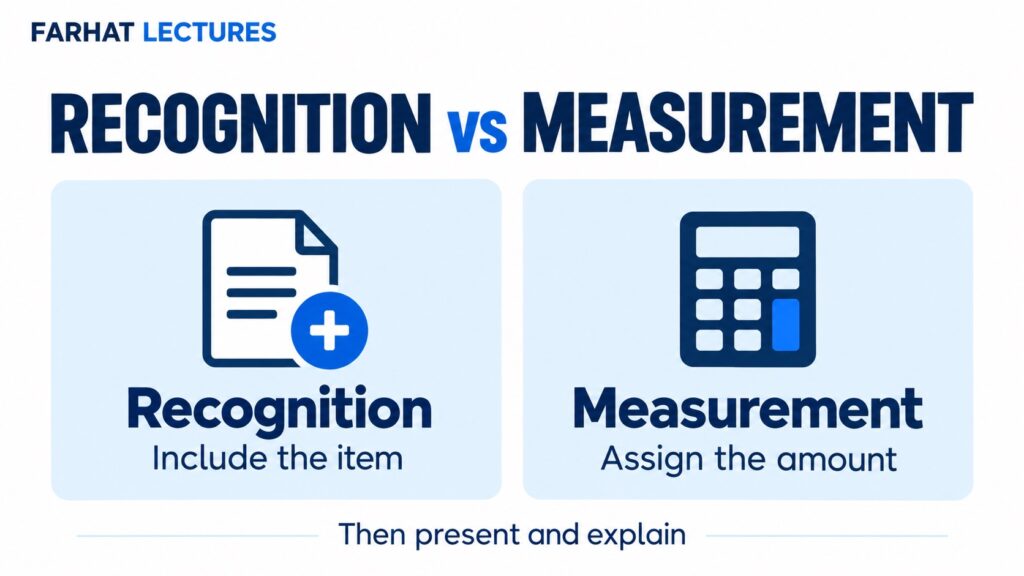
Responses