
FASB vs IASB: 5 Key Differences Made Simple

Last updated:
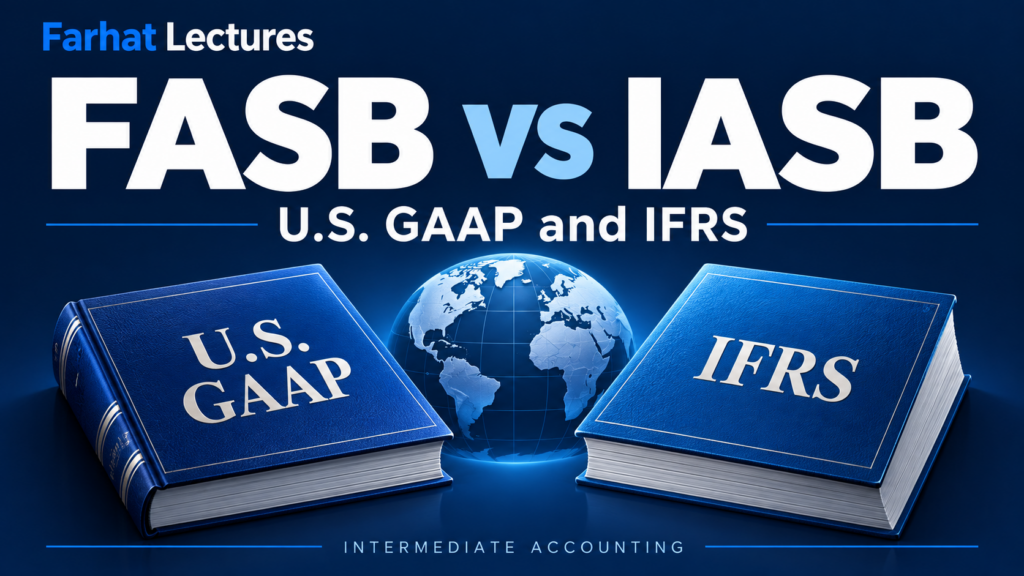
The FASB (Financial Accounting Standards Board) sets U.S. GAAP for nongovernmental entities. The IASB (International Accounting Standards Board) sets IFRS Accounting Standards, which more than 140 jurisdictions require for listed companies. The FASB, formed in 1973, answers to the Financial Accounting Foundation. The IASB, formed in 2001, answers to the IFRS Foundation. They cooperate, but their standards differ.
For intermediate accounting, start with the pairing: FASB → U.S. GAAP; IASB → IFRS Accounting Standards. This lesson covers the two organizations, how they work together, and the handful of U.S. GAAP vs IFRS differences you are most likely to be tested on. Exam note: the AICPA removed U.S. GAAP vs IFRS differences from the CPA Exam FAR blueprint in 2021, and they are not in the current blueprints, so CPA candidates mainly need the big picture. The CMA exam still lists major U.S. GAAP vs IFRS differences in Part 1, Section A.
FASB vs IASB: 5 differences to understand
| Point of comparison | FASB | IASB |
|---|---|---|
| What it sets | U.S. GAAP for nongovernmental entities, organized in the FASB Accounting Standards Codification (ASC). New rules are issued as Accounting Standards Updates (ASUs) that amend the ASC. | IFRS Accounting Standards. Older standards issued by its predecessor, called IAS, stay in force until replaced. Interpretations come from the IFRS Interpretations Committee. |
| Where the standards apply | Required for U.S. public companies by the SEC. Used by U.S. private companies and not-for-profits that follow GAAP. | Required for listed companies in more than 140 jurisdictions, including the European Union, the United Kingdom, Canada and Australia. Not permitted for U.S. domestic public companies. |
| Oversight and location | Overseen and funded by the Financial Accounting Foundation (FAF), which also oversees the GASB. Based in Norwalk, Connecticut. | Overseen by the IFRS Foundation Trustees, who answer to a Monitoring Board of capital markets authorities that includes the SEC. Based in London. |
| Formed and size | 1973, replacing the Accounting Principles Board. 7 full-time members. | 2001, replacing the International Accounting Standards Committee (formed 1973). 14 members. |
| Style and where research starts | Often described as more rules-based. Research starts in the ASC, plus SEC rules for public companies. | Often described as more principles-based. Research starts in the individual standard, for example IAS 2 Inventories, plus any IFRIC interpretation. |
These five points cover who the boards are, what they issue, and where their standards apply. The sections below cover what the boards share, what convergence changed, and how the standards themselves differ on the rules students get tested on. For the official descriptions, see FASB’s overview and the IFRS Foundation’s description of the IASB.
When comparing FASB vs IASB, avoid treating the organizations as the frameworks themselves. A board is a standard-setting body. U.S. GAAP and IFRS refer to accounting requirements. Keeping “who develops the guidance?” separate from “which guidance applies?” makes the abbreviations easier to understand.
What do the two boards have in common?
Both boards work to develop high-quality financial reporting standards. Useful standards help investors and other users understand a company’s financial position and performance. More understandable and comparable information can support decisions about providing resources to a business.
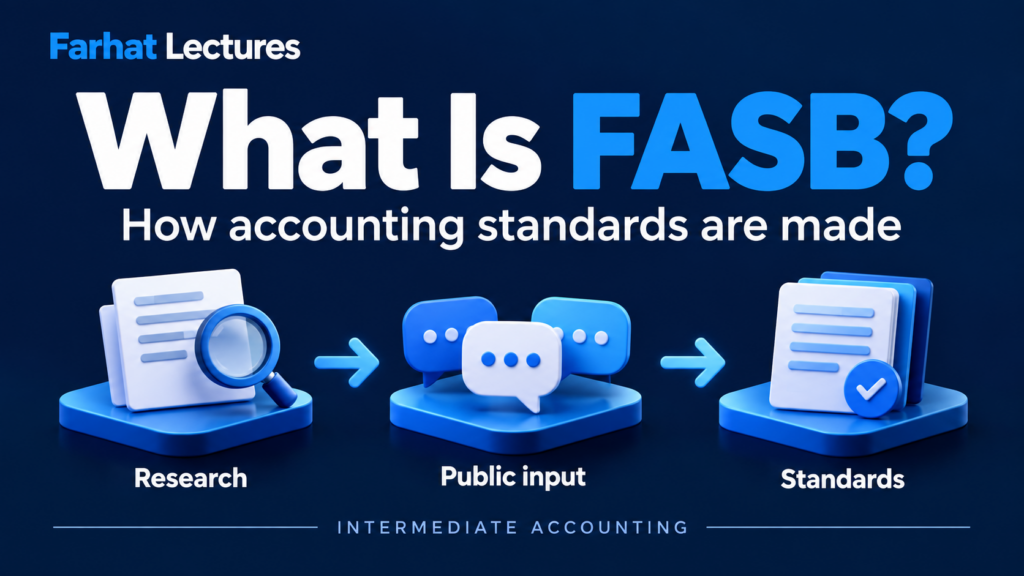
Both also follow a public due process. A project starts with research, moves to a public exposure draft, collects comment letters from preparers, auditors, investors and academics, and ends with a final standard. Both boards also publish a conceptual framework that explains the ideas behind their standards. Sharing a goal and a process does not mean they reach the same conclusions, and sometimes they do not.
A useful way to study FASB vs IASB is to make two lists: shared purpose and distinct responsibilities. Put useful financial reporting and public input on the first list. Put each organization’s name, framework, and institutional setting on the second. This keeps similarities from obscuring the differences.
What does convergence mean?
Convergence means working to bring U.S. GAAP and IFRS closer together. The effort became formal in September 2002, when the FASB and the IASB signed the Norwalk Agreement and committed to making their standards compatible and coordinating future projects. The biggest results came later: a joint revenue recognition standard in 2014 (ASC 606 and IFRS 15) and lease standards issued within weeks of each other in 2016 (ASC 842 and IFRS 16). The formal joint program has since ended, and the boards now set standards separately while still sharing research. The SEC never adopted IFRS for U.S. companies. Since 2007 it has allowed foreign companies listed in the United States to file IFRS financial statements without reconciling to U.S. GAAP, but U.S. domestic public companies must still use U.S. GAAP. Convergence improved comparability. It never made the two frameworks identical.
For example, two standards can address the same transaction and share important ideas while retaining differences. A student should therefore identify the required framework before applying guidance. Do not take a conclusion reached under one framework and assume it automatically applies under the other.
The broader financial reporting lesson is that investors may compare companies across national borders. Different reporting frameworks can complicate that comparison. Work toward high-quality, more comparable standards addresses that problem, but the framework used in a particular set of statements still matters.
How do U.S. GAAP and IFRS actually differ? 6 rules students see most
Convergence narrowed the gap, but these six differences still show up in textbooks, CMA Part 1 questions and real financial statements. Each row names the standard so you can look it up.
| Topic | U.S. GAAP (FASB) | IFRS (IASB) |
|---|---|---|
| Inventory cost flow | LIFO (last-in, first-out) is allowed (ASC 330). | LIFO is prohibited (IAS 2). Companies use FIFO or weighted average. |
| Inventory write-downs | A write-down to net realizable value creates a new cost basis and is never reversed. | A write-down is reversed, up to the original cost, if net realizable value recovers (IAS 2). |
| Development costs | Research and development costs are expensed as incurred (ASC 730). Certain software costs have their own rules. | Research is expensed, but development costs are capitalized as an intangible asset once six criteria in IAS 38 are met, including technical feasibility and the intention and ability to complete and use or sell the asset. |
| Property, plant and equipment | Carried at historical cost less depreciation. Upward revaluation is not allowed. | Choice of cost model or revaluation model (IAS 16). Revaluation increases generally go to other comprehensive income as a revaluation surplus. |
| Impairment of long-lived assets held and used | Two-step test (ASC 360). Step 1: compare the carrying amount with undiscounted future cash flows. Step 2: if not recoverable, the loss is carrying amount minus fair value. Reversals are prohibited. | One-step test (IAS 36). The loss is carrying amount minus recoverable amount, which is the higher of fair value less costs of disposal and value in use. Reversals are recognized if the recoverable amount recovers, except for goodwill. |
| Lessee expense pattern | Two models (ASC 842). Finance leases show interest plus amortization, so expense is front-loaded. Operating leases show one straight-line lease cost. Both types go on the balance sheet. | One model (IFRS 16). All leases are accounted for like finance leases, with depreciation plus interest. IFRS 16 also exempts low-value assets, an exemption U.S. GAAP does not offer. |
Exam tip: if you are preparing for the CMA exam, Part 1, Section A lists major differences between U.S. GAAP and IFRS. LIFO, inventory write-down reversals, revaluation and impairment reversals are the ones review materials emphasize most. Want every difference worked through with practice problems? Professor Farhat’s International Accounting course covers them in order, and the CMA Part 1 course covers the ones tested on that exam.
Watch: GAAP, IFRS, and global comparability
In this short segment, Professor Farhat explains why differences between U.S. GAAP and IFRS matter when investors compare companies across borders. Watch the discussion, then apply the ideas to the example below.
A worked example: the same inventory, two different answers
Lakeside Manufacturing reports under U.S. GAAP. Ocean Manufacturing reports under IFRS Accounting Standards. Each company bought identical inventory for $100,000. At the end of Year 1, the net realizable value of that inventory (the expected selling price minus the costs to sell it) fell to $80,000. At the end of Year 2, the inventory is still on hand and its net realizable value has recovered to $95,000. Both companies sell it in Year 3 for $95,000.
Year 1 is the same for both. Each writes the inventory down by $20,000 ($100,000 minus $80,000):
Debit Cost of goods sold 20,000
Credit Inventory 20,000
Year 2 is where the frameworks split.
Lakeside (U.S. GAAP, ASC 330): no entry. The write-down created a new cost basis of $80,000, and U.S. GAAP does not allow a write-down to be reversed.
Ocean (IFRS, IAS 2): reverses $15,000, because net realizable value recovered from $80,000 to $95,000. A reversal is capped at the original $20,000 write-down, so inventory can never go above its $100,000 cost:
Debit Inventory 15,000
Credit Cost of goods sold (reversal of write-down) 15,000
Year 3, both companies sell the inventory for $95,000. Lakeside reports gross profit of $15,000 ($95,000 minus $80,000). Ocean reports gross profit of $0 ($95,000 minus $95,000).
| Lakeside (U.S. GAAP) | Ocean (IFRS) | |
|---|---|---|
| Year 1 effect on profit | (20,000) | (20,000) |
| Inventory at end of Year 2 | 80,000 | 95,000 |
| Year 2 effect on profit | 0 | +15,000 |
| Year 3 gross profit | +15,000 | 0 |
| Total over three years | (5,000) | (5,000) |
Both companies lose $5,000 on the same inventory over three years. What differs is the timing and the balance sheet. An investor comparing Year 2 earnings without knowing the framework would think Ocean had the better year. That is why the first step in any cross-border comparison is to identify the framework, and only then read the numbers.
Common mistakes in FASB vs IASB questions
“The IASB is a department of FASB.” Incorrect. The IASB is a separate board within the IFRS Foundation. Cooperation between the organizations does not make one part of the other.
“FASB issues IFRS Accounting Standards.” Incorrect. Pair the Board with nongovernmental U.S. GAAP. Pair the IASB with IFRS Accounting Standards.
“Every company outside the United States uses IFRS.” Too broad. Reporting requirements depend on jurisdiction and entity circumstances. Do not turn widespread international use into a claim that every business follows exactly the same requirements.
“Convergence means the frameworks are identical.” Incorrect. The boards can cooperate while differences remain. Read the applicable guidance for the question you are answering.
“U.S. companies can pick IFRS if they want.” Incorrect. The SEC lets foreign private issuers file IFRS as issued by the IASB without reconciliation to U.S. GAAP, but U.S. domestic public companies must use U.S. GAAP.
“IFRS differences are a big part of the CPA FAR exam.” Outdated. The AICPA removed U.S. GAAP vs IFRS differences from the FAR blueprint in 2021. They are still tested on the CMA exam, Part 1, Section A.
If the abbreviations still feel crowded, start with what GAAP means and what FASB does. Then return to this comparison.
Practice questions: match the board and framework
1. Which organization develops IFRS Accounting Standards? The IASB. The wording asks for the standard-setting board, rather than the name of the accounting framework.
2. Does cooperation between the boards make U.S. GAAP and IFRS interchangeable? No. Cooperation can reduce differences, but the applicable requirements still need to be identified and followed.
3. A problem explicitly says an entity reports under U.S. GAAP. Should you choose IFRS guidance because the company sells internationally? No. International sales alone do not replace the reporting framework specified in the problem.
4. Ocean Co. (IFRS) wrote inventory down by $20,000 last year. This year the net realizable value of that inventory rose by $25,000. How much can Ocean reverse? $20,000. IAS 2 limits a reversal to the amount of the original write-down, so inventory never goes above its original cost. Under U.S. GAAP the answer would be $0, because reversals are not allowed.
5. Lakeside Co. (U.S. GAAP) uses LIFO for its inventory. Could Ocean Co. (IFRS) use LIFO too? No. IAS 2 prohibits LIFO, so IFRS companies use FIFO or weighted average. This is one of the most frequently tested U.S. GAAP vs IFRS differences.
Before the quiz: 5 conceptual framework ideas
- Standards: U.S. GAAP is often described as more rules-based and IFRS as more principles-based. This is a broad comparison; both require judgment and contain detailed requirements.
- Stewardship: Evaluate how well management has used the resources entrusted to it.
- Prudence (IASB framework): The IASB Conceptual Framework describes prudence as exercising caution when making judgments under uncertainty. It supports neutrality. It does not mean deliberately understating assets or income. The FASB framework does not use the term prudence; it relies on neutrality instead.
- Measurement uncertainty: Consider relevance together with how faithfully an estimate can represent the underlying item. Some uncertainty does not make information useless.
- Reporting entity: Financial reporting boundaries need not match legal boundaries. Both the IASB and FASB conceptual frameworks recognize this.
Conceptual frameworks explain the ideas behind standards; they do not override applicable accounting requirements. For the full FASB framework, see FASB Conceptual Framework: 8 Chapters Made Simple. See the IASB Conceptual Framework overview and FASB Concepts Statement No. 8, Chapter 2, The Reporting Entity (issued June 2023).
Review your results: Explain why each correct choice fits, then revisit any concept you missed. To reinforce the basics, return to the FASB vs IASB comparison table or the board-and-framework practice questions.
Key takeaways
- The FASB sets U.S. GAAP. The IASB sets IFRS Accounting Standards. They are separate organizations with separate oversight bodies, the Financial Accounting Foundation and the IFRS Foundation.
- FASB: formed 1973, Norwalk, Connecticut, 7 full-time members. IASB: formed 2001, London, 14 members.
- Convergence, starting with the 2002 Norwalk Agreement, narrowed the gap, especially on revenue (2014) and leases (2016), but differences remain.
- The differences students see most: LIFO (U.S. GAAP only), inventory write-down reversals (IFRS only), development cost capitalization (IFRS only), PP&E revaluation (IFRS only), one-step vs two-step impairment, and one vs two lessee expense models.
- U.S. domestic public companies must use U.S. GAAP. Foreign private issuers may file IFRS with the SEC without reconciliation.
- Exam note: the CPA FAR blueprint no longer tests U.S. GAAP vs IFRS differences. CMA Part 1 still does.
Frequently asked questions about FASB vs IASB
Is IASB the same as IFRS?
No. IASB is the board. IFRS Accounting Standards are the standards it develops, in the same way that FASB is the board and U.S. GAAP is the body of rules.
What is the difference between FASB and IASB in one sentence?
The FASB sets U.S. GAAP for the United States, and the IASB sets IFRS Accounting Standards used in most other major economies.
Does the CPA exam test FASB vs IASB?
Not as a rules comparison. The AICPA removed U.S. GAAP vs IFRS differences from the FAR blueprint in 2021, and they are not in the current blueprints. Knowing what each board is, and that U.S. public companies use U.S. GAAP, is still useful background for FAR. The CMA exam does test major differences in Part 1, Section A.
Can U.S. companies use IFRS?
U.S. domestic public companies must use U.S. GAAP. Since 2007 the SEC has allowed foreign private issuers to file IFRS as issued by the IASB without reconciling to U.S. GAAP.
What is the Norwalk Agreement?
A September 2002 agreement in which the FASB and the IASB committed to making their standards compatible and coordinating their future work. It started the convergence era that produced the joint revenue recognition standard in 2014 and the lease standards in 2016.
Is this the same comparison as FASB vs SEC?
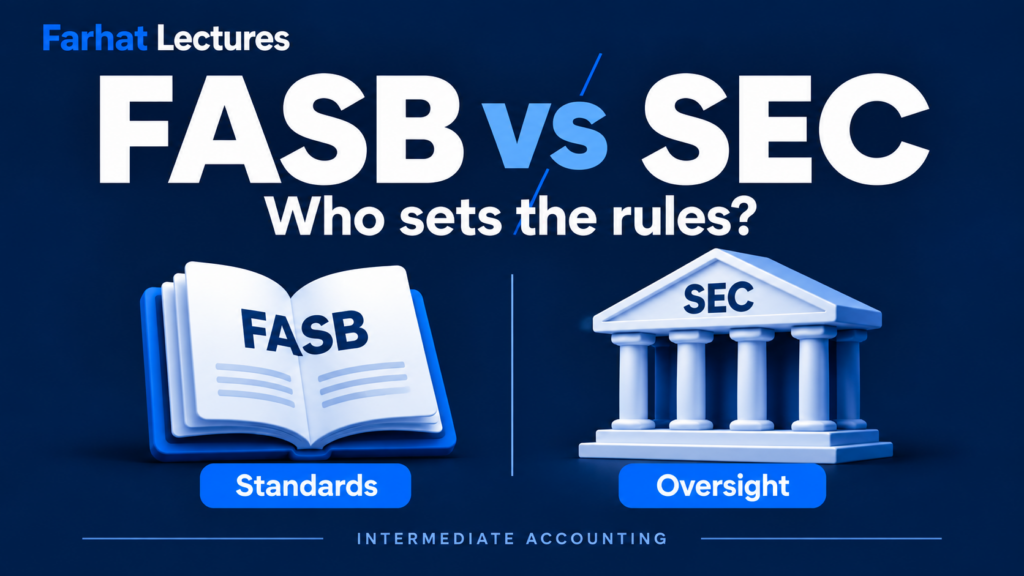
No. FASB vs IASB compares two standard setters that produce different frameworks. FASB vs SEC explains the U.S. relationship between a private standard setter and a government regulator.
What should I remember first?
Match each board to its framework, know that the FASB answers to the Financial Accounting Foundation and the IASB to the IFRS Foundation, and remember that cooperation reduced differences but did not eliminate them.
Continue learning
FASB vs SEC: 5 Key Differences Made Simple · FASB Codification: 4 Levels Explained Simply · Accounting Standards Update: A Simple ASU vs ASC Guide · What Is GAAP? 5 Essential Ideas for Accounting Students · What Is FASB? 7 Simple Steps in Setting Standards · FASB Conceptual Framework: 8 Chapters Made Simple · International Accounting course
Learn with Farhat Lectures
Build your understanding one step at a time. Explore the Farhat Lectures free sample course to see the teaching approach, then return to the practice questions in this lesson. If you want every U.S. GAAP vs IFRS difference worked through with examples, the International Accounting course picks up where this page leaves off, and the Intermediate Accounting course covers the FASB side in depth.
About the author
Mansour Farhat, CPA, CIA, DBA, teaches the Farhat Lectures courses and runs the Farhat Lectures YouTube channel, covering financial, intermediate, advanced, cost and governmental accounting, auditing and tax, along with CPA and CMA exam review. Read more on the About Me page or connect on LinkedIn.



Responses