
Stock Splits and EPS: How to Restate Weighted Average Shares

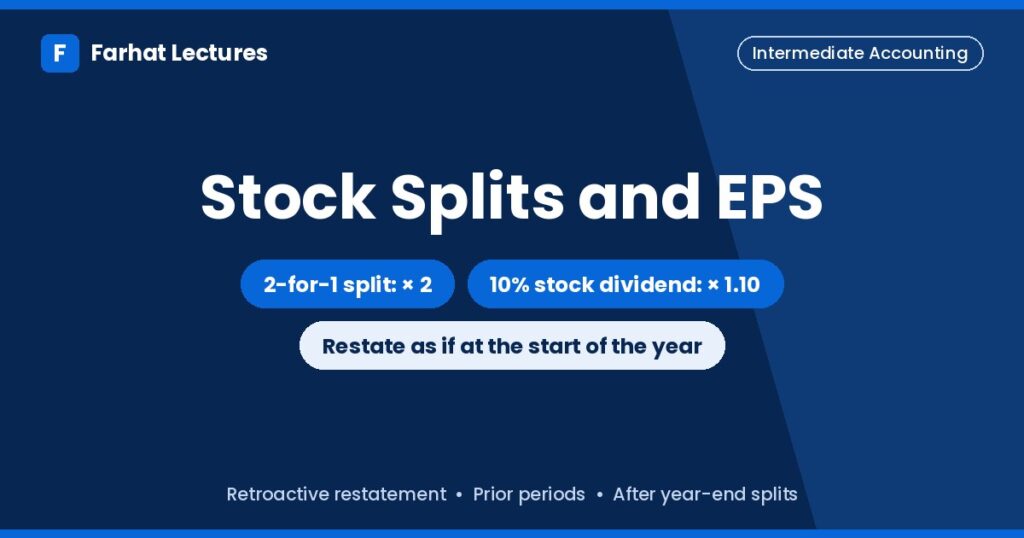
Stock splits and EPS are linked through the share count. Under FASB ASC 260, adjust weighted-average shares outstanding for a stock split or stock dividend as if it occurred at the start of the reporting period. Restate basic and diluted EPS for every prior period presented. A 2-for-1 split doubles the share count and halves positive EPS when earnings available to common shareholders stay the same.
This matters because a 2-for-1 split doubles the share count without changing the company’s earnings. Weighting the split shares only from the split date distorts EPS and makes periods harder to compare. This lesson builds on weighted average shares outstanding; if you need a refresher on how the two transactions are recorded, see stock dividend vs. stock split.
Watch: Weighted average number of shares example with a stock split (starts at 5:14, restating for the stock split)
Stock Splits and EPS: Why Restatement Is Required
Stock splits and stock dividends do not change total stockholders’ equity, do not change assets, and do not change any shareholder’s ownership percentage. They cut the same company into more pieces.
New shares sold for cash are different. They bring in resources the company can use to earn income from the issue date forward, so they are weighted by time. The table shows the contrast.
| Share change | Resources change? | Treatment in weighted average |
|---|---|---|
| Stock split | No | Restate to the start of the year and to prior periods |
| Stock dividend | No | Restate to the start of the year and to prior periods |
| Shares issued for cash | Yes (cash comes in) | Weight from the issue date |
| Treasury stock purchase | Yes (cash goes out) | Weight from the purchase date |
What multiplier do you use for a stock split or stock dividend?
Multiply every share balance and share transaction dated before the split or stock dividend by the multiplier.
| Event | Multiplier |
|---|---|
| 2-for-1 stock split | × 2 |
| 3-for-1 stock split | × 3 |
| 10% stock dividend | × 1.10 |
| 50% stock dividend | × 1.50 |
| 1-for-4 reverse stock split | × 0.25 |
Worked example: Pinecrest Corp.
Hypothetical example. Pinecrest Corp. reports on a calendar year. Net income is $351,000 and there is no preferred stock.
| Date | Event | Shares outstanding after event |
|---|---|---|
| January 1 | Beginning balance | 50,000 |
| April 1 | Issued 10,000 shares for cash | 60,000 |
| July 1 | 2-for-1 stock split | 120,000 |
| October 1 | Issued 8,000 shares for cash | 128,000 |
| Period | Shares | Split restatement | Months | Weighted shares |
|---|---|---|---|---|
| Jan 1 to Apr 1 | 50,000 | × 2 | 3/12 | 25,000 |
| Apr 1 to Jul 1 | 60,000 | × 2 | 3/12 | 30,000 |
| Jul 1 to Oct 1 | 120,000 | 3/12 | 30,000 | |
| Oct 1 to Dec 31 | 128,000 | 3/12 | 32,000 | |
| Weighted average shares outstanding | 117,000 |
Basic EPS = $351,000 ÷ 117,000 = $3.00.
Check with the changes method: the restated beginning shares count for the full year (50,000 × 2 = 100,000), the April shares count for 9 months after restatement (10,000 × 2 × 9/12 = 15,000), and the October shares count for 3 months (8,000 × 3/12 = 2,000). Total: 117,000.
The wrong way: weighting the 60,000 extra split shares only from July 1 gives 89,500 shares and EPS of about $3.92. That overstates EPS for the year.
Do you restate prior-year EPS after a stock split?
The restatement reaches back to every earlier period shown in comparative statements. Suppose Pinecrest reported last year’s EPS as $2.50 ($120,000 net income ÷ 48,000 weighted shares). In this year’s comparative income statement, last year becomes $120,000 ÷ 96,000 = $1.25. Now both years are measured in post-split shares.
The same restatement applies to diluted EPS. ASC 260-10-55-12 requires both basic and diluted EPS to be adjusted retroactively for all periods presented. If you are not sure which EPS figures a company has to report, see simple vs. complex capital structure.
What if the split happens after year-end?
If a stock split or stock dividend occurs after the balance sheet date but before the financial statements are issued (or available to be issued), the per-share amounts for the year just ended, and for any prior periods presented, are restated to reflect it. The company also discloses that per-share amounts reflect the change. This guidance is in FASB ASC 260-10-55-12, summarized in the Deloitte EPS Roadmap.
One detail to watch is when the shares start trading on a post-split basis. If that happens after the financial statements are issued (or available to be issued, as applicable), use the pre-split share count for EPS and disclose the split’s effect on per-share amounts.
Hypothetical example. Brightwater Inc. computes 90,000 weighted average shares for the year ended December 31. On February 5, before issuing its statements, it declares and completes a 3-for-1 split. It reports 270,000 weighted average shares for the year.
Common mistakes
- Weighting split shares from the split date. Restate them to the start of the year.
- Applying the multiplier to later issuances. Shares issued after the split are already post-split shares.
- Forgetting prior periods. Comparative EPS for earlier years must be restated too.
- Treating a stock dividend differently from a split. For EPS, both are restated the same way.
- Flipping the multiplier for a reverse split. A 1-for-4 reverse split multiplies pre-split shares by 0.25, not by 4. With fewer shares, positive EPS increases and a loss per share becomes more negative.
- Using the declaration date for a post-year-end split. Check when the split was completed and post-split trading began to determine whether to restate EPS.
Exam tip: Build a timeline before you compute anything. Put every share event on it, then ask one question about each balance: did it exist before the split? If yes, multiply it by the split factor. If no, leave it alone. This one habit prevents every mistake on the list above.
Practice questions with answers
Stock Dividends and Stock Splits in the EPS Calculation
Use these three interactive questions to review how stock dividends and stock splits affect total assets, total stockholders’ equity, ownership percentages, and weighted-average shares outstanding for earnings per share (EPS). Then apply the same rules to the worked calculations below.
Question 1: Split with no other changes
Corvan Co. had 40,000 shares outstanding all year and completed a 3-for-1 stock split on September 1. What is its weighted average shares outstanding?
Answer:
120,000 shares
Restate the 40,000 shares as if the split happened January 1: 40,000 × 3 = 120,000 for the full year.
Question 2: Issuance before a stock dividend
Delta Ridge Inc. had 90,000 shares on January 1, issued 30,000 shares for cash on May 1, and distributed a 10% stock dividend on July 1. There were no other changes. Compute the weighted average.
Answer:
121,000 shares
Jan 1 to May 1: 90,000 × 1.10 × 4/12 = 33,000. May 1 to Jul 1: 120,000 × 1.10 × 2/12 = 22,000. Jul 1 to Dec 31: 132,000 × 6/12 = 66,000. Total: 121,000. The May shares were outstanding before the dividend, so they get the 1.10 multiplier too.
Question 3: Split after year-end
Oakfield Corp. computed weighted average shares of 85,000 for this year and 80,000 for last year. On January 20, before issuing its financial statements, it completed a 2-for-1 split. What weighted average shares does it report for each year?
Answer:
170,000 this year and 160,000 last year
A split after year-end but before the statements are issued restates all periods presented: 85,000 × 2 and 80,000 × 2.
Want more practice like this? Work through Weighted-Average Shares and Basic Earnings Per Share in the Farhat Lectures Intermediate Accounting course.
Key takeaways
- Stock splits and stock dividends are restated as if they happened at the start of the year.
- Apply the multiplier only to balances and transactions dated before the split.
- Restate EPS for every prior period presented.
- Restate EPS for a post-year-end split if the split is completed and post-split trading begins before the statements are issued (or available to be issued, as applicable). If post-split trading begins after that cutoff, use pre-split shares and disclose the effect.
- Splits change only the denominator; the numerator, including preferred dividends in EPS, does not change.
Frequently asked questions
Does a stock split lower EPS?
A forward stock split lowers positive EPS and moves a loss per share closer to zero. A 2-for-1 split doubles the share count while net income stays the same. In the Pinecrest example, prior-year EPS of $2.50 becomes $1.25. A prior-year loss of $2.00 per share would become a loss of $1.00 per share.
Why are stock splits restated instead of weighted by date?
A stock split or stock dividend brings in no new resources. Each shareholder simply holds more, smaller pieces of the same company. Restating the shares as if the split always existed keeps EPS comparable before and after the split.
Do I multiply shares issued after the split date?
No. Shares issued after the split are already post-split shares. Apply the multiplier only to share balances and transactions dated before the split.
What happens if the split occurs after year-end?
If the split is completed and shares begin trading on a post-split basis before the financial statements are issued (or available to be issued, as applicable), restate EPS for all periods presented and disclose the change. If post-split trading begins after that cutoff, use pre-split shares to compute EPS and disclose the split’s effect on per-share amounts.
What is the multiplier for a reverse stock split?
Use the split ratio. A 1-for-4 reverse split means every 4 old shares become 1 new share, so multiply pre-split shares by 0.25. The smaller share count increases positive EPS and makes a loss per share more negative.
Does a stock split change net income or the EPS numerator?
No. A split only changes the number of shares. Net income and preferred dividends stay the same, so only the denominator is restated.
Sources
- Deloitte Roadmap: Earnings per Share, Section 8.2.1 Stock Dividends and Stock Splits (ASC 260-10-55-12)
- FASB Accounting Standards Codification, Topic 260: Earnings Per Share
- Journal of Accountancy: Simplifying EPS (a split is treated as if it occurred at the beginning of the year)
About the author
Mansour Farhat, CPA, CIA, DBA, teaches accounting and CPA exam review at Farhat Lectures and on the Farhat Lectures YouTube channel. His lessons help CPA, CMA, and EA candidates and accounting students work through topics like earnings per share step by step, with original examples, practice questions, and the mistakes students make most often.
Continue learning with Farhat Lectures
Strengthen your accounting understanding with clear explanations and guided practice.
Explore the free sample course


Responses