
Weighted Average Shares Outstanding: How to Calculate It for EPS


Weighted average shares outstanding is the number of common shares a company had outstanding during a period, with each block of shares weighted by the fraction of the period it was outstanding. It is the denominator of basic earnings per share (EPS). For a full-year calculation, multiply each share balance by the months it stayed unchanged, divide by 12, and add the results.
This matters because the share count changes during the year. A company may sell new shares in March and buy back shares in August. If you divide net income by the year-end share count, you get the wrong EPS. This lesson shows the rule, two ways to compute it, and a full worked example. For the overall EPS picture, see earnings per share (EPS): basic and diluted EPS explained.
Watch: Weighted average number of shares and basic EPS (starts at 5:00, calculating weighted average shares)
What are weighted average shares outstanding?
Outstanding shares are common shares held by investors. Issued shares that the company has repurchased and holds as treasury stock are not outstanding.
Because income is earned over the whole period, the share count should also reflect the whole period. Weighting finds the equivalent number of whole shares outstanding for the year. A block of 12,000 shares outstanding for 6 months counts as 6,000 shares for the year.
How is each share transaction treated?
Use this table to decide how each event affects the weighted average number of common shares.
| Event during the year | Effect on weighted average shares |
|---|---|
| Shares outstanding at the beginning of the year | Count for the full year (12/12) |
| New shares issued for cash | Add, weighted from the issue date to year-end |
| Shares repurchased as treasury stock | Subtract, weighted from the purchase date to year-end |
| Treasury shares reissued | Add back, weighted from the reissue date to year-end |
| Stock split or stock dividend | Not weighted by date. Multiply the shares outstanding before the split by the split ratio, as if the split happened at the start of the year, and restate every period presented. Shares issued after the split are weighted normally. This also applies to a split that happens after year-end but before the financial statements are issued or available to be issued, as applicable (see stock splits and EPS) |
Weighted average shares outstanding formula
Weighted average shares = Σ (Shares outstanding × Fraction of the year outstanding)
There are two common ways to apply the formula. Both give the same answer, so use whichever you find easier on an exam.
Method 1: Weight each balance
List the share balance after every change, multiply each balance by the months it stayed unchanged, and add the results.
Method 2: Weight each change
Start with the beginning shares for the full year. Then add each issuance and subtract each repurchase, weighted by the months remaining in the year after the change.
Worked example: Harbor Tech Inc.
Hypothetical example. Harbor Tech Inc. has a December 31 year-end and only common stock outstanding. Its net income for the year is $434,000. Share activity:
| Date | Event | Shares outstanding after event |
|---|---|---|
| January 1 | Beginning balance | 120,000 |
| March 1 | Issued 24,000 shares for cash | 144,000 |
| August 1 | Purchased 18,000 shares as treasury stock | 126,000 |
| October 1 | Issued 30,000 shares for cash | 156,000 |
Harbor Tech, Method 1: Weight each balance
| Period | Shares | Months | Weighted shares |
|---|---|---|---|
| Jan 1 to Mar 1 | 120,000 | 2/12 | 20,000 |
| Mar 1 to Aug 1 | 144,000 | 5/12 | 60,000 |
| Aug 1 to Oct 1 | 126,000 | 2/12 | 21,000 |
| Oct 1 to Dec 31 | 156,000 | 3/12 | 39,000 |
| Weighted average shares outstanding | 12/12 | 140,000 |
Harbor Tech, Method 2: Weight each change
| Item | Shares | Months remaining | Weighted shares |
|---|---|---|---|
| Beginning shares | 120,000 | 12/12 | 120,000 |
| March 1 issuance | 24,000 | 10/12 | 20,000 |
| August 1 treasury purchase | (18,000) | 5/12 | (7,500) |
| October 1 issuance | 30,000 | 3/12 | 7,500 |
| Weighted average shares outstanding | 140,000 |
Basic EPS = $434,000 ÷ 140,000 = $3.10. If you had wrongly used the 156,000 year-end shares, EPS would be about $2.78, understating the earnings each share actually supported.
What if there is a stock split during the year?
A split does not bring in new money, so it is not weighted by date. Here is a quick example.
Pine Co. had 50,000 common shares outstanding on January 1. On July 1 it declared and distributed a 2-for-1 stock split. On October 1 it issued 10,000 new shares for cash.
| Item | Shares | Split factor | Months | Weighted shares |
|---|---|---|---|---|
| Beginning shares, restated for the split | 50,000 | × 2 | 12/12 | 100,000 |
| October 1 issuance (after the split) | 10,000 | None | 3/12 | 2,500 |
| Weighted average shares outstanding | 102,500 |
The common wrong answer is 77,500. That happens when someone treats the 50,000 extra split shares like a July 1 issuance (50,000 + 50,000 × 6/12 + 2,500). The split shares are restated to January 1 instead. The October shares came after the split, so they are not multiplied.
Common mistakes
- Using year-end shares. Ending shares ignore timing, as the Harbor Tech example shows.
- Averaging beginning and ending shares. (120,000 + 156,000) ÷ 2 = 138,000, which is not the weighted average. It ignores when each change happened.
- Miscounting months. Shares issued March 1 are outstanding for 10 months (March through December), not 9.
- Forgetting treasury purchases. Repurchased shares stop counting on the purchase date.
- Weighting a stock split by date. Splits and stock dividends are restated to the start of the year instead.
- Including preferred shares. Only common shares go in the denominator.
Exam tip: On the CPA exam, basic and diluted EPS are tested in the FAR section. Before you multiply anything, write the months next to each date. Shares issued on October 1 count for 3 months (October, November, December), and shares bought back on April 1 stop counting for 9 months. Most wrong answers come from miscounting months, not from the math.
Practice questions with answers
Weighted-Average Shares Outstanding for Basic EPS Practice
Basic earnings per share (EPS) uses weighted-average common shares outstanding as its denominator. This three-question exercise tests how to count newly issued shares from the issuance date and how to account for treasury stock repurchases.
Question 1: One issuance
Maple Co. had 80,000 common shares outstanding on January 1 and issued 20,000 shares on July 1. What is its weighted average shares outstanding for the calendar year?
Answer:
90,000 shares
80,000 × 12/12 = 80,000, plus 20,000 × 6/12 = 10,000. Total: 90,000 shares.
Question 2: Treasury stock bought and reissued
Ridgeline Inc. had 200,000 shares outstanding on January 1. On April 1 it purchased 30,000 treasury shares, and on November 1 it reissued 12,000 of those treasury shares. Compute the weighted average.
Answer:
179,500 shares
200,000 × 12/12 = 200,000. Subtract 30,000 × 9/12 = 22,500. Add 12,000 × 2/12 = 2,000. Total: 200,000 − 22,500 + 2,000 = 179,500 shares.
Question 3: From weighted average to basic EPS
Lumen Corp. had 60,000 shares outstanding on January 1 and issued 15,000 shares on September 1. Net income was $260,000, and Lumen has no preferred stock. Compute basic EPS.
Answer:
Basic EPS = $4.00
Weighted average = 60,000 + (15,000 × 4/12) = 65,000 shares. Basic EPS = $260,000 ÷ 65,000 = $4.00.
Want more practice like this? Work through Weighted-Average Shares and Basic Earnings Per Share in the Farhat Lectures Intermediate Accounting course. If the company also has preferred stock, the numerator changes too; see preferred dividends in EPS.
Key takeaways
- Weighted average shares outstanding is the denominator of basic EPS.
- Weight beginning shares for the full year and every issuance or repurchase from its date to year-end.
- Treasury shares are not outstanding; reissued treasury shares count again from the reissue date.
- Stock splits and stock dividends are restated to the start of the year for every period presented, not weighted by date.
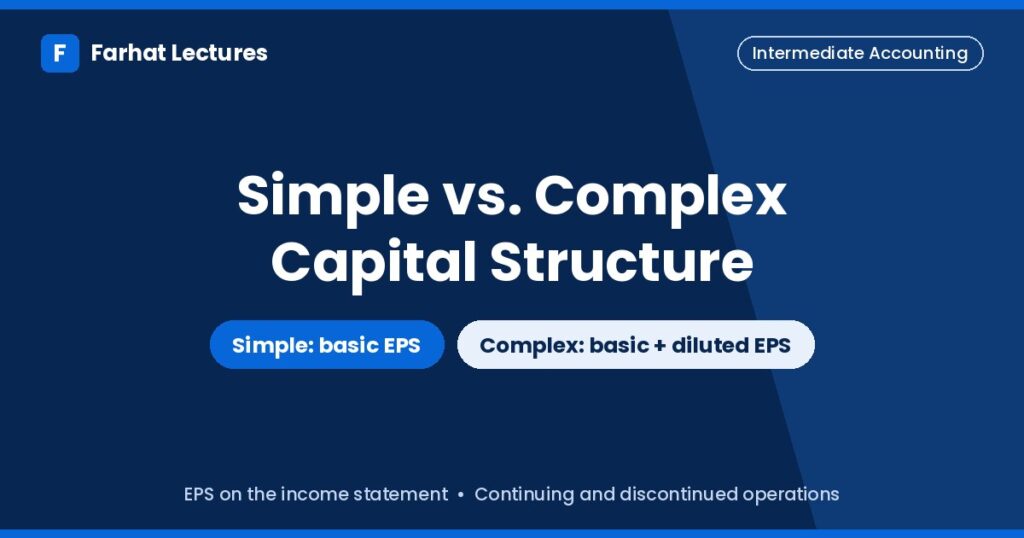
- Whether a company reports only basic EPS depends on its simple vs. complex capital structure.
Frequently asked questions
Why not just use the number of shares outstanding at year-end?
The year-end share count ignores when shares were issued or repurchased during the period. Using that count for the full period can distort basic EPS. Weighting each share balance by the time it was outstanding reflects the share changes during the reporting period.
Do treasury shares count as outstanding?
No. Treasury shares are issued shares the company has bought back, so they are not outstanding. A treasury stock purchase reduces the share count from the purchase date, and reissuing treasury shares increases it again from the reissue date.
Should I weight by months or by days?
Companies often weight by days for precision. Textbook and CPA exam problems usually use months, so count whole months from the transaction date to the end of the period unless the problem gives days.
Are preferred shares included in weighted average shares outstanding?
No. Basic EPS is earnings per common share, so the denominator counts only common shares. Preferred stock affects the numerator instead, through preferred dividends.
How do stock splits and stock dividends affect the weighted average?
They are not weighted by date. You restate the shares as if the split or stock dividend happened at the beginning of the year, and you restate prior years presented too. The stock splits and EPS lesson in this series walks through the multipliers.
What is the difference between shares outstanding and weighted average shares outstanding?
Shares outstanding is a snapshot on one date, such as December 31. Weighted average shares outstanding is a time-weighted average for the whole period, so each block of shares counts only for the months it was actually outstanding. Basic EPS uses the weighted average.
Is weighted average shares outstanding the same for basic and diluted EPS?
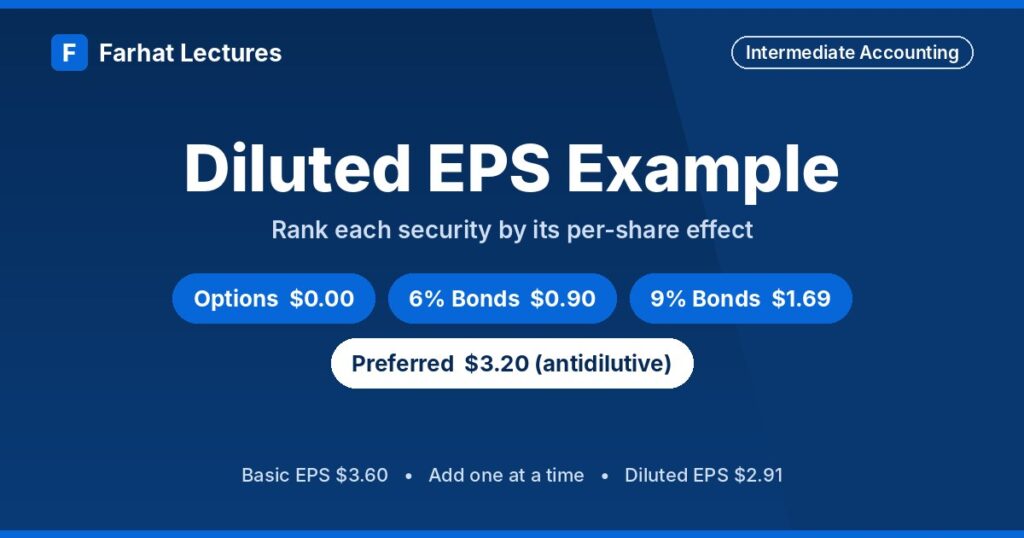
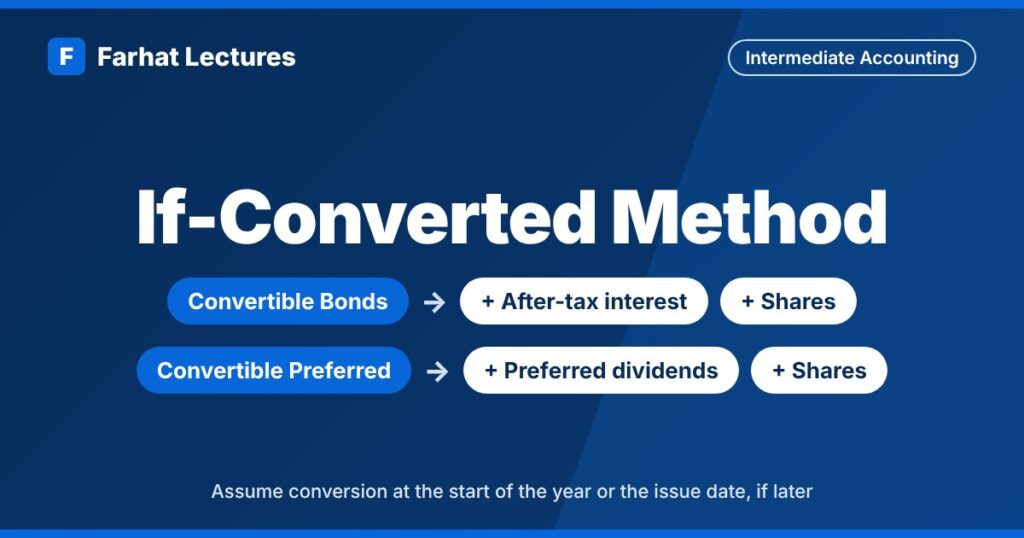
No. Basic EPS uses only common shares actually outstanding. Diluted EPS starts with that same weighted average and then adds dilutive potential common shares, such as options and warrants (using the treasury stock method) and convertible securities (using the if-converted method). See the diluted EPS example for a full walkthrough.
Where do I find weighted average shares outstanding in financial statements?
Companies that report EPS often show the basic and diluted weighted average share counts on the face of the income statement, right near EPS. The EPS footnote also reconciles the numerators and denominators of basic and diluted EPS, as ASC 260 requires.
How are shares issued in a business combination weighted?
From the acquisition date. Those shares were not outstanding before the deal closed, so they count only for the part of the year after the acquisition, just like shares issued for cash.
Sources
- FASB Accounting Standards Codification, Topic 260: Earnings Per Share (ASC 260-10-45-10: basic EPS uses the weighted-average number of common shares outstanding; ASC 260-10-55-12: retroactive adjustment for stock dividends and splits)
- Deloitte Roadmap: Earnings per Share, Section 8.2 Shareholder Distributions (stock dividends and stock splits)
- Deloitte Roadmap: Earnings per Share, Section 3.1 Basic EPS (ASC 260-10-10-1, objective of basic EPS, and ASC 260-10-45-10, weighting shares for the portion of the period outstanding)
About the author
Mansour Farhat, CPA, CIA, DBA, is a veteran accounting educator and the founder of Farhat Lectures and the Farhat Lectures YouTube channel. He holds a Doctor of Business Administration from Temple University and a Master of Accountancy from Bloomsburg University, and he teaches accounting students and candidates preparing for the CPA, CMA, and EA exams.
Continue learning with Farhat Lectures
Strengthen your accounting understanding with clear explanations and guided practice.
Explore the free sample course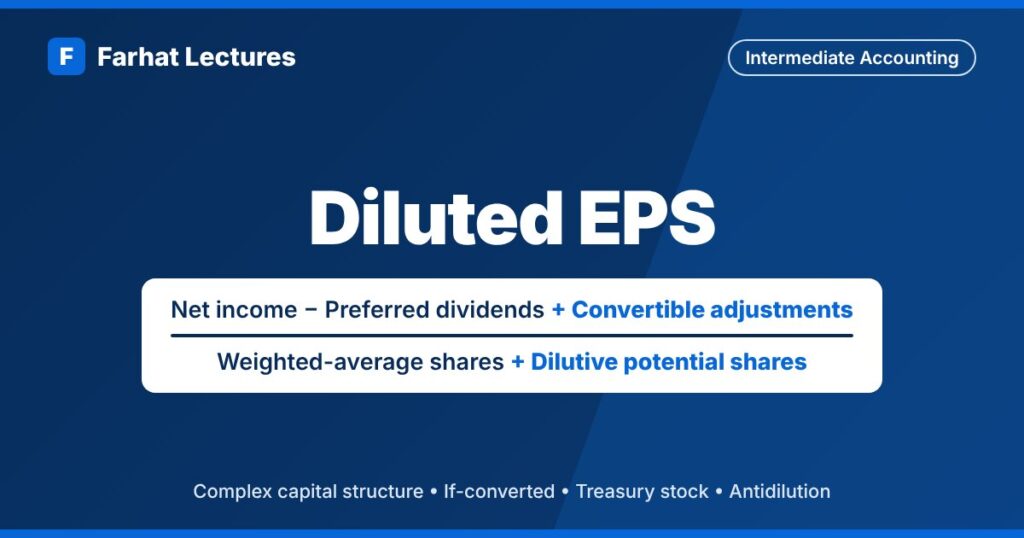

Responses