
Cash Dividend Journal Entry: Declaration, Record, and Payment Dates

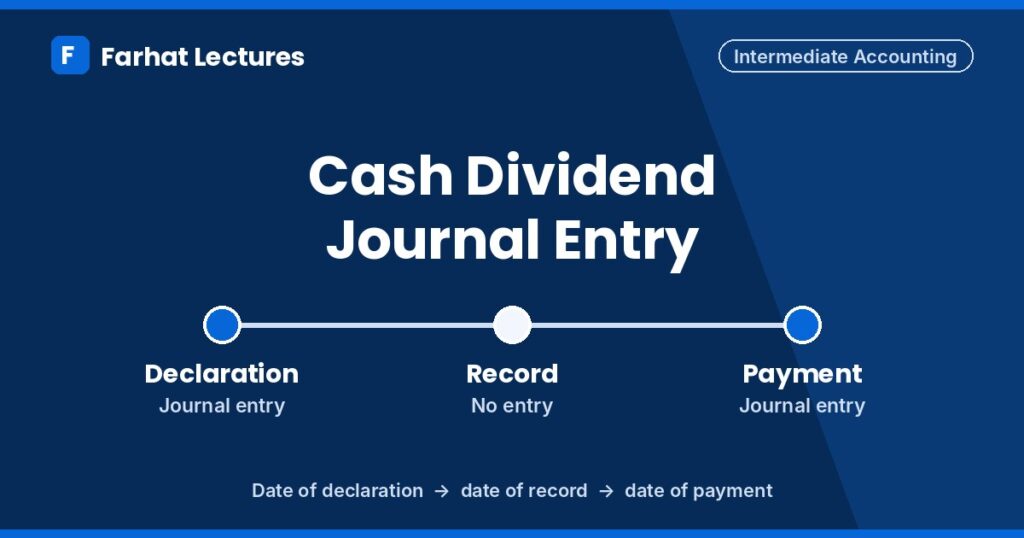
A cash dividend journal entry is needed on two dates. On the declaration date, debit Retained Earnings and credit Dividends Payable for the total dividend, which creates a liability. On the payment date, debit Dividends Payable and credit Cash. The date of record needs no entry because it only identifies which stockholders get paid.
Cash dividends are the most common type of dividend, and the three-date pattern shows up throughout intermediate accounting and the CPA exam. Getting the timing right tells you when a liability exists, when retained earnings decreases, and when cash actually leaves the company.
This guide walks through the dividend timeline, a complete example, how to compute dividends stated per share or as a percentage of par, and a quick example with preferred dividends in arrears.
Watch: Cash Dividends: Definition, Accounting w/example
Watch this Farhat lesson on YouTube
In this 11-minute lesson, Professor Farhat explains why companies pay cash dividends and walks through the declaration, record, and payment dates with the journal entries for each. Watch it first, then use the written example below to practice.
What are the three dividend dates?
Only the board of directors can declare a dividend. After it votes, the company needs time to prepare a current list of stockholders, so there is usually a gap of a few weeks between declaration and payment.
| Date | What happens | Journal entry? |
|---|---|---|
| Date of declaration | The board approves the dividend. The company now has a legal obligation to pay it. | Yes: record the liability and reduce retained earnings |
| Date of record | The company determines who owns the shares. Owners on this date receive the dividend. | No |
| Date of payment | The company sends the cash to stockholders. | Yes: pay the liability |
Investors also hear about the ex-dividend date. A buyer who purchases shares on or after that date does not get the upcoming dividend. According to Investor.gov, the ex-dividend date is usually set on the record date, or one business day earlier if the record date is not a business day. It matters to investors but requires no journal entry.
Example: cash dividend journal entries
Pinecrest Outfitters (a hypothetical company) has 2,500,000 common shares outstanding. On March 3, its board declares a cash dividend of $0.40 per share, payable April 2 to stockholders of record on March 17.
Total dividend = 2,500,000 shares × $0.40 = $1,000,000.
March 3: date of declaration
| Account | Debit | Credit |
|---|---|---|
| Retained Earnings (or Cash Dividends Declared) | 1,000,000 | |
| Dividends Payable | 1,000,000 |
If the company uses a Cash Dividends Declared account, it closes that account to Retained Earnings at year-end. The result is the same: retained earnings decreases by $1,000,000.
Here is that year-end closing entry:
| Account | Debit | Credit |
|---|---|---|
| Retained Earnings | 1,000,000 | |
| Cash Dividends Declared | 1,000,000 |
For the full year-end process, see closing entries.
March 17: date of record
No journal entry. The company simply identifies the stockholders who will be paid.
April 2: date of payment
| Account | Debit | Credit |
|---|---|---|
| Dividends Payable | 1,000,000 | |
| Cash | 1,000,000 |
How do you calculate a cash dividend: per share or percentage of par?
A board can state a dividend in one of two ways.
| Method | How to compute the total | Typical use |
|---|---|---|
| Amount per share | Shares outstanding × dividend per share | Common stock |
| Percentage of par value | Dividend rate × total par value of shares outstanding | Preferred stock |
Example. A company has 40,000 shares of 6%, $50 par preferred stock outstanding. The total par value is 40,000 × $50 = $2,000,000, so the annual preferred dividend is 6% × $2,000,000 = $120,000 ($3 per share).
Preferred dividends in arrears
Many preferred shares are cumulative. If the board skips a year, the missed preferred dividend becomes a dividend in arrears, and it must be paid before common stockholders receive anything.
Dividends in arrears are not a liability until the board declares them. Instead, the company discloses the amount in arrears, in total and per share, in the notes to the financial statements, as FASB ASC 505-10-50 requires. (FASB, the Financial Accounting Standards Board, sets U.S. accounting standards. ASC is its Accounting Standards Codification.) For the full set of preferred stock features, see Preferred Stock Features: Cumulative, Participating, Convertible, Callable, and Redeemable.
Example. Delmar Corp. (hypothetical) has 20,000 shares of 5%, $100 par cumulative, nonparticipating preferred stock, so the annual preferred dividend is $100,000. It declared no dividends in Year 1. At the end of Year 2, it declares $260,000 of total dividends.
| Item | Preferred | Common |
|---|---|---|
| Year 1 dividend in arrears | $100,000 | |
| Year 2 current preferred dividend | $100,000 | |
| Remainder to common ($260,000 − $200,000) | $60,000 | |
| Total | $200,000 | $60,000 |
| Account | Debit | Credit |
|---|---|---|
| Retained Earnings | 260,000 | |
| Dividends Payable—Preferred Stock | 200,000 | |
| Dividends Payable—Common Stock | 60,000 |
How do cash dividends affect the financial statements?
| Item | At declaration | At payment |
|---|---|---|
| Retained earnings | Decreases | No effect |
| Liabilities (dividends payable) | Increase | Decrease |
| Total stockholders’ equity | Decreases | No effect |
| Working capital | Decreases | No effect |
| Cash and total assets | No effect | Decrease |
Notice that payment does not change working capital. Cash (a current asset) and dividends payable (a current liability) fall by the same amount. In the statement of cash flows, dividends paid are a financing activity. Under U.S. GAAP (FASB ASC 230), that classification is required. To see how declared dividends flow through equity during the year, read the statement of stockholders’ equity.
Before declaring any cash dividend, a board also checks whether the company can afford it. See how dividend policy balances legality and liquidity. When a company pays with assets other than cash, the entries change; see the property dividend journal entry.
Key takeaways: cash dividend journal entry
- The cash dividend journal entry at declaration debits Retained Earnings and credits Dividends Payable.
- The date of record needs no entry.
- At payment, debit Dividends Payable and credit Cash.
- Common dividends are usually stated per share outstanding, while preferred dividends are often stated as a percentage of par value.
- Cumulative preferred dividends in arrears are paid first but are not recorded until declared.
Common mistakes
- Recording an entry on the date of record.
- Debiting an expense account instead of Retained Earnings.
- Computing dividends on issued or authorized shares instead of shares outstanding.
- Recording dividends in arrears as a liability before the board declares them.
- Saying payment reduces working capital. Declaration does; payment does not.
Practice questions with answers
1. On May 10, a company with 900,000 common shares outstanding declares a $0.25 per share dividend, payable June 5 to stockholders of record May 24. Record all required entries.
| Account | Debit | Credit |
|---|---|---|
| May 10: Retained Earnings | 225,000 | |
| Dividends Payable | 225,000 | |
| June 5: Dividends Payable | 225,000 | |
| Cash | 225,000 |
Why: 900,000 × $0.25 = $225,000. No entry is made on May 24, the date of record.
2. A company has 1,000,000 shares issued, including 50,000 treasury shares. It declares $0.60 per share. What is the total dividend?
Answer: $570,000. Shares outstanding are 950,000 (1,000,000 − 50,000), and 950,000 × $0.60 = $570,000. Treasury shares do not receive dividends.
3. A company has 10,000 shares of 8%, $100 par cumulative, nonparticipating preferred stock. No dividends were declared last year. This year it declares $250,000. How much goes to common stockholders?
Answer: $90,000. The annual preferred dividend is $80,000 (8% × $1,000,000). Preferred receives $160,000 (one year in arrears plus the current year), leaving $250,000 − $160,000 = $90,000 for common.
Interactive practice: cash dividend journal entries
Ready to test yourself? Work through a new company, Roadway Freight Corp., from declaration to payment. Pick an answer for each step, open a hint if you get stuck, and check the worked solution to see how each answer is derived.
Frequently asked questions
What is the journal entry when a cash dividend is declared?
Debit Retained Earnings (or Cash Dividends Declared) and credit Dividends Payable for the total dividend. The declaration creates a liability, usually a current liability.
Why is there no journal entry on the date of record?
The date of record only identifies who owns the shares and will receive the dividend. No asset, liability, or equity balance changes on that date.
Is a dividend an expense?
No. A dividend is a distribution of earnings to owners, not a cost of running the business. It reduces retained earnings directly and is not reported as an expense on the income statement. One exception you may see later: dividends on mandatorily redeemable preferred shares that are classified as liabilities are reported as interest cost under FASB ASC 480.
Do treasury shares receive cash dividends?
No. Dividends are paid only on shares outstanding. Treasury shares are issued but not outstanding, so leave them out when you compute the total dividend.
Where do cash dividends appear in the financial statements?
Declared dividends reduce retained earnings in the statement of stockholders’ equity (or retained earnings). Unpaid dividends are a current liability on the balance sheet, and cash paid for dividends is a financing outflow in the statement of cash flows.
What is the closing entry for Cash Dividends Declared?
At year-end, debit Retained Earnings and credit Cash Dividends Declared for the total dividends declared during the year. This brings the temporary account to zero and moves the reduction into retained earnings.
How does the investor record a cash dividend?
An investor that measures its shares at fair value debits Cash (or Dividends Receivable) and credits Dividend Revenue. An investor using the equity method debits Cash and credits the Investment account instead, because the dividend returns part of its investment.
What is a liquidating dividend?
A liquidating dividend is a dividend that is not based on retained earnings, so it returns part of the stockholders’ original investment. For that portion, the company debits Additional Paid-in Capital instead of Retained Earnings.
About the author
Mansour Farhat, CPA, CIA, DBA, is the founder of Farhat Lectures and its YouTube channel. He holds a Doctor of Business Administration from Temple University and a Master of Accountancy from Bloomsburg University.
He teaches accounting students and CPA, CMA, and EA candidates with clear explanations and step-by-step examples. Read more about Professor Farhat.
Continue learning with Farhat Lectures
Strengthen your accounting understanding with clear explanations and guided practice.
Ready for the full picture? The Intermediate Accounting course covers Intermediate Accounting I and II, from the conceptual framework through liabilities, equity, revenue recognition, taxes, pensions, and leases.
Explore the free sample course




Responses