
Participating Preferred Stock Dividends: Fully vs. Partially Participating Calculations

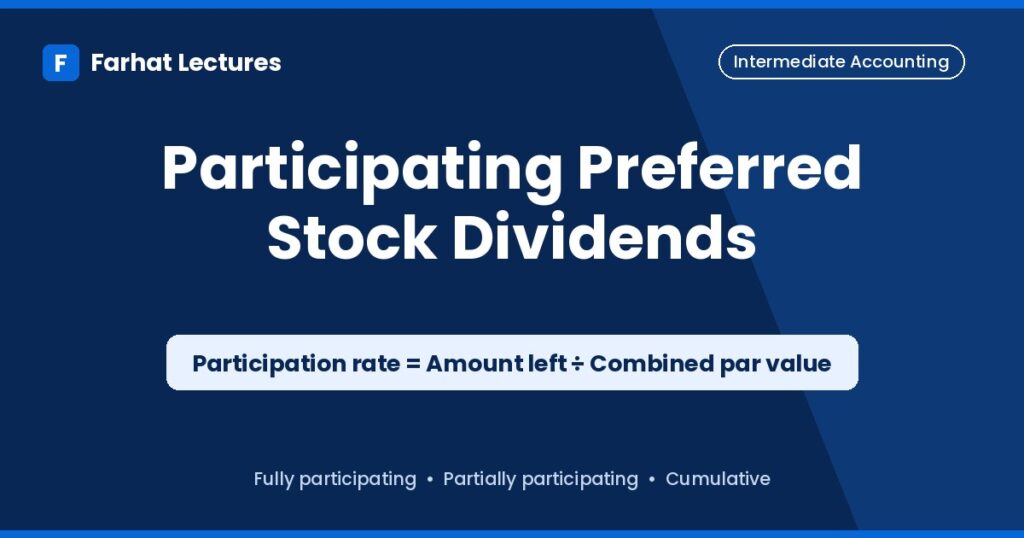
Participating preferred stock dividends are the preferred stock’s stated dividend plus a share of any extra dividend left after common stockholders receive the same rate. To calculate them, pay any cumulative arrears, pay preferred its stated rate, pay common that same rate on its par, then share the rest in proportion to each class’s total par value.
This matters because participation can shift a large part of a dividend from common to preferred stockholders. Exam problems often mix participation with the cumulative feature, so you need a reliable step-by-step method.
For a definition of the participating feature, see preferred stock features. If cumulative arrears are new to you, read dividends in arrears first. For the full lesson sequence on stockholders’ equity, with videos and practice, see the Intermediate Accounting course.
Watch: Dividend preferences and book value per share (starts at the participating examples)
What is participating preferred stock?
Most preferred stock is nonparticipating: its dividend never exceeds the stated rate, no matter how large the total dividend is. Participating preferred stock can receive more than its stated rate when the company pays a large dividend.
- Fully participating: preferred shares in the extra dividend with no upper limit, at the same rate as common.
- Partially participating: preferred shares in the extra dividend only up to a stated maximum rate (for example, “participating up to 8%”).
How to calculate participating preferred stock dividends
Follow these four steps in order. Skip step 1 when the preferred stock is noncumulative or no dividends are in arrears.
| Step | What to do | Formula |
|---|---|---|
| 1 | Pay any dividends in arrears (cumulative preferred only) | Annual preferred dividend × years unpaid |
| 2 | Pay the current preferred dividend | Preferred rate × preferred par |
| 3 | Pay common the same rate (the matching dividend) | Preferred rate × common par |
| 4 | Share the amount left in proportion to par value | Participation rate = amount left ÷ combined par. Each class gets that rate × its own par. |
Arrears are paid only to preferred and are not part of the amount shared in step 4.
Quick check: the four-step allocation order
Test yourself on the allocation order before you work the examples. These four questions cover dividends in arrears, the current preferred dividend, the matching common dividend, and how the amount left is shared in proportion to combined par value.
Example: fully participating
Hypothetical example. Ridgeway Inc. has 5% preferred stock with a total par value of $200,000 and common stock with a total par value of $600,000. The preferred stock is noncumulative and fully participating. Ridgeway declares $64,000 of dividends.
- Step 2: preferred receives 5% × $200,000 = $10,000.
- Step 3: common receives 5% × $600,000 = $30,000.
- Step 4: amount left is $64,000 − $40,000 = $24,000. Participation rate is $24,000 ÷ $800,000 = 3%.
| Item | Preferred | Common | Total |
|---|---|---|---|
| Current dividend at 5% | $10,000 | $30,000 | $40,000 |
| Participating dividend at 3% | $6,000 | $18,000 | $24,000 |
| Total | $16,000 | $48,000 | $64,000 |
Both classes end up with an 8% return on par value. That equal rate is a quick check that a fully participating calculation is correct.
Example: partially participating
Now assume Ridgeway’s preferred stock participates up to 7% of par in total. The full participation rate (3%) would push preferred to 8%, so the cap applies. Preferred receives only 2% more (7% − 5%), or $4,000. Common receives everything else.
| Item | Preferred | Common | Total |
|---|---|---|---|
| Current dividend at 5% | $10,000 | $30,000 | $40,000 |
| Participating dividend (preferred capped at 2%) | $4,000 | $20,000 | $24,000 |
| Total | $14,000 | $50,000 | $64,000 |
Read the cap carefully. “Participating up to 7%” usually means a 7% total rate, while “participating for an additional 2%” states the extra amount directly. Both give the same answer here.
Example: cumulative and fully participating
Assume Ridgeway’s preferred stock is cumulative and fully participating, and one year of preferred dividends ($10,000) is in arrears. Ridgeway again declares $64,000.
| Item | Preferred | Common | Total |
|---|---|---|---|
| Dividends in arrears (1 year) | $10,000 | $10,000 | |
| Current dividend at 5% | $10,000 | $30,000 | $40,000 |
| Participating dividend at 1.75% ($14,000 ÷ $800,000) | $3,500 | $10,500 | $14,000 |
| Total | $23,500 | $40,500 | $64,000 |
Paying the arrears first leaves only $14,000 to share, so the participation rate falls from 3% to 1.75%.
Comparison of the results
| Preferred stock terms | Preferred receives | Common receives |
|---|---|---|
| Noncumulative, nonparticipating | $10,000 | $54,000 |
| Noncumulative, partially participating (up to 7%) | $14,000 | $50,000 |
| Noncumulative, fully participating | $16,000 | $48,000 |
| Cumulative (1 year in arrears), fully participating | $23,500 | $40,500 |
The same $64,000 dividend produces four different splits, so always read the preferred stock terms before you calculate participating preferred stock dividends.
Participation also affects analysis. When preferred stock participates, part of retained earnings is assigned to preferred stockholders in the book value per share calculation.
How do you record and report participating preferred stock dividends?
Once the board declares the dividend, record one entry for the full amount and split the payable by class. Here is the entry for Ridgeway’s fully participating example ($64,000 declared).
| Account | Debit | Credit |
|---|---|---|
| Retained Earnings | $64,000 | |
| Dividends Payable, Preferred | $16,000 | |
| Dividends Payable, Common | $48,000 |
On the payment date, debit Dividends Payable for $64,000 and credit Cash for $64,000.
Dividends in arrears work differently. They are not a liability until the board declares them, so you do not record them in the accounts. Instead, the company discloses the amount in arrears in the notes to the financial statements.
Effect on earnings per share (EPS)
Participating preferred stock is a participating security under FASB ASC 260, Earnings per Share. That means basic EPS uses the two-class method.
After subtracting dividends declared, the company allocates the remaining (undistributed) earnings between common and participating preferred as if all of the period’s earnings had been paid out. Participation therefore lowers EPS for common stockholders even in years without an extra dividend. For the full EPS calculation, see our guide to earnings per share.
Key takeaways
- Pay in this order: arrears (cumulative stock only), the current preferred dividend, the matching common dividend, then share what is left.
- The participation rate equals the amount left divided by the combined par value of both classes.
- With full participation, both classes end at the same total rate on par.
- With partial participation, preferred stops at its cap and common receives the rest.
- Arrears go only to preferred and never join the shared amount.
Common mistakes
- Skipping the matching common dividend. Common must receive the preferred rate before anything is shared.
- Dividing by preferred par only. The participation rate uses the combined par value of both classes.
- Sharing the arrears. Arrears go only to preferred and come out before the sharing step.
- Ignoring the cap. With partial participation, preferred’s current-year dividend never exceeds its stated maximum rate. Any arrears from earlier years are paid on top of the cap.
- Using share counts instead of par. Unless the terms say otherwise, problems share in proportion to par value.
Practice questions with answers
1. Birch Co. has 6% noncumulative, fully participating preferred stock with a total par value of $100,000 and common stock with a total par value of $300,000. It declares $36,000. How much does each class receive?
Answer:
Preferred: $9,000. Common: $27,000.
Preferred current dividend: 6% × $100,000 = $6,000. Common matching dividend: 6% × $300,000 = $18,000. Amount left: $36,000 − $24,000 = $12,000. Participation rate: $12,000 ÷ $400,000 = 3%. Preferred extra: $3,000; common extra: $9,000. Each class ends up with a 9% return on par.
2. Same facts, except the preferred stock participates only up to 8% of par in total. How much does each class receive?
Answer:
Preferred: $8,000. Common: $28,000.
The 3% participation rate would give preferred an extra 3%, but the cap allows only 2% more (8% − 6%). Preferred extra is 2% × $100,000 = $2,000, for a total of $8,000. Common receives the rest: $36,000 − $8,000 = $28,000.
3. Same as question 1, except the preferred stock is cumulative and fully participating, and dividends are two years in arrears. How much does each class receive?
Answer:
Preferred: $18,000. Common: $18,000.
Arrears: 2 × $6,000 = $12,000. Current preferred: $6,000. Common matching: $18,000. That uses the full $36,000, so nothing is left to participate.
Frequently asked questions
Is participation based on par value or number of shares?
In intermediate accounting problems, participation is usually shared in proportion to the total par value of each class. The actual stock agreement controls in practice, so always follow the terms given in the problem.
What happens if the dividend is not large enough for common to receive the matching rate?
Then there is nothing left to participate. Preferred receives its stated dividend (plus any arrears if cumulative), common receives whatever remains, and no participating dividend is paid.
Is participating preferred stock common?
Most preferred stock issued by public companies is nonparticipating. Participating features appear more often in privately negotiated financing. You still need the calculation because it is a classic intermediate accounting topic, and equity, including dividends, is tested in the FAR section of the CPA Exam.
What is the difference between fully and partially participating?
Fully participating preferred stock shares in any extra dividend without a limit, at the same rate as common. Partially participating preferred stock shares only up to a stated maximum rate, and common receives everything above that cap.
Can preferred stock be both cumulative and participating?
Yes. The two features work independently. Pay the arrears first, then the current preferred dividend, then the matching common dividend, and only then share the remainder.
Are dividends in arrears a liability?
No. Dividends in arrears become a liability only when the board declares them. Until then, the company discloses the amount in the notes to its financial statements.
How does participating preferred stock affect EPS?
Participating preferred stock is a participating security, so basic EPS uses the two-class method. Undistributed earnings are allocated between common and participating preferred as if all earnings had been paid out, which lowers EPS for common stockholders.
Does participating preferred mean something different in startup financing?
Often, yes. In venture capital deals, participation usually refers to liquidation proceeds. In a sale, the investor first receives its liquidation preference and then also shares in what is left with common. Accounting courses and CPA exam problems use the term for dividends, which is what this guide covers.
Sources
- FASB Accounting Standards Codification, ASC 505-10-50-3 (disclosure of the rights and privileges of each class of stock, including dividend preferences and participation rights)
- Investor.gov (SEC): Stocks FAQs, preferred stock dividend priority
- FASB Accounting Standards Codification, Topic 260: Earnings per Share (two-class method for participating securities)
About the author
Mansour Farhat, CPA, CIA, DBA, is an accounting educator and the founder of Farhat Lectures and its YouTube channel. He holds a Doctor of Business Administration from Temple University and a Master of Accountancy from Bloomsburg University. He teaches accounting from introductory courses through CPA, CMA, and EA exam preparation. Read more about Professor Farhat.
Continue learning with Farhat Lectures
Strengthen your accounting understanding with clear explanations and guided practice.
Explore the free sample course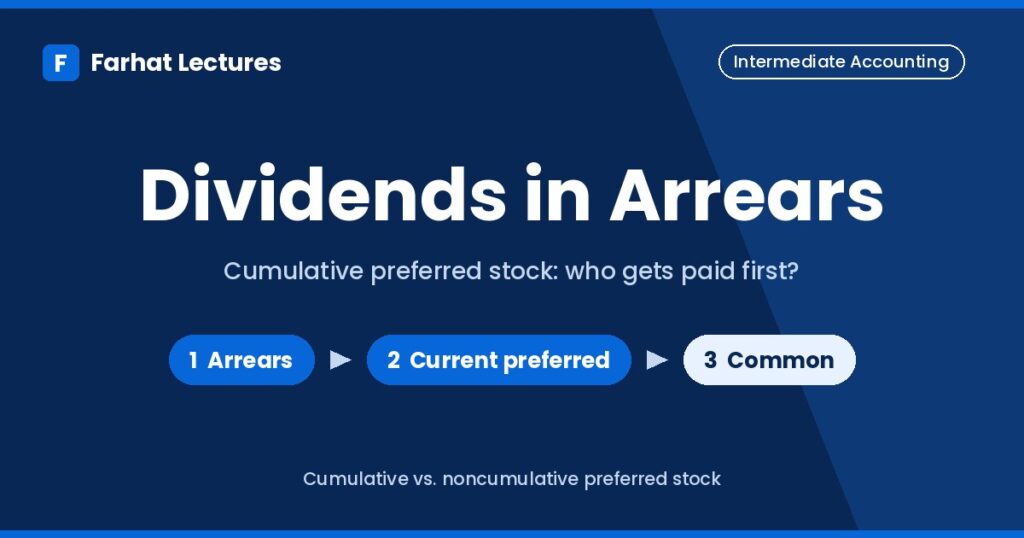


Responses