Stockholders’ Equity Section of the Balance Sheet: Presentation and Disclosures

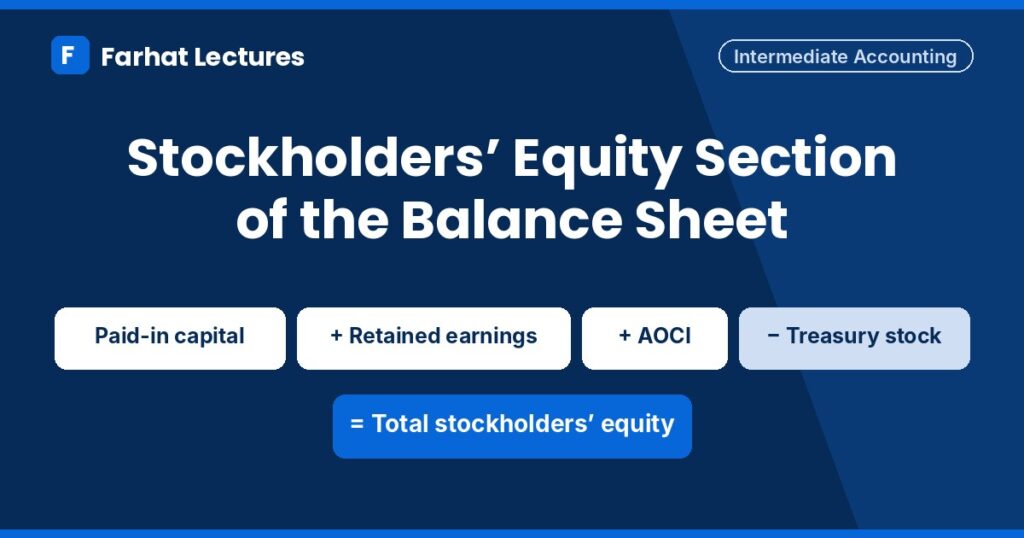
The stockholders’ equity section of the balance sheet shows the owners’ claim on a corporation’s net assets, grouped by source. It usually lists capital stock, additional paid-in capital, retained earnings, accumulated other comprehensive income (AOCI), and treasury stock as a deduction, ending with total stockholders’ equity. Notes disclose each stock class’s rights and any dividend restrictions.
Getting the order right is only half the job. The section, together with the notes, must also tell readers what rights each class of stock carries and whether any retained earnings are restricted from paying dividends.
Why it matters: investors and lenders read this section to see how much capital owners contributed, how much profit the company kept, and whether preferred stockholders or loan agreements limit what common stockholders can receive. Exam questions often ask you to build the section from a list of account balances.
Watch: Stockholders' Equity CPA FAR Simulation: Treasury Stock and Paid-In Capital
In this 4-minute Farhat Lectures simulation, you will build an equity section with common stock, additional paid-in capital, retained earnings, and treasury stock, the same skills tested in CPA FAR task-based simulations.
What is the order of the stockholders’ equity section?
Most U.S. companies list contributed capital first (what owners paid in), then earned capital (retained earnings), then AOCI and treasury stock. The order of those last two lines varies from company to company. Quick definition: par value (or stated value, for no-par stock) is a fixed legal amount per share set in the corporate charter. It has nothing to do with market price. If you need a refresher on what each component means, start with Stockholders’ Equity Explained.
| Line in the section | What it shows | Typical detail shown |
|---|---|---|
| Capital stock | Par or stated value of preferred and common stock issued, plus any stock dividend distributable | Par value, dividend rate, shares authorized, issued, and outstanding |
| Additional paid-in capital (APIC) | Amounts received above par or stated value, and other capital items | Separate lines by source, such as excess over par for preferred and common |
| Retained earnings | Cumulative net income kept in the business after dividends | A reference to a note if any amount is restricted |
| Accumulated other comprehensive income (AOCI) | Cumulative other comprehensive income or loss, such as unrealized gains on certain investments | Added if a gain balance, deducted if a loss balance |
| Treasury stock | Cost of the company’s own shares that it bought back and still holds | Number of shares and the cost, shown as a deduction |
How do you prepare the stockholders’ equity section?
Follow these five steps:
- List each class of capital stock at par or stated value: preferred first, then common, then any common stock dividend distributable. Show shares authorized, issued, and outstanding.
- Add additional paid-in capital by source. Capital stock plus additional paid-in capital equals total paid-in capital.
- Add retained earnings, with a note reference if any amount is restricted.
- Add AOCI if it is a gain balance, or subtract it if it is a loss balance.
- Subtract treasury stock at cost. The result is total stockholders’ equity.
Consolidated companies add one more line. Noncontrolling interest (the part of a subsidiary owned by outside shareholders) appears within equity on its own line, separate from the parent’s stockholders’ equity (ASC 810-10-45-16).
Stockholders’ equity section example
Cedar Point Corporation (a hypothetical company) reports the following stockholders’ equity section at December 31, 2026.
| Cedar Point Corporation, December 31, 2026 | Detail | Total |
|---|---|---|
| Capital stock | ||
| Preferred stock, $50 par, 6% cumulative, 40,000 shares authorized, 12,000 shares issued and outstanding | $600,000 | |
| Common stock, $1 par, 1,000,000 shares authorized, 300,000 shares issued | 300,000 | |
| Common stock dividend distributable, 15,000 shares | 15,000 | |
| Total capital stock | 915,000 | |
| Additional paid-in capital | ||
| Paid-in capital in excess of par: preferred | $60,000 | |
| Paid-in capital in excess of par: common | 2,100,000 | 2,160,000 |
| Total paid-in capital | 3,075,000 | |
| Retained earnings (see Note 7) | 1,480,000 | |
| Total paid-in capital and retained earnings | 4,555,000 | |
| Less: Treasury stock, 5,000 common shares at cost | (95,000) | |
| Accumulated other comprehensive income | 40,000 | |
| Total stockholders’ equity | $4,500,000 |
Four details students often miss in this example:
- Issued vs. outstanding: 300,000 common shares are issued, but 5,000 sit in treasury, so only 295,000 are outstanding.
- Stock dividend distributable is part of capital stock, not a liability, because the company will settle it with its own shares.
- Treasury stock is deducted at cost under the cost method, which most companies use. It is never reported as an asset.
- Order of the last two lines: this example deducts treasury stock before adding AOCI, while the table above lists AOCI first. Both orders are acceptable. What matters is that each appears on its own line.
The statement of stockholders’ equity explains how each of these balances changed during the year, using the same Cedar Point numbers.
What must be disclosed for each class of stock?
Under U.S. GAAP (ASC 505-10-50-3), a company must explain in summary form the pertinent rights and privileges of the securities it has outstanding. The FASB’s examples include:
- Dividend and liquidation preferences
- Participation rights
- Call prices and dates
- Conversion or exercise prices or rates, and the pertinent dates
- Sinking-fund requirements
- Unusual voting rights
- Significant terms of contracts to issue additional shares, or terms that may change conversion or exercise prices
One item gets special placement. When a preferred issue’s liquidation preference is considerably larger than its par or stated value, the company shows the total (aggregate) preference in the equity section itself, usually in parentheses, rather than only in the notes (ASC 505-10-50-4). A hypothetical line might read: “Preferred stock, $50 par (aggregate liquidation preference, $1,200,000).” This keeps the possible effect on common stockholders in plain view. Review the features themselves in Preferred Stock Features.
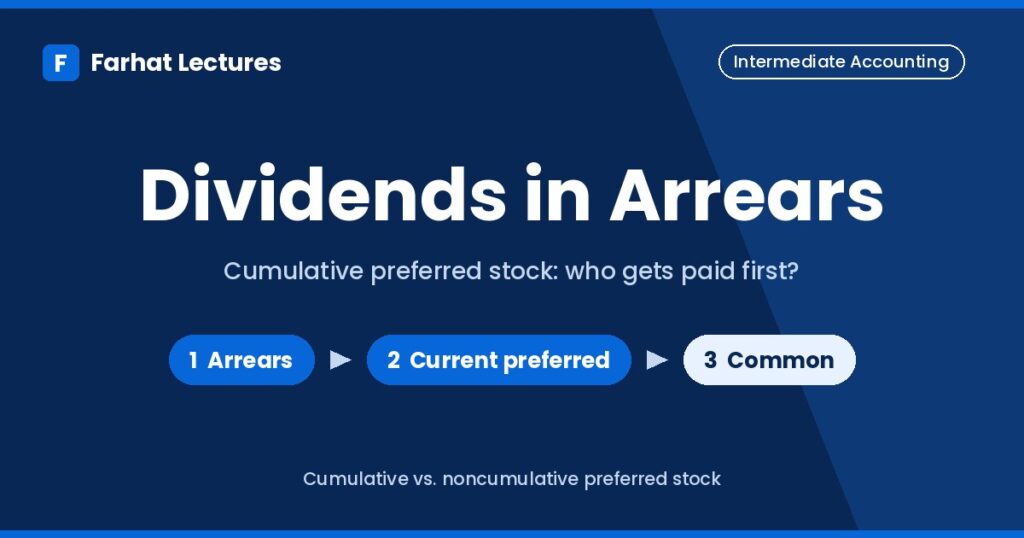
Cumulative preferred stock adds one more disclosure. If the board skips a preferred dividend, the unpaid amount becomes a dividend in arrears. It is not a liability until the board declares it, but the company must disclose arrearages in total and per share, along with any prices at which the preferred stock can be called or redeemed (ASC 505-10-50-5). Cedar Point’s 6% cumulative preferred stock earns $36,000 a year ($600,000 × 6%), or $3 per share. If Cedar Point skipped one year, its note would report $36,000 in arrears, or $3 per share.
How are restrictions on retained earnings reported?
A restriction on retained earnings limits how much the company can pay out as dividends. Restrictions usually come from bond indentures (the legal contracts behind a bond issue), loan agreements, or state law, and sometimes from a board decision.
Most companies do not record a journal entry for a restriction. Instead, they disclose it in a note, because a note can explain the details that a short parenthetical label cannot. The note should reveal:
- The source of the restriction, such as a specific loan agreement
- The pertinent provisions
- The amount of retained earnings that is restricted, or the amount that is not restricted
Example note (hypothetical): Note 7. Cedar Point’s term loan agreement prohibits dividends that would reduce retained earnings below $900,000. At December 31, 2026, $580,000 of retained earnings was available for dividends. The math: $1,480,000 total retained earnings minus the $900,000 floor equals $580,000.
A company that does set aside (appropriate) retained earnings may do so only if the appropriation is shown within stockholders’ equity and clearly labeled as an appropriation of retained earnings (ASC 505-10-45-3). Some states also restrict retained earnings equal to the cost of treasury stock the company holds. When that applies, the restriction is disclosed too.
Notice that the restriction does not change total retained earnings or total stockholders’ equity. It only limits what can be distributed. For why companies hold back dividends in the first place, see Dividend Policy.
Common mistakes
- Listing treasury stock as an asset instead of a deduction from equity.
- Using issued shares when the question asks for outstanding shares.
- Classifying a stock dividend distributable as a liability. A cash dividend payable is a liability; a stock dividend distributable is not.
- Subtracting a retained earnings restriction from total equity.
- Mixing AOCI into retained earnings. They are separate lines.
- Treating dividends in arrears as a liability before the board declares them.
- Assuming a liquidation preference always goes on the face of the balance sheet. It moves into the equity section only when it is considerably larger than par.
Practice questions
1. A company reports common stock $200,000, APIC $350,000, retained earnings $410,000, treasury stock at cost $60,000, and an accumulated other comprehensive loss of $25,000. What is total stockholders’ equity?
Answer: $875,000. Paid-in capital and retained earnings total $960,000 ($200,000 + $350,000 + $410,000). Subtract treasury stock of $60,000 and the AOCI loss of $25,000.
2. Where does a common stock dividend distributable of $30,000 appear on the balance sheet?
Answer: In the capital stock part of stockholders’ equity, next to common stock. The company owes shares, not cash, so it is not a liability.
3. Retained earnings are $750,000, and a loan agreement restricts $300,000 of them. What is reported, and how?
Answer: Retained earnings stay at $750,000 on the balance sheet. A note discloses the loan agreement, its terms, and that $300,000 is restricted ($450,000 is available for dividends).
Interactive stockholders’ equity section quiz
Put the whole section together with five quick questions on Frost Company’s year-end balances. You will measure a common stock dividend distributable, total the capital stock and paid-in capital, subtract treasury stock and an accumulated other comprehensive loss to reach total stockholders’ equity, and decide where a liquidation preference belongs. Pick your answers, then select Check my work to see how each one is solved. If you get stuck, review the Cedar Point example and the disclosure rules first.
Key takeaways
- The equity section lists capital stock, additional paid-in capital, retained earnings, AOCI, and treasury stock as a deduction.
- A stock dividend distributable is equity. A cash dividend payable is a liability.
- Treasury stock reduces equity at cost. It is never an asset.
- Restrictions on retained earnings and dividends in arrears go in the notes and do not change total equity.
- A liquidation preference considerably above par is shown in the equity section, in total.
Frequently asked questions
Is treasury stock an asset?
No. Treasury stock is the company’s own shares bought back. It is shown at cost as a deduction in the stockholders’ equity section.
Where does accumulated other comprehensive income go?
AOCI is its own line in stockholders’ equity, separate from retained earnings. A loss balance is deducted.
Does a restriction on retained earnings reduce equity?
No. It limits dividends but leaves total retained earnings and total equity unchanged. It is usually disclosed in a note.
Why show the number of shares authorized, issued, and outstanding?
Those counts help readers judge how many more shares could be issued and calculate per-share measures such as book value per share.
What are the main components of stockholders’ equity?
Capital stock, additional paid-in capital, retained earnings, accumulated other comprehensive income, and treasury stock as a deduction. Consolidated companies also show noncontrolling interest as a separate line in equity.
Are dividends in arrears a liability?
No. Dividends in arrears on cumulative preferred stock are not a liability until the board declares them. The company discloses them in the notes, in total and per share.
What is the difference between issued and outstanding shares?
Issued shares are shares the company has sold and not retired. Outstanding shares are the issued shares still held by investors. Issued shares minus treasury shares equals outstanding shares.
About the author
Mansour Farhat, CPA, CIA, DBA, creates the Farhat Lectures courses and videos for CPA, CMA, and EA candidates and accounting students. Learn more about his background on the About Me page.
Sources
- Deloitte DART: ASC 505 presentation and disclosure (Distinguishing Liabilities From Equity Roadmap, Section 10.10)
- PwC Viewpoint: preferred stock presentation and disclosure
- SEC: Beginners’ Guide to Financial Statements
Continue learning with Farhat Lectures
Strengthen your accounting understanding with clear explanations and guided practice.
Explore the free sample course