
Retirement of Treasury Stock: Journal Entry and Equity Effects

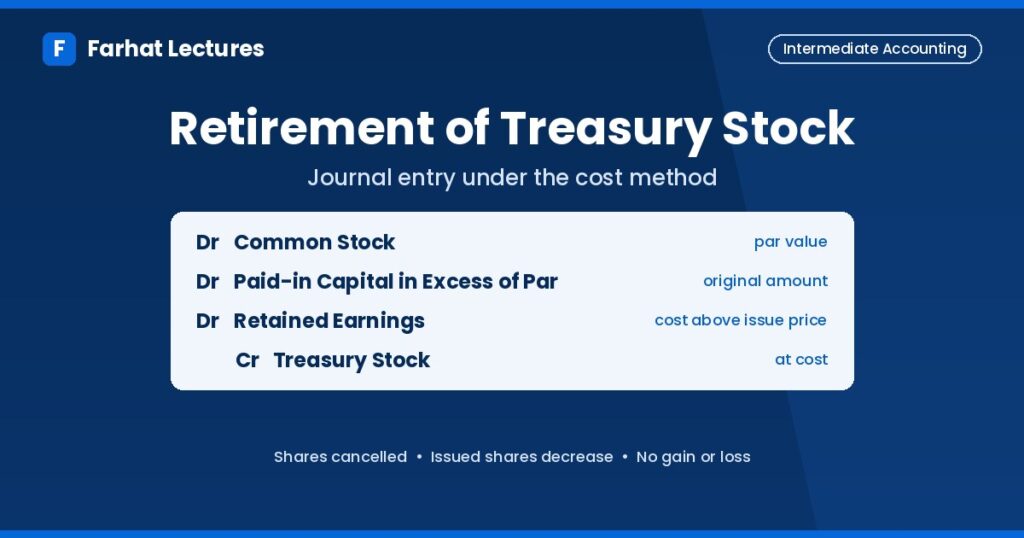
Retirement of treasury stock means the board cancels repurchased shares, so they become authorized but unissued. Under the cost method, credit Treasury Stock for its cost and debit Common Stock and Paid-in Capital in Excess of Par for the amounts originally received. Extra cost usually reduces retained earnings; a shortfall goes to paid-in capital. Total equity is unchanged.
Retirement looks like a resale of treasury stock, but instead of debiting Cash, the company removes the paid-in capital that came in when the shares were first issued. That is why the original issue price, which you could ignore at purchase, suddenly matters.
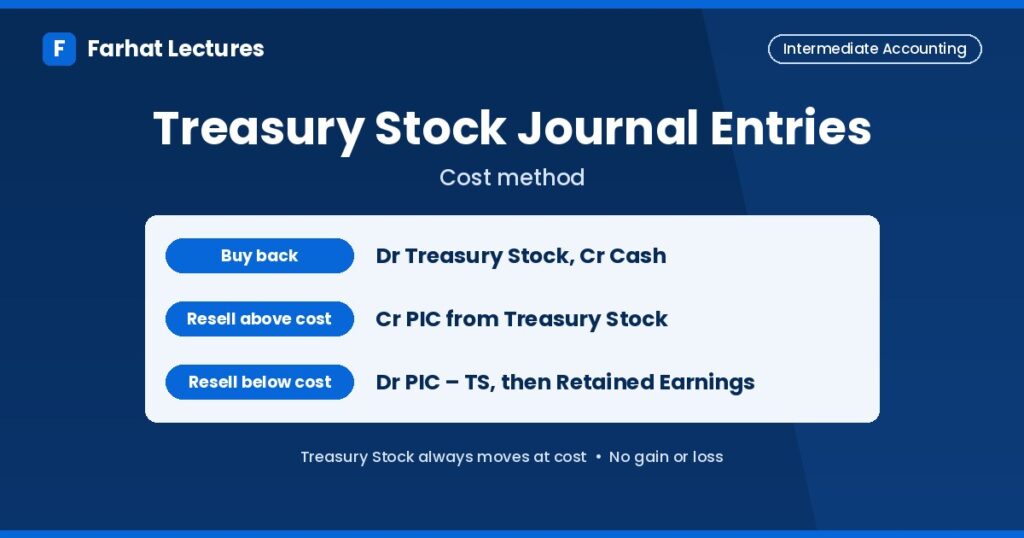
This lesson assumes you know how the buyback itself is recorded; if not, review Treasury Stock Journal Entries first. All companies and numbers below are hypothetical.
Watch: Retirement of Treasury Stock Using the Cost Method
This 5-minute lesson walks through the cost method retirement entry step by step. Watch it first, then use the examples below to practice.
What does retiring treasury stock mean?
When a company buys back its shares, it can hold them as treasury stock for possible resale, or it can cancel them. Cancelling them is called retirement. Retired shares no longer count as issued. They return to the status of authorized but unissued shares, the same as shares the company has never sold.
For why treasury shares are reported in equity rather than as an asset, see What Is Treasury Stock?
Retire vs. reissue: what changes
| Item | Reissue treasury stock | Retire treasury stock |
|---|---|---|
| What is debited | Cash received | Common Stock and the related paid-in capital |
| Issued shares | No change | Decrease |
| Outstanding shares | Increase | No change |
| Total stockholders’ equity | Increases by the cash received | No change |
| Gain or loss in net income | None | None |
How to record the retirement of treasury stock
- Credit Treasury Stock for the cost of the shares retired, which removes them from the treasury.
- Debit Common Stock for the number of shares × par (or stated) value.
- Debit Paid-in Capital in Excess of Par for the amount per share originally received above par. If the shares were issued at different prices, use the average amount per share for that class of stock.
- Balance the entry. If cost was higher than the original issue price, debit the difference first to any Paid-in Capital from Treasury Stock balance for the same class, then to Retained Earnings. If cost was lower, credit the difference to a paid-in capital account. U.S. GAAP also allows other treatments of the excess, shown in the three methods below.
Example 1: cost above the original issue price
Northfield Co. originally issued its $1 par common stock at $10 per share ($1 par plus $9 above par). It later bought back 3,000 shares at $13 each, so Treasury Stock has a $39,000 balance. The board now retires all 3,000 shares.
| Account | Debit | Credit |
|---|---|---|
| Common Stock (3,000 × $1) | 3,000 | |
| Paid-in Capital in Excess of Par (3,000 × $9) | 27,000 | |
| Retained Earnings (3,000 × $3) | 9,000 | |
| Treasury Stock (3,000 × $13) | 39,000 |
The shares originally brought in $30,000 of paid-in capital. Northfield paid $39,000 to get them back, so the extra $9,000 is treated like a distribution to the former owners and reduces retained earnings. If the company has a credit balance in Paid-in Capital from Treasury Stock from earlier resales of the same class, many courses apply that balance before retained earnings.
Example 2: cost below the original issue price
Suppose instead that Northfield bought back 2,000 shares at only $7 each, a $14,000 cost, and then retires them. The shares were still originally issued at $10.
| Account | Debit | Credit |
|---|---|---|
| Common Stock (2,000 × $1) | 2,000 | |
| Paid-in Capital in Excess of Par (2,000 × $9) | 18,000 | |
| Treasury Stock (2,000 × $7) | 14,000 | |
| Paid-in Capital from Retirement of Treasury Stock | 6,000 |
Northfield retired $20,000 of original capital for only $14,000, so the $6,000 difference stays in paid-in capital. Retained earnings is never credited in a retirement. Some companies record just the net $12,000 reduction to Paid-in Capital in Excess of Par instead of the two separate amounts; total paid-in capital ends up the same either way.
In both examples, total stockholders’ equity does not change on the retirement date. Here is the share count effect for Example 1, assuming Northfield had 50,000 shares issued before retiring:
| Share count | Before retirement | After retirement |
|---|---|---|
| Issued | 50,000 | 47,000 |
| Treasury | 3,000 | 0 |
| Outstanding | 47,000 | 47,000 |
Want to see where these balances show up? Review the Stockholders’ Equity Section and the Statement of Stockholders’ Equity.
Special cases: different prices, no-par stock, and the par value method
Shares issued at different prices. If a class of stock was issued in batches at different prices, a common approach is to use the average amount received above par per share. For example, Lakeside Corp. issued 10,000 shares of $1 par stock at $8 and another 10,000 shares at $12. Paid-in Capital in Excess of Par is $70,000 (10,000 × $7) plus $110,000 (10,000 × $11), or $180,000. That works out to $9 per share on 20,000 shares, so retiring 1,000 treasury shares removes $1,000 of Common Stock and $9,000 of Paid-in Capital in Excess of Par.
No-par stock. If the stock has no par or stated value, the whole original issue price sits in Common Stock. Debit Common Stock for the average original issue price per share and skip the Paid-in Capital in Excess of Par line.
The par value method. This lesson uses the cost method, which most textbooks and exam questions use. Under the less common par value method, the buyback entry already removes the original paid-in capital and records Treasury Stock at par. Retirement is then simply a debit to Common Stock and a credit to Treasury Stock for the par amount.
What are the three ways to treat the excess cost under U.S. GAAP?
When retirement cost is above par or stated value, U.S. accounting standards (ASC 505-30-30-8) have allowed the excess to be split between additional paid-in capital, within limits tied to the same issue of stock, and retained earnings, or charged entirely to retained earnings.
In December 2025, the Financial Accounting Standards Board (FASB) issued ASU 2025-12, which adds a third option: charge the entire excess to additional paid-in capital, as long as that does not make additional paid-in capital negative. It is effective for annual periods beginning after December 15, 2026, and early adoption is permitted. State law can also override these choices. For exam problems, follow the approach your textbook or instructor specifies.
The three methods side by side
Here is how each method handles Example 1. Northfield paid $39,000 for shares with $3,000 of par value, so the excess over par is $36,000. Assume all 50,000 shares were originally issued at $10, so Paid-in Capital in Excess of Par had a $450,000 balance before the retirement.
| Method | Common Stock | Paid-in Capital in Excess of Par | Retained Earnings | Treasury Stock |
|---|---|---|---|---|
| 1. Split between APIC and retained earnings | Dr 3,000 | Dr 27,000 | Dr 9,000 | Cr 39,000 |
| 2. All excess to retained earnings | Dr 3,000 | none | Dr 36,000 | Cr 39,000 |
| 3. All excess to APIC (ASU 2025-12) | Dr 3,000 | Dr 36,000 | none | Cr 39,000 |
Method 3 works here because Paid-in Capital in Excess of Par falls from $450,000 to $414,000 and stays positive. Total stockholders’ equity is the same under all three methods. Only the mix between paid-in capital and retained earnings changes.
Exam tip: Under the AICPA’s policy on new pronouncements, a new accounting standard is not testable on the CPA Exam before the first testing window after its earliest mandatory effective date. ASU 2025-12 is effective for annual periods beginning after December 15, 2026, so it becomes eligible for CPA Exam testing in the first testing window of 2027. Until then, exam questions use method 1 or method 2. Method 1 is the one most textbooks show.
Common mistakes
- Debiting Paid-in Capital in Excess of Par based on the buyback price. Use the amount originally received above par.
- Reducing outstanding shares again. Shares were already removed from outstanding at the buyback; retirement reduces issued shares.
- Thinking equity falls on retirement. Equity fell when the shares were bought back. Retirement only reclassifies.
- Crediting Retained Earnings when cost is below the issue price. The difference is paid-in capital.
- Using par value alone when the stock is no-par. With no-par stock, Common Stock holds the full original issue price, so debit Common Stock for that amount.
- Thinking retirement changes EPS or book value per share. Outstanding shares and total equity do not change on the retirement date, so neither ratio moves.
Practice questions with answers
1. A company retires 4,000 treasury shares that cost $18 each. They were originally issued at $15 per share with a $2 par value. Record the retirement.
| Account | Debit | Credit |
|---|---|---|
| Common Stock (4,000 × $2) | 8,000 | |
| Paid-in Capital in Excess of Par (4,000 × $13) | 52,000 | |
| Retained Earnings (4,000 × $3) | 12,000 | |
| Treasury Stock (4,000 × $18) | 72,000 |
The original issue removed is $60,000 (4,000 × $15), and the $12,000 excess cost reduces retained earnings, assuming no Paid-in Capital from Treasury Stock balance.
2. After the retirement in Question 1, what happens to issued shares, outstanding shares, and total equity?
Answer: Issued shares fall by 4,000. Outstanding shares do not change, because the treasury shares were not outstanding. Total stockholders’ equity does not change.
3. A company retires 1,500 treasury shares that cost $9 each. They were originally issued at $12 with a $1 par value. Record the retirement.
| Account | Debit | Credit |
|---|---|---|
| Common Stock (1,500 × $1) | 1,500 | |
| Paid-in Capital in Excess of Par (1,500 × $11) | 16,500 | |
| Treasury Stock (1,500 × $9) | 13,500 | |
| Paid-in Capital from Retirement of Treasury Stock | 4,500 |
The shares originally brought in $18,000 but cost only $13,500 to reacquire, so the $4,500 difference is credited to paid-in capital.
Interactive quiz: test yourself on treasury stock retirement
Now check your understanding with three quick questions on issued shares, share status, and the paid-in capital debit. Use the hints if you get stuck, then open the solution to see how each answer is derived.
Key takeaways
- Retiring treasury stock cancels the shares. They become authorized but unissued.
- Issued shares fall. Outstanding shares and total stockholders’ equity do not change.
- Under the cost method, remove the original paid-in capital: Common Stock at par plus Paid-in Capital in Excess of Par at the original amount per share.
- If cost is higher than the original issue price, the difference reduces Paid-in Capital from Treasury Stock first, then retained earnings. If cost is lower, credit paid-in capital. Never credit retained earnings.
- Retirement never creates a gain or loss in net income.
Frequently asked questions
Does retiring treasury stock change total stockholders’ equity?
No. Total equity already fell when the shares were bought back. Retirement only moves amounts between equity accounts, so total stockholders’ equity stays the same.
What happens to the number of shares when treasury stock is retired?
Issued shares decrease by the number retired, and outstanding shares do not change. The retired shares return to authorized but unissued status.
Who decides to retire treasury shares?
The board of directors approves the retirement. State corporate law can also affect how retirements are recorded.
Can a company retire shares without holding them as treasury stock first?
Yes. Some companies retire shares as soon as they buy them back. The entry is the same, except Cash is credited instead of Treasury Stock.
Is there a gain or loss on retirement of treasury stock?
No. Like other transactions with owners, a retirement changes only equity accounts and never affects net income.
What are the three ways to account for the excess cost of retired treasury stock?
Under ASC 505-30-30-8, a company can split the excess over par between additional paid-in capital and retained earnings, or charge it all to retained earnings. ASU 2025-12 adds a third option: charge it all to additional paid-in capital, as long as that balance does not go negative.
Does retiring treasury stock change earnings per share or book value per share?
No. Retirement does not change outstanding shares or total stockholders’ equity, so basic EPS and book value per share stay the same. Both changed when the shares were bought back. Learn more in Earnings Per Share and Book Value per Share.
Is the ASU 2025-12 APIC-only option tested on the CPA exam?
It becomes eligible for testing in the first testing window of 2027. Under the AICPA’s policy on new pronouncements, a new accounting standard is not testable before the first testing window after its earliest mandatory effective date. ASU 2025-12 is effective for annual periods beginning after December 15, 2026. Until then, exam questions use the two traditional methods.
What if the retired shares were originally issued at different prices?
A common approach is to use the average amount received above par per share for that class of stock. For example, 10,000 shares issued at $8 and 10,000 shares issued at $12, both with a $1 par value, average $9 above par per share.
About the author
Mansour Farhat, CPA, CIA, DBA, teaches the Farhat Lectures video lessons and courses for accounting students and CPA candidates, including the retirement of treasury stock lesson embedded above.
Sources
- Grant Thornton: FASB ASU 2025-12 Codification Improvements (Issue 10, treasury stock retirements)
- Deloitte DART: Repurchases, Reissuances, and Retirements of Common Stock (ASC 505-30)
- PwC Viewpoint: Treasury stock (9.3)
Continue learning with Farhat Lectures
Strengthen your accounting understanding with clear explanations and guided practice.
Explore the free sample course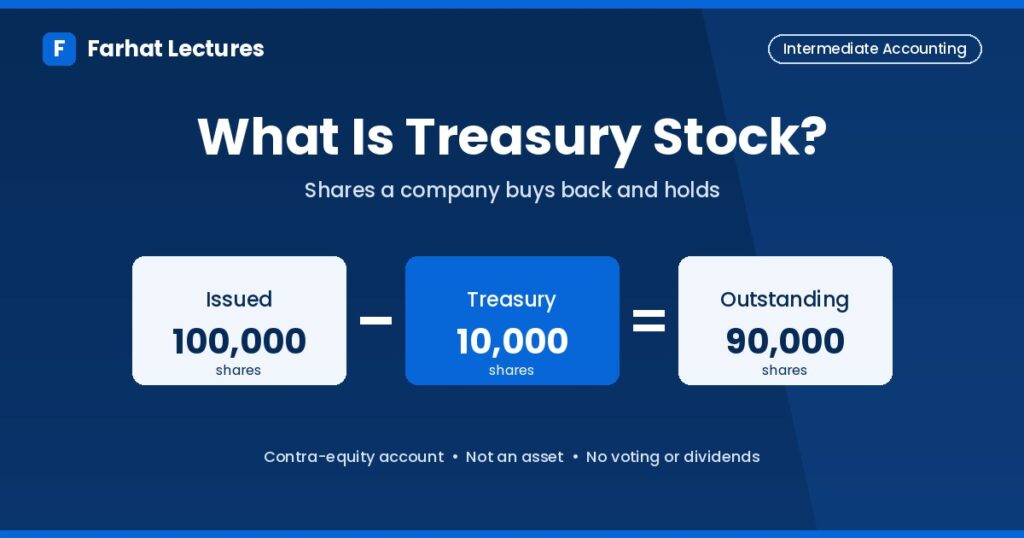
Responses