
Fair Value Method for Equity Investments: Journal Entries Step by Step

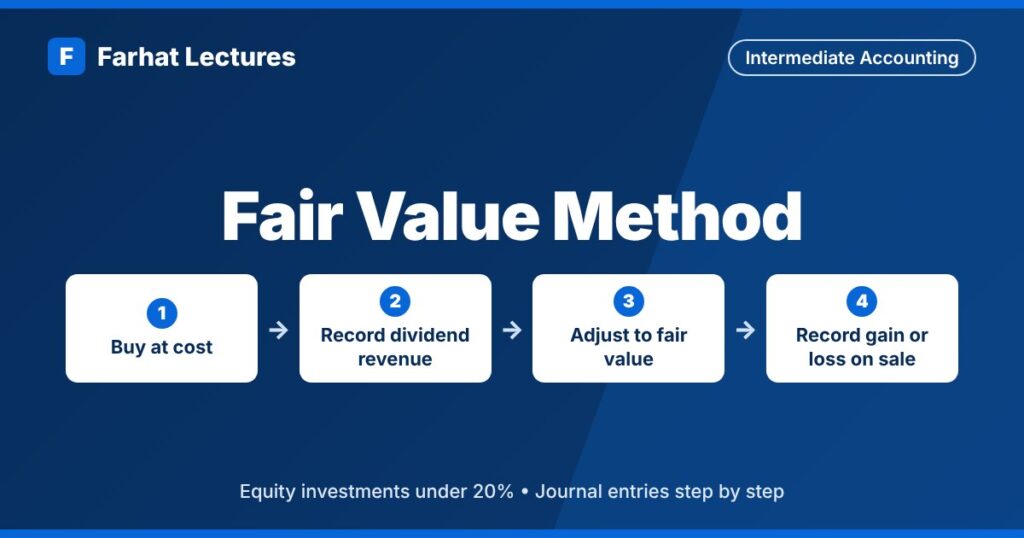
Under U.S. GAAP (ASC 321), the fair value method applies to equity investments where the investor has little or no influence, usually under 20% ownership. The entries below use a textbook purchase convention and show how to record cash dividends, report changes in fair value in net income, and account for a sale after a prior fair value adjustment.
Why does this matter? These four entries show how the purchase convention affects the investment account, when a cash dividend becomes revenue, and how to avoid counting the same gain twice when the shares are sold.
This topic is a core part of intermediate accounting and the CPA FAR section. If you are not sure the fair value method applies, start with investments in equity securities, which explains how ownership level sets the method.
Watch: Accounting for Equity Securities
Watch this Farhat lesson on YouTube
In this 15-minute lesson, Professor Farhat records the purchase, dividends, fair value adjustment, and sale of equity investments of less than 20% under the fair value method.
When does the fair value method apply?
Ownership percentage is a starting point, not a hard rule. What really decides the method is how much influence the investor has over the investee’s decisions.
| Ownership (guideline) | Level of influence | Method |
|---|---|---|
| Less than 20% | Little or no influence | Fair value method (ASC 321) |
| 20% to 50% | Significant influence | Equity method (ASC 323) |
| More than 50% | Control | Consolidation (ASC 810) |
These percentages are presumptions. An investor with 15% and a seat on the board may have significant influence and use the equity method. An investor with 25% may have none.
Three more points to know:
- No market price? A readily determinable fair value is a price you can actually look up, such as a stock exchange quote. If shares don’t have one (for example, stock in a private company), ASC 321 lets the investor elect the measurement alternative: cost, minus impairment, adjusted for observable price changes in orderly transactions for the same or a similar security of the same issuer.
- The old available-for-sale category is gone for equity securities. Since ASU 2016-01 took effect (fiscal years beginning after December 15, 2017, for public companies), unrealized gains and losses on equity securities go to net income, not other comprehensive income. Older study materials may still show the OCI treatment.
- IFRS is different. Under IFRS 9, a company can make an irrevocable election when it buys a non-trading equity investment to report fair value changes in other comprehensive income. This guide follows U.S. GAAP.
The fair value method at a glance
The journal entries below use the textbook convention of recording purchases at the transaction price plus direct broker commissions and tracking changes in fair value in a separate account.
| Event | Debit | Credit | Effect on net income |
|---|---|---|---|
| Purchase | Equity Investments | Cash | None |
| Dividend declared or received | Cash (or Dividend Receivable) | Dividend Revenue | Increase |
| Investee reports net income | No entry | No entry | None |
| Fair value rises (year-end) | Fair Value Adjustment | Unrealized Holding Gain or Loss—Income | Increase |
| Fair value falls (year-end) | Unrealized Holding Gain or Loss—Income | Fair Value Adjustment | Decrease |
| Sale | Cash (plus a loss, if any) | Equity Investments (plus a gain, if any) | Net change since the last fair value measurement |
The examples below follow one hypothetical company through a full cycle. Harlow Corp. buys stock in two companies, and each holding is less than 20% of the investee’s voting stock.
Step 1: Record the purchase at cost
Example (hypothetical). On March 1, 2027, Harlow buys:
| Investee | Shares × price | Commission | Cost |
|---|---|---|---|
| Brightway Inc. | 4,000 × $25 = $100,000 | $500 | $100,500 |
| Kestrel Co. | 2,500 × $48 = $120,000 | $300 | $120,300 |
| Total | $220,800 |
| March 1, 2027 | Debit | Credit |
|---|---|---|
| Equity Investments | 220,800 | |
| Cash | 220,800 |
In this example, the textbook purchase entry includes the broker commissions in the investment account. ASC 321 does not prescribe a general initial-measurement rule. For securities measured at fair value through net income, fair value excludes transaction costs, so commissions included in the purchase entry affect net income when the investment is remeasured in the acquisition period.
Step 2: Record dividend revenue
On November 15, 2027, Brightway declares and pays a cash dividend of $0.80 per share. Harlow receives 4,000 × $0.80 = $3,200.
| November 15, 2027 | Debit | Credit |
|---|---|---|
| Cash | 3,200 | |
| Dividend Revenue | 3,200 |
Revenue is recognized when the investee declares the dividend. If the declaration and the payment fall in different periods, debit Dividend Receivable on the declaration date and clear it when the cash arrives. The Equity Investments account does not change.
What about the investee’s net income?
Kestrel reports net income of $3 million for 2027 but pays no dividend. Harlow makes no entry. A passive investor cannot make the investee distribute its profits, and the investee may keep them in the business for good. So the investee’s net income is not a reliable basis for the investor’s income. (Recording a share of investee income is the equity method, which applies when the investor has significant influence, usually at 20% to 50% ownership.)
Step 3: Adjust to fair value at year-end
At December 31, 2027, Harlow compares the cost and fair value of its portfolio:
| Investee | Cost | Fair value | Unrealized gain (loss) |
|---|---|---|---|
| Brightway Inc. | $100,500 | $108,000 | $7,500 |
| Kestrel Co. | 120,300 | 112,000 | (8,300) |
| Total portfolio | $220,800 | $220,000 | $(800) |
| December 31, 2027 | Debit | Credit |
|---|---|---|
| Unrealized Holding Gain or Loss—Income | 800 | |
| Fair Value Adjustment | 800 |
The $800 net unrealized loss reduces 2027 net income, and the investments are reported at their $220,000 fair value. The Fair Value Adjustment account keeps the original cost intact in Equity Investments. How it works over several years, including after a sale, is covered in fair value adjustment for equity securities.
Step 4: Record the sale
On February 15, 2028, Harlow sells all 4,000 Brightway shares and receives net proceeds of $110,400 after commissions.
| Item | Amount |
|---|---|
| Net proceeds from sale | $110,400 |
| Less: cost of Brightway shares | (100,500) |
| Gain on sale of investments | $9,900 |
| February 15, 2028 | Debit | Credit |
|---|---|---|
| Cash | 110,400 | |
| Equity Investments | 100,500 | |
| Gain on Sale of Investments | 9,900 |
The textbook sale entry credits Equity Investments at its original recorded cost and shows a $9,900 gain since purchase. Brightway’s shares were already carried at $108,000 at the end of 2027, including a $7,500 gain recognized in 2027. The net effect in 2028 from the Brightway sale is $2,400 ($110,400 net proceeds minus the $108,000 prior carrying amount, assuming no intervening remeasurement). The same result follows from the textbook entries. The sale entry records $9,900 and the 2028 fair value adjustment removes the $7,500 previously recorded for Brightway. Any change in Kestrel’s fair value is accounted for separately.
For more guided practice, see the Accounting for Equity Securities lesson in the Farhat Lectures Intermediate Accounting course.
Key takeaways on the fair value method
- Under this textbook convention, record the purchase price plus direct commissions. The commissions affect net income when the investment is remeasured at fair value in the acquisition period.
- Dividends are dividend revenue; they do not reduce the investment.
- The investee’s net income is not recorded by a passive investor.
- At each reporting date, adjust the portfolio to fair value through net income.
- Net proceeds minus original cost shows the gain or loss since purchase. Compare net proceeds with the prior carrying amount to isolate the net effect since the last measurement.
Common mistakes
- Assuming that a broker commission increases the fair value of the shares.
- Crediting Equity Investments for dividends received. That is equity method treatment.
- Recording a share of a passive investee’s net income.
- Counting the full gain since purchase as current-period earnings after an earlier fair value gain was already recognized.
- Sending unrealized holding gains and losses on equity securities to other comprehensive income instead of net income. Under U.S. GAAP, OCI treatment is for available-for-sale debt securities, not equity securities.
Practice questions with answers
Fair Value Method for Equity Securities: Four Journal Entries
Use Juniper Co.’s passive equity investments to practice four journal entries. Juniper records purchases at the transaction price plus direct broker commissions for this exercise. Practice the purchase entry, dividend revenue, a sale before any fair value adjustment, and the year-end adjustment through net income. Select one answer per question.
1. A company buys 1,000 shares at $40 per share and pays a $200 commission. Record the purchase using the textbook convention above.
Answer: Debit Equity Investments $40,200; credit Cash $40,200. Under the stated convention, include the commission in the initial purchase entry.
2. A company owns 3,000 shares (a 5% interest). The investee declares and pays a $1.50 per share dividend. Record the dividend.
Answer: Debit Cash $4,500; credit Dividend Revenue $4,500 (3,000 × $1.50). The investment account does not change.
3. Shares that cost $60,000 are sold for net proceeds of $54,500 before any fair value adjustment. Record the sale.
Answer: Debit Cash $54,500 and Loss on Sale of Investments $5,500; credit Equity Investments $60,000. Net proceeds of $54,500 are $5,500 below the recorded cost.
Frequently asked questions
What is the fair value method for equity investments?
Under U.S. GAAP (ASC 321), it is the method used for equity investments where the investor has little or no influence, which is usually presumed below 20% ownership. The investment is reported at fair value, and dividends, unrealized holding gains and losses, and realized gains and losses all go to net income.
Are broker’s commissions expensed or capitalized?
ASC 321 does not prescribe a general initial-measurement rule. This example uses the textbook convention of including direct broker commissions in the initial recorded cost. For securities measured at fair value through net income, the commissions affect earnings when the investment is remeasured in the acquisition period because fair value excludes transaction costs.
Do dividends reduce the investment under the fair value method?
No. Under the fair value method, dividends are recorded as dividend revenue. Dividends reduce the investment only under the equity method.
When is dividend revenue recognized?
When the investee declares the dividend. If the cash is received in a later period, the investor records a dividend receivable on the declaration date.
Is the gain on sale measured against cost or fair value?
Net proceeds minus original recorded cost shows the gain or loss since purchase. To isolate the net effect since the last measurement, compare net proceeds with the most recent carrying amount. Under the textbook approach in this example, the fair value adjustment for the shares sold is removed during the sale period so the earlier gain or loss is counted once.
Is the 20% threshold a strict rule?
No. It is a presumption. An investor can have significant influence below 20% (for example, through a seat on the board) or lack it above 20%. Influence, not the percentage alone, decides the method.
What is the difference between the fair value method and the equity method?
Under the fair value method, the investor reports the investment at fair value, records dividends as revenue, and does not record the investee’s net income. Under the equity method, the investor records its share of the investee’s net income and treats dividends as a reduction of the investment.
What if the shares do not have a market price?
Under ASC 321, the investor can elect the measurement alternative: cost, minus impairment, adjusted for observable price changes in orderly transactions for the same or a similar security of the same issuer.
Sources
- FASB Accounting Standards Codification Topic 321, Investments: Equity Securities
- FASB staff memo on equity investments, paragraphs 27–28
- FASB Accounting Standards Codification Topic 323, Investments: Equity Method and Joint Ventures
- Deloitte: FASB issues ASU 2016-01 on classification and measurement of financial instruments
- IFRS Foundation: IFRS 9 Financial Instruments
About the author
Professor Mansour Farhat, CPA, CIA, DBA, created Farhat Lectures to help accounting students and CPA, CMA, and EA candidates learn through clear lectures, worked examples, and practice questions. The examples and exam traps in this guide come from the questions students ask most often in his courses.
Continue learning with Farhat Lectures
Strengthen your accounting understanding with clear explanations and guided practice.
Explore the free sample course




Responses