
Equity Method of Accounting: Journal Entries, Dividends, and Investee Losses

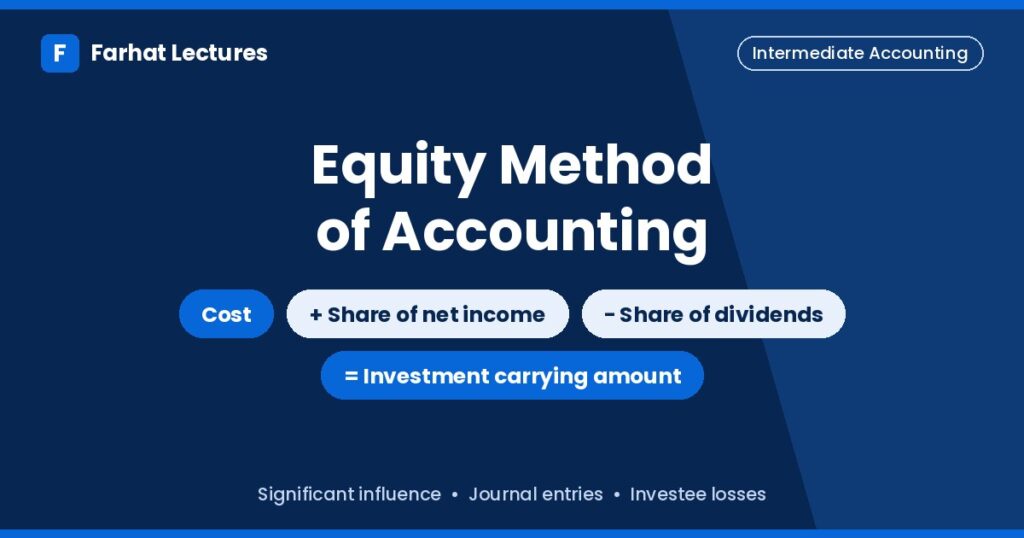
The equity method of accounting is how an investor records an investment in common stock when it has significant influence over the investee, usually 20% to 50% of the voting stock. The investment starts at cost, rises by the investor’s share of investee net income, and falls by its share of losses and dividends received.
This matters because the equity method reports the investor’s share of the investee’s results as they are earned, not when cash is paid out. That is a big change from how small, passive stock investments are reported. It is also a core topic in intermediate accounting, in the Investments area of the CPA exam’s FAR (Financial Accounting and Reporting) section, and in CMA Part 1. If you are not sure whether an investment qualifies, start with significant influence and the 20% rule.
Watch: Equity method journal entries and dividends (starts at 3:36, recording a 30% investment at cost)
How does the equity method of accounting work?
Under the equity method, the investment account (often called Equity Investments) tracks the investor’s stake in the investee as the investee earns income and pays dividends.
Basic carrying amount (before other adjustments) = Initial investment cost + share of investee net income − share of investee net losses − dividends received
| Event | Effect on the investment account | Effect on the investor’s income |
|---|---|---|
| Purchase of the shares | Increase by the cost paid | None |
| Investee reports net income | Increase by the investor’s percentage share | Investment income |
| Investee reports a net loss | Decrease by the investor’s percentage share | Investment loss |
| Investee pays a cash dividend | Decrease by the investor’s share of the dividend | None |
| Market price of the shares changes | No adjustment | None |
Two exceptions to the “no adjustment” row are worth knowing for the exam:
- Impairment. If the investment’s fair value drops below its carrying amount and the decline is other than temporary, the investor writes the investment down to fair value and records an impairment loss (FASB ASC 323-10-35-32). The written-down amount becomes the new carrying amount.
- Fair value option. When the investment first qualifies for the equity method, the investor can elect the fair value option (FASB ASC 825-10). It then reports the investment at fair value, with changes in value in net income, instead of using the equity method.
One more adjustment: if the investee reports other comprehensive income (OCI), such as foreign currency translation gains, the investor records its share in its own OCI and adjusts the investment by the same amount.
Worked example: Northgate Corp. and Lakeview Inc.
Hypothetical example. On January 1, 2027, Northgate Corp. buys 40,000 of Lakeview Inc.’s 160,000 outstanding common shares (25%) for $600,000 cash and gains significant influence. To keep the example focused, assume the price equals 25% of Lakeview’s book value, so no extra adjustments are needed. The next section shows what changes when an investor pays more.
| Year | Lakeview net income (loss) | Lakeview cash dividends | Northgate’s 25% share of income (loss) | Northgate’s 25% share of dividends |
|---|---|---|---|---|
| 2027 | $280,000 | $80,000 | $70,000 | $20,000 |
| 2028 | ($120,000) | $40,000 | ($30,000) | $10,000 |
| Account | Debit | Credit |
|---|---|---|
| January 1, 2027: buy 25% of Lakeview | ||
| Equity Investments (Lakeview) | 600,000 | |
| Cash | 600,000 | |
| 2027: record 25% of Lakeview’s $280,000 net income | ||
| Equity Investments (Lakeview) | 70,000 | |
| Investment Income | 70,000 | |
| 2027: receive 25% of Lakeview’s $80,000 dividend | ||
| Cash | 20,000 | |
| Equity Investments (Lakeview) | 20,000 | |
| 2028: record 25% of Lakeview’s $120,000 net loss | ||
| Investment Loss | 30,000 | |
| Equity Investments (Lakeview) | 30,000 | |
| 2028: receive 25% of Lakeview’s $40,000 dividend | ||
| Cash | 10,000 | |
| Equity Investments (Lakeview) | 10,000 | |
| Item | 2027 | 2028 |
|---|---|---|
| Beginning balance | $600,000 | $650,000 |
| Share of net income (loss) | 70,000 | (30,000) |
| Share of dividends | (20,000) | (10,000) |
| Ending carrying amount | $650,000 | $610,000 |
Northgate reports $70,000 of investment income in 2027 and a $30,000 investment loss in 2028. The $30,000 of dividends it received over the two years never appears as income.
What if the investor pays more than book value?
On the CPA exam, the price paid is often higher than the investor’s share of the investee’s book value. That extra amount is called a basis difference. The investor assigns it to specific investee assets that are worth more than their book value, and anything left over is equity method goodwill.
The investor does not record these pieces in separate accounts. They stay inside the single investment account. But the part assigned to depreciable assets gets depreciated, and that depreciation lowers investment income each year. Equity method goodwill is generally not amortized.
Hypothetical example. Suppose Northgate paid $700,000 instead of $600,000 for the same 25% of Lakeview. Northgate’s share of Lakeview’s book value is still $600,000, so the excess is $100,000. Lakeview’s equipment is worth $240,000 more than its book value and has 10 years of remaining life.
| Step | Amount |
|---|---|
| Price paid | $700,000 |
| 25% of Lakeview’s book value | $600,000 |
| Excess paid (basis difference) | $100,000 |
| Assigned to equipment (25% × $240,000) | $60,000 |
| Remaining equity method goodwill | $40,000 |
| Extra depreciation each year ($60,000 ÷ 10 years) | $6,000 |
In 2027, Northgate’s investment income becomes $70,000 − $6,000 = $64,000. The extra entry is a debit to Investment Income and a credit to Equity Investments (Lakeview) for $6,000. The ending 2027 carrying amount is $700,000 + $70,000 − $20,000 − $6,000 = $744,000.
Profits on sales between the investor and the investee (upstream and downstream sales) need one more adjustment. You can see it worked step by step in the free Downstream Sales and Upstream Sales sample lesson.
Why dividends reduce the investment instead of counting as income
An investor with significant influence usually has a voice on the investee’s board, and the board decides whether to pay dividends. If dividends counted as income, the investor could help decide its own income. More importantly, the investor has already recognized its share of the earnings. A dividend simply moves part of those earnings from the investee to the investor as cash, so the investment shrinks by the same amount. For how the investee records the dividend on its side, see the cash dividend journal entry. For the contrast with passive investments, see equity method vs. fair value method.
What if investee losses exceed the investment?
Normally the investor stops applying the equity method once its investment, plus any net advances (loans) it has made to the investee, is reduced to zero, and it does not record further losses. The exceptions are when the investor has guaranteed the investee’s obligations or committed to provide more financial support, or when the investee’s imminent return to profitable operations appears to be assured. If the investor also holds other investments in the same investee, such as preferred stock or loans, extra rules apply that go beyond this lesson. When the investee later earns income, the investor resumes recognizing income only after its share of that income equals the losses it did not record (FASB ASC 323-10-35-19 through 35-22, summarized in the Deloitte equity method roadmap).
Hypothetical example. Harlow Co. owns 40% of Ridge Labs with a carrying amount of $45,000 and has made no guarantees, loans, or other investments in Ridge. Ridge loses $150,000, so Harlow’s share is $60,000.
| Step | Amount |
|---|---|
| Harlow’s share of Ridge’s loss (40% × $150,000) | $60,000 |
| Loss recorded, limited to the carrying amount | $45,000 |
| Investment balance after the loss | $0 |
| Unrecorded (suspended) loss | $15,000 |
The next year Ridge earns $50,000. Harlow’s share is $20,000, but the first $15,000 only makes up the suspended loss. Harlow records $5,000 of investment income, and its investment rises to $5,000.
Common mistakes and CPA exam traps
- Recording dividends as revenue. Under the equity method they reduce the investment.
- Using the investee’s full net income. Record only the investor’s percentage share.
- Waiting for dividends to record income. Income is recorded when the investee earns it.
- Adjusting to market price. Equity method investments are not marked to fair value each period. The only exceptions are an other-than-temporary impairment and an election of the fair value option.
- Taking the investment below zero automatically. Stop at zero unless the investor guaranteed obligations or committed to more support.
- Counting income from before the purchase date. If the investor buys partway through the year, it records only its share of income earned after the purchase.
- Forgetting the excess paid over book value. If part of the price was assigned to undervalued depreciable assets, the extra depreciation reduces investment income every year.
Practice questions with answers
Equity Method Accounting: Investment Carrying Amount
Use the Summit Co. and Harbor Co. case to calculate an equity method investment’s carrying amount from acquisition through the end of Year 2. Select one answer per question, then review the calculations. In every practice case on this page, assume the price paid equals the investor’s share of the investee’s book value, so there is no excess cost to account for.
Three more questions, with the answer right below each one:
Question 6: Ending carrying amount
Bayside Co. pays $500,000 for 30% of Coral Inc. on January 1. Coral reports net income of $200,000 and pays $50,000 of dividends for the year. What are Bayside’s investment income and year-end carrying amount?
Answer:
Investment income $60,000; carrying amount $545,000
Share of income: 30% × $200,000 = $60,000. Share of dividends: 30% × $50,000 = $15,000. Carrying amount: $500,000 + $60,000 − $15,000 = $545,000.
Question 7: Recording a dividend
Under the equity method, Delmar Corp. receives a $12,000 cash dividend from its 35%-owned investee. What is the journal entry?
Answer:
Debit Cash $12,000; credit Equity Investments $12,000
The dividend is a return of part of the investment, so it reduces the investment account. No revenue is recorded.
Question 8: Losses beyond zero
Trent Co.’s equity method investment has a carrying amount of $20,000. Its share of the investee’s current loss is $32,000. Trent has made no advances, holds no other investments in the investee, and has no guarantees or commitments to provide support. The investee’s imminent return to profitable operations is uncertain. How much loss does Trent record?
Answer:
$20,000
Trent records a $20,000 loss, the investment falls to zero, and the remaining $12,000 is suspended. Trent must offset that $12,000 against its share of future income before recording new investment income.
Want more practice like this? Work through the Equity Method lesson and the CPA exam questions on the equity method in the Farhat Lectures Intermediate Accounting course. For exam-style drilling, the FAR CPA Test Bank has 35 multiple-choice questions on equity method investments.
Key takeaways
- Use the equity method when the investor has significant influence but not control.
- Record the investment at cost, add the share of income, and subtract the share of losses and dividends.
- Dividends reduce the investment and are not income.
- The investment is not adjusted to market price, unless it has an other-than-temporary impairment or the investor elected the fair value option.
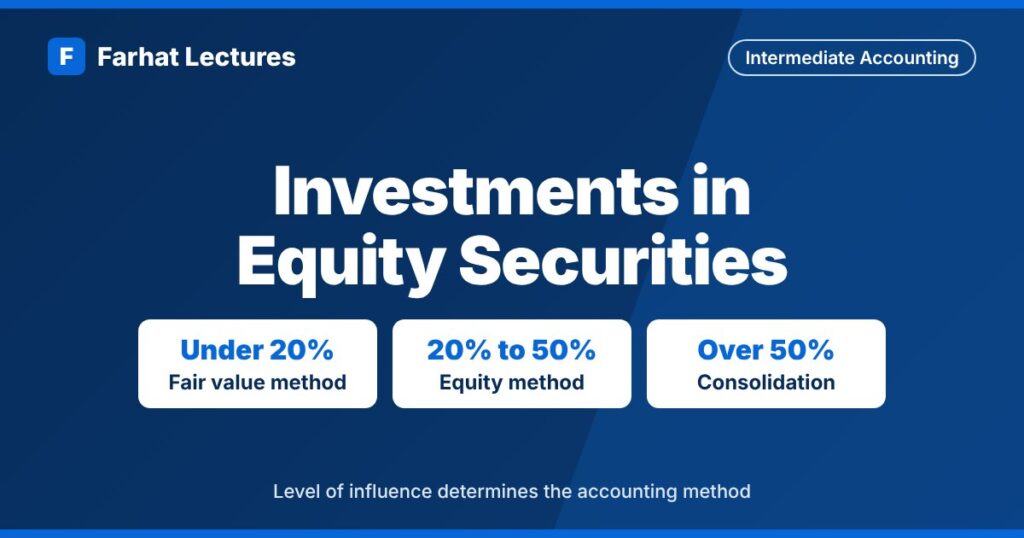
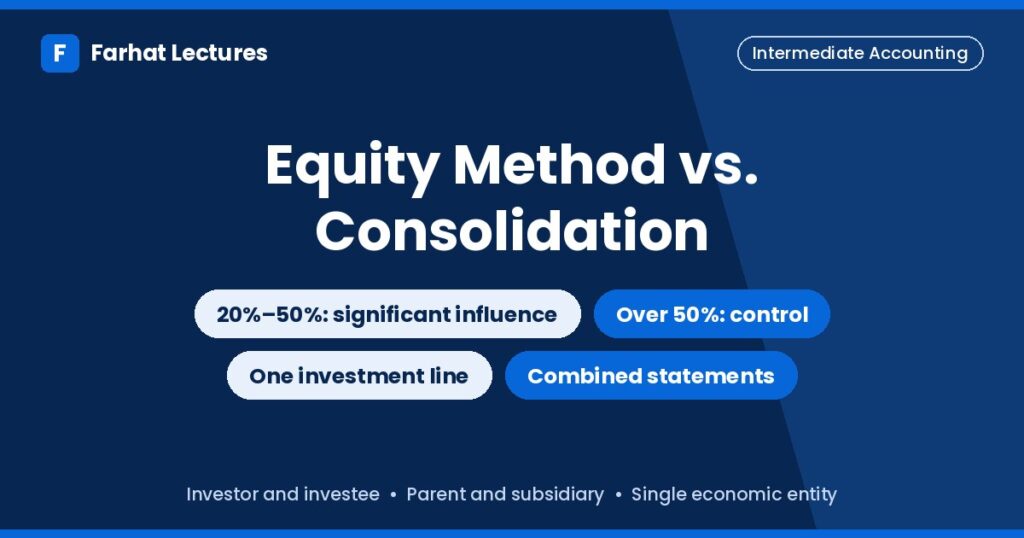
- Once the investor gains control (usually over 50%), see equity method vs. consolidation.
Frequently asked questions
Why are dividends not income under the equity method?
The investor already recorded its share of the investee’s income as it was earned. A dividend just pays out part of that income, so counting it as revenue again would double count. It is treated as a return of part of the investment instead.
Is equity method income the same as cash received?
No. Equity method income starts with the investor’s share of the investee’s earnings and reflects any required adjustments, such as extra depreciation on a basis difference. The investor receives cash separately when the investee pays dividends.
Does the equity method investment get adjusted to market price?
Not each period. The carrying amount moves with the investee’s income, losses, and dividends, not with the stock’s market price. There are two exceptions. If the investment’s value has an other-than-temporary decline, the investor writes it down and records an impairment loss. And an investor that elected the fair value option reports the investment at fair value instead. For a side-by-side comparison, see Equity Method vs. Fair Value Method.
What happens when the investee has a loss?
The investor records its share of the investee’s loss and reduces the investment carrying amount. It generally suspends further losses once the equity method investment and net advances are reduced to zero. Other interests in the investee, guarantees, commitments to provide support, or an apparently assured imminent return to profitability can change the analysis.
Where does the equity method investment appear on the balance sheet?
It is usually reported as a single long-term investment line, and the investor’s share of income or loss is reported as a single line on the income statement.
What happens when an investor first gains significant influence?
It starts using the equity method on that date, going forward. The investor adds the cost of the new shares to the carrying amount of the shares it already owned and does not go back and restate prior years (FASB ASU 2016-07).
How do you record equity method income for a mid-year purchase?
Only income earned after the purchase date counts. If an investor buys 25% on October 1 and the investee earns $120,000 evenly during the year, the investor records 25% × $120,000 × 3/12 = $7,500 of investment income.
Sources
- Deloitte Roadmap: Equity Method Investments and Joint Ventures, Chapter 1 Overview (FASB ASC 323-10)
- Deloitte Roadmap: Equity Method Losses That Exceed the Carrying Amount (ASC 323-10-35-19 to 35-22)
- FASB Accounting Standards Codification, Topic 323: Investments, Equity Method and Joint Ventures
About the author
Mansour Farhat, CPA, CIA, DBA, teaches accounting and CPA exam review at Farhat Lectures and on the Farhat Lectures YouTube channel. His lessons help CPA, CMA, and EA candidates and accounting students work through topics like the equity method step by step, with original examples, practice questions, and the mistakes students make most often.
Continue learning with Farhat Lectures
Strengthen your accounting understanding with clear explanations and guided practice.
Explore the free sample course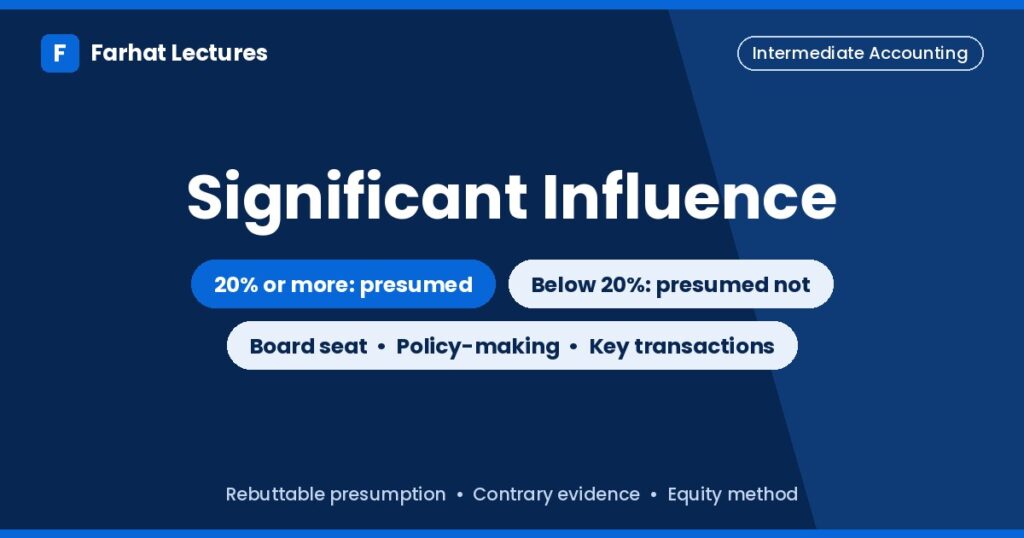

Responses