
Available-for-Sale Debt Securities: Fair Value Adjustment, OCI, and Sales


Available-for-sale (AFS) debt securities are debt investments that a company has not classified as held-to-maturity or trading. Under ASC 320, they are reported at fair value on the balance sheet. Unrealized holding gains and losses from market price changes generally go to other comprehensive income (OCI). Credit losses follow separate rules under ASC 326-30. When a security is sold, the realized gain or loss goes to net income.
Available-for-sale is the catch-all category for debt securities: any debt investment that is not held-to-maturity or trading lands here. Companies use it to earn income and capital gains over time, to diversify, and to keep a source of liquidity. This lesson walks through a full two-year example: interest revenue, the year-end fair value adjustment for a portfolio, a sale, and the next year’s adjustment. To see how this category compares with the other two, read investments in debt securities: HTM vs. AFS vs. trading.
Watch: AFS debt securities: fair value adjustments and journal entries (about 21 minutes, from purchase through the fair value adjustment)
How are available-for-sale debt securities accounted for?
| Event | Accounting treatment |
|---|---|
| Purchase | Record Debt Investments at cost |
| Interest | Recognize interest revenue with the effective-interest method, amortizing any discount or premium |
| Each reporting date | Adjust the portfolio to fair value through the Fair Value Adjustment account; the offset goes to Unrealized Holding Gain or Loss—Equity (OCI) |
| Sale | Remove the amortized cost; report the realized gain or loss in net income |
The idea is a middle ground. Investors see current fair values on the balance sheet, while net income is not affected by price changes that have not been realized.
Quick definition: amortized cost is what the company paid for the bond, adjusted for the discount or premium amortized so far. It is the number you compare with fair value at year-end, and with the selling price when you sell.
Step 1: Record interest revenue on available-for-sale securities
Hypothetical example. On January 1, 2027, Crestline Corp. buys two bond investments and classifies both as available-for-sale:
- Harlow bonds: $80,000 face value, 8%, three-year bonds with interest paid each December 31, bought for $84,277 to yield 6%. That is a premium of $4,277.
- Delmar bonds: $50,000 face value, 6% bonds bought at par, with interest paid each December 31.
For the Harlow bonds, 2027 interest revenue is $84,277 × 6% = $5,057. Cash received is $6,400, so the premium amortization is $1,343 and the amortized cost falls to $82,934.
| Date | Account | Debit | Credit |
|---|---|---|---|
| Dec. 31, 2027 | Cash | 6,400 | |
| Debt Investments | 1,343 | ||
| Interest Revenue | 5,057 |
The Delmar bonds have no premium, so Crestline simply records $3,000 of interest revenue. The amortization works the same way as for held-to-maturity securities; see our effective-interest method lesson for more.
Step 2: Adjust available-for-sale debt securities to fair value
Rather than adjust each bond separately, Crestline compares the total amortized cost of the portfolio with its total fair value.
Assume the 2027 fair value changes are market-driven and neither bond has a credit loss. At December 31, 2027, Crestline has no intent to sell Delmar, and it is not more likely than not that it will be required to sell before recovering the bond’s amortized cost. Crestline decides to sell Delmar in 2028.
| Investment | Amortized cost | Fair value | Unrealized gain (loss) |
|---|---|---|---|
| Harlow 8% bonds | $82,934 | $84,100 | $1,166 |
| Delmar 6% bonds | 50,000 | 46,500 | (3,500) |
| Total portfolio | $132,934 | $130,600 | $(2,334) |
The Fair Value Adjustment account starts at zero, so it needs a $2,334 credit balance:
| Date | Account | Debit | Credit |
|---|---|---|---|
| Dec. 31, 2027 | Unrealized Holding Gain or Loss—Equity | 2,334 | |
| Fair Value Adjustment | 2,334 |
The $2,334 unrealized loss is reported in OCI and reduces stockholders’ equity through accumulated other comprehensive income. Net income is not affected.
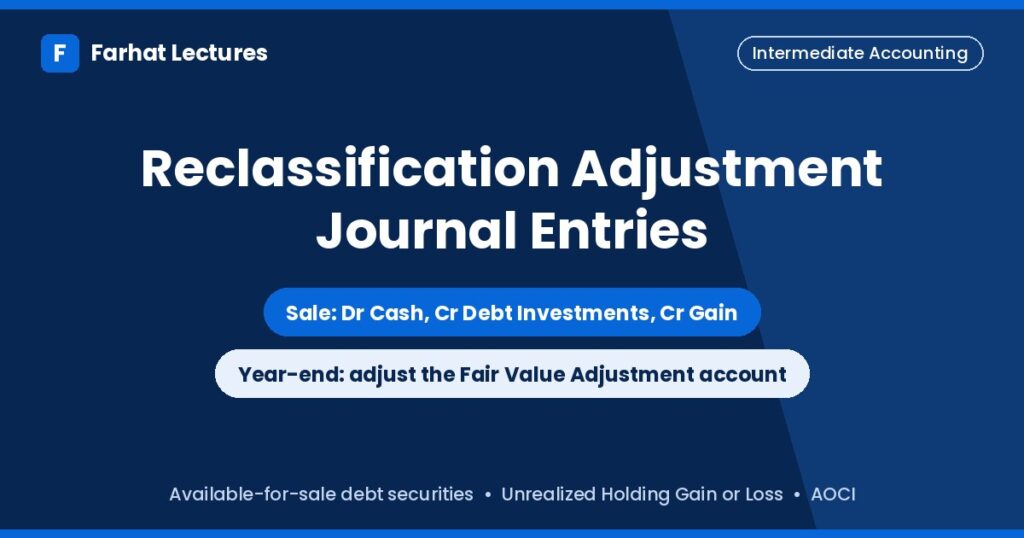
Step 3: Record the sale of an available-for-sale security
On July 1, 2028, Crestline sells the Delmar bonds for $47,200 plus $1,500 of accrued interest (six months at 6% on $50,000). The realized loss compares the selling price with amortized cost: $50,000 − $47,200 = $2,800.
| Date | Account | Debit | Credit |
|---|---|---|---|
| July 1, 2028 | Cash | 48,700 | |
| Loss on Sale of Investments | 2,800 | ||
| Debt Investments | 50,000 | ||
| Interest Revenue | 1,500 |
Notice that this entry does not touch the Fair Value Adjustment account. The year-end portfolio adjustment takes care of that.
Step 4: The next year-end fair value adjustment
On December 31, 2028, Crestline records Harlow interest revenue of $4,976 ($82,934 × 6%) and premium amortization of $1,424, so amortized cost falls to $81,510. The Harlow bonds are the only investment left, and their fair value is $81,900.
| Item | Amount |
|---|---|
| Fair value ($81,900) − amortized cost ($81,510): required balance | $390 Dr. |
| Current balance of Fair Value Adjustment | 2,334 Cr. |
| Adjustment needed | $2,724 Dr. |
| Date | Account | Debit | Credit |
|---|---|---|---|
| Dec. 31, 2028 | Fair Value Adjustment | 2,724 | |
| Unrealized Holding Gain or Loss—Equity | 2,724 |
Why $2,724? Two things happened.
First, Delmar’s $3,500 unrealized loss comes out of accumulated other comprehensive income (AOCI) because Crestline no longer owns those bonds. Of that $3,500, $2,800 became the realized loss on the sale. The other $700 is the price recovery from $46,500 to $47,200 before Crestline sold.
Second, the Harlow bonds’ unrealized gain fell by $776 ($1,166 to $390).
That is $3,500 − $776 = $2,724. Moving the $2,800 realized loss out of OCI is called a reclassification adjustment. It keeps the same loss from being counted twice: once in OCI and again in net income.
Our lessons on the reclassification adjustment and comprehensive income explain how this shows up in the statement of comprehensive income.
How are AFS debt securities reported in the financial statements?
| Statement | Item | Amount |
|---|---|---|
| Balance sheet | Debt investments (available-for-sale), at fair value (amortized cost $81,510) | $81,900 |
| Balance sheet | Accumulated other comprehensive income | $390 |
| Income statement | Interest revenue ($4,976 + $1,500) | $6,476 |
| Income statement | Loss on sale of investments (other expenses and losses) | $(2,800) |
| Other comprehensive income | Unrealized holding loss arising during 2028 ($700 Delmar recovery − $776 Harlow decline) | $(76) |
| Other comprehensive income | Reclassification adjustment for loss included in net income | $2,800 |
| Other comprehensive income | Net other comprehensive income for 2028 | $2,724 |
Available-for-sale securities can be current or noncurrent assets, depending on when the company expects to sell or collect them. The amortized cost basis, and any allowance for credit losses, must also be shown in parentheses next to the fair value, as in the balance sheet line above. To keep the example simple, these amounts ignore income taxes. Under ASC 220, a company can present OCI items net of tax or present them before tax and show the aggregate tax effect separately.
Common mistakes with AFS debt securities
- Debiting a market-driven loss to net income in this example. The unrealized AFS loss goes to Unrealized Holding Gain or Loss—Equity, an OCI account.
- Recording the required ending balance as the adjustment. Compute the required ending balance first, then compare it with the current balance.
- Using fair value to compute the realized gain or loss. Compare the selling price with amortized cost.
- Skipping amortization. Fair value accounting does not replace the effective-interest method.
- Confusing AFS with trading. Both use fair value, but only trading securities put unrealized changes in net income.
How AFS debt securities show up on the CPA and CMA exams
Investments in debt securities are tested in the Financial Accounting and Reporting (FAR) section of the CPA exam, and investment accounting also appears in CMA Part 1. Here is what to watch for:
- Required balance questions. You are often given the beginning Fair Value Adjustment balance and asked for the year-end entry. Find the required ending balance first, then record the difference.
- Realized gain or loss. Use selling price minus amortized cost, not selling price minus last year’s fair value.
- Where the number goes. A question may ask about net income, OCI, or total comprehensive income. In our 2028 example, the Delmar sale cut net income by $2,800 but raised OCI by $3,500. That is a $700 increase in comprehensive income, which matches the price recovery from $46,500 to $47,200.
- Equity securities. Since ASU 2016-01, equity securities cannot be classified as available-for-sale. If a question describes an investment in stock, think fair value through net income in most cases.
- Per-security method. Some textbooks and exam questions remove a sold security’s share of the Fair Value Adjustment on the sale date instead of waiting for year-end. The realized gain or loss in net income is the same either way.
Interactive practice on available-for-sale debt securities
Fair value, OCI, and AOCI
Calculate the balance sheet carrying amount of an available-for-sale (AFS) debt security and trace an unrealized holding gain from other comprehensive income (OCI) to accumulated other comprehensive income (AOCI) in stockholders’ equity. Choose one answer for each of the three questions.
Practice questions with answers
Question 1: First fair value adjustment
A company’s only available-for-sale bond has an amortized cost of $60,000 and a year-end fair value of $57,500. There is no previous fair value adjustment. The decline is market-driven, and the company expects to hold the bond through recovery of amortized cost. Record the entry.
Answer:
Debit Unrealized Holding Gain or Loss—Equity $2,500; credit Fair Value Adjustment $2,500.
The $2,500 loss goes to OCI, so net income is unchanged.
Question 2: Adjusting an existing balance
Fair Value Adjustment has a $3,000 credit balance. This year, the available-for-sale portfolio has an amortized cost of $140,000 and a fair value of $141,200. What adjustment is needed?
Answer:
Debit Fair Value Adjustment $4,200; credit Unrealized Holding Gain or Loss—Equity $4,200.
The required balance is a $1,200 debit. Moving from a $3,000 credit to a $1,200 debit takes a $4,200 debit.
Question 3: Realized gain on sale
A company sells an available-for-sale bond with an amortized cost of $38,400 for $39,000, excluding accrued interest. What is reported in net income?
Answer:
A realized gain of $600.
$39,000 − $38,400 = $600, reported under other revenues and gains. The Fair Value Adjustment account is updated at the next reporting date.
Want guided practice? Work through debt securities available for sale in the Farhat Lectures Intermediate Accounting course.
Key takeaways
- Available-for-sale debt securities are those not classified as held-to-maturity or trading.
- They are reported at fair value, with unrealized holding gains and losses in OCI and accumulated in stockholders’ equity.
- Interest revenue still uses the effective-interest method.
- One Fair Value Adjustment account is adjusted to the required portfolio balance at each reporting date.
- On a sale, the realized gain or loss is selling price minus amortized cost, reported in net income. If the company had the intent and ability to hold to maturity, see held-to-maturity securities instead.
Frequently asked questions
Why do AFS unrealized gains and losses go to OCI instead of net income?
The FASB accepted the argument, made especially by financial institutions, that recognizing fair value changes on assets but not on related liabilities would add volatility to net income that does not reflect the business. Reporting them in OCI keeps them out of net income while still showing fair value on the balance sheet.
What is accumulated other comprehensive income?
Accumulated other comprehensive income (AOCI) is the running total of OCI items, reported as a separate component of stockholders’ equity. Unrealized holding gains and losses on available-for-sale debt securities build up there until the securities are sold.
Is the fair value adjustment recorded for each security or for the portfolio?
In this textbook approach, one Fair Value Adjustment account is kept for the whole available-for-sale portfolio, and it is adjusted to the required balance at each reporting date. Companies still track each security’s amortized cost, which is needed to compute gains and losses when a security is sold.
Do available-for-sale securities still amortize discounts and premiums?
Yes. Interest revenue is recognized with the effective-interest method, exactly as for held-to-maturity securities. The fair value adjustment is a separate step, made after amortization.
What about credit losses on available-for-sale securities?
Declines caused by credit problems follow ASC 326-30. Under the allowance model, the company recognizes the credit-related decline in earnings through an allowance capped at the amount by which amortized cost exceeds fair value. It reports the remaining decline in OCI. If the company intends to sell an impaired security, or will more likely than not be required to sell it before recovering its amortized cost, it writes the security down to fair value and recognizes any additional impairment in earnings. That topic is covered in a later lesson on impairment of debt investments.
Can equity securities be classified as available-for-sale?
No. Since ASU 2016-01, the available-for-sale category applies only to debt securities. Most equity investments where the investor does not have significant influence are measured at fair value, with changes reported in net income.
What is the difference between available-for-sale and trading debt securities?
Both are reported at fair value on the balance sheet. The difference is where unrealized gains and losses go: trading securities report them in net income, while available-for-sale securities report them in other comprehensive income until the security is sold.
Sources
- FASB Accounting Standards Codification, Topic 320: Investments—Debt Securities (ASC 320-10-35-1(b): available-for-sale securities at fair value, unrealized holding gains and losses in other comprehensive income)
- PwC Viewpoint: Available-for-sale securities
- Deloitte Roadmap: Current Expected Credit Losses, 8.1 Presentation (ASC 326-30-45-1: available-for-sale debt securities presented at fair value, with the amortized cost basis and any allowance for credit losses shown parenthetically)
- KPMG Executive Summary: Investments (2026)
About the author
Mansour Farhat, CPA, CIA, DBA, is a veteran accounting educator and the founder of Farhat Lectures and the Farhat Lectures YouTube channel. He holds a Doctor of Business Administration from Temple University and a Master of Accountancy from Bloomsburg University, and he teaches accounting students and candidates preparing for the CPA, CMA, and EA exams.
Continue learning with Farhat Lectures
Strengthen your accounting understanding with clear explanations and guided practice.
Explore the free sample course


Responses