
Reclassification Adjustment Journal Entry for Available-for-Sale Debt Securities

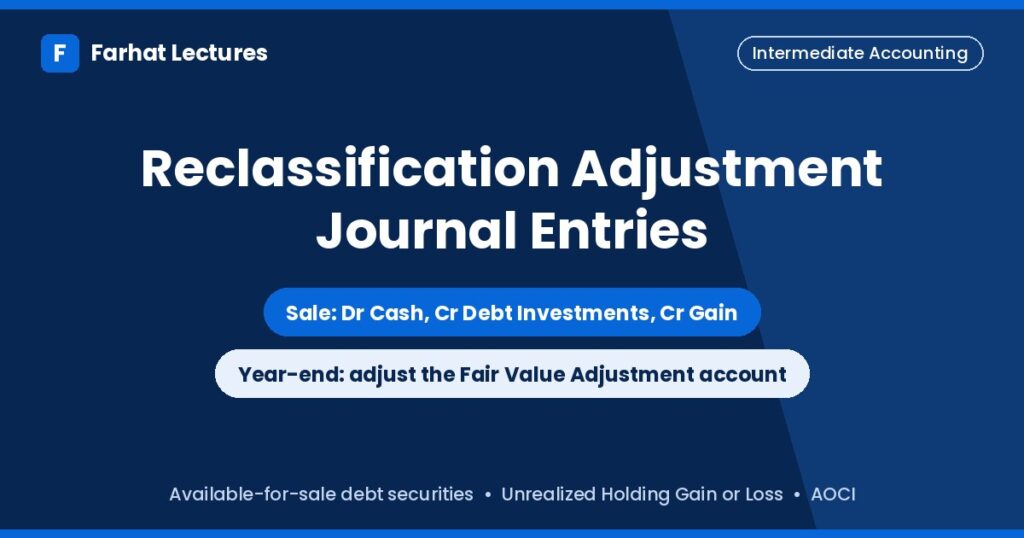
A reclassification adjustment journal entry moves an available-for-sale (AFS) debt security’s old unrealized gain or loss out of other comprehensive income (OCI) when the security is sold. For a gain, debit Unrealized Holding Gain or Loss – Equity and credit Fair Value Adjustment. For a loss, do the opposite. This keeps the gain or loss from being counted twice in comprehensive income.
Under the portfolio approach (adjusting one Fair Value Adjustment account for all your AFS securities together at year-end), the reclassification is built into the year-end entry. Companies may also record it as a separate entry on the sale date. Both give the same ending balances.
This matters because students often record the sale correctly but leave the old fair value adjustment on the books. Then the balance sheet, AOCI, and comprehensive income are all wrong. This lesson walks through every entry over two years using the Harlow Co. example from what a reclassification adjustment is. For the AFS basics, see Available-for-Sale Debt Securities: Fair Value Through OCI in the course.
Watch: CPA exam simulation: fair value adjustment and reclassification (starts at 6:35, reclassification when the investment is sold)
Why is a reclassification adjustment needed?
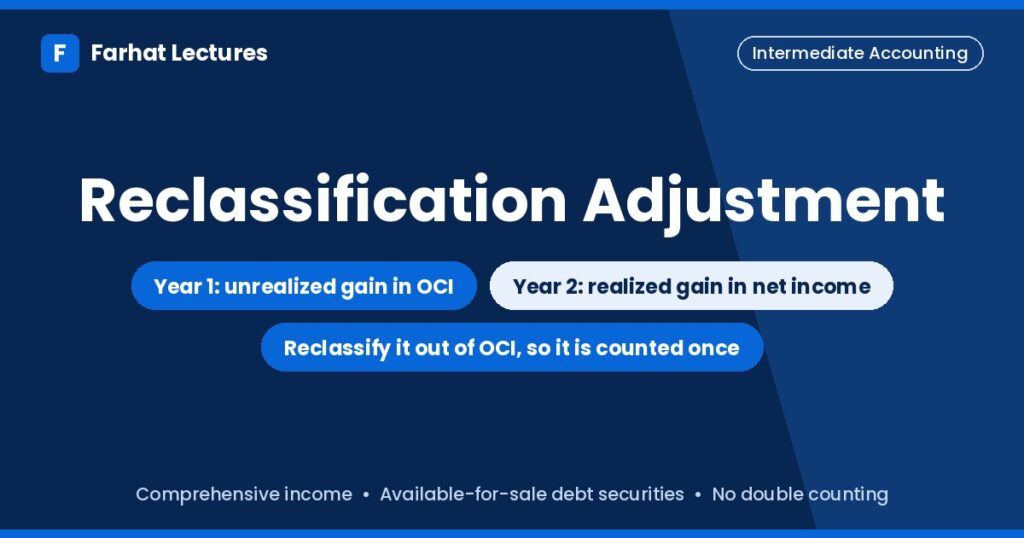
When an AFS debt security goes up in value while you still own it, that unrealized gain (a gain on paper, because you have not sold yet) is reported in other comprehensive income. OCI is the part of comprehensive income that sits outside net income. When you later sell the security, the realized gain goes into net income. Without an adjustment, the same gain would show up in comprehensive income twice: once as OCI in the year it happened, and again as net income in the year you sold.
The reclassification adjustment fixes that. It takes the old gain back out of OCI in the year of sale, so it is counted only once. FASB requires this in ASC 220-10-45-15.
Quick reference: the reclassification entry
| If the sold security had | Debit | Credit |
|---|---|---|
| An unrealized gain | Unrealized Holding Gain or Loss – Equity | Fair Value Adjustment |
| An unrealized loss | Fair Value Adjustment | Unrealized Holding Gain or Loss – Equity |
Net income does not change. The realized gain or loss was already recorded in the sale entry.
Accounts you will use
| Account | Type | What it holds |
|---|---|---|
| Debt Investments | Asset | Amortized cost of the bonds |
| Fair Value Adjustment | Asset valuation account | Difference between fair value and amortized cost (debit if above cost, credit if below) |
| Unrealized Holding Gain or Loss – Equity | Temporary OCI account | This year’s unrealized holding gains and losses, including reclassifications |
| Accumulated Other Comprehensive Income (AOCI) | Stockholders’ equity | Cumulative unrealized gains and losses on securities still held |
| Gain (Loss) on Sale of Investments | Income statement | Realized gain or loss: sale price minus amortized cost |
Textbook note: Some textbooks never close Unrealized Holding Gain or Loss – Equity. They let it carry a running balance and report that balance as AOCI. If your book does this, skip the closing entries below. Every ending balance comes out the same.
Year 1 entries
Hypothetical example; income taxes and interest entries omitted. Harlow Co. bought two AFS bonds at par (face value) in Year 1. Because there is no premium or discount, each bond’s amortized cost equals its face value.
| Security | Amortized cost | Fair value | Unrealized gain (loss) |
|---|---|---|---|
| Bond A | $60,000 | $72,000 | $12,000 |
| Bond B | $90,000 | $96,000 | $6,000 |
| Total portfolio | $150,000 | $168,000 | $18,000 |
The Fair Value Adjustment account needs an $18,000 debit balance, and it starts at zero.
December 31, Year 1: record the unrealized holding gain
| Account | Debit | Credit |
|---|---|---|
| Fair Value Adjustment | 18,000 | |
| Unrealized Holding Gain or Loss – Equity | 18,000 |
December 31, Year 1: close OCI to AOCI
| Account | Debit | Credit |
|---|---|---|
| Unrealized Holding Gain or Loss – Equity | 18,000 | |
| Accumulated Other Comprehensive Income | 18,000 |
The balance sheet shows Debt Investments of $150,000 plus the $18,000 Fair Value Adjustment, or $168,000 at fair value, and AOCI of $18,000.
Recording the sale
In Year 2, Harlow sells Bond A for $72,000. The realized gain is the sale price minus amortized cost: $72,000 − $60,000 = $12,000.
Year 2: sell Bond A
| Account | Debit | Credit |
|---|---|---|
| Cash | 72,000 | |
| Debt Investments | 60,000 | |
| Gain on Sale of Investments | 12,000 |
Net income now includes the $12,000 gain. But AOCI still contains Bond A’s $12,000 unrealized gain from Year 1. That is the amount the reclassification must remove.
Year 2 fair value adjustment (portfolio approach)
At the end of Year 2, Harlow holds only Bond B, with amortized cost of $90,000 and fair value of $91,000. Compute the balance the Fair Value Adjustment account needs, then compare it with the existing balance.
| Item | Amount |
|---|---|
| Required balance: Bond B fair value $91,000 − amortized cost $90,000 | $1,000 Dr |
| Existing balance from Year 1 | $18,000 Dr |
| Adjustment needed | $17,000 Cr |
December 31, Year 2: adjust to fair value
| Account | Debit | Credit |
|---|---|---|
| Unrealized Holding Gain or Loss – Equity | 17,000 | |
| Fair Value Adjustment | 17,000 |
December 31, Year 2: close OCI to AOCI
| Account | Debit | Credit |
|---|---|---|
| Accumulated Other Comprehensive Income | 17,000 | |
| Unrealized Holding Gain or Loss – Equity | 17,000 |
Under the portfolio approach, the reclassification adjustment is built into this year-end entry. The $17,000 has two parts: the $12,000 reclassification of Bond A’s old gain and Bond B’s $5,000 holding loss for Year 2. AOCI ends at $1,000, and the balance sheet shows the bond at $90,000 + $1,000 = $91,000.
Alternative: a separate reclassification adjustment journal entry
Some companies, and some exam questions, record the reclassification on the sale date. Because Bond A sold at its Year 1 fair value, there is no holding gain to record first. If you want to see these entries worked live, the video above walks through this step starting at 6:35.
Year 2, at the sale date: reclassify Bond A’s gain
| Account | Debit | Credit |
|---|---|---|
| Unrealized Holding Gain or Loss – Equity | 12,000 | |
| Fair Value Adjustment | 12,000 |
December 31, Year 2: adjust Bond B to fair value
| Account | Debit | Credit |
|---|---|---|
| Unrealized Holding Gain or Loss – Equity | 5,000 | |
| Fair Value Adjustment | 5,000 |
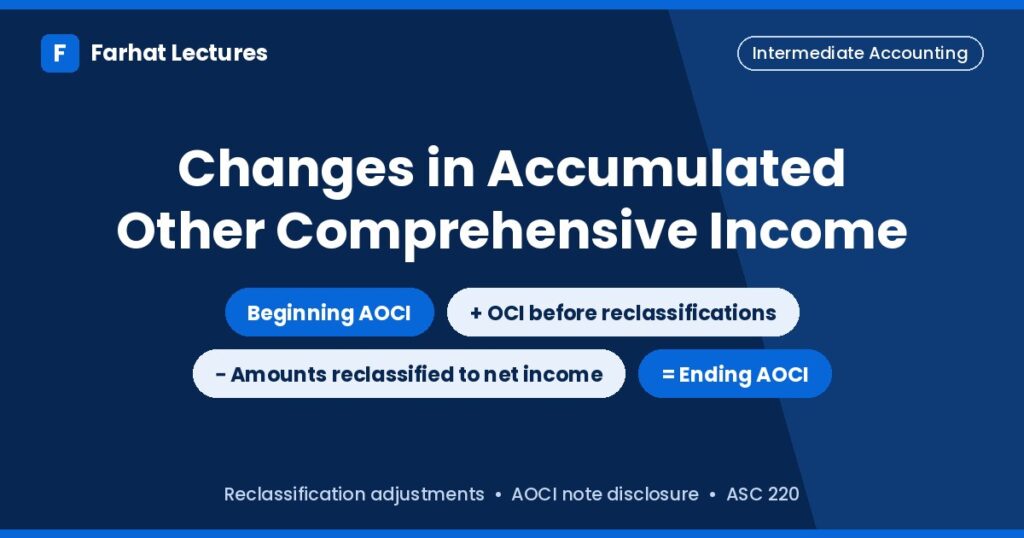
The Fair Value Adjustment goes from $18,000 to $6,000 at the sale and to $1,000 at year-end. The total charged to OCI is $17,000, the same as the portfolio approach. Whichever way you record it, the financial statements still show the $12,000 reclassification and the $5,000 holding loss separately, either in the statement of comprehensive income or in the notes. That presentation is covered in changes in accumulated other comprehensive income.
What about income taxes?
Companies may present OCI components net of tax or before tax with one aggregate amount for the related tax expense or benefit. Here is the Harlow example again with an assumed 25% tax rate. The rate is hypothetical and chosen to keep the math simple.
| Item | Pretax | Tax effect (25%) | Net of tax |
|---|---|---|---|
| Reclassification of Bond A’s gain | ($12,000) | $3,000 | ($9,000) |
| Bond B holding loss, Year 2 | ($5,000) | $1,250 | ($3,750) |
| Year 2 other comprehensive income | ($17,000) | $4,250 | ($12,750) |
AOCI started Year 2 at $13,500 net of tax, which is the $18,000 Year 1 gain less $4,500 of tax. After Year 2’s ($12,750), AOCI ends at $750. That is Bond B’s $1,000 unrealized gain net of 25% tax. Companies show the tax effect of each OCI item either on the face of the statement or in the notes.
When the rules are different
- Credit losses. Under ASC 326-30, if a company intends to sell an impaired AFS debt security or will more likely than not be required to sell it before recovering its amortized cost basis, it writes the security down to fair value through earnings. In other cases, it recognizes any credit loss in earnings through an allowance and reports the noncredit portion in OCI. That noncredit amount can later be reclassified from AOCI.
- Equity securities. Equity securities can’t be classified as AFS under ASC 321. Most of their fair value changes go straight to net income, so nothing sits in OCI to reclassify.
- Other OCI items. Reclassification adjustments also apply to other parts of OCI, such as pension amounts amortized into net income, cash flow hedges, and foreign currency translation when a foreign operation is sold or substantially liquidated. This lesson covers AFS debt securities only.
Common mistakes
- Crediting Debt Investments at fair value. Remove amortized cost ($60,000), not $72,000.
- Measuring the gain from last year’s fair value. The realized gain is sale price minus amortized cost.
- Leaving the sold bond in the year-end computation. The required Fair Value Adjustment covers only securities still held.
- Closing in the wrong direction. A net credit to the OCI account closes with a debit to it; a net debit closes with a credit.
- Confusing it with transferring between categories. Moving a security from held-to-maturity to AFS is a different entry; see Investment Reclassification.
- Changing net income with the reclassification. The realized gain is already in net income from the sale entry. The reclassification only moves the old gain out of OCI.
- Reclassifying for equity securities. Equity securities can’t be AFS under ASC 321, so their fair value changes go to net income and there is nothing to reclassify.
Interactive Practice: Available-for-Sale Debt Securities
Gain on Sale and Fair Value Adjustment
When an available-for-sale (AFS) debt security is sold, the realized gain or loss equals sale proceeds minus amortized cost. At year-end, compare fair value with amortized cost for the securities still held, then adjust the existing Fair Value Adjustment balance to the required ending balance. Use the portfolio data below and select one answer per question.
Practice questions with answers
Question 1: The sale entry
Corbin Co. holds an AFS bond with amortized cost of $30,000. Its fair value at last year-end was $33,000. Corbin sells it for $33,000. Record the sale.
Answer:
Dr Cash $33,000; Cr Debt Investments $30,000; Cr Gain on Sale of Investments $3,000
The realized gain is $33,000 − $30,000 = $3,000. The $3,000 sitting in AOCI from last year is removed through the reclassification, either at the sale date or at year-end.
Question 2: Year-end adjustment after a sale
Before its year-end entry, Dalton Inc.’s Fair Value Adjustment has a $9,000 debit balance. After selling one bond during the year, its remaining AFS bonds have amortized cost of $120,000 and fair value of $118,000. Record the year-end entry.
Answer:
Dr Unrealized Holding Gain or Loss – Equity $11,000; Cr Fair Value Adjustment $11,000
The required balance is a $2,000 credit ($118,000 − $120,000). Going from a $9,000 debit to a $2,000 credit takes an $11,000 credit to Fair Value Adjustment.
Question 3: A loss with a separate reclassification entry
Ellery Corp. holds an AFS bond with amortized cost of $70,000 and a Year 1 fair value of $65,000 (Fair Value Adjustment credit balance of $5,000). It sells the bond in Year 2 for $65,000. Record the sale and the reclassification.
Answer:
Sale: Dr Cash $65,000; Dr Loss on Sale of Investments $5,000; Cr Debt Investments $70,000. Reclassification: Dr Fair Value Adjustment $5,000; Cr Unrealized Holding Gain or Loss – Equity $5,000
The realized loss goes to net income. The reclassification removes the $5,000 unrealized loss from OCI and clears the Fair Value Adjustment for this bond.
Want more practice like this? Work through CPA Simulation: Fair Value Adjustment and Reclassification in the Farhat Lectures Intermediate Accounting course.
Key takeaways
- Record the sale by removing amortized cost from Debt Investments; the realized gain or loss goes to net income.
- At year-end, compute the Fair Value Adjustment only for securities still held.
- The year-end change in Fair Value Adjustment, recorded in Unrealized Holding Gain or Loss – Equity, includes the reclassification of the sold security’s old gain or loss.
- A separate reclassification entry at the sale date gives the same ending balances.
- Close the OCI account to AOCI, which then equals the unrealized gain or loss on securities still held.
Frequently asked questions
What is the journal entry for a reclassification adjustment?
If the sold security had an unrealized gain, debit Unrealized Holding Gain or Loss – Equity and credit Fair Value Adjustment for that gain. If it had an unrealized loss, debit Fair Value Adjustment and credit Unrealized Holding Gain or Loss – Equity. Net income does not change.
Is there a separate journal entry called the reclassification adjustment?
Not always. Under the portfolio approach, the year-end entry to the Fair Value Adjustment account removes the sold security’s old unrealized gain or loss, so the reclassification is built into that entry. Some companies record a separate entry at the sale date instead. Both methods end with the same balances.
Why credit Debt Investments for amortized cost instead of fair value?
Debt Investments carries the security at amortized cost. The fair value change sits in a separate valuation account, Fair Value Adjustment. So the sale entry removes amortized cost from Debt Investments, and the realized gain is measured from amortized cost.
What if the sale price is different from last year’s fair value?
The realized gain or loss equals sale proceeds minus amortized cost. Under the portfolio approach illustrated here, the year-end Fair Value Adjustment entry removes the sold bond’s prior fair value adjustment and adjusts the remaining bonds to their year-end fair value. If you record a separate reclassification entry, one approach is to record the holding gain or loss through the sale date, then reclassify the security’s accumulated amount out of AOCI.
What account is the unrealized gain recorded in during the year?
In Unrealized Holding Gain or Loss – Equity, a temporary OCI account. At year-end it closes to Accumulated Other Comprehensive Income, the permanent equity account.
Do I still record interest revenue on the bonds?
Yes. Interest revenue and any premium or discount amortization are recorded separately in net income. The examples here use bonds bought at par and omit the interest entries to focus on the reclassification.
Is a reclassification adjustment reported net of tax?
It can be. Companies may present OCI components net of tax or before tax with one aggregate tax amount. They present the tax effect of each component, including reclassification adjustments, in the statement of comprehensive income or disclose it in the notes. With a 25% tax rate, a $12,000 pretax reclassification removes $9,000 from AOCI.
Do equity securities need a reclassification adjustment?
No. Equity securities can’t be classified as available-for-sale under ASC 321. Most fair value changes on equity securities go straight to net income, so nothing sits in OCI to reclassify.
Sources
- PwC Viewpoint: Loans and investments, 4.3 Available-for-sale debt securities (fair value, OCI, and realized gains in earnings)
- PwC Viewpoint: Financial statement presentation, 4.5 Accumulated other comprehensive income (reclassification adjustments)
- FASB Accounting Standards Codification, Topics 220 and 320
About the author
Mansour Farhat, CPA, CIA, DBA, teaches accounting and CPA exam review at Farhat Lectures and on the Farhat Lectures YouTube channel. For the full set of lessons on investments and comprehensive income, explore his Intermediate Accounting course.
Continue learning with Farhat Lectures
Strengthen your accounting understanding with clear explanations and guided practice.
Explore the free sample course

Responses