
Transfer of Debt Securities Between Trading, AFS, and HTM

Under U.S. GAAP, transfers of debt securities into or out of trading use transfer-date fair value. Held-to-maturity (HTM) securities transfer to available-for-sale (AFS) at amortized cost, followed by AFS fair value measurement. AFS securities transfer to HTM at amortized cost adjusted for the remaining unrealized gain or loss in accumulated other comprehensive income (AOCI).
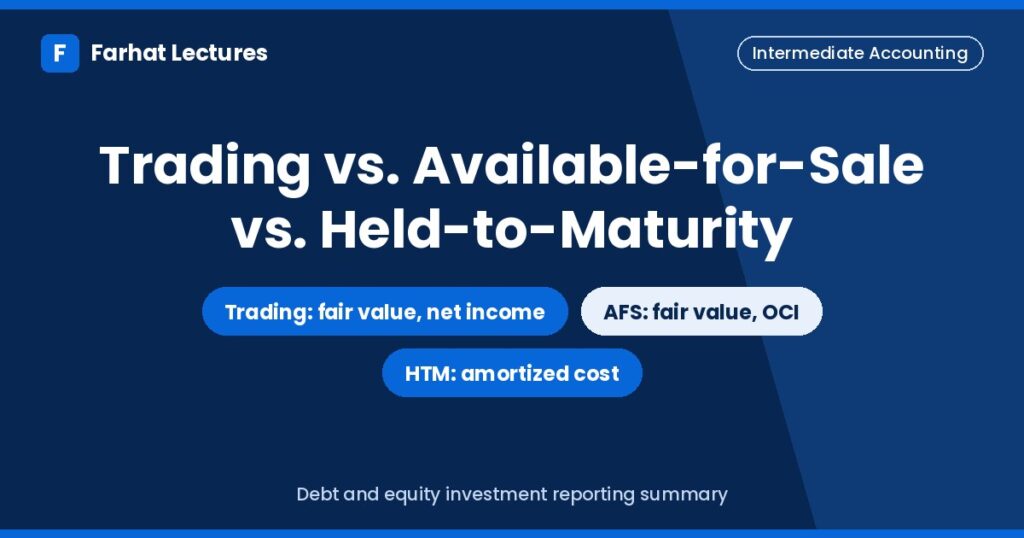
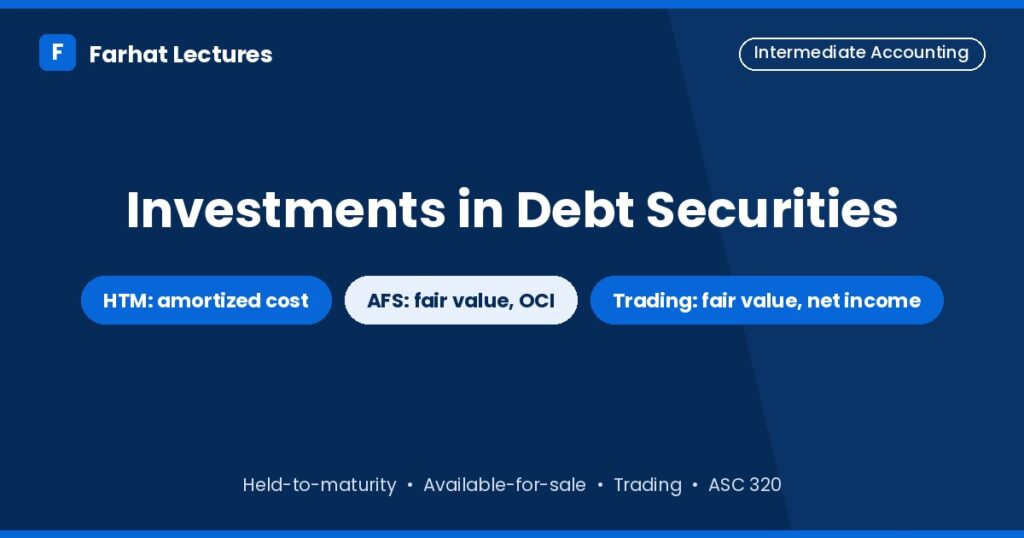
HTM securities are carried at amortized cost, and expected credit losses are recognized through an allowance. AFS securities are carried at fair value, with noncredit holding gains and losses generally reported in other comprehensive income (OCI). The examples below show how those measurement rules affect a transfer. For more on the three categories, see trading vs. available-for-sale vs. held-to-maturity.
On the exams: Debt investments are part of the CPA exam’s FAR section and CMA Part 1. For transfers, the key thing to know is where the transfer-date gain or loss goes, which is exactly what the rules table below shows.
Watch: Reclassifying debt investments between categories (starts at 2:13, transfers out of held-to-maturity)
How is a transfer of debt securities recorded?
ASC 320-10-35-10 through 35-10B set the transfer rules. The OCC’s Bank Accounting Advisory Series explains how the transfer basis and any credit loss allowance depend on the direction of the transfer.
| Transfer | Transfer basis | Treatment of unrealized gain or loss |
|---|---|---|
| Into trading (from AFS or HTM) | Fair value | Recognize in net income the portion of the holding gain or loss that has yet to be recognized in earnings. For AFS, this includes the amount in AOCI. |
| Out of trading (to AFS or HTM) | Transfer-date fair value | The gain or loss through the transfer date is already in earnings and stays there. |
| HTM to AFS | Amortized cost basis before AFS fair value measurement | After reclassification, measure the AFS security at fair value. Report the unrealized gain or loss in OCI, excluding the portion recognized through the new AFS credit loss allowance. |
| AFS to HTM | Amortized cost basis adjusted for the remaining unrealized gain or loss in AOCI | The remaining gain or loss stays in AOCI and is amortized as a yield adjustment over the bond’s remaining life. |
How does fair value affect a transfer?
Fair value sets the transfer amount when a debt security moves into or out of trading. An HTM security that moves to AFS is reported at fair value after the transfer. When an AFS security moves to HTM, its existing AOCI gain or loss carries forward and is amortized as a yield adjustment.
Worked example: one bond, four transfers
Hypothetical example. Ridgeview Corp. holds a bond with an amortized cost of $300,000 and a transfer-date fair value of $312,000. Assume each scenario begins with a zero credit loss allowance and requires no new allowance. The table shows the resulting carrying amount and how each transfer reports the $12,000 unrealized gain.
| Transfer | New carrying amount | Effect on net income | Effect on OCI |
|---|---|---|---|
| HTM to trading | $312,000 | +$12,000 | None |
| HTM to AFS | $312,000 | None | +$12,000 |
| AFS to trading (gain already in AOCI) | $312,000 | +$12,000 moved from AOCI | −$12,000 reclassified out |
| AFS to HTM (gain already in AOCI) | $312,000 | None at transfer | $12,000 stays in AOCI and is amortized |
Entry: HTM to AFS
| Account | Debit | Credit |
|---|---|---|
| Debt Investments (AFS) | 312,000 | |
| Debt Investments (HTM) | 300,000 | |
| Unrealized Holding Gain or Loss—Equity | 12,000 |
Entry: HTM to trading
| Account | Debit | Credit |
|---|---|---|
| Debt Investments (Trading) | 312,000 | |
| Debt Investments (HTM) | 300,000 | |
| Unrealized Holding Gain or Loss—Income | 12,000 |
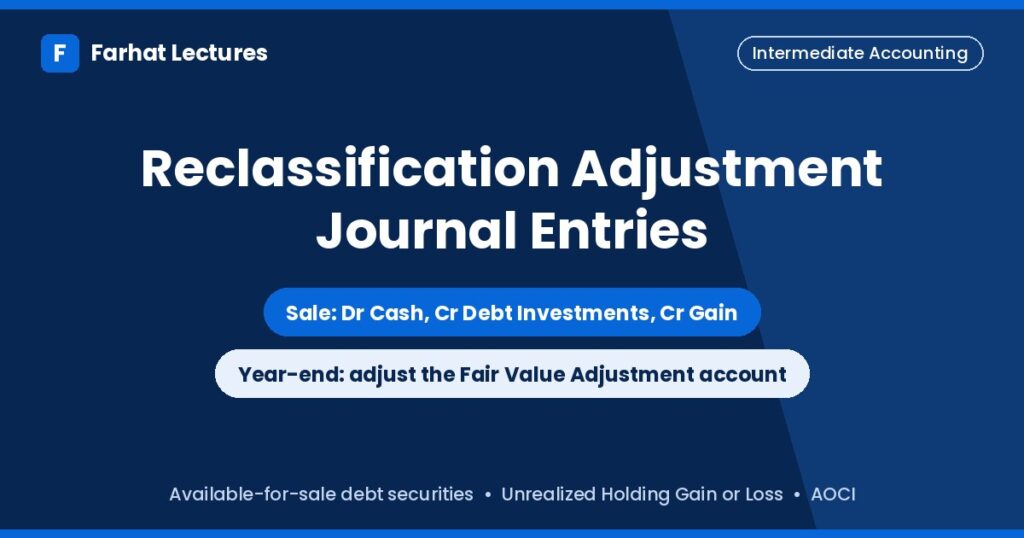
The combined HTM-to-AFS entry shows the $300,000 reclassification at amortized cost and the $12,000 AFS fair value adjustment recorded in OCI. The HTM-to-trading entry records the $12,000 gain in earnings.
Now the two transfers out of AFS. Here the bond is already carried at its $312,000 fair value, and the $12,000 gain is already in AOCI.
Entry: AFS to trading
| Account | Debit | Credit |
|---|---|---|
| Debt Investments (Trading) | 312,000 | |
| Debt Investments (AFS) | 312,000 | |
| Unrealized Holding Gain or Loss—Equity | 12,000 | |
| Unrealized Holding Gain or Loss—Income | 12,000 |
Entry: AFS to HTM
| Account | Debit | Credit |
|---|---|---|
| Debt Investments (HTM) | 312,000 | |
| Debt Investments (AFS) | 312,000 |
In the AFS-to-trading entry, the second pair of lines moves the gain out of AOCI and into income. The AFS-to-HTM entry has no second pair: the $12,000 stays in AOCI.
AFS to HTM: how is the AOCI balance amortized?
When the bond moves from AFS to HTM, Ridgeview adds the $12,000 unrealized gain in AOCI to the $300,000 amortized cost basis to obtain the $312,000 HTM basis. The $12,000 gain remains in AOCI. Over the bond’s remaining life, the company amortizes both the premium and the AOCI balance. The two amortizations offset each other, so the transfer itself does not change total income. Crowe’s explanation of AFS-to-HTM transfers describes the AOCI amortization as a yield adjustment.
To make it concrete, say the bond has 4 years left to maturity. To keep the math simple, we’ll use straight-line amounts. In practice, companies use the effective interest method.
Each year, Ridgeview amortizes $3,000 of the extra $12,000 in the HTM carrying amount. That lowers interest revenue by $3,000. It also moves $3,000 out of AOCI and into interest revenue, which raises interest revenue by $3,000. The net effect on income is zero, and after 4 years both balances are gone.
Entry: each year for 4 years (straight-line illustration)
| Account | Debit | Credit |
|---|---|---|
| Interest Revenue | 3,000 | |
| Debt Investments (HTM) | 3,000 | |
| Unrealized Holding Gain or Loss—Equity | 3,000 | |
| Interest Revenue | 3,000 |
To see how amounts move from AOCI into net income in general, read what is comprehensive income.
What happens to the allowance for credit losses?
The examples above assume a zero allowance for credit losses. ASC 326-20 applies the current expected credit loss (CECL) model to HTM debt securities. ASC 326-30 provides a separate impairment model for AFS debt securities.
When a security transfers between HTM and AFS, ASC 320-10-35-10A and 35-10B require the company to assess credit loss allowances on the transfer date.
- Reverse any existing allowance through earnings.
- Move the security into its new category based on its amortized cost basis (after any write-offs, but not counting the allowance). For AFS to HTM, that amount is adjusted by the unrealized gain or loss still in AOCI.
- Decide whether the security needs a new allowance under the rules for its new category: ASC 326-20 for HTM or ASC 326-30 for AFS.
For HTM to AFS, the holding gain or loss reported in OCI excludes the credit loss recognized through the new AFS allowance. The OCC’s transfer guidance walks through each step. For how credit losses work on AFS bonds, see AFS debt securities impairment.
Why are transfers between categories rare?
Trading securities are bought for quick resale, so moving a security into or out of trading should be rare. HTM securities require the positive intent and ability to hold to maturity. Selling or transferring them outside a few limited situations can taint the rest of the HTM portfolio. The KPMG investments executive summary explains the tainting rule.
How is this different under IFRS?
Under IFRS 9, classification depends on both the business model and the contractual cash flows. A debt investment can qualify for amortized cost or fair value through OCI only if its contractual cash flows are solely payments of principal and interest (SPPI). An eligible investment is generally measured at amortized cost in a hold-to-collect business model and at fair value through OCI in a hold-to-collect-and-sell business model. Other debt investments are generally measured at fair value through profit or loss.
Under IFRS 9, a company can reclassify a debt investment only when that business model changes, which should be very infrequent. The change applies going forward, from the first day of the next reporting period.
The biggest contrast is a move into amortized cost. Under IFRS 9, when a debt investment moves from fair value through OCI to amortized cost, the amount in OCI is removed and netted against the asset, so the asset looks as if it had always been at amortized cost. Under US GAAP, an AFS-to-HTM transfer keeps the amount in AOCI and amortizes it.
Common mistakes
- Using one measurement rule for all transfers. Apply the rule for the transfer direction and distinguish the transfer basis from subsequent measurement.
- Sending an HTM-to-AFS gain to net income. It goes to OCI.
- Leaving AOCI behind when moving AFS to trading. The amount in AOCI moves to net income.
- Clearing AOCI on an AFS-to-HTM transfer. It stays in AOCI and is amortized.
- Treating a transfer as a sale. No realized gain or loss and no cash are involved.
- Forgetting the credit loss allowance. For HTM and AFS transfers, reverse it on the transfer date, then measure a new one under the new category’s rules if needed.
Interactive practice on AFS and HTM transfers
Transfers Between Available-for-Sale and Held-to-Maturity Debt Securities
Practice the ASC 320 transfer rules for available-for-sale (AFS) and held-to-maturity (HTM) debt securities, including the transfer basis, the credit loss allowance, and the treatment of OCI. Use the hints if you get stuck, then review the explanations.
Practice questions with answers
Question 1: HTM to AFS with a loss
A bond with an amortized cost of $150,000 and a fair value of $146,000 is transferred from HTM to AFS. Assume a zero credit loss allowance before and after the transfer. What is the effect on net income and OCI?
Answer:
No effect on net income; a $4,000 unrealized loss in OCI
The bond transfers at its $150,000 amortized cost basis. After AFS fair value measurement, its carrying amount is $146,000 and the $4,000 unrealized loss goes to OCI.
Question 2: AFS to trading
An AFS bond is reported at its $206,000 fair value, and a $6,000 unrealized gain sits in AOCI. On the transfer date, its fair value is still $206,000. The company moves it to trading. What happens?
Answer:
The $6,000 gain moves from AOCI to net income
Into-trading transfers recognize the unrealized gain or loss in net income at once, including amounts previously held in AOCI. The bond is recorded at $206,000 as trading.
Question 3: AFS to HTM
An AFS bond with a $9,000 unrealized loss in AOCI is transferred to HTM. Assume a zero credit loss allowance before and after the transfer. Is the $9,000 loss moved to net income?
Answer:
No
The $9,000 loss stays in AOCI and is amortized over the bond’s remaining life, offsetting the amortization of the discount created in the HTM carrying amount.
Question 4: Trading to AFS
A trading bond was last reported at $95,000. On the transfer date, its fair value is $98,000, and the company moves it to AFS. Assume the AFS bond requires no credit loss allowance at that date. What happens?
Answer:
A $3,000 gain goes to net income, and the bond is recorded as AFS at $98,000
The company first brings the trading bond up to its $98,000 fair value and records the $3,000 gain in net income. That gain is never reversed. Nothing goes to OCI on the transfer date. After the transfer, noncredit changes in the bond’s fair value are reported in OCI.
Want more practice like this? Work through the Debt Securities Available for Sale lesson in the Farhat Lectures Intermediate Accounting course.
Key takeaways
- Transfers into or out of trading are measured at fair value on the transfer date.
- Transfers involving trading put the unrealized gain or loss in net income.
- HTM to AFS transfers at amortized cost, followed by fair value measurement. The holding gain or loss reported in OCI excludes the portion recognized through the new AFS allowance.
- AFS to HTM adjusts the amortized cost basis for the remaining unrealized gain or loss in AOCI. That gain or loss stays in AOCI and is amortized over the remaining life.
- For transfers between HTM and AFS, reverse any allowance for credit losses on the transfer date, then measure a new one if needed.
- An AFS security that has lost value may also need an AFS debt securities impairment review.
Frequently asked questions
What amount is used to transfer a debt security?
Transfers into or out of trading use transfer-date fair value. HTM to AFS uses amortized cost for the transfer, followed by AFS fair value measurement. AFS to HTM uses amortized cost adjusted for the remaining unrealized gain or loss in AOCI.
Can equity securities be transferred between these categories?
No. Under current GAAP, trading, available-for-sale, and held-to-maturity are categories for debt securities only. Equity securities are generally measured at fair value through net income, so there is nothing to transfer.
What does it mean to taint the held-to-maturity portfolio?
Selling or transferring HTM securities, except in a few limited situations, calls into question the company’s intent to hold its other HTM securities to maturity. The company may then have to reclassify the rest of the portfolio.
How often do transfers happen?
Rarely. Transfers into or out of trading are expected to be rare, and transfers out of held-to-maturity are limited by the tainting rules.
Does a transfer bring in any cash?
No. A transfer is a reclassification within the company’s own books. No securities are sold and no cash changes hands.
Does a transfer affect the allowance for credit losses?
Yes. For transfers between HTM and AFS, the company reverses any existing allowance through earnings on the transfer date. It then measures a new allowance, if one is needed, under the rules for the new category: ASC 326-20 for HTM or ASC 326-30 for AFS.
Do I need to know this for the CPA or CMA exam?
Yes. Debt investments are part of the CPA exam’s FAR section and CMA Part 1. The most useful thing to know about transfers is where the transfer-date gain or loss goes: net income, OCI, or AOCI.
Sources
- OCC Bank Accounting Advisory Series, Topic 1A, Question 2 (debt security transfers)
- KPMG Investments Handbook, Section 4.4 (ASC 320 transfer guidance)
- IFRS Foundation: IFRS 9 Financial Instruments (classification and reclassification)
- Crowe: Transferring AFS Debt Securities to HTM
- KPMG Executive Summary: Investments (tainting of HTM)
About the author
Mansour Farhat, CPA, CIA, DBA, teaches accounting and CPA exam review at Farhat Lectures and on the Farhat Lectures YouTube channel.
Continue learning with Farhat Lectures
Strengthen your accounting understanding with clear explanations and guided practice.
Explore the free sample course
Responses