
Trading Securities: Fair Value Through Net Income, With Journal Entries

Trading securities are debt securities that companies typically buy for near-term resale to profit from short-term price changes. Under ASC 320, the U.S. GAAP standard for debt investments, they are reported at fair value, and unrealized holding gains and losses go straight into net income each period, not other comprehensive income. That makes trading the only one of the three debt categories where every unrealized gain and loss hits earnings before a sale.
This matters because trading accounting can move net income up or down every reporting period, even when nothing is sold. Companies use trading securities to earn more than a savings account would pay on idle cash and to keep investments they can buy and sell easily. This lesson shows the accounting through a two-year portfolio example. For how trading compares with the other two categories, read investments in debt securities: HTM vs. AFS vs. trading.
Watch: Trading securities accounting: fair value and sale journal entries (about 9 minutes, with a three-bond portfolio example)
What are trading securities?
Trading typically involves frequent buying and selling to profit from short-term price changes. ASC 320 also allows a company to classify a debt security as trading at acquisition when it expects to hold the security longer. Common examples include Treasury bills, commercial paper, corporate bonds, and municipal bonds bought for short-term gains. Most bank certificates of deposit (CDs) are not debt securities under ASC 320, although some large negotiable CDs can qualify.
How trading securities are accounted for
- Purchase: record Debt Investments at cost, which is the purchase price plus any brokerage fees. Because trading securities are adjusted to fair value at the next reporting date, those fees end up in net income in the first period, and many companies simply expense them right away.
- Interest: recognize interest revenue as earned and amortize any discount or premium.
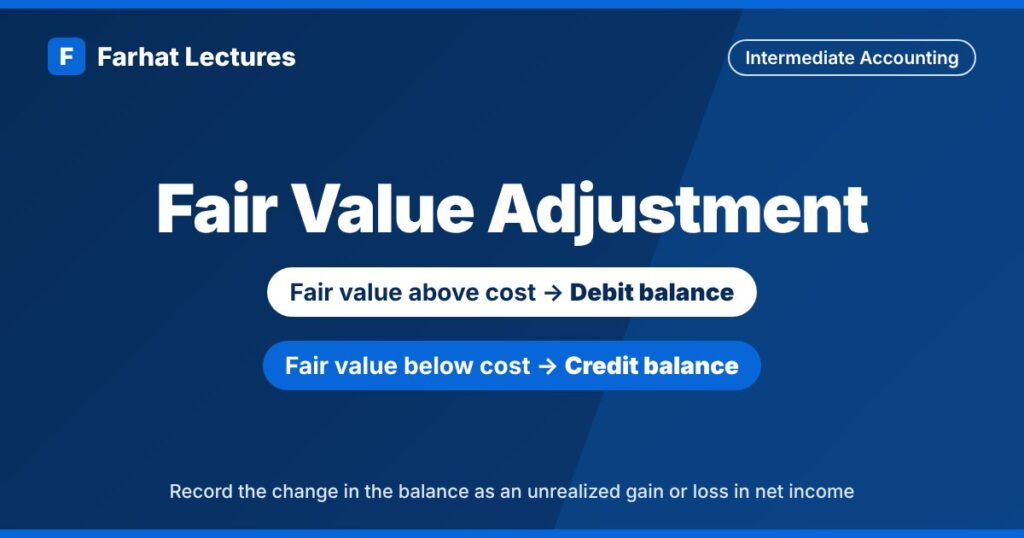
- Each reporting date: adjust the portfolio to fair value through the Fair Value Adjustment account. The offset is Unrealized Holding Gain or Loss—Income, which goes into net income.
- Sale: remove the amortized cost and report the realized gain or loss in net income.
A holding gain or loss is the net change in a security’s fair value from one period to the next, excluding interest revenue that has been recognized but not received.
Worked example: trading securities at Bayview Capital
Hypothetical example. Bayview Capital buys three bond investments at par during 2027 and classifies them as trading. This is its first year holding trading securities, so Fair Value Adjustment starts at zero.
| Investment | Amortized cost | Fair value | Unrealized gain (loss) |
|---|---|---|---|
| Treasury notes | $60,000 | $61,800 | $1,800 |
| Hollis Corp. bonds | 45,000 | 42,900 | (2,100) |
| Municipal bonds | 30,000 | 31,450 | 1,450 |
| Total portfolio | $135,000 | $136,150 | $1,150 |
| Date | Account | Debit | Credit |
|---|---|---|---|
| Dec. 31, 2027 | Fair Value Adjustment | 1,150 | |
| Unrealized Holding Gain or Loss—Income | 1,150 |
The $1,150 net unrealized gain increases 2027 net income, along with the interest revenue Bayview earned. The trading securities are reported in current assets at $136,150: the $135,000 in Debt Investments plus the $1,150 Fair Value Adjustment.
Selling a trading security
In February 2028, Bayview sells the Hollis bonds for $43,500, excluding accrued interest, which is recorded separately. The realized loss compares the selling price with amortized cost: $45,000 − $43,500 = $1,500.
| Date | Account | Debit | Credit |
|---|---|---|---|
| Feb. 2028 | Cash | 43,500 | |
| Loss on Sale of Investments | 1,500 | ||
| Debt Investments | 45,000 |
In this method, which many intermediate accounting textbooks use, the sale entry leaves the Fair Value Adjustment account alone. It is corrected at year-end.
Another way you may see the sale recorded
Some companies and exam review materials measure the gain or loss on sale from the last reported fair value, called the carrying amount, instead of amortized cost. Hollis was carried at $42,900 at the end of 2027, so Bayview would report a $600 gain ($43,500 minus $42,900). It would also remove the Hollis share of the Fair Value Adjustment, which was a $2,100 credit, at the time of sale.
| Date | Account | Debit | Credit |
|---|---|---|---|
| Feb. 2028 | Cash | 43,500 | |
| Fair Value Adjustment | 2,100 | ||
| Debt Investments | 45,000 | ||
| Gain on Sale of Investments | 600 |
After this entry, Fair Value Adjustment has a $3,250 debit balance ($1,800 for the Treasury notes plus $1,450 for the municipal bonds). To reach the required $1,100 debit at December 31, 2028, the year-end entry becomes a $2,150 credit instead of $50.
Here is the good news: 2028 net income ends up the same either way. This method gives +$600 minus $2,150, or a $1,550 decrease. The method above gives a $1,500 loss plus a $50 unrealized loss, also a $1,550 decrease. Only the labels change. On an exam, check whether the question compares the selling price with amortized cost or with the carrying amount, and use that method from start to finish.
The next year-end adjustment for trading securities
At December 31, 2028, the Treasury notes are worth $60,900 and the municipal bonds $30,200. The required Fair Value Adjustment balance is a $1,100 debit ($91,100 fair value − $90,000 amortized cost). The account already has a $1,150 debit balance, so it needs a $50 credit.
| Date | Account | Debit | Credit |
|---|---|---|---|
| Dec. 31, 2028 | Unrealized Holding Gain or Loss—Income | 50 | |
| Fair Value Adjustment | 50 |
This small entry hides three movements. It reverses the old $2,100 unrealized loss on the sold Hollis bonds (+$2,100), and it records smaller gains on the Treasury notes (−$900) and the municipal bonds (−$1,250). The net is −$50. Over the two years, Hollis reduced net income by $2,100 − $2,100 + $1,500 = $1,500, which equals its actual loss. No amount is counted twice.
Trading securities vs. available-for-sale securities
| Feature | Trading | Available-for-sale |
|---|---|---|
| Why bought | Typically for near-term resale | Neither trading nor held-to-maturity |
| Balance sheet amount | Fair value | Fair value |
| Unrealized holding gains and losses | Net income (Unrealized Holding Gain or Loss—Income) | OCI (Unrealized Holding Gain or Loss—Equity) for unrealized gains and noncredit losses. Credit losses can affect earnings under ASC 326-30. |
| Usual balance sheet section | Current assets | Current or noncurrent |
| Realized gain or loss on sale | Net income | Net income |
For the OCI version of these entries, see available-for-sale debt securities.
Can stocks be trading securities?
Not under current U.S. GAAP. When the Financial Accounting Standards Board (FASB) issued ASU 2016-01, which took effect in 2018 for public companies, it limited the trading, available-for-sale, and held-to-maturity categories to debt securities.
Stock investments that don’t give the investor significant influence or control now follow ASC 321. Most are measured at fair value with changes in net income, so the result looks a lot like trading accounting. The “trading” label, though, now applies only to debt.
If an older textbook or practice question shows stock in a trading portfolio, it is using the pre-2018 rules. For the current treatment, see investments in equity securities.
Trading securities on the statement of cash flows
Cash paid to buy trading securities and cash received from selling them is classified based on the nature and purpose of the securities (ASC 230). When securities are bought specifically for resale, as trading securities usually are, these cash flows are typically operating activities.
Unrealized holding gains and losses involve no cash, so they never show up as cash flows. For a refresher on the three sections, see the statement of cash flows.
Common mistakes
- Sending trading changes to OCI. Trading unrealized gains and losses go to net income.
- Adjusting by the change in a single security. Compute the portfolio’s required balance, then compare it with the current balance.
- Mixing the two sale methods. If you compare the selling price with amortized cost, leave the Fair Value Adjustment alone until year-end. If you compare it with the last fair value, remove that security’s share of the Fair Value Adjustment at the sale. Pick one method and follow it through.
- Forgetting interest revenue. Fair value changes and interest revenue are separate items in net income.
- Calling any security you might sell “trading.” Near-term resale is typical of trading. Companies determine and document the classification at acquisition.
Interactive trading securities practice
Trading Securities Practice: Fair Value Through Net Income
Under U.S. GAAP, trading debt securities are measured at fair value at each reporting date, and unrealized holding gains and losses are recognized in net income. Try these four multiple-choice questions before moving on to the journal entry practice below.
Practice questions with answers
Question 1: First-year adjustment
In its first year, a company’s trading portfolio has an amortized cost of $25,000 and a fair value of $26,300. Record the year-end entry.
Answer:
Debit Fair Value Adjustment $1,300; credit Unrealized Holding Gain or Loss—Income $1,300.
Net income increases by $1,300.
Question 2: Same facts, different category
How would the answer to Question 1 change if the securities were available-for-sale?
Answer:
The credit would go to Unrealized Holding Gain or Loss—Equity.
The balance sheet still shows $26,300, but the $1,300 gain is reported in OCI, and net income is unaffected.
Question 3: Adjusting an existing balance
Fair Value Adjustment has an $800 debit balance. At year-end, the trading portfolio has an amortized cost of $70,000 and a fair value of $69,400. Record the adjustment and state the effect on net income.
Answer:
Debit Unrealized Holding Gain or Loss—Income $1,400; credit Fair Value Adjustment $1,400.
The required balance is a $600 credit. Going from an $800 debit to a $600 credit takes a $1,400 credit. Net income decreases by $1,400.
Want guided practice? Work through debt securities: trading securities in the Farhat Lectures Intermediate Accounting course.
Key takeaways
- Companies typically buy trading debt securities for near-term resale and short-term profit.
- They are reported at fair value, usually in current assets.
- Unrealized holding gains and losses go to net income every period.
- A single Fair Value Adjustment account is adjusted to the required portfolio balance at each reporting date.
- Securities the company will hold to maturity belong in held-to-maturity securities instead.
- Stocks are not trading securities under current U.S. GAAP. Equity investments outside the equity method and consolidation generally follow ASC 321.
Frequently asked questions
How long are trading securities held?
Companies typically buy trading securities for near-term resale. ASC 320 allows trading classification at acquisition even if a company expects to hold a debt security longer.
What is the difference between trading securities and available-for-sale securities?
Both are reported at fair value. Trading securities’ unrealized holding gains and losses go to net income. For available-for-sale debt securities, unrealized gains and noncredit losses generally go to OCI. Credit losses can affect earnings under ASC 326-30.
Do trading securities need discount and premium amortization?
Yes. Like the other categories, trading debt securities recognize interest revenue and amortize any discount or premium. The fair value adjustment is made after that.
Are trading securities current assets?
Usually. They are generally reported as short-term investments in current assets because the company expects to sell them soon.
What is a holding gain or loss?
It is the net change in a security’s fair value from one period to the next, excluding interest revenue that has been recognized but not yet received.
Can stocks be classified as trading securities?
Not under current U.S. GAAP. Since ASU 2016-01, the trading, available-for-sale, and held-to-maturity categories apply only to debt securities. Stock investments without significant influence or control follow ASC 321, and most are measured at fair value through net income.
Where do trading securities appear on the statement of cash flows?
Purchases and sales are classified based on the nature and purpose of the securities. When they are bought specifically for resale, the cash flows are usually operating activities. Unrealized gains and losses involve no cash.
Can a debt security be reported at fair value through net income without being classified as trading?
Yes. Under the fair value option in ASC 825, a company can elect fair value through net income for eligible financial assets, one instrument at a time. The choice is usually made when the asset is first recognized and cannot be reversed.
Sources
- FASB Accounting Standards Codification, Topic 320: Investments—Debt Securities (ASC 320-10-25-1(a): trading classification; ASC 320-10-35-1(a): unrealized holding gains and losses on trading securities included in earnings)
- KPMG Executive Summary: Investments (2026)
- Journal of Accountancy: Identifying and analyzing the risks of “risk-free” securities (classification and balance sheet presentation of trading securities)
About the author
Mansour Farhat, CPA, CIA, DBA, is a veteran accounting educator and the founder of Farhat Lectures and the Farhat Lectures YouTube channel. He holds a Doctor of Business Administration from Temple University and a Master of Accountancy from Bloomsburg University, and he teaches accounting students and candidates preparing for the CPA, CMA, and EA exams.
Continue learning with Farhat Lectures
Strengthen your accounting understanding with clear explanations and guided practice.
Explore the free sample course


Responses