
Historical Cost vs Fair Value: 3 Key Differences + Examples

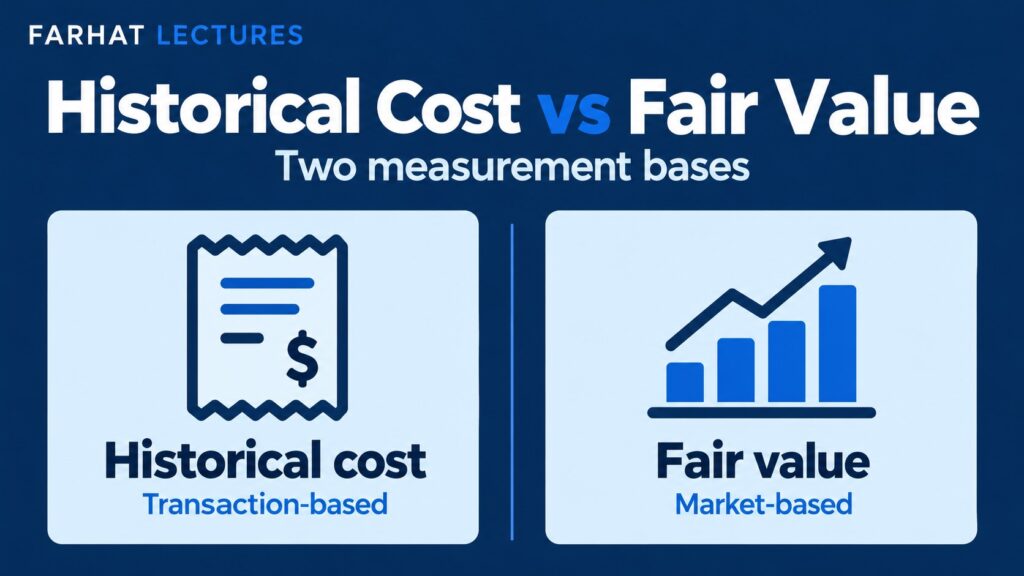
Historical cost records an asset at the amount paid in the original transaction. Fair value is the price you would receive to sell that asset in an orderly transaction between market participants at the measurement date (ASC 820). Under U.S. GAAP, land and equipment use historical cost, while marketable equity securities and derivatives use fair value.
That is why a balance sheet is not a list of what everything could sell for today. U.S. generally accepted accounting principles (GAAP), set by the Financial Accounting Standards Board (FASB), use a mixed measurement system: some amounts preserve the original transaction, and others reflect current market conditions. The standard that applies to each item, not management preference, decides which basis is used. Knowing the basis tells you how to read the number before you draw a conclusion from it.
Watch: historical cost and fair value
Professor Farhat connects historical cost with current market-based measurement, explains fair value as an exit price, and walks through Level 1, Level 2, and Level 3 inputs. Watch the lesson, then use the comparison and examples below to check your understanding.
Jump to a topic on YouTube: 2:54 Historical cost · 4:37 Fair value as an exit price · 5:57 Principal market · 9:51 Highest and best use · 11:05 Level 1 inputs · 12:10 Level 2 inputs · 14:59 Level 3 inputs · 17:29 Practice question
As you watch: Separate the measurement basis from the inputs used to estimate fair value. Then apply that distinction to Brook Studio’s land and quoted-share examples below. When you are ready, take the six-question historical cost vs fair value quiz.
What is the difference between historical cost and fair value?
| Question | Historical cost | Fair value |
|---|---|---|
| Starting point? | The original transaction | Market conditions at the measurement date |
| Basic perspective? | Transaction-based entry amount | Market-based exit price |
| Typical evidence? | Invoices, agreements, payment records | Market quotations or valuation inputs |
The three differences concern the time of measurement, the entry-versus-exit perspective, and the supporting evidence. Both bases can involve estimates. Follow the applicable GAAP requirement and any specifically permitted election; management cannot freely choose either basis for every item.
Practice focus: To test your understanding, be ready to (1) pick the definition of fair value (exit price, orderly transaction, market participants, measurement date), (2) classify an input as Level 1, Level 2, or Level 3, and (3) compute an unrealized gain or loss on an investment carried at fair value, like the $120 in Brook’s example below.
Recognition asks whether and when an item enters the statements. Measurement asks what amount to report. Keep this distinction in mind when studying revenue versus expense recognition.
What is historical cost?
Historical cost is the amount paid, or the value given up, to acquire an asset, or the amount received when a liability was incurred, measured at the transaction date. It anchors accounting to a transaction that can be checked against evidence such as an invoice or a signed agreement. For an asset purchase, the recorded cost may include qualifying amounts needed to acquire the asset and prepare it for use. Historical cost does not mean the carrying amount can never change: depreciation, amortization, and applicable impairment rules can affect later reporting.
Hypothetical example: Brook Studio buys land for $72,000. Assume that amount is the land’s total recorded cost and that no impairment or other adjustment applies. An appraisal a year later suggests $91,000. Under the ordinary U.S. GAAP historical-cost treatment for this land, the appraisal alone does not produce a $19,000 gain.
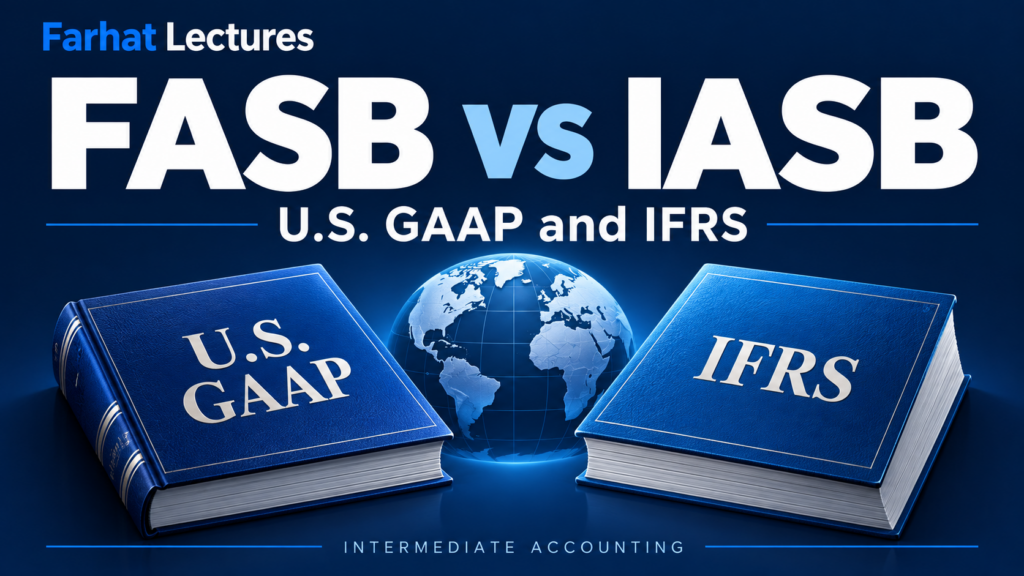
IFRS comparison: IAS 16 permits a revaluation model for property, plant, and equipment when fair value can be measured reliably. The policy applies to an entire class of assets, with revaluations kept sufficiently current. If Brook applies that model to the relevant class of land, the $19,000 increase generally enters other comprehensive income and accumulates in revaluation surplus, assuming it does not reverse a prior revaluation decrease recognized in profit or loss. Ordinary U.S. GAAP subsequent accounting for land used in operations does not permit this revaluation model. See FASB vs IASB: 5 Key Differences for more GAAP and IFRS contrasts.
The $72,000 amount answers a transaction-cost question. It does not claim the land could only sell for $72,000 today. Historical cost can provide useful evidence for evaluating how management invested resources, even when current value differs.
The FASB’s measurement concepts (Concepts Statement No. 8, Chapter 6, issued July 2024) describe two measurement systems, entry price and exit price, and the historical cost model is the entry price system with later cost allocation. Concepts Statements explain the FASB conceptual framework; they do not override authoritative GAAP for a particular asset or liability.
What is fair value?
Fair value is the price that would be received to sell an asset, or paid to transfer a liability, in an orderly transaction between market participants at the measurement date. That is the definition in ASC 820, and it is the one to memorize. Market participants are independent, knowledgeable buyers and sellers who are willing and able to transact; an orderly transaction is a normal sale, not a forced liquidation. It is not management’s preferred selling price, the value unique to one owner, or necessarily a forced-sale amount.
Hypothetical example: Brook holds 40 unrestricted shares in an equity investment within ASC 321, outside consolidation and equity-method accounting. Assume the investment’s carrying amount immediately before adjustment is $1,000, equal to its original cost. An accessible active market quotes identical shares at $28 each at the reporting date. The simple measurement is 40 × $28 = $1,120. The $1,120 fair value exceeds the $1,000 carrying amount by $120. Because these are equity securities with a readily determinable fair value, ASC 321 (Investments: Equity Securities) requires Brook to report that $120 unrealized holding gain in net income. The adjusting entry is: debit Fair value adjustment (equity securities) $120; credit Unrealized holding gain (net income) $120.
A transaction price often equals fair value at initial recognition, but not in every situation. For example, a transaction that is not orderly or involves different markets can require additional analysis. Avoid memorizing that original cost and fair value must always be identical.
Which assets use historical cost and which use fair value under U.S. GAAP?
U.S. GAAP is often called a mixed-attribute model because different standards call for different measurement bases. Here are the ones you will meet most often:
| Item | Measurement basis under U.S. GAAP | Where to find it |
|---|---|---|
| Land used in operations | Historical cost, subject to applicable impairment rules; land is generally not depreciated | ASC 360 |
| Buildings and equipment used in operations | Historical cost less accumulated depreciation and applicable impairment losses | ASC 360 |
| Inventory | Cost, written down to net realizable value when lower (lower of cost or market for LIFO and retail methods) | ASC 330 |
| Equity securities with readily determinable fair values | Fair value, with changes in net income | ASC 321 |
| Trading debt securities | Fair value, with changes in net income | ASC 320 |
| Available-for-sale debt securities | Fair value; noncredit unrealized changes generally enter other comprehensive income. Credit losses are recognized separately through earnings under ASC 326; intent or a requirement to sell can change the treatment. | ASC 320 and ASC 326 |
| Held-to-maturity debt securities | Amortized cost | ASC 320 |
| Derivatives | Fair value | ASC 815 |
| Assets acquired in a business combination | Fair value at the acquisition date | ASC 805 |
The applicable standard, the item’s classification, and any specifically permitted election determine its measurement basis. The ability to sell an asset does not, by itself, require fair value measurement. For example, held-to-maturity debt securities use amortized cost, while trading and available-for-sale debt securities use fair value. These examples summarize common treatments; individual standards include scope limitations and exceptions.
What are the three levels of the fair value hierarchy?
The hierarchy ranks the inputs used in a valuation. It gives priority to observable market evidence. It does not classify an item according to whether management likes the result.
| Level | Main input type | Hypothetical illustration |
|---|---|---|
| Level 1 | Unadjusted active-market quotes for identical items accessible at the measurement date | The quoted shares in Brook’s example |
| Level 2 | Other directly or indirectly observable inputs | A valuation supported by similar bond prices and observable market rates |
| Level 3 | Significant unobservable inputs reflecting market-participant assumptions | A specialized asset valuation using estimated cash flows when relevant market evidence is limited |
The overall measurement is categorized by the lowest-level input that is significant to the measurement. A model is therefore not automatically Level 3 simply because a calculation is required. For the official definitions and hierarchy, see the FASB’s ASU 2011-04, which amended Accounting Standards Codification (ASC) Topic 820, Fair Value Measurement.
ASC 820 describes three valuation approaches: the market approach (prices for identical or comparable items), the income approach (converting expected future cash flows to a single present amount), and the cost approach (current replacement cost). Techniques and input levels answer different questions: a technique is how the estimate is made; a level describes the evidence used. Detailed valuation calculations belong in later lessons.
Need a refresher? Review the historical cost vs fair value comparison or the three levels of the fair value hierarchy, then try again.
Want the full chapter? This lesson comes from Professor Farhat’s Intermediate Accounting course, where Chapter 1 is free to try.
Common measurement mistakes
- Revaluing every asset when prices rise. GAAP does not give every company a general permission to update all assets to fair value.
- Equating fair value with net realizable value. Net realizable value considers expected selling proceeds less specified completion and disposal costs. It is not simply another name for fair value.
- Calling every write-down a fair value calculation. Inventory and other asset rules can require different measurement tests.
- Assuming historical cost uses no estimates. Cost allocation and impairment can require judgment.
The accounting assumptions help explain the setting for measurement, while the full disclosure principle explains why users may also need the measurement policies and significant estimation information.
Practice questions and explained answers
1. Land recorded at $72,000 is appraised at $91,000. Does the appraisal alone require a gain under the assumed historical-cost treatment?
Answer: No. The original cost remains the reporting basis under the stated facts. A new market estimate does not by itself authorize revaluation.
2. A valuation uses unadjusted quoted prices for identical assets in an accessible active market. Which hierarchy level applies?
Answer: Level 1. The key clues are identical items, an active market, and an unadjusted price available at the measurement date.
3. Does using a valuation model automatically make a measurement Level 3?
Answer: No. A model may use observable Level 2 inputs. Classification depends on the significant inputs, not merely on whether a model is used.
Key takeaways
- Historical cost is an entry price: the amount from the original transaction, later adjusted by depreciation, amortization, or impairment.
- Fair value is an exit price: what market participants would pay at the measurement date in an orderly transaction (ASC 820).
- U.S. GAAP is a mixed measurement system. The standard for each item, not management preference, sets the basis.
- An appraisal above cost does not create a gain for land under U.S. GAAP. Under IFRS, the IAS 16 revaluation model can.
- The fair value hierarchy ranks inputs, not techniques. The lowest-level input that is significant to the measurement sets the level.
Frequently asked questions
Which is always better: historical cost or fair value?
Neither is universally superior. They convey different information, and the applicable standard determines the measurement basis.
Is depreciation a way to update an asset to fair value?
No. Depreciation systematically allocates a depreciable asset’s cost over its useful life; it is not ordinarily a market revaluation.
Can a Level 3 estimate still be a fair value measurement?
Yes. Limited market evidence may require significant unobservable inputs. Those inputs must still reflect reasonable market-participant assumptions.
What is the difference between historical cost and fair value in one sentence?
Historical cost is the entry price from the original transaction; fair value is the current exit price a market participant would pay at the measurement date.
Which assets are reported at fair value under U.S. GAAP?
Common examples are equity securities with readily determinable fair values (ASC 321), trading and available-for-sale debt securities (ASC 320), derivatives (ASC 815), and assets acquired in a business combination, measured at the acquisition date (ASC 805). Companies may also elect the fair value option for certain financial instruments under ASC 825.
Can land be written up to fair value under U.S. GAAP?
For land used in operations under ordinary subsequent U.S. GAAP accounting, an appraisal above carrying amount does not permit an upward revaluation. Applicable impairment rules can require a write-down. This differs from acquisition-date measurement in a business combination, where land is generally measured at fair value. Under IFRS, IAS 16 permits a revaluation model for an entire class of property, plant, and equipment, subject to its requirements.
Is fair value the same as market value?
Not always. Fair value under ASC 820 is a specific definition: the exit price in an orderly transaction between market participants at the measurement date, measured in the principal market or, if there is none, the most advantageous market. A quoted price in an active market is the best evidence (Level 1), but fair value can also be estimated when no active market exists (Level 2 and Level 3).
Why doesn’t U.S. GAAP use fair value for everything?
Because relevance and verifiability pull in different directions. Historical cost is easy to verify from invoices and keeps the link between what a company paid and the revenue it earns. Fair value is more relevant for items like marketable securities that could be sold today at a known price, but it brings measurement uncertainty and cost when no market exists. The FASB weighs these qualitative characteristics standard by standard.
Learn with Farhat Lectures.
Build confidence with clear explanations and guided accounting practice. Explore the free sample course and keep your study momentum going.
Try the free sample course →


Responses