
Revenue vs Expense Recognition: Rules, Examples & Quiz

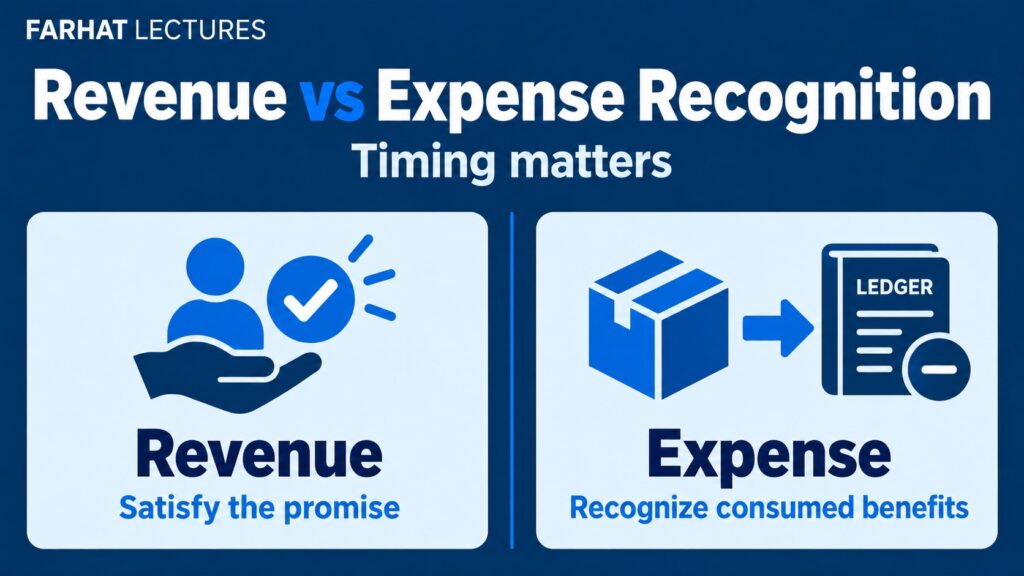
Revenue vs expense recognition compares when each is recorded under accrual accounting. For customer contracts within ASC 606’s scope, revenue is recognized when or as a company satisfies a performance obligation by transferring control of goods or services to the customer. Expenses reflect resources consumed or obligations incurred that do not create a qualifying asset, subject to the applicable accounting standards. Related costs are recognized with revenue when a direct link exists. Cash receipt or payment alone does not determine recognition.
The distinction matters because collecting money, earning revenue, paying a supplier, and consuming a resource can happen in different months. Accrual accounting separates these events so each reporting period shows the activity that belongs to it. Otherwise, moving a payment date could make performance appear better or worse without changing the underlying business activity.
Revenue vs expense recognition at a glance
| Question | Revenue recognition | Expense recognition |
|---|---|---|
| What triggers it? | Satisfying a performance obligation, which usually means the customer gains control of the good or service | Consuming an asset’s benefits or incurring an obligation that does not create a qualifying asset, under the applicable standards |
| Where is the main guidance? | ASC 606, Revenue from Contracts with Customers | Authoritative topic standards, such as ASC 330 for inventory and ASC 360 for property, plant, and equipment; FASB Concepts Statement 8 provides nonauthoritative conceptual background |
| What does a typical entry look like? | Debit Cash, Contract liability, Accounts receivable, or Contract asset as appropriate; credit Revenue | Debit an expense account, credit Inventory, a prepaid asset, Accumulated depreciation, or a payable |
| Does the cash date decide? | No | No |
Watch: Revenue and expense recognition
See the timing distinction in action with Professor Farhat. This focused excerpt explains customer advances, prepaid expenses, and when an expense is incurred. It also connects expense recognition to matching costs with revenue and allocating costs such as depreciation.
Featured excerpt: 1:26–5:50 (4 minutes, 24 seconds).
From Farhat Lectures’ Revenue & Expense Recognition: Deferrals, Gift Cards & Construction. The player starts at 1:26 and stops at 5:50; the full lesson and its updated notes are available on YouTube.
Apply it as you read: Compare the video’s customer advance with Harbor Repair’s April deposit and May service. Identify the liability at collection, then the revenue and expense recognized when the repair is completed.
What is the difference between revenue recognition and expense recognition?
| Concept | Question to ask | Simple illustration |
|---|---|---|
| Revenue recognition | Has the company satisfied the performance obligation? | A completed customer service may produce revenue before collection |
| Expense recognition | Which benefits were consumed, or which obligations created an expense rather than a qualifying asset? | The cost of goods sold follows the sale of the inventory |
| Cash receipt or payment | When did money enter or leave the bank? | A deposit can precede the service it pays for |
A performance obligation is a promise in a customer contract to transfer a distinct good or service to the customer. It can also be a series of distinct goods or services that are substantially the same and transfer in the same pattern. Satisfying the promise is the central timing idea. The periodicity assumption creates the reporting intervals in which these events must be placed.
What are the five steps of revenue recognition under ASC 606?
Accounting Standards Codification (ASC) Topic 606 uses a five-step approach. At this introductory level, focus on the purpose of each step rather than complex contract exceptions. The FASB’s revenue standard explains the model.
Hypothetical example: Harbor Repair agrees to complete one distinct repair for $600. Assume the contract meets the ASC 606 contract criteria (both parties have approved it, each party’s rights and the payment terms are clear, it has commercial substance, and collection is probable), the price is fixed, and the performance obligation is satisfied on completion.
| Step | Purpose | Harbor example |
|---|---|---|
| 1. Identify the contract | Establish the qualifying customer agreement | The agreed repair contract |
| 2. Identify the performance obligations | Identify the distinct promises | One repair service |
| 3. Determine the transaction price | Identify expected consideration | $600 |
| 4. Allocate the price | Assign consideration to the promises | All $600 relates to the single repair |
| 5. Recognize revenue | Record revenue when or as the obligation is satisfied | On completion under the stated facts |
Some obligations are satisfied over time, while others are satisfied at a point in time. A cash deposit alone does not settle that question. For more background on the model, see the site’s existing revenue recognition overview.
Exam tip: On the CPA exam, the five-step model is tested in the Financial Accounting and Reporting (FAR) section. CMA candidates see revenue recognition in Part 1, External Financial Reporting Decisions. The most common trap is choosing “when the contract is signed” or “when cash is received” as the recognition point. The correct trigger is satisfying the performance obligation. Candidates who want the advanced cases can read about repurchase agreements under ASC 606.
When is an expense recognized, and what does matching mean?
Incurring a liability does not automatically create an expense. Purchasing inventory on account creates an inventory asset and a payable. The cost ordinarily becomes an expense when the inventory is sold, unless a write-down or another adjustment is required.
Matching describes recognizing related costs in the period of the revenue they help generate. It is useful for understanding inventory becoming cost of goods sold. It is not a license to create an asset merely to postpone an expense or achieve a preferred profit number.
Three patterns help organize the lesson. First, some costs can be linked to particular revenue, such as the cost of inventory sold. Second, costs that benefit multiple periods may be allocated systematically, such as depreciation. Third, certain costs are recognized in the current period because a direct revenue connection or a qualifying future asset cannot be established.
The FASB’s measurement concepts (Concepts Statement No. 8, Chapter 6, Measurement, paragraphs M10 and M11) explain why allocating an asset’s cost over its benefit period reflects consumption. The FASB calls this systematic amortization, and depreciation is the everyday example. That allocation differs from measuring its current market value, as explained in historical cost versus fair value.
How do accruals and deferrals fit into revenue vs expense recognition?
Most timing differences fall into four cases. A deferral means cash moved first. An accrual means the revenue or expense comes first and cash follows later.
| Case | What happened first | Entry when the revenue or expense is recognized |
|---|---|---|
| Deferred revenue (customer advance) | Cash was received before the obligation was satisfied | Debit Contract liability, credit Revenue when or as the obligation is satisfied |
| Deferred expense (prepaid) | Cash was paid before the resource was used | Debit Expense, credit the prepaid asset as the benefit is used |
| Accrued revenue | The obligation was satisfied before cash was received | Debit Accounts receivable, credit Revenue, assuming the right to payment is unconditional; the later collection reduces the receivable |
| Accrued expense | The resource was used before cash was paid | Debit Expense, credit a payable; the later payment reduces the payable |
A receivable is an unconditional right to consideration: only the passage of time is required before payment is due. If the right depends on another condition, such as further performance, revenue recognized before billing may instead create a contract asset.
Hypothetical example (prepaid): On January 1, a company pays $1,200 for a 12-month insurance policy. The payment creates a prepaid asset, not an expense. Each month, $100 of coverage is used up ($1,200 ÷ 12). The January 31 entry is a $100 debit to Insurance expense and a $100 credit to Prepaid insurance, leaving a $1,100 prepaid balance.
Hypothetical example (accrued): Employees earn $3,000 of salaries in the last week of December, and the company pays them on January 5. The December 31 entry is a $3,000 debit to Salaries expense and a $3,000 credit to Salaries payable. The January 5 entry is a $3,000 debit to Salaries payable and a $3,000 credit to Cash. December carries the expense. January only settles the payable.
The video excerpt above walks through the customer advance and the prepaid expense cases. The Financial Accounting course covers all four cases with adjusting entry practice.
What is the difference between product costs and period costs?
| Type | Examples for a manufacturer | Basic treatment |
|---|---|---|
| Product costs | Direct materials, production labor, manufacturing overhead | Included in inventory, then recognized as cost of goods sold when the related goods are sold (an inventory write-down can also create an expense before a sale) |
| Period costs | General office salaries and administrative expenses | Recognized in the period incurred |
Hypothetical example: A small manufacturer completes 100 identical units at a total production cost of $2,000 and sells 60 units. Assume no opening inventory or other adjustments. Cost per unit is $20, cost of goods sold is $1,200, and ending inventory is $800. A separate $500 administrative salary is a period expense.
Do not classify all salaries the same way. The function matters: production labor can attach to inventory, while general administrative salaries ordinarily relate to the period.
If you want more practice sorting manufacturing costs, the Cost Accounting course works through product and period costs with full examples.
Revenue vs expense recognition example: cash and profit timing
Return to Harbor Repair. It receives the customer’s $600 deposit on April 10, completes the repair on May 3, and uses $220 of parts already held in inventory. Assume no other costs and no earlier satisfaction of the performance obligation.
- April: Cash increases by $600, with a corresponding obligation to provide the service. The deposit is not April revenue under these facts.
- May: Harbor recognizes $600 of revenue when it completes the repair and $220 of expense for the parts consumed.
- May profit contribution: $600 − $220 = $380, before any other expenses.
Journal entries for the customer advance and completed repair
These entries show revenue vs expense recognition using the same Harbor Repair facts. The advance creates a liability in April. Completing the repair releases that liability and recognizes revenue in May; using the parts creates a May expense.
| Date and event | Account | Debit | Credit |
|---|---|---|---|
| April 10: customer advance | Cash | $600 | — |
| Contract liability (unearned revenue) | — | $600 | |
| May 3: repair completed | Contract liability (unearned revenue) | $600 | — |
| Service revenue | — | $600 | |
| May 3: parts consumed | Parts expense | $220 | — |
| Parts inventory | — | $220 |
The receipt affects April cash. The service and consumed parts affect May profit. This is why bank activity alone cannot answer an accrual-accounting question.
Want more journal entry practice like this? The Intermediate Accounting course covers revenue recognition and expense timing with video lectures and worked problems.
Common revenue vs expense recognition mistakes
- Recording every customer advance as immediate revenue.
- Expensing all inventory when purchased, even if it remains unsold.
- Delaying administrative expenses until a profitable month.
- Assuming signing a contract always satisfies the performance obligation.
Always identify what changed in assets, liabilities, and performance. If an amount is accounted for incorrectly, explaining it in a note does not fix the error. See the full disclosure principle for that distinction.
Key takeaways
- For contracts within ASC 606’s scope, revenue is recognized when or as a performance obligation is satisfied by transferring control to the customer.
- Expenses reflect consumed benefits or obligations that do not create a qualifying asset, subject to the applicable standards. Matching links related costs to revenue when a direct relationship exists.
- A customer advance for a qualifying contract remains a contract liability until or as the related performance obligation is satisfied. A qualifying prepaid cost remains an asset until its benefit is consumed.
- Product costs ordinarily remain in inventory until the goods are sold, although write-downs or other required adjustments can create earlier expenses. Period costs are expensed when incurred.
- Cash receipt or payment alone does not determine recognition under accrual accounting.
Need a review? Revisit the five revenue recognition steps or product costs vs period costs, then try the explained practice questions.
Practice questions and explained answers
1. A qualifying $900 service is completed in November, and cash is collected in December. When is revenue recognized?
Answer: November, assuming completion satisfies the performance obligation. December collection settles the receivable rather than creating a second revenue amount.
2. A manufacturer sells 30 of 50 identical units that cost $40 each. What are cost of goods sold and ending inventory?
Answer: Cost of goods sold is 30 × $40 = $1,200. Ending inventory is 20 × $40 = $800, assuming no other adjustments.
3. A December administrative salary is paid in January. Is it a January expense because cash is paid then?
Answer: No. Under the stated facts, December receives the service and incurs the obligation. The expense belongs to December; January payment settles the payable.
Revenue vs expense recognition: frequently asked questions
Is the matching principle the same as paying expenses?
No. Matching concerns recognition in the appropriate period. Payment can occur earlier or later.
Does every expense have a directly matching revenue amount?
No. Systematic allocation and current-period recognition also apply. A direct link to one specific sale is not always available.
Does a signed customer contract always create revenue?
No. Contract identification is only the first step. Revenue depends on satisfying the relevant performance obligation.
Is a customer deposit revenue?
An advance for a qualifying customer contract is a contract liability until or as the related performance obligation is satisfied. Harbor Repair recognizes its April advance as May revenue under the stated completion assumption.
How is revenue vs expense recognition different under cash basis accounting?
Cash basis accounting generally records revenue at collection and expenses at payment. Accrual accounting records the underlying activity in the appropriate period. Cash basis financial statements use a special purpose framework rather than U.S. GAAP.
Is the five-step model the same under IFRS?
Yes. IFRS 15 uses the same five-step model as ASC 606 because the FASB and the IASB developed the standards together. Some application details differ, but the core timing idea is the same.
Learn with Farhat Lectures.
Build confidence with clear explanations and guided accounting practice. Explore the free sample course and keep your study momentum going.
Try the free sample course →




Responses