
FASB Conceptual Framework: 8 Chapters Made Simple

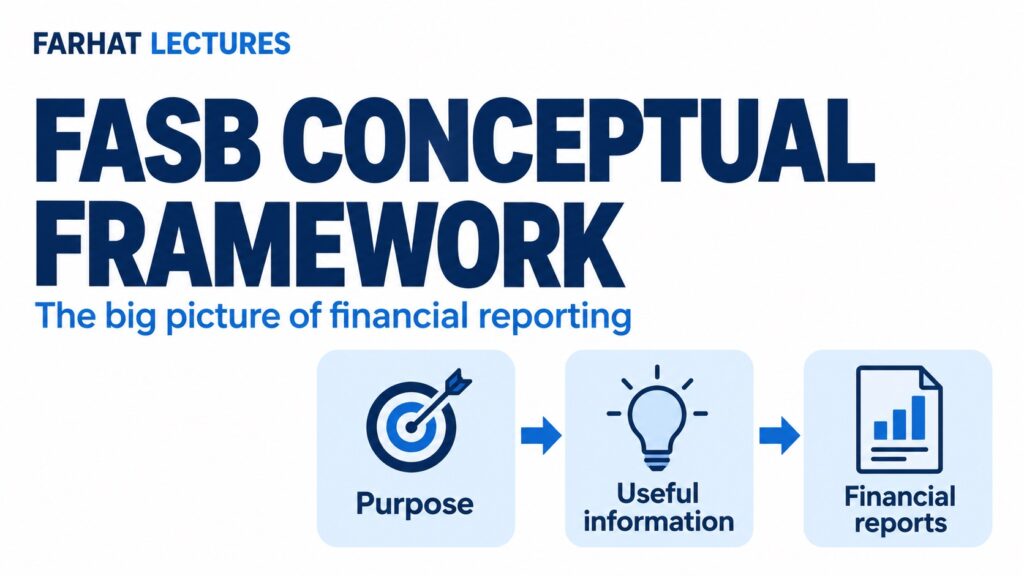
The FASB conceptual framework is the connected set of ideas that helps the Financial Accounting Standards Board (FASB) develop financial reporting standards. It explains the purpose of reporting, what makes information useful, and how economic events become financial statements. It guides standard setting, but it does not override generally accepted accounting principles (GAAP).
Watch: FASB conceptual framework with Farhat
Watch Professor Farhat explain the purpose of the FASB conceptual framework, the objective of financial reporting, and the qualities that make accounting information useful. Use this introductory lesson alongside the eight-chapter guide below.
Watch Farhat’s FASB conceptual framework lesson on YouTube · About 13 minutes
Study connection: As you watch, identify who uses financial information and what makes it useful. Then apply those ideas to the Cedar Repair example and practice questions below.
Why the FASB conceptual framework matters
Imagine learning every journal entry as a separate rule. A new transaction would leave you guessing. A framework gives you a common starting point: identify the economic event, the information users need, and the qualities that make its depiction useful.
It also helps standard setters work consistently across different issues. Without shared concepts, one standard might favor useful information while another favors a convenient result for a particular industry. The framework provides a reasoned basis for discussing those choices.
However, a concept is not permission to ignore a specific standard. FASB explicitly describes its framework as a foundation for setting standards, rather than a direct replacement for existing GAAP. When a homework question supplies a specific accounting requirement, apply that requirement.
The objective and the reporting entity
General-purpose financial reporting helps existing and potential investors, lenders, and other creditors decide whether to provide resources to an entity. Investors may consider buying or holding shares. Lenders may assess whether a borrower can make future payments.
These users need help assessing future cash flows: how much cash may be available, when it may arrive, and how uncertain it is. Financial reports supply evidence for those assessments; they do not guarantee future outcomes.
The reporting entity is the entity whose activities and resources the reports describe. Start by asking, “Whose financial information am I reading?” That question prevents mixing the company’s financial picture with the personal finances of an investor.
General-purpose reports address common information needs. They cannot provide a custom report answering every question for every reader. Users are expected to bring reasonable business knowledge and study the information with care.
The eight chapters at a glance
| Chapter | Learning question |
|---|---|
| 1. Objective | Why provide financial information, and for whom? |
| 2. Reporting entity | Which entity is being described? |
| 3. Qualitative characteristics | What makes information useful? |
| 4. Elements | What kinds of resources, claims, and changes are represented? |
| 5. Recognition and derecognition | When should an item enter or leave the statements? |
| 6. Measurement | What numerical amount should describe it? |
| 7. Presentation | How should line items and totals communicate it? |
| 8. Notes | What additional explanation does the reader need? |
The chapter numbers identify FASB framework chapters, not eight separate textbook lessons. They are parts of one system. The FASB Concepts Statement 8 collection is the primary reference.
A simple example connecting the framework
Hypothetical example: Cedar Repair buys equipment for $12,000 in cash. A student wants to understand how this purchase fits into financial reporting. Assume the transaction qualifies for the ordinary equipment accounting used in the assignment.
First, identify Cedar as the reporting entity. An outside lender may care about Cedar’s available cash and productive resources. The purchase changes the composition of its assets: it gives up cash and receives rights to use equipment.
Next, distinguish the questions. Whether equipment belongs in the statements is a recognition question. The amount assigned to it is a measurement question. Where it appears and how it is grouped are presentation questions. An explanation of the accounting policy belongs in the notes.
A useful report must also describe the purchase faithfully and provide relevant information. For example, recording a larger amount simply to make Cedar look stronger would undermine neutrality. Our qualitative characteristics guide explains that quality test.
This example is a map, not a complete equipment-accounting lesson. The framework organizes the reasoning; detailed standards supply the rules for a specific transaction.
How to study the connections
Read the framework in three passes. Begin with purpose and entity. Then study the qualities and elements of financial statements. Finally, connect those ideas to recognition, measurement, presentation, and notes.
Keep the cost constraint in view. Producing and using information consumes resources, so the benefits of reporting should justify its costs. This constraint informs standard setting; it is not an unrestricted option for a company to avoid required accounting.
Also separate the broad usefulness of information from its importance in a particular company. Materiality in accounting addresses that company-specific judgment.
Common mistakes
- Treating the framework as GAAP: concepts guide standards but do not override them.
- Equating useful information with good news: disappointing results may be essential to a lender’s decision.
- Thinking notes are optional decoration: numbers often need explanations to convey a complete picture.
- Expecting one report to answer everything: general-purpose reporting serves common needs and has limitations.
Practice questions with explanations
1. Can management override a specific standard using a framework concept?
Answer: No. The FASB conceptual framework is nonauthoritative. An appealing conceptual argument does not replace the applicable GAAP requirement.
2. A bank studies a borrower’s resources before renewing a loan. Which objective does this illustrate?
Answer: Helping a resource provider make a decision. The bank uses financial information to evaluate potential repayment and uncertainty.
3. A report explains what a debt balance represents. Is that measurement or notes?
Answer: Notes. The numerical amount involves measurement. Explaining its nature and relevant terms is a disclosure function.
Frequently asked questions
Is the FASB conceptual framework only a list of definitions?
No. Definitions are one part. The framework connects the reporting objective to qualities, recognition, measurement, presentation, and explanatory notes.
Is financial reporting intended only for managers?
No. The objective emphasizes outside investors, lenders, and other creditors. Management can often obtain additional internal information.
Should I memorize the chapter numbers?
Know them if your course requires it, but practice matching a question to its concept. That skill is more useful than reciting a list without understanding it.
Learn with Farhat Lectures
Build your understanding with clear explanations and guided practice. Explore the free sample course, then continue studying at your own pace.
Try the free sample course →
Responses