
Stock Appreciation Rights vs Stock Options: Key Differences for Accounting Students

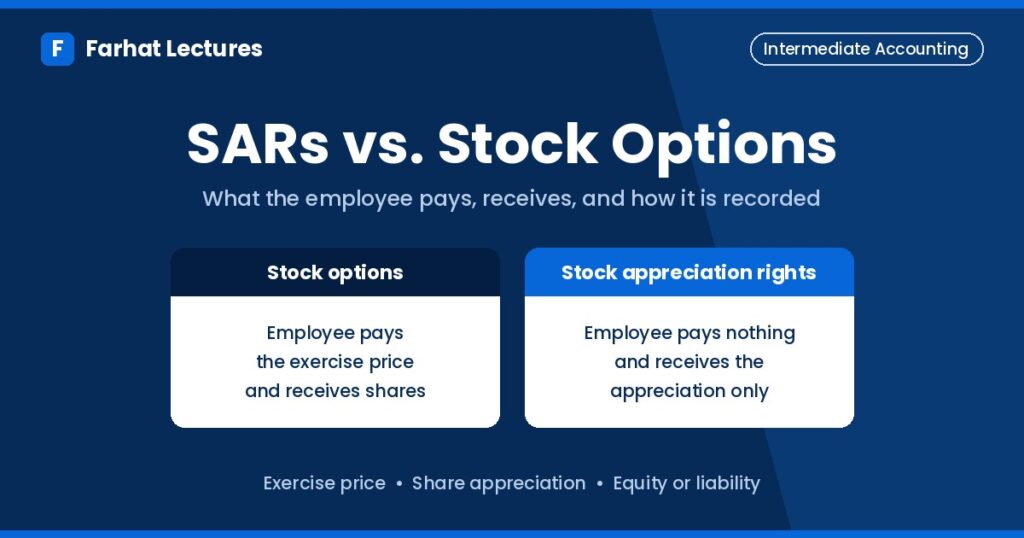
Stock appreciation rights (SARs) vs stock options comes down to what the employee pays and gets. An option holder pays the exercise price and receives shares. A SAR holder pays nothing and receives only the stock price increase, in cash or shares. Stock options and share-settled SARs often qualify as equity awards. SARs that require cash settlement are liabilities remeasured each reporting period until settlement.
Both awards reward employees when the stock price rises, so they look alike at first. But they affect the balance sheet, the income statement, and the share count very differently. Exam questions often give the same facts for both awards and ask how the numbers change.
This comparison supports Appendix 15A (Accounting for Stock-Appreciation Rights) and the stock option material in Chapter 15 of Kieso, Weygandt, and Warfield’s Intermediate Accounting, 18th edition. Earlier editions cover the same material in Appendix 16A. If you are new to SARs, start with stock appreciation rights accounting: equity vs. liability awards.
Watch: Accounting for Stock Options
Professor Farhat covers how employee stock options are valued at the grant date and expensed over the service period. Watch it for the option side of this comparison, then compare it with the SAR treatment below.
Stock appreciation rights vs stock options at a glance
| Feature | Stock options | Stock appreciation rights (SARs) |
|---|---|---|
| Employee receives | The right to buy shares at the exercise price | The appreciation above a pre-established price |
| Employee pays at exercise | Exercise price × number of shares | Usually nothing |
| Form of payment | Shares | Cash, shares, or both |
| New shares issued | The full number exercised | None (cash) or only shares worth the appreciation |
| Cash flow for the company | Receives cash at exercise | Pays cash if cash-settled |
| Classification | Usually equity | Generally equity when the substantive terms require settlement in shares. Liability when the terms require cash settlement or let the employee demand cash. |
| Measurement | Equity-classified options: grant-date fair value | Equity-classified SAR: grant-date fair value. Liability-classified SAR: remeasured each reporting date until settlement. |
| Total expense | Grant-date fair value of equity-classified options earned | Equity-classified SAR: grant-date fair value. Liability-classified SAR: final settlement value, which equals the cash paid for a cash-settled SAR. |
How do stock options and SARs work?
Stock options
A stock option gives the employee the right to buy a set number of shares at a fixed exercise price for a period of time. If the market price rises, the employee pays the exercise price, receives the shares, and keeps the gain. The catch is cash. The employee must fund the exercise price. For a nonqualified option with no readily determinable fair market value at grant, the spread is generally ordinary income at exercise if the shares are substantially vested at that point. The IRS explains these rules in Topic 427, Stock Options. For the company’s entries from grant to expiration, see accounting for stock options journal entries.
Stock appreciation rights
A SAR gives the employee the share appreciation when the market price at exercise exceeds the pre-established price. No purchase is needed. The company simply pays the gain in cash or in shares with a fair value equal to the gain. Textbooks describe SARs as a solution to the cash burden of exercising options.
Side-by-side example
Ridgeway Labs (a hypothetical company) grants Executive A 2,000 stock options and Executive B 2,000 cash-settled SARs. Both awards have a $30 exercise or pre-established price, a two-year service period, and a grant-date fair value of $6 each. Both executives exercise when the stock trades at $45. The common stock has a $1 par value.
| Item | Executive A (options) | Executive B (SARs) |
|---|---|---|
| Cash paid by the executive | $60,000 (2,000 × $30) | $0 |
| What the executive receives | 2,000 shares worth $90,000 | $30,000 cash |
| Executive’s gain | $30,000 | $30,000 |
| Ridgeway’s total compensation expense | $12,000 (2,000 × $6) | $30,000 |
The executives gain the same $30,000, but Ridgeway’s expense is very different. Option expense was fixed on the grant date at $12,000 ($6,000 per year). SAR expense was remeasured each period until settlement, so it ends up equal to the $30,000 actually paid.
Key takeaway: same employee gain, different expense. The options cost Ridgeway $12,000, fixed at the grant date. The cash-settled SARs cost $30,000, the cash actually paid.
Executive A exercises the options:
| Account | Debit | Credit |
|---|---|---|
| Cash (2,000 × $30) | 60,000 | |
| Paid-in Capital—Stock Options | 12,000 | |
| Common Stock (2,000 × $1) | 2,000 | |
| Paid-in Capital in Excess of Par—Common Stock | 70,000 |
Executive B exercises the SARs:
| Account | Debit | Credit |
|---|---|---|
| Liability Under Stock-Appreciation Plan | 30,000 | |
| Cash | 30,000 |
The year-by-year accruals that build the $30,000 liability are shown in stock appreciation rights journal entries.
What if the terms of Executive B’s SARs required Ridgeway to settle them in shares instead? Assume the SARs meet the other requirements for equity classification. They would then be accounted for as equity awards, just like the options. Total expense would stay at the $12,000 grant-date fair value (2,000 × $6), and Ridgeway would issue about 667 shares ($30,000 ÷ $45, rounded). The simplified exercise entry assumes settlement in whole shares:
| Account | Debit | Credit |
|---|---|---|
| Paid-in Capital (Stock-Appreciation Rights) | 12,000 | |
| Common Stock (667 × $1) | 667 | |
| Paid-in Capital in Excess of Par (Common Stock) | 11,333 |
No cash changes hands in this entry, and total stockholders’ equity does not change at exercise. In practice, a fractional share is usually paid in cash.
Why are SARs and stock options accounted for differently?
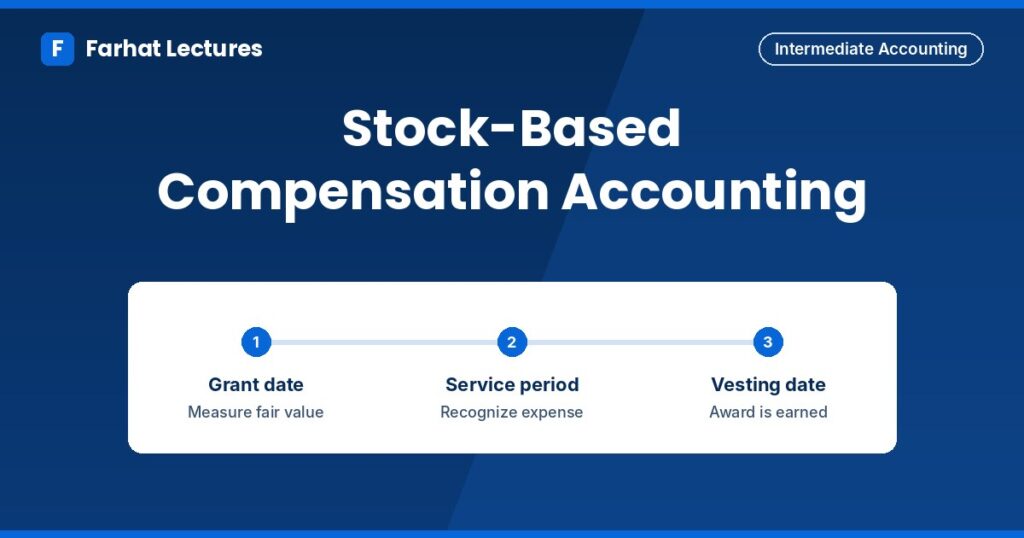
Under ASC 718, equity-classified awards are measured once, at grant-date fair value. Liability-classified awards are remeasured at each reporting date until they are settled, as Deloitte’s overview of ASC 718 measurement explains. For equity-classified stock options and SARs, grant-date fair value establishes the compensation cost recognized over the requisite service period. A SAR that requires cash settlement is a liability, and its cost follows changes in its measurement until settlement.
That is why liability SARs can create large swings in expense, including credits to expense when fair value falls. Deloitte’s chapter on liability-classified awards walks through the ASC 718-30 guidance.
Who decides how a SAR is paid matters. If the employee can demand cash, the SAR is a liability. If the company chooses between cash and shares, the SAR is usually an equity award, unless the company has a practice of paying cash.
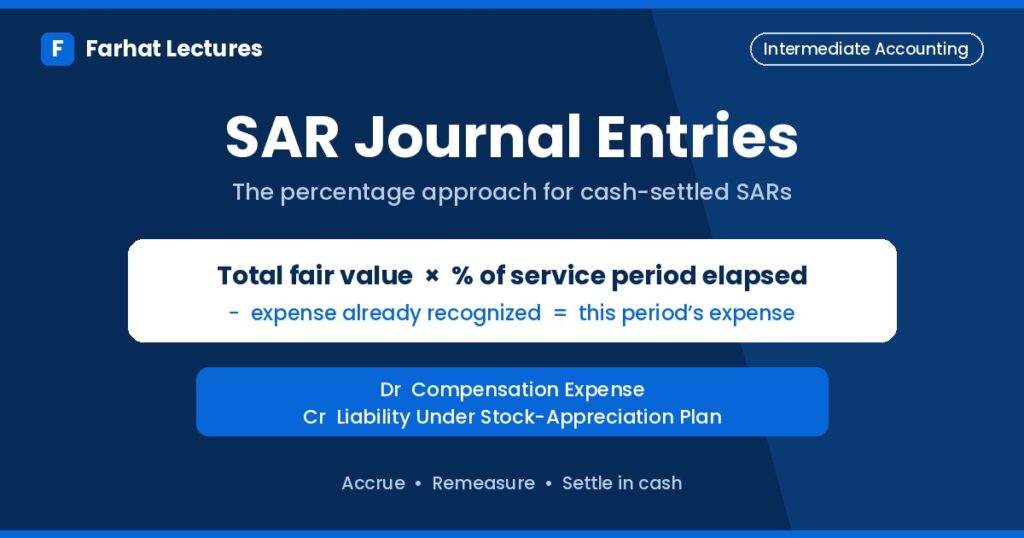
What is a liability SAR remeasured at? Under ASC 718, public companies remeasure it at fair value, usually from an option pricing model. Nonpublic companies may elect to use intrinsic value for liability-classified awards. For a SAR, intrinsic value per right is the amount by which the current share price exceeds the pre-established price, with a floor of zero. Many textbook problems, including our percentage approach example, use intrinsic value to keep the math simple.
How do SARs and stock options affect shares and cash?
- Stock options add the full number of shares exercised and bring cash into the company.
- Share-settled SARs add only the shares equal to the appreciation. In the example, a share-settled version would issue only about 667 shares ($30,000 ÷ $45), not 2,000. See the stock appreciation rights accounting lesson for how equity and liability SARs are recorded.
- Cash-settled SARs add no shares but use company cash.
Securities that can increase the share count are called dilutive securities. See dilutive securities and how dilution works for the bigger picture.
Exam insight: for diluted earnings per share (EPS), the treasury stock method gives the same result for the options and the share-settled SARs in the Ridgeway example. The method assumes the company uses the $60,000 of exercise proceeds to buy back shares at the average market price: $60,000 ÷ $45 = about 1,333 shares. So the options add 2,000 minus 1,333, or about 667 incremental shares before time-weighting, the same as the share-settled SARs. For the full-period comparison, assume both awards are outstanding throughout the period, both are fully vested with no unrecognized compensation cost, and $45 is the average market price. If the awards are outstanding for only part of the period, time-weight the incremental shares for that portion.
How are SARs and stock options taxed for employees?
Taxes are a separate topic from the accounting, but they explain why employees and companies care about the difference. Here are the federal income tax basics from IRS Publication 525 | New Window:
- Nonqualified stock options: If the option has no readily determinable fair market value at grant, there is generally no tax at grant. The spread (market value minus the exercise price) is generally ordinary income at exercise when the shares acquired are substantially vested at exercise.
- Incentive stock options (ISOs): no regular income tax at grant or exercise, although the alternative minimum tax (AMT) may apply in the year of exercise. If the employee holds the shares more than 2 years from the grant date and more than 1 year from exercise, the gain on sale is a long-term capital gain.
- SARs: no tax at grant. At exercise, the payment the employee receives is ordinary income.
In the Ridgeway example, assume Executive A holds nonqualified options with no readily determinable fair market value for tax purposes at grant and receives substantially vested shares at exercise. Both executives report $30,000 of ordinary income in the year they exercise. The difference is cash: Executive A had to come up with $60,000 to buy the shares, while Executive B simply received $30,000.
Common mistakes
- Assuming SARs always mean cash. A SAR whose substantive terms require settlement in shares generally qualifies for equity classification. The issuer measures an equity-classified SAR at grant-date fair value, just as it does for an equity-classified stock option. If the employee can demand cash, the SAR is a liability even if the employee later takes shares.
- Remeasuring equity-classified stock options. Grant-date fair value remains the measurement basis for an unmodified equity-classified option throughout its life.
- Assuming equal gains mean equal expense. The example shows identical employee gains but different expense.
- Recording cash received on a SAR. The employee pays nothing, so there is no debit to Cash when a SAR is exercised.
Practice questions
Equity-Classified Stock Appreciation Rights (SARs) Practice
Compare share-settled stock appreciation rights with stock options in four CPA practice questions on ASC 718. Choose one answer per question to test equity classification, settlement at exercise, and recognition of compensation expense.
1. Which award increases shares outstanding by the full number of shares exercised: stock options, share-settled SARs, or cash-settled SARs?
Answer: Stock options. Share-settled SARs issue only shares worth the appreciation, and cash-settled SARs issue none.
2. A company grants 1,000 stock options and 1,000 cash-settled SARs, both with a $20 price and a grant-date fair value of $5. Both are exercised when the stock is $32. What is total compensation expense for each award?
Answer: Options: $5,000 (1,000 × $5, fixed at grant). SARs: $12,000, which is the cash paid of 1,000 × ($32 − $20). Liability awards are remeasured until settlement.
3. True or false: an equity-classified SAR is remeasured to fair value at each reporting date.
Answer: False. The issuer measures an equity-classified SAR at grant-date fair value and recognizes the cost over the requisite service period, just as it does for an equity-classified stock option.
Frequently asked questions
What is the main difference between stock appreciation rights and stock options?
With a stock option, the employee pays the exercise price and receives shares. With a SAR, the employee pays nothing and receives only the increase in value, in cash, shares, or both.
Are SARs better than stock options for employees?
SARs avoid the cash needed to pay the exercise price, which is their main advantage. Options let the employee own the full block of shares and any future growth on them. Which is better depends on the plan and the employee’s goals.
Why might a company prefer stock options over cash-settled SARs?
Equity-classified stock options typically bring in cash at exercise and establish compensation cost at grant. Cash-settled SARs use company cash, and their compensation cost changes as the liability is remeasured until settlement.
Do SARs dilute existing stockholders?
Cash-settled SARs issue no shares, so they do not dilute ownership. Share-settled SARs issue some new shares, but only enough to equal the appreciation, so they dilute less than the same number of options.
Is a share-settled SAR accounted for like a stock option?
Yes, when both awards qualify for equity classification. The issuer measures both at grant-date fair value and recognizes compensation expense over the requisite service period using that measurement.
Are stock appreciation rights a liability or equity?
Classification depends on the substantive award terms. SARs that require settlement in shares generally qualify as equity awards and are measured at grant-date fair value. SARs that require cash settlement or let the employee demand cash are liabilities remeasured at each reporting date until settlement.
How are SARs taxed compared with stock options?
For federal income tax, a SAR is taxed as ordinary income when the employee exercises it. The spread on a nonqualified stock option is generally ordinary income at exercise if the option had no readily determinable fair market value at grant and the acquired shares are substantially vested at exercise. An incentive stock option generally has no regular income tax at exercise, although the alternative minimum tax may apply.
What journal entry records the exercise of a cash-settled SAR?
Debit Liability Under Stock-Appreciation Plan and credit Cash for the amount paid. The liability was built up through compensation expense over the service period and adjusted to the final payout.
About the author: Mansour Farhat, CPA, CIA, DBA, is the instructor behind Farhat Lectures, where he teaches accounting courses and CPA, CMA, and EA exam review. Learn more about Professor Farhat.
Continue learning with Farhat Lectures
Strengthen your accounting understanding with clear explanations and guided practice.
Want the whole chapter? The Intermediate Accounting course covers stock compensation plans, dilutive securities, and earnings per share, with video lessons and practice.
Explore the free sample course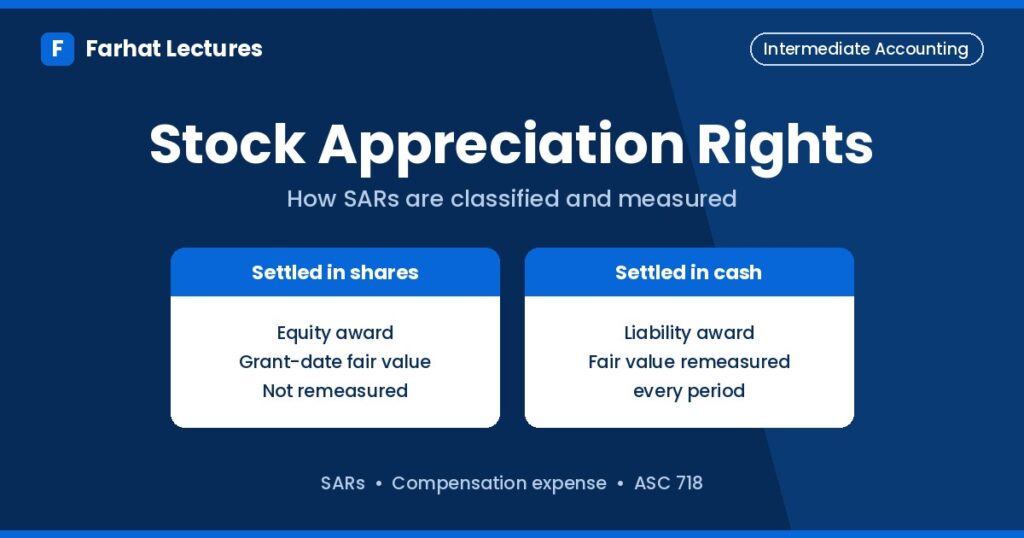
Responses