
Stock Appreciation Rights (SARs) Accounting: Equity vs. Liability Awards

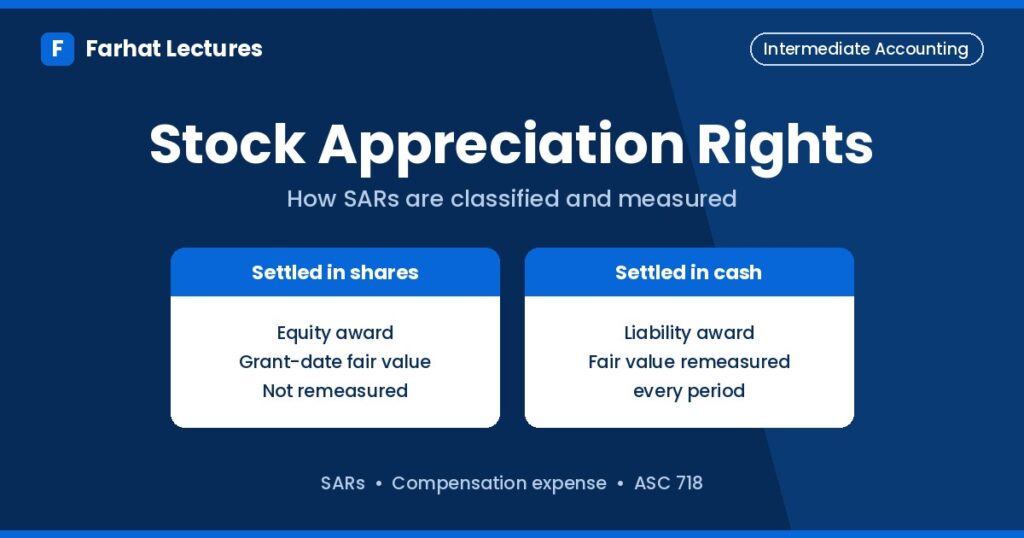
Stock appreciation rights accounting depends on how the rights are settled. Stock appreciation rights (SARs) pay an employee the increase in the stock price above a pre-established price. Share-settled SARs that qualify for equity classification are measured at grant-date fair value. Cash-settled SARs are liability awards remeasured at fair value each reporting period until paid.
This distinction drives everything else: which account is credited, whether compensation expense can swing up and down, and how much expense the company reports in total. The 2026 Business Analysis and Reporting (BAR) blueprint for the CPA exam covers stock compensation concepts and journal entries for equity-classified awards. It also trips up intermediate accounting students, who often treat every SAR like a stock option.
This guide supports the appendix on accounting for stock-appreciation rights at the end of the dilutive securities chapter in most intermediate accounting textbooks (for example, Appendix 16A in the 17th edition of Kieso’s Intermediate Accounting). It explains what SARs are, why companies use them, how they are classified, and how each type is measured. All examples use original, hypothetical numbers.
Watch: Stock Appreciation Rights Explained
Professor Farhat explains what SARs are, how they differ from stock options, and how companies measure and remeasure the compensation expense, so it pairs well with this guide.
What are stock appreciation rights?
A stock appreciation right (SAR) is a compensation award that pays the holder the share appreciation: the excess of the stock’s market price on the exercise date over a pre-established price set when the award is granted. The company can pay that amount in cash, in shares of its own stock, or in a combination of both.
Two terms come up again and again:
- Pre-established price: the base price fixed in the plan, often the market price on the grant date. It works like the exercise price of a stock option, except the employee never pays it.
- Service period: the period the employee must work to earn the award. The company spreads compensation expense over this period.
Share appreciation per right = market price at exercise − pre-established price. If the market price never rises above the pre-established price, the SAR pays nothing.
Why do companies use SARs?
SARs were created to solve a cash problem with stock options. To exercise a stock option, an executive must pay the exercise price. With a nonqualified option, the executive also owes income tax on the spread (market price minus exercise price) at exercise, even if they keep the shares. With an incentive stock option, there is generally no regular income tax at exercise, but the executive may still need to borrow to pay the exercise price.
A SAR removes that cash outlay. The executive receives the appreciation directly, without buying any shares. The company also does not issue the full block of shares the appreciation is based on. It pays only cash or shares worth the appreciation. For a side-by-side look at the two awards, see stock appreciation rights vs stock options. For the other types of stock compensation plans, see stock-based compensation accounting.
Stock appreciation rights accounting: equity vs. liability
Under ASC 718, Compensation—Stock Compensation, in the Financial Accounting Standards Board (FASB) Codification, classification depends on the award’s substantive terms, including the form of settlement and the company’s settlement practices. The share-settled awards in the comparison and examples below are assumed to meet ASC 718’s equity-classification criteria.
| Feature | Equity SAR (share-settled) | Liability SAR (cash-settled) |
|---|---|---|
| Holder receives | Shares worth the appreciation | Cash equal to the appreciation |
| Classification | Equity award | Liability award |
| Measured at | Fair value on the grant date | Fair value at each reporting date until settlement |
| Remeasured later? | No | Yes, every reporting period |
| Credit during service period | A paid-in capital account | Liability Under Stock-Appreciation Plan |
| Total expense equals | Grant-date fair value of the awards earned | The cash finally paid |
An equity SAR is essentially a stock option with a different payment form. With an option, the holder pays the exercise price and receives shares. With an equity SAR, the holder pays nothing and receives only the shares equal to the appreciation. That is why equity SARs follow the same accounting as stock options.
Cash settlement creates a real obligation to transfer assets, so a cash-settled SAR is a liability. Deloitte’s guide to substantive terms under ASC 718 also explains that if the holder can demand cash, the company has a liability even if it might pay in shares.
How are equity and liability SARs measured?
Equity SARs: fix the cost on the grant date
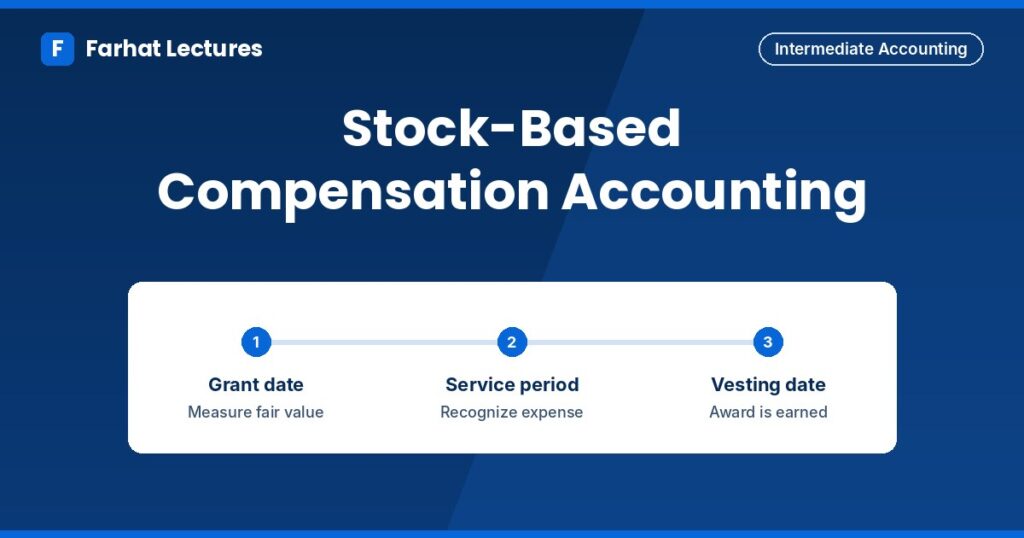
The company estimates the fair value of each SAR on the grant date, usually with an option-pricing model (a valuation formula, such as Black-Scholes or a lattice model, that estimates what the right is worth today). It multiplies that value by the number of SARs and allocates the total to compensation expense evenly over the service period. Later changes in the stock price are ignored.
Liability SARs: remeasure every period
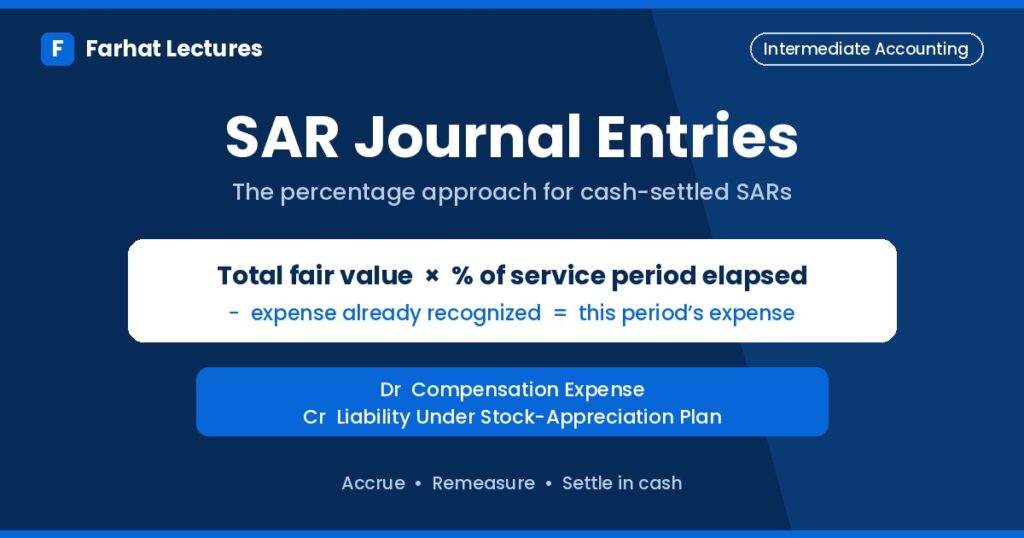
The company estimates fair value at the end of each period and records expense using the percentage approach: cumulative expense to date equals total estimated fair value times the percentage of the service period completed. Each period’s expense is the new cumulative amount minus what was already recognized. After the service period ends, the liability is still adjusted for every change in fair value until the SARs are exercised or expire. Deloitte’s roadmap chapter on liability-classified awards reproduces the ASC 718-30 remeasurement guidance.
Because of remeasurement, expense can rise sharply in one year and become a credit the next. The one limit is that cumulative compensation expense can never be negative. The full year-by-year method is in stock appreciation rights journal entries.
Stock appreciation rights accounting example
Cedar Lane Co. (a hypothetical company) grants an executive 1,000 SARs with a pre-established price of $40 and a two-year service period. The grant-date fair value is $4 per SAR. Two years later, the executive exercises when the stock trades at $50.
| Item | Amount |
|---|---|
| Appreciation per SAR ($50 − $40) | $10 |
| Total appreciation (1,000 × $10) | $10,000 |
| If cash-settled: cash received | $10,000 |
| If share-settled: shares received ($10,000 ÷ $50) | 200 shares |
If the share-settled SARs qualify for equity classification: total cost is fixed at 1,000 × $4 = $4,000, so Cedar Lane records $2,000 of compensation expense each year and credits Paid-in Capital—Stock Appreciation Rights. The rise to $50 does not change the expense.
If the SARs are cash-settled (liability): suppose fair value is $4 at the end of year 1 and $10 at the end of year 2 (the exercise date). Year 1 expense is $4,000 × 50% = $2,000. Year 2 expense is $10,000 × 100% − $2,000 = $8,000. Total expense is $10,000, exactly the cash paid.
Journal entries for the Cedar Lane example
Here is how the two versions look in the books. Notice that the equity version never touches a liability, and the liability version never touches equity.
| When | Share-settled (equity) | Cash-settled (liability) |
|---|---|---|
| End of year 1 | Dr Compensation Expense 2,000 Cr Paid-in Capital (Stock Appreciation Rights) 2,000 | Dr Compensation Expense 2,000 Cr Liability Under Stock-Appreciation Plan 2,000 |
| End of year 2 | Dr Compensation Expense 2,000 Cr Paid-in Capital (Stock Appreciation Rights) 2,000 | Dr Compensation Expense 8,000 Cr Liability Under Stock-Appreciation Plan 8,000 |
| Exercise | Dr Paid-in Capital (Stock Appreciation Rights) 4,000 Cr Common Stock and Paid-in Capital in Excess of Par 4,000 (200 shares issued; split the credit based on par value) | Dr Liability Under Stock-Appreciation Plan 10,000 Cr Cash 10,000 |
Exam tip: When a question gives you both a grant-date fair value and year-end fair values, determine the award’s classification first. Use grant-date fair value for equity-classified SARs. For liability-classified SARs measured at fair value, use the latest fair value and the percentage of the service period completed.
Common mistakes
- Treating every SAR like a stock option. Equity-classified SARs use grant-date fair value. Liability-classified SARs are remeasured through settlement.
- Forgetting remeasurement after the service period. A cash-settled SAR is adjusted until it is exercised or expires, not just until it vests (the point when the employee has fully earned it).
- Recording the full block of shares. A share-settled SAR issues only shares worth the appreciation (200 shares above, not 1,000).
- Letting cumulative expense go negative. A credit to expense cannot exceed the expense previously recognized for the plan.
Practice questions
Test what stock appreciation rights pay and how share settlement or cash settlement affects award classification and fair value measurement. Try the three interactive questions before reviewing the worked questions below.
1. A plan pays executives cash equal to the stock’s increase over $15. How are the SARs classified?
Answer: As a liability award. The company must transfer cash, so it credits a liability and remeasures it at fair value each reporting date until settlement.
2. An employee exercises 5,000 SARs with a pre-established price of $18 when the stock is at $25. How much appreciation does the employee receive?
Answer: $35,000. The appreciation is $25 − $18 = $7 per SAR, times 5,000 SARs.
3. A company grants 6,000 equity-classified, share-settled SARs with a grant-date fair value of $3 each and a three-year service period. The stock price doubles in year 2. What is year 2 compensation expense?
Answer: $6,000. Total cost is fixed at $18,000 on the grant date and spread evenly over three years. The awards are equity-classified, so the price increase is ignored.
Key takeaways
- A stock appreciation right pays the holder the increase in the stock price above a pre-established price. The holder pays nothing to exercise.
- Share-settled SARs that qualify as equity are measured at grant-date fair value. The company recognizes the cost over the service period.
- Cash-settled SARs are liability awards. The company remeasures the liability at fair value every reporting period until settlement, so expense can rise or fall.
- For a cash-settled SAR, total expense equals the cash finally paid.
- Cumulative compensation expense for a SAR plan can never go below zero.
Frequently asked questions
Are stock appreciation rights a liability or equity?
Cash-settled SARs are liability awards. Share-settled SARs are equity awards if they meet ASC 718’s equity-classification criteria. A liability measured at fair value is remeasured at each reporting date and at settlement.
Do employees pay anything to exercise a SAR?
Usually not. The holder simply receives the share appreciation, in cash, in shares, or in a mix of both. That is the main advantage of SARs over stock options.
Does the company issue shares under a SAR plan?
A cash-settled SAR issues no shares at all. A share-settled SAR issues only enough shares to equal the appreciation, not the full number of shares the appreciation was based on.
What happens if the stock price falls below the pre-established price?
There is no appreciation, so a SAR exercised at that point would pay nothing. For a cash-settled SAR, the falling fair value reduces the liability and creates a credit to compensation expense, but total expense recognized to date can never drop below zero.
What if the employee can choose cash or shares?
If the holder can require the company to pay cash, the company has an obligation it cannot avoid, so ASC 718 generally treats the award as a liability.
What if the company, not the employee, chooses cash or shares?
The award is generally classified as equity if the company can choose to settle in shares and has the ability and intent to do so. If the company has a practice of settling in cash, or pays cash whenever employees ask, the award’s substantive terms point to a liability instead.
Can a private company measure cash-settled SARs at intrinsic value?
Yes. Under ASC 718, a nonpublic company can make an accounting policy election to measure all of its liability-classified awards at intrinsic value instead of fair value. Intrinsic value is the excess of the share price over the pre-established price, with a minimum of zero. The award is still remeasured at each reporting date until it is settled.
Do SARs affect diluted earnings per share?
Share-settled SARs can. Because they may result in new shares, they are potentially dilutive securities, and companies include them in diluted EPS using the treasury stock method when their effect is dilutive.
How does IFRS treat cash-settled SARs?
IFRS 2 calls them cash-settled share-based payment transactions. The company recognizes a liability and remeasures it at fair value at each reporting date and at the settlement date. One difference: if the employee can choose cash or shares, IFRS 2 treats the award as a compound financial instrument with a liability part and an equity part.
About the author: Mansour Farhat, CPA, CIA, DBA, is the instructor behind Farhat Lectures, where he teaches accounting courses and CPA, CMA, and EA exam review. Learn more about Professor Farhat.
Continue learning with Farhat Lectures
Strengthen your accounting understanding with clear explanations and guided practice.
Want the whole chapter? The Intermediate Accounting course covers stock compensation plans, dilutive securities, and earnings per share, with video lessons and practice.
Explore the free sample course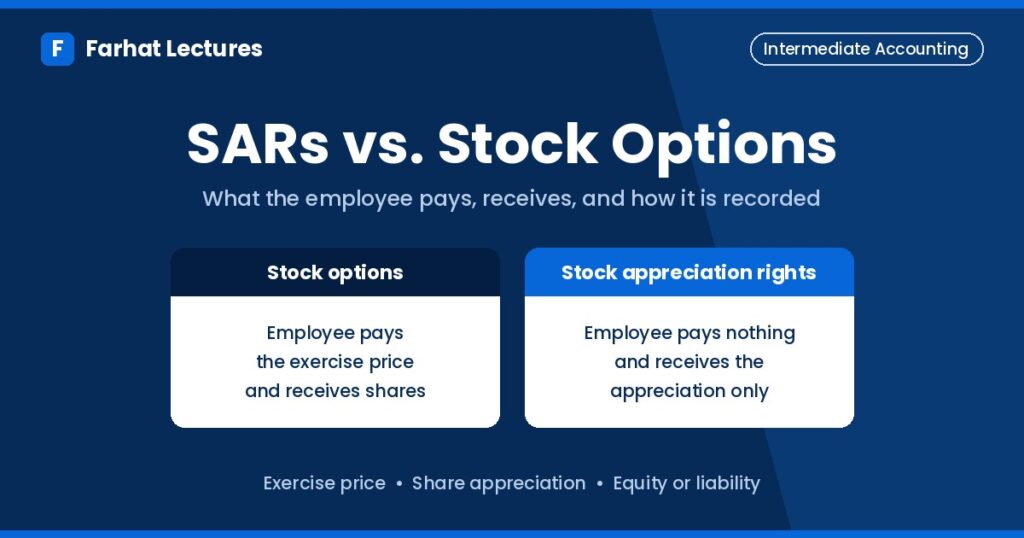
Responses