
Stock-Based Compensation Accounting: Options, Restricted Stock, and ESPPs

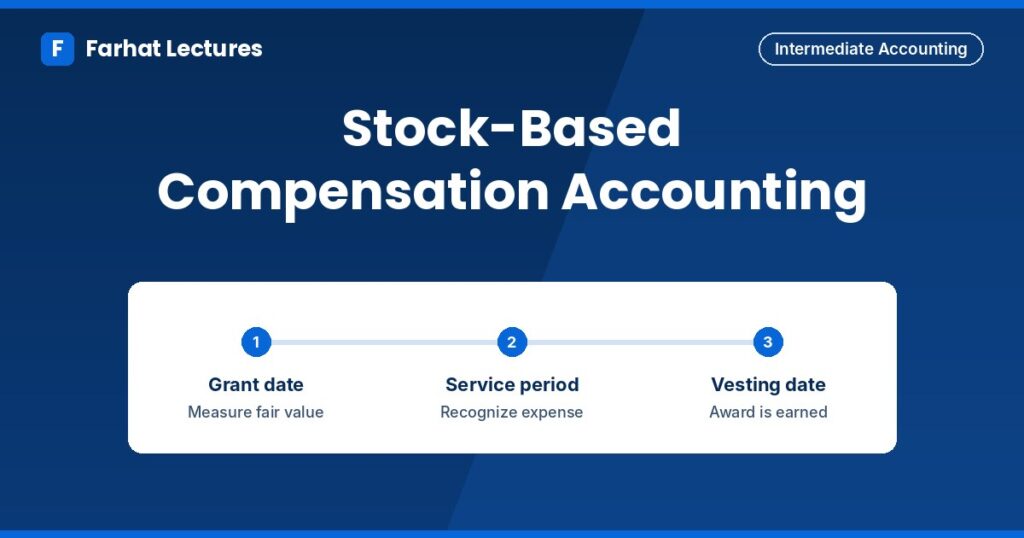
Stock-based compensation accounting is how a company records the cost of paying employees in company stock or stock rights, such as stock options, restricted stock, and employee stock purchase plans (ESPPs). Under U.S. GAAP (ASC 718), a company generally measures equity-classified awards at grant-date fair value and recognizes compensation cost over the service period, usually the vesting period. It remeasures liability-classified awards at each reporting date until settlement.
Why it matters: for many executives, stock awards are a much larger part of pay than salary. If companies left that cost out of the income statement, profits would look higher than they really are. Recording the expense lets investors compare companies fairly, and it is a core topic in intermediate accounting and on the CPA exam.
This guide gives you the big picture: the fair value method, the main plan types, when an ESPP counts as compensation, how cash-settled awards and income taxes fit in, and what companies must disclose. For full journal entries, see the companion lessons on accounting for stock options and restricted stock vs RSU accounting. All examples use original, hypothetical numbers.
Watch: Accounting for Stock Options
Professor Farhat explains why GAAP requires companies to expense employee stock options and how the fair value method works, which is the foundation for every plan type in this guide.
What is stock-based compensation?
Cash pay (salary and bonuses) rewards short-term results. To keep key people focused on the long term, companies also give them an ownership stake in the business. These arrangements are called stock-based (or share-based) compensation plans.
A good compensation plan ties pay to employee and company performance, motivates strong work, helps the company keep and recruit talent, gives employees the best after-tax benefit at a reasonable cost to the employer, and rewards results employees can actually influence.
How do you account for stock-based compensation? The fair value method
The Financial Accounting Standards Board (FASB) requires the fair value method in ASC 718. The idea is that the fair value of what employees receive is the best measure of the services they provide. For a typical equity-classified award, start with two questions.
- How much is the total compensation cost? Measure it at the grant date, using the fair value of the awards. For forfeitures due to employees leaving before completing the required service, GAAP lets the company choose a policy: estimate forfeitures or record them as they happen. (FASB added that choice in ASU 2016-09, a 2016 update to ASC 718.) Companies value stock options with an option-pricing model such as Black-Scholes, a formula that estimates an option’s value from six inputs: the stock price, the exercise price, the expected term, expected volatility, expected dividends, and the risk-free interest rate. Later stock price changes do not change the grant-date fair value of an equity-classified award.
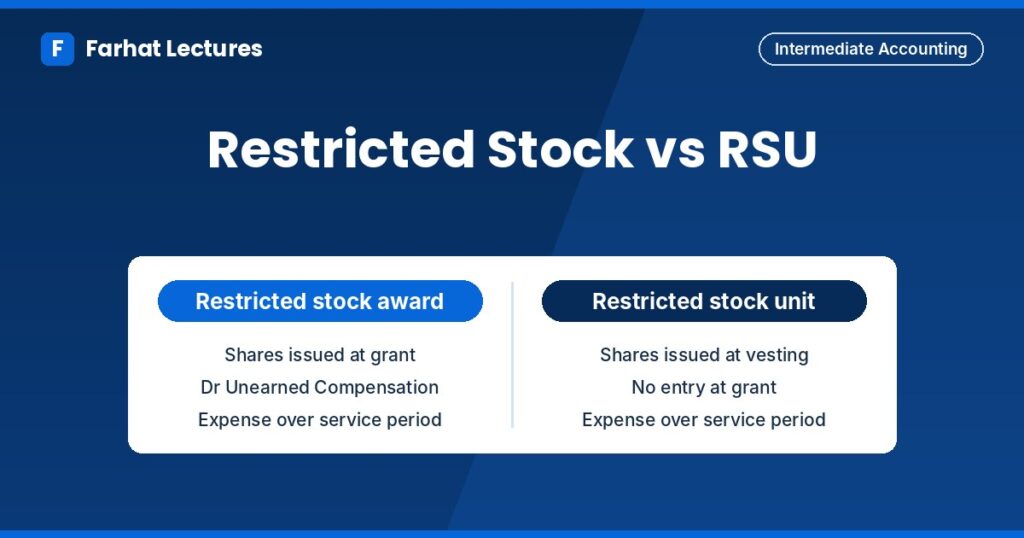
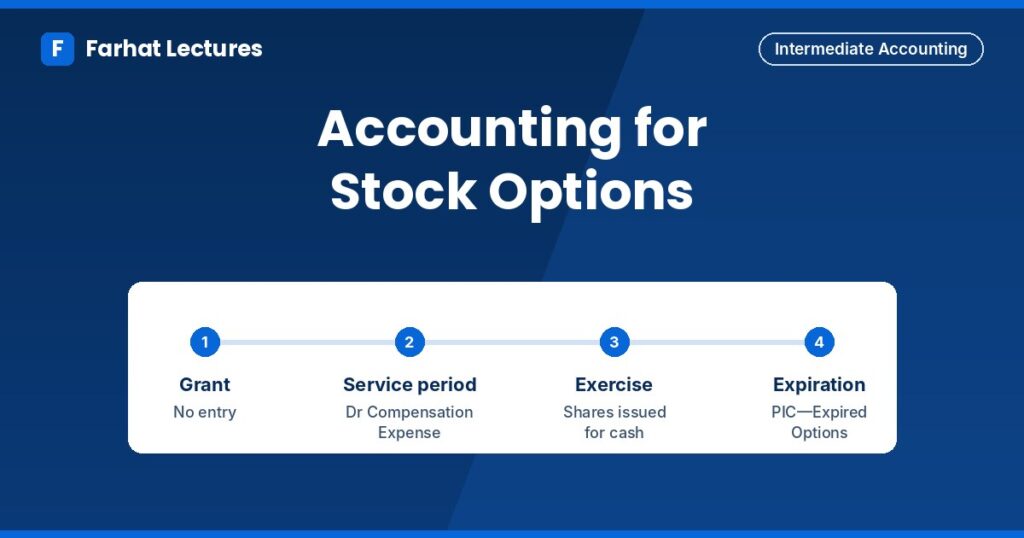
- When is it expensed? Spread the total over the periods in which employees perform the service. When options or RSUs are granted before the employee performs the required service, there is no compensation expense entry at grant. If an award is fully vested at grant and the service period begins on that date, recognize the cost immediately. Some textbooks record a restricted stock award at the grant date with a contra-equity account called Unearned Compensation, but that entry nets to zero in total equity and records no expense.
Here is the whole process in four steps:
- Classify the award based on its terms. Many share-settled awards qualify as equity. Cash-settled awards and some share-settled awards, such as an award payable in a variable number of shares worth a fixed dollar amount, are liabilities.
- For an equity-classified award, measure the cost using the number of awards × grant-date fair value per award, subject to the applicable vesting and forfeiture rules. For a liability-classified award, update the measurement at each reporting date through settlement.
- Identify the service period, which is usually the vesting period.
- Each period, recognize the applicable compensation cost, applying the company’s forfeiture policy. For compensation charged to expense, debit Compensation Expense and credit Paid-in Capital for an equity award or the share-based compensation liability for a liability award. A downward liability remeasurement can reduce compensation expense.
Key dates and terms
| Term | Meaning |
|---|---|
| Grant date | The date the company awards the options or shares. Total cost is measured here. |
| Service period | The time over which employees earn the award; usually the vesting period. |
| Vesting date | The date employees have earned the award and can keep it, even if they leave. |
| Exercise price | For stock options, the fixed price per share the employee pays to buy stock. |
| Expiration date | The last day options can be exercised. Unused options lapse after it. |
| Forfeiture | The employee leaves before vesting and loses the award. |
What are the main types of stock compensation plans?
Intermediate accounting covers three main plan types. The table shows how they differ before you study each one in detail.
| Feature | Stock options | Restricted stock (awards and units) | Employee stock purchase plan (ESPP) |
|---|---|---|---|
| What the employee gets | The right to buy shares at a fixed exercise price for a set period | Shares (or units that become shares) that cannot be sold until vesting | The chance to buy shares at a discount for a short window |
| Does the employee pay? | Yes, the exercise price when exercising | No; the employee earns the shares by staying (or performing) | Yes, the discounted purchase price |
| How cost is measured | Fair value of the options at grant date (option-pricing model) | Fair value of the shares at grant date | Only if compensatory: the discount for a simple plan, or an option-pricing fair value if the plan has a look-back |
| Can it become worthless? | Yes, if the stock price stays below the exercise price | Rarely; the shares keep value unless the stock price falls to zero | Not applicable |
| Learn the entries | Stock option journal entries | Restricted stock vs RSU | This guide (below) |
Example: measuring and allocating the cost
Hypothetical facts: On January 1, 2027, Lakeview Corporation grants its managers 4,000 stock options. The exercise price equals the $25 market price that day. An option-pricing model values each option at $6, and the managers must work 3 years before the options vest. To keep the math simple, assume no managers leave, so no options are forfeited.
| Step | Calculation | Result |
|---|---|---|
| Total compensation cost (grant date) | 4,000 options × $6 | $24,000 |
| Expense each year | $24,000 ÷ 3 years | $8,000 |
| Entry on January 1, 2027 | No entry on the grant date | $0 |
Each December 31 from 2027 to 2029, Lakeview debits Compensation Expense $8,000 and credits Paid-in Capital – Stock Options $8,000. If the stock price jumps to $40 in 2028, nothing changes: the $24,000 was locked in on the grant date. The stock options lesson continues this pattern through exercise and expiration.
When is an employee stock purchase plan compensatory?
An employee stock purchase plan (ESPP) lets employees buy company stock at a discount for a short time. Companies use ESPPs to raise equity capital or to spread ownership among employees. An ESPP is compensatory (it creates compensation expense) unless it meets all three of these conditions:
- Broad participation: substantially all employees who meet limited employment qualifications (for example, full-time status) may participate on an equitable basis.
- Small discount: the discount is no more than the per-share costs the company avoids by not raising cash in a public offering. A discount of 5% or less meets this test without further support.
- No option features: for example, no “look-back” that lets employees pay the lower of two prices.
Under ASC 718-50, a discount above 5% that the company cannot justify makes the entire discount compensation cost, not just the part above 5% (Deloitte summary of ASC 718-50-25-1). Companies recognize compensation cost for compensatory plans over the employees’ service period. For a plan with a look-back, the option feature also contributes to the award’s fair value.
ESPP example: 5% vs. 15% discount
| Plan (hypothetical) | Open to all full-time staff? | Option features? | Discount | Result |
|---|---|---|---|---|
| Plan A | Yes | No | 5% | Noncompensatory: no expense |
| Plan B | Yes | No | 15% | Compensatory: the 15% discount cannot be justified, so the full discount is compensation cost |
Assume Plan B cannot justify its 15% discount under ASC 718-50. In this simplified fixed-discount example, use $50 as the share price for measurement. Employees buy 2,000 shares for $42.50 each, a $7.50 discount per share. The compensation cost is 2,000 × $7.50 = $15,000. Many companies once offered 15% discounts; to avoid expense, some cut the discount to 5%, which tends to lower participation.
Fair value vs. intrinsic value: why the rule changed
Until FASB Statement No. 123(R) was issued in 2004, companies could use the intrinsic value method from APB Opinion No. 25 and simply disclose fair value in the notes, and most did. It measured compensation as the market price minus the exercise price on the grant date. Because most options are granted with an exercise price equal to the market price, the intrinsic value was usually zero, so options created no expense.
Options clearly have value, though: if the price rises, employees can earn large gains. That is why GAAP now requires fair value. Many companies, especially smaller technology firms, opposed the change because it added a large expense, but the FASB concluded that leaving the cost out made reported income biased.
| Intrinsic value method (former) | Fair value method (current GAAP) | |
|---|---|---|
| Measures | Market price − exercise price at grant | Value of the option, including time value, from a pricing model |
| Typical expense for at-the-money options | Zero | Positive amount |
| Lakeview example | ($25 − $25) × 4,000 = $0 | $6 × 4,000 = $24,000 |
Trends: restricted stock and performance vesting
Once options had to be expensed, many companies shifted toward restricted stock, and especially restricted stock units (RSUs). Restricted stock keeps value as long as the share price stays above zero, usually means fewer shares and less dilution (a smaller increase in the share count) than an equivalent option grant, and makes employees think like long-term stockholders. The restricted stock vs RSU lesson explains why units have become more common than awards.
Companies have also leaned on time-based vesting, where employees vest just by staying employed. Vesting tied to targets is becoming more popular because it links pay to long-term goals. Watch the wording here, because ASC 718 treats two kinds of targets differently. A performance condition is tied to the company’s own operations, such as earnings, cash flow, or environmental, social, and governance (ESG) results. The company records expense only if it is probable the target will be met. A market condition is tied to the stock price, such as total stockholder return (TSR). It is built into the grant-date fair value, and the expense is recorded as long as employees provide the service, even if the target is missed.
Equity vs. liability awards and tax effects
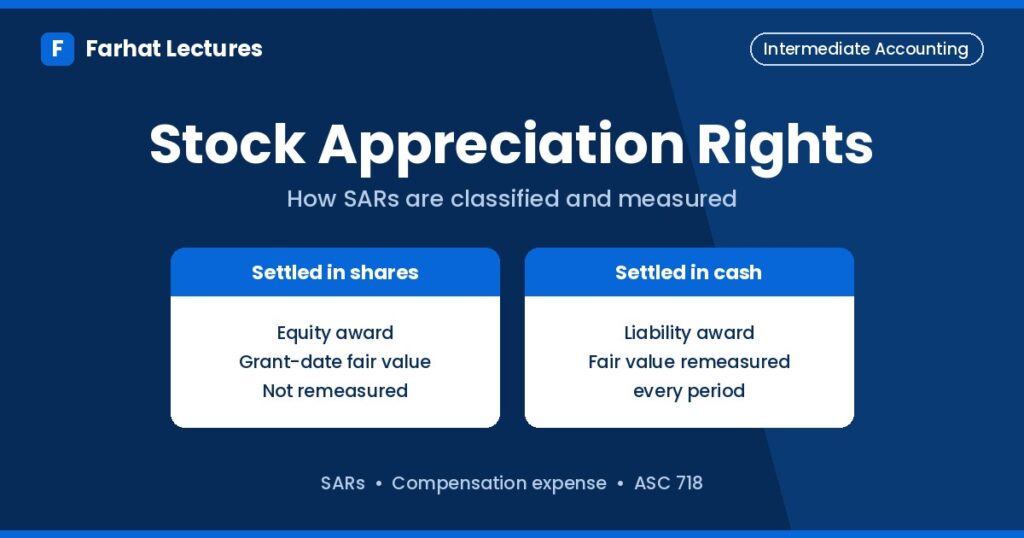
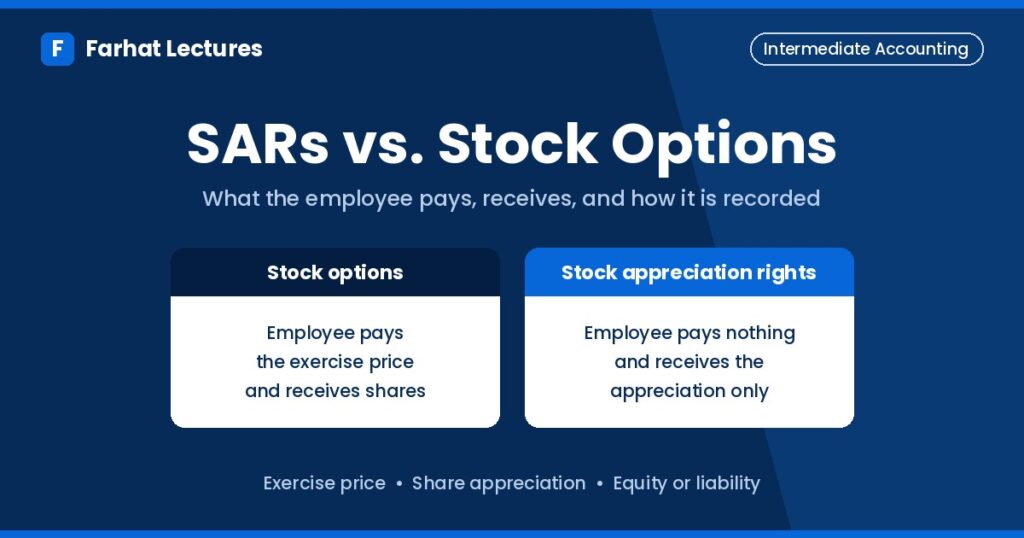
Many share-settled options and RSUs qualify as equity awards. Their grant-date fair value stays fixed in the absence of a modification. Classification depends on the award’s terms. Cash-settled awards are liability awards, as are certain share-settled awards. A common example is a cash-settled stock appreciation right (SAR), which pays the employee the increase in the stock price above a set base price.
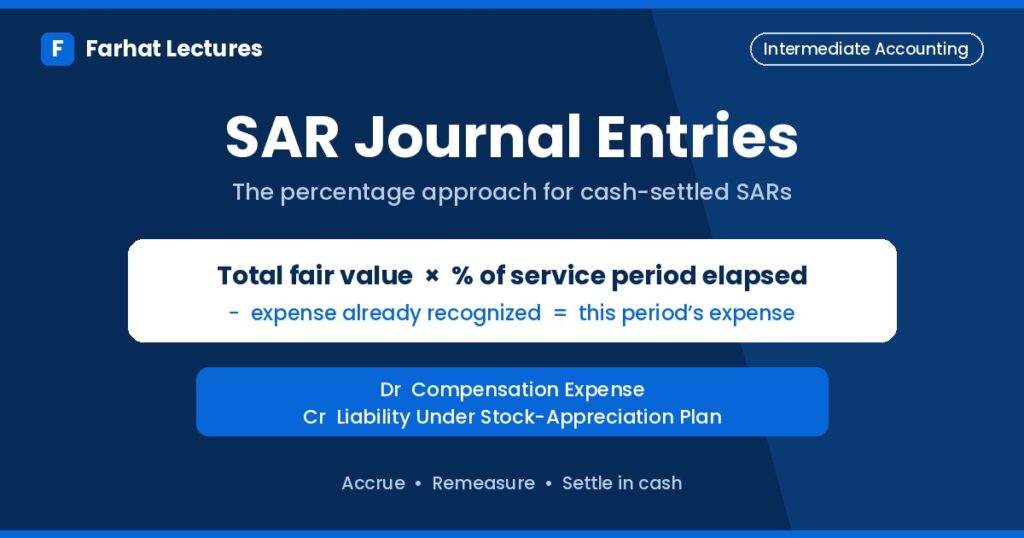
For a liability award, the company remeasures the liability at fair value at each reporting date until it is settled (nonpublic companies may elect intrinsic value instead). That means the expense rises and falls with the stock price, unlike an equity award.
Taxes add one more layer. For awards that will be tax deductible, such as nonqualified stock options and RSUs, the company records a deferred tax asset (a future tax saving shown on the balance sheet) as it books the expense. The tax deduction generally arises at exercise or vesting, depending on the award. When the tax deduction is determined, the company compares the actual tax benefit from that deduction with the related deferred tax asset. Under ASU 2016-09, it recognizes any excess as an income tax benefit and any shortfall as income tax expense.
Incentive stock options (ISOs) generally give the company no tax deduction, so no deferred tax asset is recorded for them. If an employee sells ISO shares too early (a disqualifying disposition), the company records the tax benefit at that point.
What must companies disclose about stock compensation?
A company with share-based payment plans must disclose enough for readers to understand:
- The nature and terms of the plans in place during the period and their potential effect on stockholders.
- The compensation cost from these plans on the income statement.
- How the company estimated the fair value of the awards granted.
- The cash flow effects of the plans.
Stock options and unvested units are potential common shares, so they can increase the share count used for diluted earnings per share through the treasury stock method.
Common mistakes
- Recording compensation expense before the required service is performed. For an equity-classified option or RSU with future service requirements, measure fair value at grant and recognize cost over the service period.
- Remeasuring an equity-classified award solely because the stock price changes. The grant-date fair value stays fixed.
- Using intrinsic value for options. Current GAAP uses fair value, which is usually more than zero even when intrinsic value is zero.
- Applying the 5% discount test on its own. Check all three conditions. If a simple plan is compensatory because its discount cannot be justified, include the full discount. For a look-back plan, include the value of the option feature when measuring the award.
- Expensing everything in the grant year when service spans several years. Spread the cost across the service period. Straight-line is the usual textbook method. When an award vests in installments (graded vesting) and has only a service condition, the company may use straight-line or a faster, tranche-by-tranche method.
Key takeaways
- Under ASC 718, equity-classified awards are generally measured at grant-date fair value, with compensation cost recognized over the requisite service period.
- For equity-classified awards, later stock price changes do not change grant-date fair value. Liability-classified awards, such as cash-settled SARs, are remeasured each reporting period until settlement.
- Stock options are valued with an option-pricing model such as Black-Scholes. Restricted stock and RSUs are valued at the share price on the grant date.
- An ESPP creates no expense only if it is broadly available, has a small discount (5% or less is automatically acceptable), and has no option features.
- If an ESPP discount above 5% cannot be justified, the entire discount is compensation cost.
Ready to practice the full journal entries? Work through accounting for stock options and restricted stock vs RSU accounting next.
Practice questions with answers
1. A company grants 10,000 options with a grant-date fair value of $3 each and a 4-year service period. The exercise price equals the $25 market price. What is the annual compensation expense?
Answer: $7,500 per year. Total cost is 10,000 × $3 = $30,000, spread over 4 years. The fact that intrinsic value is zero ($25 − $25) does not matter under the fair value method.
2. An ESPP lets substantially all full-time employees buy shares at a 5% discount, with no look-back or other option feature. Should the company record compensation expense?
Answer: No. The plan meets all three conditions, and a 5% discount is accepted without further justification, so the plan is noncompensatory.
3. In question 1, the stock price rises to $40 during year 2. How does that change the year 2 expense?
Answer: It does not. Total compensation cost was fixed at the grant date, so the company still records $7,500. The higher price only makes the options more valuable to employees.
Stock-Based Compensation and Cash Compensation Practice
Salary and cash bonuses typically reward near-term performance, while stock-based compensation can align employees with the company’s long-term results. Evaluate performance incentives, retention, recruitment, and after-tax outcomes. Select the best answer for each of the five questions.
Frequently asked questions
Is stock-based compensation a cash expense?
No. For awards settled in shares, the company debits Compensation Expense and credits a paid-in capital account, so no cash leaves the business. It still reduces net income because employees are being paid with something of value.
Which accounting standard covers stock-based compensation?
In U.S. GAAP, the rules are in FASB Accounting Standards Codification Topic 718, Compensation—Stock Compensation (ASC 718). Companies reporting under IFRS follow IFRS 2, Share-based Payment.
Why is the expense measured on the grant date and not later?
The grant date is when the company and employee agree on the award. GAAP fixes the cost at that date, so later rises or falls in the stock price do not change the total expense for an equity-settled award.
What is the difference between the vesting period and the service period?
The service period is the time over which employees earn the award. Unless the plan says otherwise, it equals the vesting period: the time between the grant date and the date the award vests.
Do all employee stock purchase plans create compensation expense?
No. A plan is noncompensatory, with no expense, only if substantially all full-time employees can join on an equal basis, the discount is small (5% or less is accepted without further support), and the plan has no option features. Otherwise the plan is compensatory.
How do forfeitures affect stock-based compensation expense?
The company picks a policy. It can estimate how many awards will be forfeited and adjust as people leave, or it can reverse the expense already recorded when an employee leaves before vesting. For awards with only a service condition, total expense ends up equal to the grant-date fair value of the awards that actually vest.
How are stock appreciation rights (SARs) accounted for?
It depends on how they are settled. SARs settled in shares are equity awards, measured once at grant-date fair value like stock options. SARs settled in cash are liability awards. The company remeasures the liability at each reporting date until settlement, so the expense rises and falls with the stock price.
How does IFRS 2 differ from ASC 718?
Both generally measure employee equity-classified awards at grant-date fair value. IFRS 2 requires companies to estimate forfeitures related to service conditions and account for each installment of a graded-vesting award separately. IAS 12 governs deferred tax. If the expected tax deduction depends on the share price, estimate the deduction using the share price at each reporting date. For share options, this generally means using current intrinsic value.
Sources
- FASB Accounting Standards Codification, Topic 718: Compensation—Stock Compensation
- Deloitte DART: Noncompensatory employee stock purchase plans (ASC 718-50)
- SEC Staff Accounting Bulletin Topic 14: Share-Based Payment (Deloitte DART)
- RSM: A guide for accounting for stock compensation
About the author: Mansour Farhat, CPA, CIA, DBA, is the instructor behind Farhat Lectures, where he teaches accounting courses and CPA, CMA, and EA exam review. Learn more about Professor Farhat.
Continue learning with Farhat Lectures
Strengthen your accounting understanding with clear explanations and guided practice.
Want the whole chapter? The Intermediate Accounting course covers dilutive securities and stock compensation from start to finish, with video lessons and practice.
Responses