
CPA Exam Preparation in College: 5 Habits and a Timeline


CPA exam preparation in college means mastering your accounting courses with exam-style practice, then timing your first exam section while the material is still fresh. Learn each concept well enough to explain it, practice questions before looking at solutions, and check your state board of accountancy’s rules early. Eligibility depends on your jurisdiction’s education and application requirements.
Undergraduate courses introduce the transactions, financial statements, tax rules, and audit decisions that you will revisit during CPA review. Learning why an answer is correct gives you a foundation for applying the same principle when the facts change.
You do not need to complete an entire CPA review program during your first accounting course. Start by mastering your coursework, practicing independently, and retaining what you learn. This guide explains which subjects to prioritize, how to build a practical study routine, when you may be able to sit for the exam, and how Farhat Lectures can support that process.
Why CPA exam preparation in college starts with coursework
Accounting courses build on one another. Adjusting entries support financial statement preparation. Financial reporting knowledge helps you understand what auditors examine. Knowing how book income works (the profit reported in the financial statements) also makes it easier to spot where tax rules treat the same transaction differently.
A strong college foundation can make later review more productive, but a degree alone does not establish exam readiness. You will still need to study the applicable exam content, practice multiple-choice questions and task-based simulations (case-style problems where you work with documents, data, and calculations), and address gaps in your understanding.
Think of each college assignment as an opportunity to develop three skills: identify the relevant rule, apply it to the facts, and explain the result. These habits are more useful than memorizing the steps in one familiar solution.
Connect your college courses to CPA Exam content
The U.S. CPA Exam requires three Core sections: Auditing and Attestation (AUD), Financial Accounting and Reporting (FAR), and Taxation and Regulation (REG). Candidates also select one Discipline: Business Analysis and Reporting (BAR), Information Systems and Controls (ISC), or Tax Compliance and Planning (TCP).
In other words, every candidate passes four sections in total: all three Core sections plus the one Discipline section they choose. Pick your Discipline based on the work that interests you most, whether that is financial reporting and analysis (BAR), technology and controls (ISC), or tax (TCP).
The following connections can help you organize your learning. They are a study guide, not a statement that a college course covers every exam requirement. Check the AICPA CPA Exam Blueprints applicable to your planned testing date. For testing in 2027, review the Blueprints effective January 1, 2027; for later dates, check for subsequent updates. Our overview of CPA Exam changes in 2027 covers key dates for that year.
On a narrow screen, swipe across the table to view all three columns.
| College subject | Foundation to develop | CPA connection |
|---|---|---|
| Financial and intermediate accounting | Adjusting entries, assets, liabilities, equity, and financial statements | A foundation for FAR and for understanding financial reporting in other sections |
| Auditing | Risk assessment, internal controls, evidence, and audit reports | Core concepts used in AUD |
| Taxation and business law | Tax compliance, business transactions, and legal responsibilities | REG foundations; additional tax study supports TCP |
| Managerial and cost accounting | Cost behavior, budgeting, performance measures, and business analysis | Foundations for the business analysis area of BAR, which also tests advanced financial reporting and state and local government accounting |
| Advanced and governmental accounting | Business combinations, consolidations, and state and local government accounting | Extends FAR topics and supports the technical accounting and state and local government areas of BAR |
| Accounting information systems | Transaction processing, data, technology risks, and controls | Supports ISC and the understanding of controls in AUD |
Use your syllabus to select supplemental lessons. For financial reporting topics, explore the Farhat Lectures Intermediate Accounting course. For risk, evidence, and reporting, use the Auditing course. Taking tax, managerial, cost, advanced, or governmental accounting? Try the Individual Income Tax course, the Managerial Accounting course, the Cost Accounting course, the Advanced Accounting course, or the Governmental and Not-for-Profit Accounting course. Choose the topic that addresses your current difficulty rather than watching unrelated lessons.
Five study habits that build CPA exam skills
1. Explain the reason behind each answer
After solving a problem, explain the accounting treatment in your own words. Why is an amount an asset or an expense? Why does an auditor select that procedure? If your explanation depends entirely on remembering the example, revisit the underlying concept.
2. Attempt problems before viewing the solution
Work through the facts, calculations, and journal entries independently. Then compare your reasoning with the explanation. Following a completed solution can feel familiar even when you would struggle to reproduce it on your own.
3. Keep a short error log
For each important mistake, record the topic, the reason for the error, and the rule you need to apply next time. Distinguish a conceptual misunderstanding from an arithmetic error or a missed fact. This makes your next study session more focused.
4. Revisit earlier topics regularly
Include a few questions from previous chapters alongside your current assignment. Return to a difficult topic after a delay and try a different question. Use short notes or flashcards for reminders, then check understanding through application.
5. Ask focused questions and connect subjects
Bring the specific step you cannot explain to your professor, study group, or supplemental lesson. Connect the answer to other courses. For example, recognizing revenue in financial accounting and evaluating evidence about revenue in auditing involve different tasks, but both require understanding the underlying transaction.
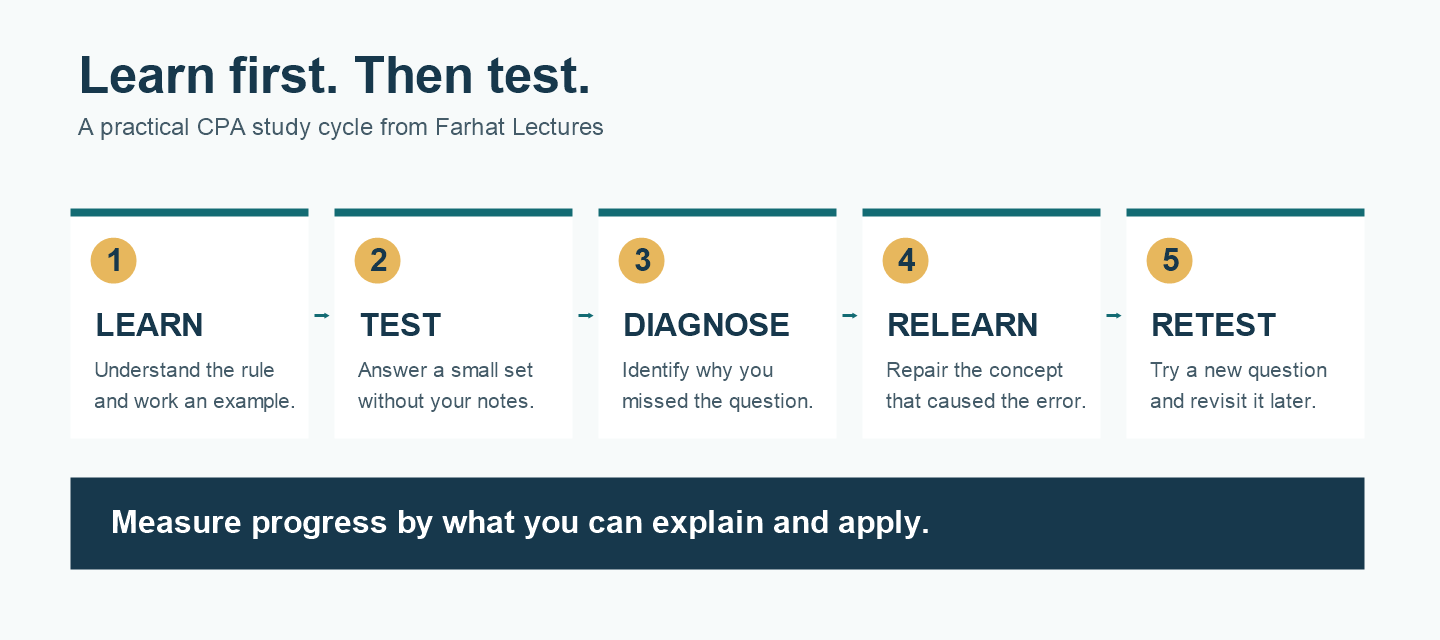
Watch Professor Farhat explain a practical study method
In Farhat Lectures: 4 Steps to Study Smarter for the CPA Exam, Professor Farhat explains how to learn, review, practice, and retain material. The demonstration uses a CPA review course, but college students can apply the same sequence to their lectures, textbook chapters, and assignments.
Start with 1:47: Learn with Farhat Lectures for the foundation-building discussion. The chapters at 12:45: Practice MCQs and simulations and 13:48: Retain what you learn explain the later stages of the process. Finish with 14:47: Common CPA study mistakes and next steps for a look at common study mistakes to avoid.
Example: understand an adjusting entry instead of memorizing it
Assume a company with a December 31 year-end pays $1,200 on October 1 for insurance covering the next 12 months. It records the payment as Prepaid Insurance and makes its adjusting entries once a year, at year-end. At December 31, three months of coverage (October, November, and December) have expired.
- Monthly cost: $1,200 ÷ 12 = $100.
- Insurance expense: $100 × 3 months = $300.
- Remaining prepaid insurance: $1,200 − $300 = $900.
- December 31 adjusting entry: debit Insurance Expense $300; credit Prepaid Insurance $300.
The adjustment recognizes the coverage used during the period and leaves the unused coverage as an asset. Now change the reporting date or policy amount and solve the problem again. Being able to adapt the calculation demonstrates understanding beyond memorizing a single entry.
Exam trap: Watch for how often the company adjusts its books. If it made adjusting entries every month instead, October and November would already be recorded, so the December 31 entry would be only $100 (one month). The ending Prepaid Insurance balance would still be $900.
Build a manageable weekly study routine
Fit CPA prep around your existing coursework using this weekly sequence. Adjust its length to your assignments and the difficulty of the topic; it is a suggested routine, not a required number of study hours.
- Before class: preview the learning objectives and identify unfamiliar terms.
- After class: explain the main concept and attempt an assigned problem without the solution.
- During a follow-up session: review errors, use a targeted supplemental lesson, and solve a new problem.
- At the end of the week: revisit earlier material and identify the next concept that needs attention.
Measure progress by what you can explain and apply independently. Time spent watching videos is useful only when it leads to stronger understanding and problem-solving. When you move into full CPA review later, our guide on how many hours to study for the CPA exam can help you set a realistic total.
A simple college-to-CPA timeline
Every program is different, so treat this as a starting point.
First and second year: Build the base. Focus on debits and credits, adjusting entries, financial statements, and managerial accounting. Start your error log now so the habit is in place before harder courses arrive.
Third year: Intermediate accounting, tax, and auditing often show up here. Use the course table above to see which CPA section each class supports, and mix a few exam-style questions into your regular homework.
Final year: Confirm when you will be eligible to sit (see the next section), pick a first section that matches a course you just finished, and try exam-style practice such as the Farhat Lectures CPA Test Bank to find your gaps before focused review.
Can you take the CPA Exam while still in college?
Some students can qualify before graduation, but your jurisdiction determines the required semester hours, accounting and business courses, degree status, and application timing. Reaching 120 semester hours alone does not establish eligibility. Use NASBA’s jurisdiction directory to find the requirements for the board where you intend to apply.
Requirements and scheduling reviewed October 30, 2026. Check these three items before planning your first section:
- Exam-credit window: Your board sets how long passing scores remain valid. Check both the allowed period and its starting point: jurisdictions may calculate it from the examination date or the score-release date. For example, Nevada’s instructions use the examination date for its 30-month period, while Florida’s guidance uses the NASBA grade-release date. Follow the expiration dates assigned to your credits.
- Testing dates: In 2026, Core sections are available throughout the year, subject to appointments, and Discipline sections are offered in January, April, July, and October. The announced 2027 platform transition includes a July 1–11 testing pause and a July 12–August 12 Discipline window. Consult the AICPA testing and score-release schedule for your testing year; dates may change.
- Exam eligibility versus licensure: Qualifying to sit and qualifying for a license are separate decisions. The 2025 Uniform Accountancy Act model added a pathway combining a bachelor’s degree with an accounting concentration, two years of qualifying experience, and passage of the CPA Exam. It becomes available only after a jurisdiction adopts the necessary law or rules. Review NASBA’s licensure-pathway updates and your board’s effective requirements before choosing additional coursework.
For application steps, scheduling, and credit questions, see the NASBA CPA Exam FAQ.
What to do before graduation
- Review your academic plan. Discuss accounting and business coursework with your adviser and check the requirements of the jurisdiction where you intend to apply.
- Separate exam eligibility from licensure. Permission to sit for the exam and qualification for a CPA license are different milestones. Do not assume that completing a particular degree satisfies every requirement.
- Identify knowledge gaps. Review representative problems from financial accounting, auditing, and taxation before selecting your first exam section.
- Plan around your schedule. Consider graduation, work, internships, and other commitments when deciding when to begin focused review. Budget for fees too; our guide to CPA exam cost in 2026 breaks down what you will pay.
- Choose an informed exam sequence. Read Professor Farhat’s discussion of which CPA exam to take first, then consider your own coursework and readiness. If FAR is on your list, see why many candidates call it the hardest CPA exam section.
Key takeaways
- Treat every accounting course as CPA prep: identify the rule, apply it to the facts, and explain the result.
- Use the course table to connect each class to a CPA section, and check the Blueprints for the year you plan to test.
- Attempt problems before viewing solutions, keep a short error log, and revisit earlier topics every week.
- Check your jurisdiction’s education and application rules early, including whether you may sit before graduation.
- Plan around your assigned credit-expiration dates and the official testing schedule for your exam year.
Frequently asked questions
When should I begin CPA exam preparation in college?
Build strong study habits from your first accounting course. Begin focused exam review when your eligibility date and available study time support a realistic testing plan.
Are undergraduate accounting courses enough to pass the CPA Exam?
Coursework provides a foundation. Compare your skills with the applicable Blueprints and test yourself with exam-style questions and simulations. Read more about CPA Exam difficulty and preparation.
Can Farhat Lectures help while I am still in college?
Yes. Use Accounting Help for Students to find supplemental explanations and practice that match your syllabus.
Should I memorize accounting rules?
Learn essential rules and terminology, then practice explaining when they apply and how changing the facts changes the answer.
Can I take the CPA Exam before I graduate?
Possibly. Your jurisdiction’s education and application rules determine eligibility. Follow the official links in the eligibility and timing section.
Which CPA Exam section should I take first?
Consider your recent coursework, readiness, and testing schedule. Professor Farhat’s exam-sequence guide explains his reasons for recommending FAR first to many candidates.
How long do I have to pass all four sections?
Your jurisdiction determines the credit period and starting date. Use the expiration dates assigned to your passing scores when scheduling the remaining sections.
Do I need 150 credit hours to become a CPA?
Not in every jurisdiction. Alternative pathways have different education, experience, and effective-date requirements. Check NASBA’s pathway directory and your board’s current rules.
Strengthen your accounting foundation with Farhat Lectures
Strong CPA preparation comes from steady work on the material in front of you. Select one topic you cannot yet explain, review a focused lesson, and solve a new problem independently.
Explore the Farhat Lectures free sample course to try lessons and practice resources. Still taking accounting classes? Visit Accounting Help for Students to find lessons that match your syllabus, or browse Farhat Lectures accounting and CPA courses to find support for your current coursework.
About the author
Professor Mansour Farhat, DBA, CPA, CIA is an accounting educator and the founder of Farhat Lectures. He creates step-by-step video lessons, worked examples, and practice for college accounting courses and the CPA Exam, built to work alongside major CPA review courses.


Responses