
Impracticable Retrospective Application: When It Applies and What Does Not Qualify

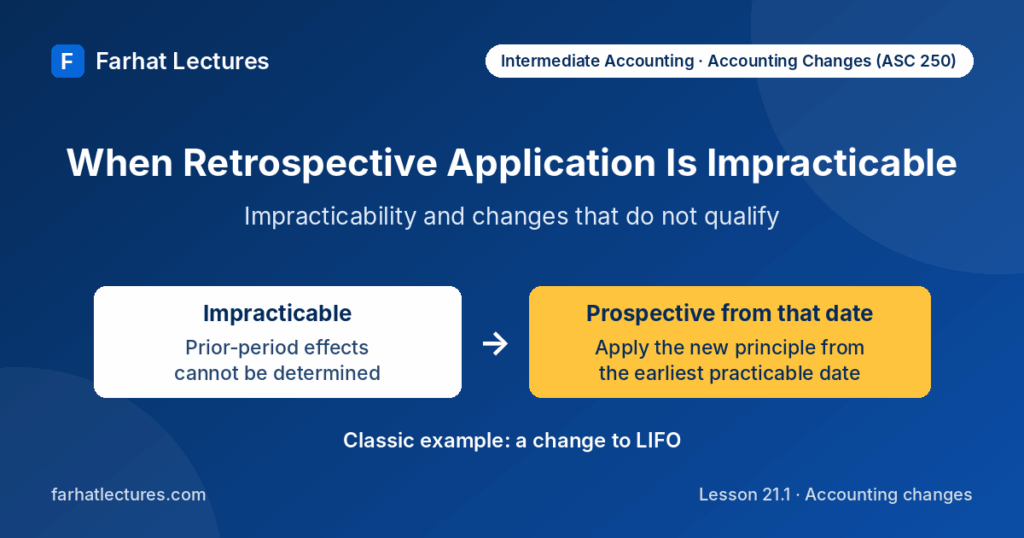
Impracticable retrospective application is the FASB ASC 250 exception that applies when a company cannot apply a new accounting principle to prior periods, even after every reasonable effort. The company then applies the change from the earliest period practicable, or prospectively if even the cumulative effect cannot be determined. A switch to LIFO is the classic example.
Retrospective application is the default for a change in accounting principle, but it is not always possible. Old records may not exist, or the numbers may depend on estimates nobody could have made at the time. Knowing the impracticability exception, and the related list of changes that do not count as a change in principle at all, keeps you from applying the wrong method on an exam.
For the default method and the three reporting approaches, see retrospective vs. prospective application.
For the big picture of changes in principle, changes in estimate, and error corrections, see our ASC 250 guide to accounting changes and error corrections.
Watch Professor Farhat: the video starts at 1:18, where he covers error corrections and first-time transactions, which do not count as a change in principle. The rest of the video works through a full retrospective application example.
Watch “Change in Accounting Principle: Retrospective Example | ASC 250” on YouTube
When is retrospective application impracticable?
ASC 250 sets a high bar. “Too expensive” or “inconvenient” is not enough. Retrospective application is impracticable only if at least one of these conditions exists:
- The effects cannot be determined. After making every reasonable effort, the company still cannot work out the effects of retrospective application.
- It requires guessing management’s past intent. Applying the change would require assumptions about what management intended in a prior period, and those assumptions cannot be independently substantiated.
- It requires significant estimates that cannot be objectively verified. The company would need significant estimates for the prior period. It also cannot objectively separate information that existed back then (and would have been available when those statements were issued) from information learned later.
The third condition prevents hindsight. A company cannot use what it knows today to produce estimates that look as if they were made years ago.
What to do when retrospective application is impracticable
The treatment of an impracticable retrospective application depends on how much the company can still determine:
| Situation | Treatment |
|---|---|
| Effects on every prior period can be determined | Full retrospective application (the normal rule) |
| Cumulative effect can be determined, but not the effects on individual prior periods | Apply the new principle to balances at the start of the earliest period for which it is practicable, and adjust opening retained earnings (or another appropriate component of equity) of that period |
| Even the cumulative effect cannot be determined | Apply the new principle prospectively from the earliest date practicable |
In every case, the company discloses the reasons retrospective application was impracticable and describes the alternative method it used to report the change, such as the date it started applying the new principle.
Example: a change from FIFO to LIFO
Hypothetical example. Harbor Company has used FIFO since it began. Effective January 1, 2027, it changes to LIFO. Harbor never tracked LIFO layers, so it cannot determine what LIFO inventory would have been in prior years. Retrospective application is impracticable.
- No adjusting entry and no recast. Prior-year statements stay on FIFO, and retained earnings is not adjusted.
- Opening inventory becomes the LIFO base layer. Harbor’s December 31, 2026 FIFO inventory of $84,000 becomes its January 1, 2027 LIFO base-year layer. LIFO applies to purchases and sales from that date.
- Disclosure. Harbor explains why it omitted the cumulative effect for prior years and why LIFO is preferable. It also discloses the effect of the change on 2027 results. If 2027 net income is $7,500 lower than it would have been under FIFO, that is the amount reported.
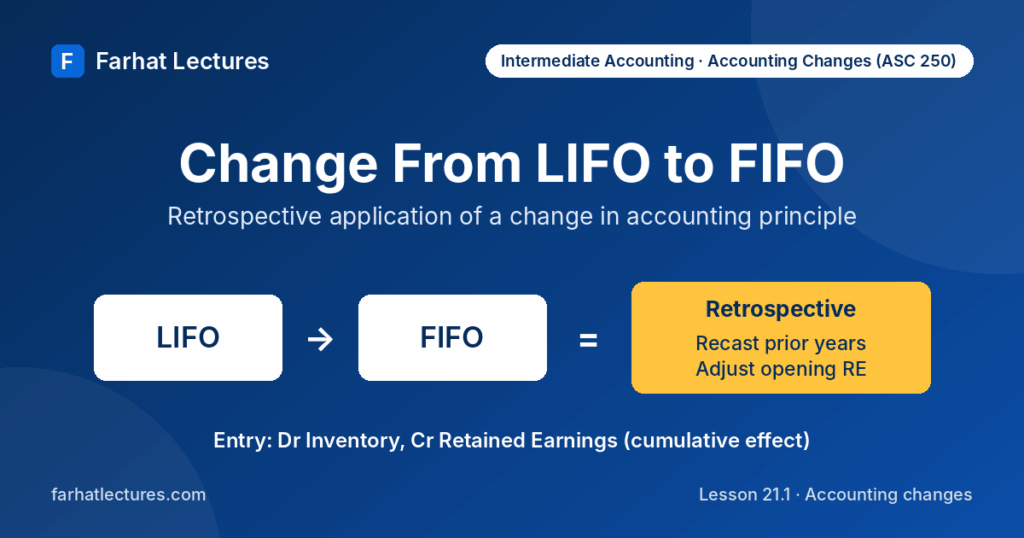
Compare this with the opposite switch in the change from LIFO to FIFO example, where FIFO costs can be rebuilt and the change is fully retrospective.
New to LIFO layers? Review FIFO vs LIFO and the LIFO reserve lesson first.
Example: cumulative effect known, prior years unknown
Hypothetical example. Coastline Corp. presents comparative financial statements for 2026 and 2027. Effective January 1, 2027, it changes its inventory method from average cost to FIFO.
Coastline can rebuild FIFO costs for the inventory on hand at January 1, 2027, using recent purchase invoices. It cannot rebuild FIFO cost of goods sold for 2026, because its older records are incomplete. So the cumulative effect is known, but the effect on 2026 is not.
| Item | Amount |
|---|---|
| Inventory at January 1, 2027, average cost | $138,000 |
| Inventory at January 1, 2027, FIFO | $150,000 |
| Cumulative effect ($150,000 minus $138,000) | $12,000 increase |
Ignoring income taxes to keep it simple, Coastline records this entry as of January 1, 2027:
| Account | Debit | Credit |
|---|---|---|
| Inventory | 12,000 | |
| Retained earnings | 12,000 |
Here is what that means:
- The 2026 comparative statements stay on average cost. Nothing is recast.
- Opening retained earnings for 2027 goes up by $12,000.
- FIFO applies to all 2027 purchases and sales.
- Coastline discloses why 2026 could not be adjusted and describes the method it used to report the change.
In practice, Coastline would also record the related income tax effect, so the retained earnings adjustment would be net of tax.
Changes that are not a change in accounting principle
Some changes look like a new method but are not a change in accounting principle at all. ASC 250 lists two, and error corrections are a third trap:
1. First-time or previously immaterial events
Adopting a principle for transactions that are happening for the first time, or that were immaterial before, is not a change. For example, a company might start using FIFO for a newly acquired product line while older inventory stays on another method. That is not a change in principle. The same goes for costs that were immaterial and expensed but have now grown large enough to capitalize and amortize.
2. Transactions that are clearly different in substance
Adopting or modifying a principle because new transactions are clearly different in substance from past ones is also not a change in principle.
3. Corrections of errors
Moving from a method that is not generally accepted to one that is counts as an error correction. Two examples: switching from the cash (income tax) basis to the accrual basis, and fixing double-declining-balance depreciation that wrongly deducted salvage value. Errors are corrected through restatement, covered in the prior period adjustment lesson.
Quick decision table
| Scenario | Classification | Treatment |
|---|---|---|
| LIFO to FIFO, records available | Change in principle | Retrospective |
| FIFO to LIFO, no LIFO layer history | Change in principle, impracticable | Prospective from the start of the year of change (opening inventory becomes the LIFO base layer) |
| FIFO adopted for a brand-new product line | Not a change in principle | Apply going forward; no disclosure as a change |
| Cash basis to accrual basis | Error correction | Restatement |
| Revised useful life of equipment | Change in estimate | Prospective (see change in estimate) |
| Straight-line to double-declining-balance depreciation | Change in estimate effected by a change in principle | Prospective |
US GAAP vs. IFRS and tax: three exam traps
- US GAAP gives error corrections no impracticability exception. ASC 250 allows the exception only for changes in accounting principle. A material prior-period error must be corrected by restating the prior periods presented. IFRS (IAS 8) allows an impracticability exception for errors too, so read the question carefully to see which framework it uses.
- The FIFO to LIFO example is a US GAAP scenario only. IFRS does not allow LIFO (IAS 2), so an IFRS company cannot make this change at all.
- LIFO has a tax side. A company elects LIFO for federal income tax purposes by filing IRS Form 970 with its return (Internal Revenue Code Section 472). Under the LIFO conformity rule, a company that uses LIFO for tax generally must also use LIFO in its financial reports to owners and creditors.
Common mistakes
- Calling cost or effort “impracticable.” The test requires that effects truly cannot be determined after every reasonable effort.
- Using hindsight to build old estimates. That is exactly what the third condition forbids.
- Skipping disclosure. An impracticable change still needs a note explaining why and how it was applied.
- Treating cash-to-accrual as a change in principle. The cash basis is not GAAP, so the switch is an error correction.
- Assuming error corrections can be impracticable. Under US GAAP, only changes in accounting principle get the impracticability exception. Errors are restated.
Practice questions
1. A company changes from FIFO to LIFO and has no records of historical LIFO layers. How should it report the change?
Show answer
Prospectively from the date of change. Retrospective application is impracticable, so opening inventory becomes the LIFO base layer. The company discloses why it did not compute the cumulative effect and the effect on current-year results.
2. A company can compute the total cumulative effect of a change through the beginning of the current year but cannot split it among the two prior years presented. What should it do?
Show answer
Apply the change as of the beginning of the earliest period for which it is practicable. Here, that means the start of the current year. It adjusts the opening balances and opening retained earnings of that period, and discloses why the earlier periods were not adjusted.
3. A company starts a construction division and uses an over-time revenue method for its first contracts. Is this a change in accounting principle?
Show answer
No. Adopting a principle for transactions occurring for the first time is not a change in accounting principle, so no retrospective application is required.
Frequently asked questions
What does impracticable mean in ASC 250?
Retrospective application is impracticable when, after every reasonable effort, a company cannot determine the effects. It also applies when the change would require unverifiable assumptions about management’s past intent or significant estimates that cannot be objectively separated from hindsight.
Is a change to LIFO applied retrospectively?
Usually not. Companies typically cannot rebuild historical LIFO layers, so the change is applied prospectively, with beginning inventory in the year of change serving as the base layer.
Is high cost a valid reason to skip retrospective application?
No. Cost or effort alone does not make retrospective application impracticable. One of the specific ASC 250 conditions must exist.
Is switching from the cash basis to the accrual basis a change in accounting principle?
No. The cash basis is not generally accepted for financial reporting, so the switch is a correction of an error and is handled by restatement.
What must be disclosed when retrospective application is impracticable?
The company discloses the reasons retrospective application was impracticable and a description of the alternative method it used to report the change. It also gives the other change-in-principle disclosures, such as the nature of the change, why the new principle is preferable, and the effect on current-period income.
Does the impracticability exception apply to error corrections?
Not under US GAAP. ASC 250 allows the exception only for changes in accounting principle, so a material prior-period error is corrected by restating the prior periods presented. IFRS (IAS 8) is different and does allow an impracticability exception for errors.
How is a change in depreciation method reported?
Under ASC 250, a change in depreciation method is a change in accounting estimate effected by a change in accounting principle. It is applied prospectively, so the impracticability question does not come up.
Sources
- Deloitte DART: FASB ASC 250, Accounting Changes and Error Corrections
- Deloitte DART: ASC 250-10-20 Glossary
- Journal of Accountancy: The Change Game (impracticability exception under Statement No. 154)
- PwC Viewpoint: Change in accounting principle (what is not a change in principle)
Written by Mansour Farhat, CPA, CIA, DBA, for accounting students and CPA candidates studying with Farhat Lectures. Read more about Professor Farhat.
Continue learning with Farhat Lectures
Accounting changes are easier when you can watch each step worked out. Start with the free sample course to try our lectures, practice questions, and exam-style exercises at no cost.
Explore the free sample course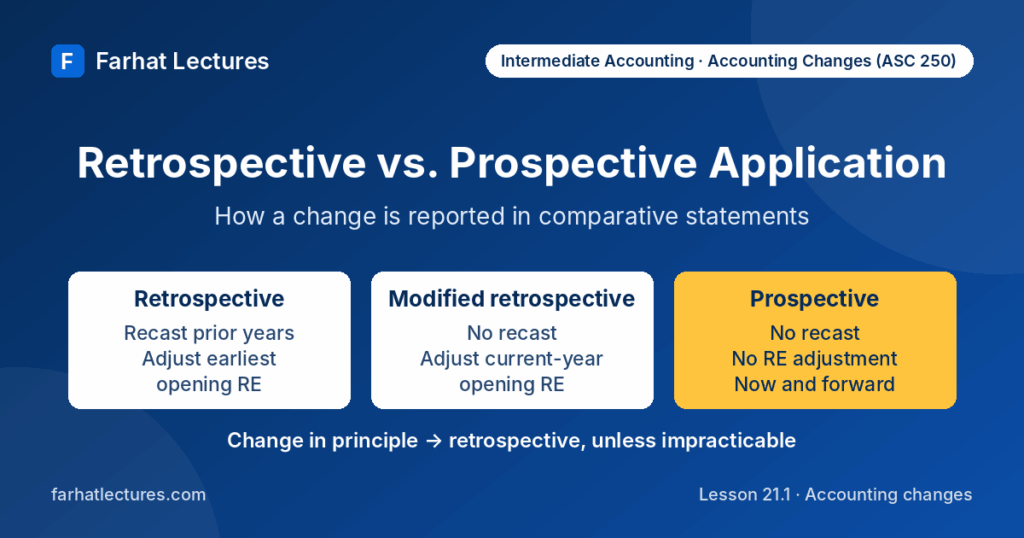


Responses