
Direct and Indirect Effects of a Change in Accounting Principle

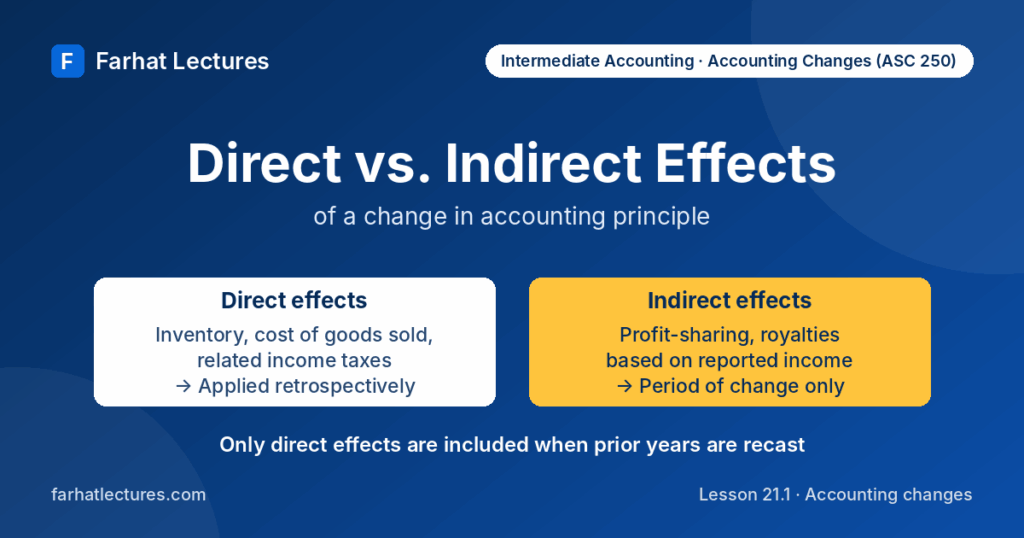
Direct effects of a change in accounting principle are the asset and liability changes needed to apply the new method, like an inventory adjustment and its tax effect. They are recast into prior years. Indirect effects are cash flow changes the switch triggers, like extra profit-sharing payments. Under U.S. GAAP, they are recorded only in the period of change.
This distinction matters whenever a company has contracts tied to reported income or revenue. Bonus plans, profit-sharing plans, and royalty agreements all use reported numbers. When a retrospective change raises prior-year income, students often want to recast those payments too. ASC 250, the FASB’s rules on accounting changes and error corrections, says no.
This lesson defines direct and indirect effects and walks through a hypothetical profit-sharing example. It also lists common traps. If you are new to retrospective application, start with retrospective vs. prospective application, or walk through a full change in accounting principle example with journal entries.
Watch Professor Farhat: for background, this example shows how retrospective application and the cumulative-effect adjustment work. Indirect effects arise only after that step, so it helps to see the mechanics first.
What are direct and indirect effects?
Direct effects
ASC 250 defines direct effects as the recognized changes in assets or liabilities necessary to effect a change in accounting principle. The classic example is the inventory adjustment when a company switches from LIFO (last in, first out) to FIFO (first in, first out). Related changes also count as direct effects. These include deferred income taxes on the adjustment and any write-down that results from testing the newly adjusted inventory.
Indirect effects
Indirect effects are changes to a company’s current or future cash flows that result from applying a change in accounting principle retrospectively. The usual example is a nondiscretionary profit-sharing or royalty payment based on reported net income or revenue. Nondiscretionary means the plan or contract sets the amount by formula, so management cannot simply choose not to pay it. If retrospective application raises prior income, the company may owe more under such a contract.
What is the difference between direct and indirect effects?
| Question | Direct effects | Indirect effects |
|---|---|---|
| What are they? | Changes in assets and liabilities needed to apply the new method, plus related tax effects | Changes in cash flows caused by the change in reported amounts |
| Examples | Inventory adjustment; deferred taxes on it; write-down to net realizable value of the adjusted inventory | Extra profit-sharing, bonus, or royalty payments based on reported income or revenue |
| Included in retrospective application? | Yes, recast into prior periods | No |
| Where recognized | Prior-period columns and opening retained earnings | Current period (the period of change), if incurred |
| Disclosure | Part of the general change-in-principle disclosure | Description of the indirect effects, the amount recognized in the current period, and related per-share amounts, if applicable |
Example: a profit-sharing plan after a change to FIFO
Hypothetical example; income taxes are ignored. Ridgeway Company changes from LIFO to FIFO on January 1, 2027. FIFO would have increased income by $4,000 in 2025 and $5,000 in 2026. That is a cumulative $9,000 through December 31, 2026. Ridgeway’s employee profit-sharing plan pays 10% of income before profit-sharing expense. The plan requires Ridgeway to pay any extra amount owed when prior income is revised.
Step 1: Record the direct effect
| Account | Debit | Credit |
|---|---|---|
| Inventory | $9,000 | |
| Retained Earnings | $9,000 |
The 2025 and 2026 columns are recast to FIFO as usual. Those recast columns still show the profit-sharing expense that was originally recorded. See the change from LIFO to FIFO example for the full recast.
What if income taxes were included? Suppose a 21% tax rate and the tax effect is deferred. The entry on January 1, 2027 would be: Inventory, debit $9,000; Deferred Tax Liability, credit $1,890 (21% × $9,000); Retained Earnings, credit $7,110. The deferred tax piece is still a direct effect, so it is part of the retrospective adjustment.
Step 2: Record the indirect effect in the period of change
The higher prior income means Ridgeway owes 10% × $9,000 = $900 more to employees. This is an indirect effect, so it is not pushed back into 2025 or 2026. Ridgeway recognizes it in 2027:
| Account | Debit | Credit |
|---|---|---|
| Profit-Sharing Expense | $900 | |
| Profit-Sharing Payable | $900 |
The $900 reduces 2027 income even though it relates to earlier years. That is what ASC 250 requires. The logic is simple: the extra payment exists only because the company decided to change methods, so it belongs to the period when that decision was made, not to the earlier years.
A direct effect students miss: inventory write-downs
Suppose the newly adjusted FIFO inventory at December 31, 2026 exceeds its net realizable value (the expected selling price minus the costs to complete and sell it) by $1,200. That write-down exists only because the inventory was restated, so it is a direct effect. Ridgeway would include it in the retrospective adjustment, and the net cumulative effect would become $9,000 − $1,200 = $7,800. The same reasoning applies to deferred taxes on the inventory adjustment. The write-down also shrinks the indirect effect. With a cumulative effect of $7,800, Ridgeway’s catch-up profit-sharing payment becomes 10% × $7,800 = $780 instead of $900. It is still recorded in 2027.
How are indirect effects disclosed?
When a company recognizes indirect effects, ASC 250 requires a description of them in the notes. The note gives the amounts recognized in the current period and, if the company reports earnings per share, the related per-share amounts. It also gives, if practicable, the portion attributable to each prior period presented. In the original example, Ridgeway recognizes the full $900 of additional profit-sharing expense in 2027. Its note attributes $400 to 2025 (10% × $4,000) and $500 to 2026 (10% × $5,000). Profit-sharing expense in the comparative income statements stays as originally reported. If the $1,200 inventory write-down applies, Ridgeway recognizes $780 of additional profit-sharing expense in 2027.
A practical point: IFRS does not specifically address indirect effects. IAS 8, which IFRS 18 retitles Basis of Preparation of Financial Statements starting January 1, 2027, has no equivalent guidance. US GAAP (ASC 250) does. For the full list of US GAAP and IFRS differences, see the ASC 250 guide.
Common mistakes
- Recasting prior profit-sharing or bonus expense. These are indirect effects. They go in the period of change only.
- Treating tax effects as indirect. Income taxes related to the direct adjustment are part of the direct effect and are included retrospectively.
- Forgetting the write-down test. A lower-of-cost-and-net-realizable-value adjustment on the restated inventory is a direct effect.
- Recording indirect effects that were never incurred. If the company incurs no additional bonus, it records nothing. If it grants a discretionary catch-up bonus because the accounting change raised prior-year income, it recognizes that indirect effect in the period of change.
- Confusing a change in principle with a change in estimate. A change in accounting estimate is applied prospectively, so nothing is recast and there are no indirect effects to separate out.
Exam tip: When a question gives you a change to FIFO plus a bonus or profit-sharing plan, sort every item into two piles. Inventory, its taxes, and any write-down go back into the prior years. The extra bonus or profit-sharing payment stays in the current year. If an answer choice recasts the prior-year bonus, cross it out.
CPA FAR exercise: Classify the effects of a LIFO-to-FIFO change
In this CPA Financial Accounting and Reporting (FAR) exercise, use a change from LIFO to FIFO to distinguish direct financial statement adjustments from indirect effects on current or future cash flows.
Practice questions
1. A change to FIFO raises prior income by $20,000. A nondiscretionary bonus plan pays 5% of income and requires catch-up payments. How much is recorded, and when?
Show answer
$1,000 of bonus expense in the period of change. 5% × $20,000 = $1,000. This is an indirect effect, so it is not recast into the prior years.
2. Is the deferred tax liability created by a retrospective inventory adjustment a direct or indirect effect?
Show answer
Direct. Income taxes related to the direct adjustment are part of the direct effect and are included in the retrospective adjustment, which is why retained earnings is adjusted net of tax.
3. After a change to FIFO, the restated inventory at the start of the year exceeds net realizable value by $2,000. Where does the $2,000 write-down go?
Show answer
Into the retrospective adjustment. The write-down results from applying the inventory test to the adjusted balance, so it is a direct effect and reduces the cumulative effect recorded in retained earnings.
Frequently asked questions
What are the direct effects of a change in accounting principle?
They are the recognized changes in assets and liabilities needed to apply the new method, such as an inventory adjustment, along with related income tax effects and any resulting impairment or write-down. Direct effects are included in retrospective application.
What is an example of an indirect effect?
A nondiscretionary profit-sharing, bonus, or royalty payment based on reported income or revenue. If a retrospective change raises prior income and the contract requires an extra payment, that payment is an indirect effect.
Are indirect effects recorded retrospectively?
No. Indirect effects are not included in retrospective application. If they are incurred and recognized, they are reported in the period in which the accounting change is made.
Do indirect effects require disclosure?
Yes. The company describes the indirect effects and discloses the amounts recognized in the current period, plus the related per-share amounts if it reports earnings per share. It also shows the portion attributable to each prior period presented, if practicable.
Does IFRS address indirect effects?
IAS 8 does not specifically address the accounting or disclosure of indirect effects of a change in accounting policy. US GAAP (ASC 250) does.
Do indirect effects apply to a change in accounting estimate?
No. Indirect effects come from a change in accounting principle that is applied retrospectively. A change in estimate is applied prospectively, so nothing is recast.
What if the bonus plan is discretionary?
If the company incurs no additional bonus, it records nothing. If it grants a catch-up bonus because FIFO increased reported prior-year income, it recognizes the bonus as an indirect effect in the period of change. Prior-year bonus expense stays as originally reported.
Are prior-year earnings per share figures adjusted for indirect effects?
No. The prior-year columns reflect only direct effects. The note discloses the per-share amount of the indirect effects, if the company reports earnings per share.
Sources
- Deloitte DART: ASC 250-10-20 Glossary (direct and indirect effects defined)
- Deloitte DART: IFRS vs. US GAAP, changes in accounting principle (indirect effects comparison)
- Journal of Accountancy: The Change Game, a review of FASB Statement No. 154
- EY Financial Reporting Developments: Accounting changes and error corrections
Written by Mansour Farhat, CPA, CIA, DBA, for accounting students and CPA candidates studying with Farhat Lectures. Read more about Professor Farhat.
Continue learning with Farhat Lectures
Accounting changes are easier when you can watch each step worked out. Start with the free sample course to try our lectures, practice questions, and exam-style exercises at no cost.
Explore the free sample course



Responses