
Change From LIFO to FIFO: Retrospective Journal Entry and Example

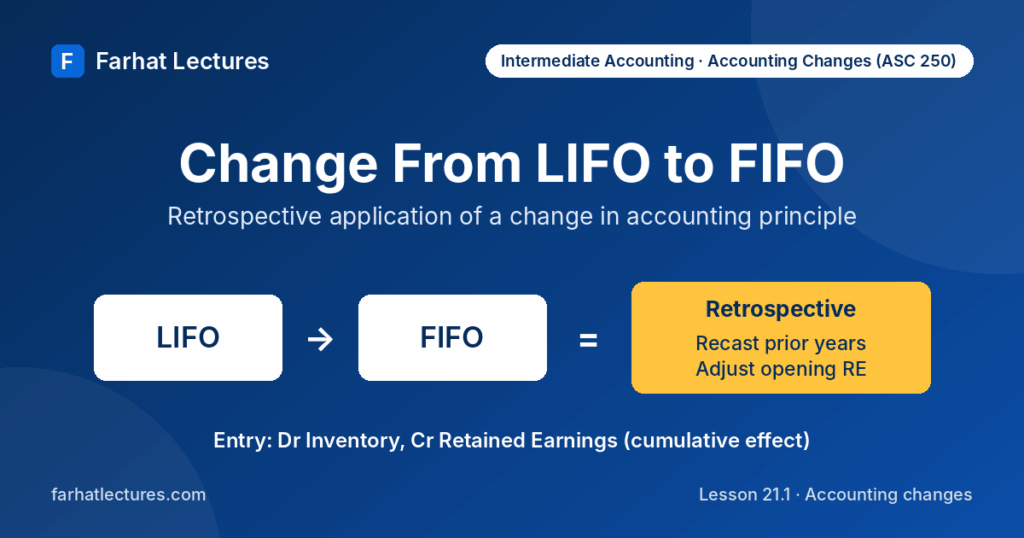
A change from LIFO (last-in, first-out) to FIFO (first-in, first-out) is a change in accounting principle under ASC 250, so it is applied retrospectively. The company recasts every prior year presented as if it had always used FIFO. In Birchwood’s example, FIFO inventory is $6,000 higher than LIFO inventory at the start of the year of change. Ignoring income taxes, Birchwood debits Inventory and credits Retained Earnings for $6,000.
LIFO and FIFO produce different inventory balances, cost of goods sold, and net income. When a company switches, readers need every comparative column on the same basis. Otherwise a jump in profit could be caused by the switch rather than by better performance.
This lesson walks through a complete hypothetical example: the comparison of income under both methods, the adjusting entry, the recast statements, and the required disclosure. For the general rules behind it, see the change in accounting principle guide, which works a FIFO to weighted-average example.
Watch Professor Farhat: this CPA exam-style simulation works a retrospective change from LIFO to FIFO, including the adjusting entry and tax effects.
Watch “Change in Accounting Principle CPA Exam Simulation” on YouTube
Why a change from LIFO to FIFO is retrospective
A change in accounting principle is a switch from one generally accepted method to another, such as from LIFO to FIFO. ASC 250 requires retrospective application for these changes unless it is impracticable. A switch to FIFO is usually practicable because a company can rebuild FIFO costs from its purchase records.
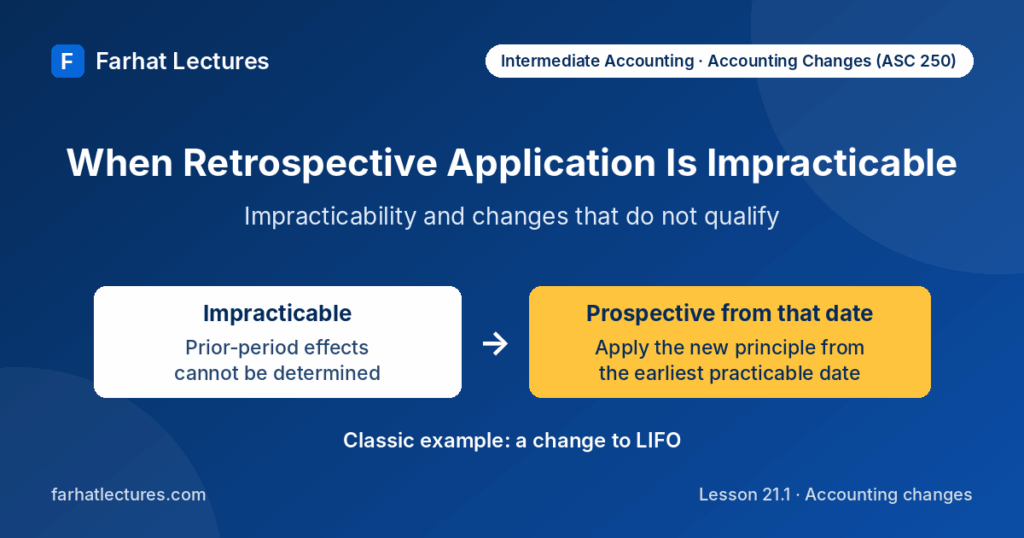
A switch in the other direction, to LIFO, is different. It is often impracticable to rebuild old LIFO layers, so that change is usually applied prospectively. See when retrospective application is impracticable. For how all three reporting methods compare, read retrospective vs. prospective application.
One more point for CPA candidates: IFRS does not allow LIFO at all (IAS 2, Inventories). That is one reason companies with international reporting or global peers often move to FIFO.
The three steps of retrospective application
| Step | What the company does |
|---|---|
| 1. Adjust opening balances | Record one entry at the start of the current year to bring affected assets (here, inventory) and retained earnings to the FIFO amounts. |
| 2. Recast prior periods presented | Show every comparative year under FIFO. Put the effect on years before the earliest year shown into that year’s opening retained earnings. |
| 3. Disclose the change | Explain what changed, why FIFO is preferable, and the effect on each affected line item. |
Example: Birchwood Company changes from LIFO to FIFO
Hypothetical example; income taxes are ignored to keep the focus on the mechanics. Birchwood Company began operations on January 1, 2025, and used LIFO. In 2027 it switches to FIFO and presents comparative statements for 2026 and 2027. Sales are $400,000 and operating expenses are $120,000 each year.
| December 31 | LIFO inventory | FIFO inventory | Difference |
|---|---|---|---|
| 2025 | $18,000 | $21,000 | $3,000 |
| 2026 | $30,000 | $36,000 | $6,000 |
| 2027 | $41,000 | $49,000 | $8,000 |
| Year | Net income (LIFO) | Net income (FIFO) | Difference |
|---|---|---|---|
| 2025 | $88,000 | $91,000 | $3,000 |
| 2026 | $62,000 | $65,000 | $3,000 |
| 2027 | $46,000 | $48,000 | $2,000 |
FIFO income is higher each year because FIFO leaves the newer, higher costs in ending inventory and puts older, cheaper costs into cost of goods sold. The difference in income for 2025 and 2026 combined is $6,000. That equals the inventory difference at December 31, 2026. This is no coincidence: the inventory gap is exactly the extra income FIFO would have reported to date.
The journal entry for a change from LIFO to FIFO
Birchwood’s books still show LIFO balances on January 1, 2027. The revenue and expense accounts for 2025 and 2026 are already closed to retained earnings, so the catch-up goes straight to retained earnings:
| Account | Debit | Credit |
|---|---|---|
| Inventory | $6,000 | |
| Retained Earnings | $6,000 |
This is the only journal entry. After it, Birchwood records 2027 transactions under FIFO. No entries are made to 2025 or 2026 cost of goods sold, because those accounts no longer exist. In practice the entry also records income tax effects, and retained earnings would be credited net of tax.
What about income taxes?
LIFO comes with a tax string attached. Under the LIFO conformity rule in IRC Section 472(c), a company that uses LIFO on its tax return must also use LIFO in its financial statements. So when a company moves its books to FIFO, it generally has to leave LIFO for tax purposes too.
To change its tax method, the company files Form 3115, Application for Change in Accounting Method, with the IRS. Depending on the facts, the change may qualify for automatic consent or may need advance consent.
The tax catch-up is called a Section 481(a) adjustment. For a switch out of LIFO, it equals the tax LIFO reserve at the start of the year of change, and it increases taxable income. When the adjustment increases income, the company generally spreads it over four tax years, starting with the year of change. The Journal of Accountancy article The Death of LIFO? walks through these tax effects.
Here is Birchwood’s January 1, 2027 entry if we assume a 25% income tax rate:
| Account | Debit | Credit |
|---|---|---|
| Inventory | $6,000 | |
| Deferred Tax Liability | $1,500 | |
| Retained Earnings | $4,500 |
The tax is $6,000 × 25% = $1,500, so retained earnings rises by the after-tax amount of $4,500. The tax is recorded as a deferred tax liability because most of it is paid in later years under the four-year spread. Each year’s share moves to income taxes payable as it comes due.
Recasting the comparative statements
The 2026 income statement column is recast to FIFO: net income becomes $65,000 instead of the $62,000 originally reported. The retained earnings statement shows the adjustment at the start of the earliest year presented, which is January 1, 2026.
| Retained earnings statement | 2027 | 2026 |
|---|---|---|
| Balance, January 1, as previously reported | — | $88,000 |
| Cumulative effect of change to FIFO | — | $3,000 |
| Balance, January 1, as adjusted | $156,000 | $91,000 |
| Add: Net income (FIFO) | $48,000 | $65,000 |
| Balance, December 31 | $204,000 | $156,000 |
The 2026 opening adjustment is only $3,000, the effect on 2025. The effect on 2026 itself is already inside the recast 2026 net income. Notice that the 2027 column has no adjustment line at all. It simply opens at $156,000, the recast December 31, 2026 balance.
So where did the $6,000 journal entry go? In the ledger, it fixes retained earnings in one step. In the statements, it is split into two pieces: $3,000 at the start of 2026 plus the $3,000 increase in recast 2026 net income.
On the balance sheet, inventory at December 31, 2026 is shown at FIFO cost of $36,000. Cash does not change, because switching cost flow methods does not change what was actually paid when taxes are ignored. Under the indirect method, two lines in the 2026 operating section do change: net income rises by $3,000, and the deduction for the increase in inventory grows by $3,000 ($15,000 under FIFO instead of $12,000 under LIFO). They offset, so net cash from operating activities stays the same.
What the note disclosure says
ASC 250 requires the note to explain the nature of the change and why FIFO is preferable. It must also state that the change was applied retrospectively, describe the prior-period information that was adjusted, and give the effect on income, other affected line items, and per-share amounts for the current year and for each prior year adjusted. Finally, it must show the cumulative effect on retained earnings at the start of the earliest period presented. A short version for Birchwood might read: “Effective January 1, 2027, the Company changed its inventory method from LIFO to FIFO because FIFO better reflects the current cost of inventory on hand. The change was applied retrospectively, and 2026 amounts have been adjusted. Compared with LIFO, the change increased inventory by $6,000 at December 31, 2026 and by $8,000 at December 31, 2027. It reduced cost of goods sold and increased net income by $3,000 in 2026 and by $2,000 in 2027. The cumulative effect increased January 1, 2026 retained earnings by $3,000.”
A real example: Twin Disc in 2026
Twin Disc, Incorporated filed its independent auditor’s preferability letter as Exhibit 18 to its Form 10-K for the fiscal year ended June 30, 2026. In the letter, RSM US LLP agreed that FIFO was preferable in Twin Disc’s circumstances.
Twin Disc changed the inventory method for its U.S. operations from LIFO to FIFO. Management said FIFO better matches costs with revenues, follows the physical flow of inventory more closely, better reflects the acquisition cost of inventory on the balance sheet, and improves comparability with industry peers. You can read the Twin Disc preferability letter on SEC EDGAR.
Common mistakes
- Debiting cost of goods sold. Prior-year expenses are closed. The catch-up goes to retained earnings, not to current-year cost of goods sold.
- Using the wrong cumulative amount. The entry uses the inventory difference at the start of the year of change ($6,000), not at the end ($8,000).
- Adjusting the current year’s opening balance in the statement. In the recast retained earnings statement, the cumulative effect appears at the earliest year presented.
- Forgetting the LIFO reserve link. The inventory difference is the LIFO reserve, so a company that tracks its reserve already knows the cumulative effect.
- Forgetting the tax side. Leaving LIFO on the books usually means leaving it on the tax return too, because of the LIFO conformity rule. See What about income taxes? above.
Practice questions
1. At December 31, 2026, a company’s inventory is $44,000 under LIFO and $51,500 under FIFO. It changes to FIFO in 2027. Ignoring taxes, what is the January 1, 2027 entry?
Show answer
Debit Inventory $7,500; credit Retained Earnings $7,500. The cumulative effect equals the inventory difference at the start of the year of change ($51,500 − $44,000).
2. Same company: the LIFO/FIFO inventory difference was $3,200 at December 31, 2025. If 2026 and 2027 are presented, how much is added to January 1, 2026 retained earnings?
Show answer
$3,200. That is the effect on all years before 2026, the earliest year presented. The remaining $4,300 ($7,500 − $3,200) appears in recast 2026 net income.
3. Ignoring income taxes, does switching from LIFO to FIFO change Birchwood’s net cash from operating activities for 2026?
Show answer
No. Under the indirect method, FIFO increases 2026 net income by $3,000. The deduction for the increase in inventory also grows by $3,000, from $12,000 to $15,000. The two changes offset, so net cash from operating activities stays the same.
Interactive LIFO to FIFO exercise
Apply retrospective accounting to Alder Supply in three questions. Alder used LIFO through 20X5 and switches to FIFO at the start of 20X6. It presents comparative statements for 20X4, 20X5, and 20X6. At December 31, 20X5, its inventory was $126,000 under LIFO and $154,000 under FIFO. Ignore income taxes. Classify the inventory method change, decide how to present the comparative years, and record the opening inventory adjustment.
Frequently asked questions
Is a change from LIFO to FIFO a change in accounting principle?
Yes. Both are generally accepted inventory cost flow methods, so switching between them is a change in accounting principle under ASC 250 and is reported retrospectively unless that is impracticable.
What is the journal entry when changing from LIFO to FIFO?
The entry adjusts opening inventory to its FIFO carrying amount. In Birchwood’s example, FIFO inventory is $6,000 higher. Ignoring income taxes, Birchwood debits Inventory and credits Retained Earnings for $6,000. At the assumed 25% tax rate, it credits Deferred Tax Liability for $1,500 and Retained Earnings for $4,500 instead.
Why is a change from LIFO to FIFO retrospective but a change to LIFO often prospective?
FIFO costs can usually be rebuilt from purchase records, so retrospective application is practicable. Rebuilding historical LIFO layers is often impossible, so a change to LIFO is commonly applied prospectively from the date of change.
Which retained earnings balance is adjusted in the comparative statements?
The opening retained earnings of the earliest year presented. The effects on later years presented are included in each recast year’s net income.
Does net income for the current year change because of the switch?
Yes, compared with what LIFO would have shown. The current year is reported under FIFO from January 1, so its net income reflects FIFO cost of goods sold. In the Birchwood example, 2027 net income is $48,000 under FIFO instead of $46,000 under LIFO. There is no separate cumulative-effect line in current-year income under retrospective application.
Does a company need IRS consent to switch from LIFO to FIFO?
Yes. It requests the change on Form 3115, Application for Change in Accounting Method. Depending on the facts, the change may qualify for automatic consent or require advance consent.
Can a company use FIFO for its books and LIFO for taxes?
Generally no. The LIFO conformity rule in IRC Section 472(c) says a company using LIFO on its tax return must also use LIFO in its financial statements. Leaving LIFO for book purposes usually means leaving it for tax too.
Why do companies switch from LIFO to FIFO?
Common reasons are an inventory balance closer to current cost, better comparability with peers, and alignment with IFRS, which does not permit LIFO. Twin Disc cited cost matching, physical flow, current acquisition cost, and peer comparability when it switched in fiscal 2026.
Sources
- Deloitte DART: FASB ASC 250, Accounting Changes and Error Corrections
- Journal of Accountancy: Changes in Accounting for Changes (LIFO to FIFO illustration)
- Journal of Accountancy: The Death of LIFO? (accounting and tax effects of leaving LIFO)
- EY Financial Reporting Developments: Accounting changes and error corrections
- SEC EDGAR: Twin Disc, Inc. preferability letter, Exhibit 18 to Form 10-K (fiscal 2026)
Written by Mansour Farhat, CPA, CIA, DBA, for accounting students and CPA candidates studying with Farhat Lectures. Read more about Professor Farhat.
Continue learning with Farhat Lectures
Accounting changes are easier when you can watch each step worked out. Start with the free sample course to try our lectures, practice questions, and exam-style exercises at no cost.
Explore the free sample course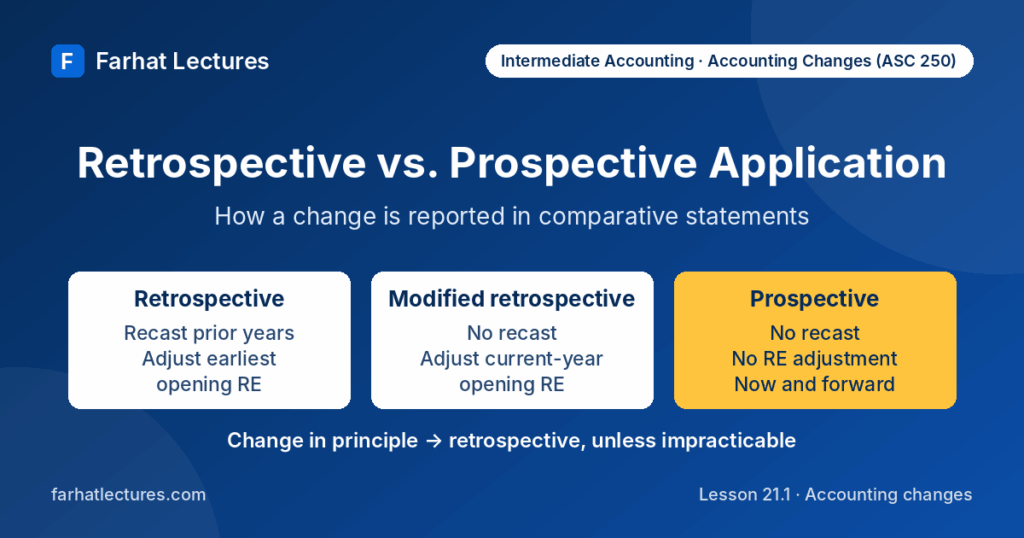


Responses