
Retrospective vs. Prospective Application: Accounting Changes Compared

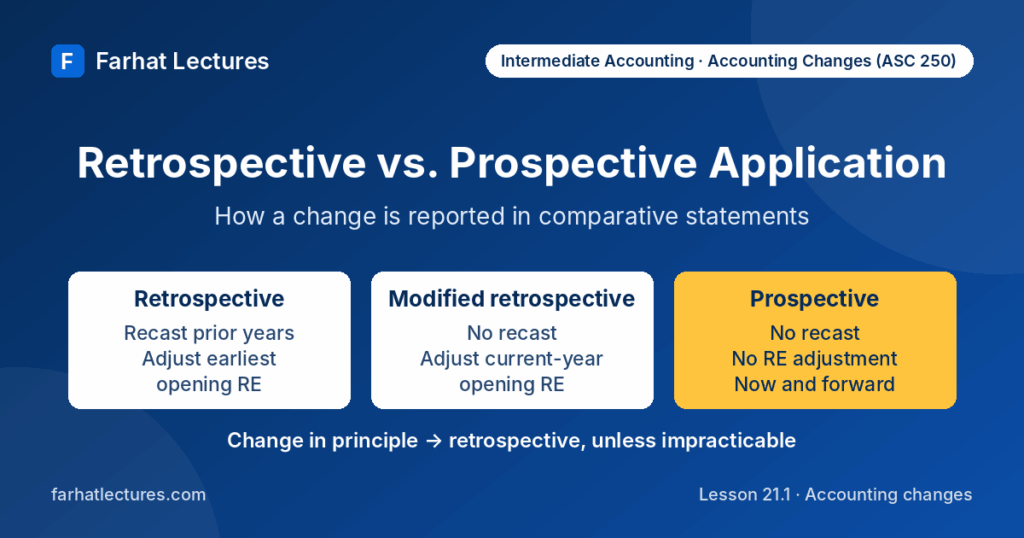
Retrospective vs. prospective application comes down to one question: do you change the years you already reported? Retrospective application recasts prior-year statements as if the new method had always been used. When a company changes an accounting principle, it follows any transition guidance in the applicable standard. If that guidance is silent, ASC 250 requires retrospective application unless it is impracticable. Prospective application leaves prior years alone and applies the new method only to the current and future years.
A third approach sits in between: modified retrospective application. It puts the full catch-up amount, called the cumulative effect, into the current year’s opening retained earnings but does not recast prior years. Don’t confuse it with the older “currently” approach some textbooks describe, which ran the cumulative effect through current-year net income. ASC 250 no longer uses that approach for a change in accounting principle.
This matters because the method you choose changes what readers see in the comparative columns. Under US GAAP, the Financial Accounting Standards Board (FASB) assigns a specific method to each type of accounting change in ASC 250, Accounting Changes and Error Corrections. On an exam, picking the wrong method means every number that follows is wrong.
This lesson compares the three methods side by side. If you want the big picture of all accounting changes first, read the ASC 250 guide to accounting changes and error corrections.
Watch Professor Farhat: this lecture walks through the three types of accounting changes and explains when to use retrospective versus prospective treatment.
Watch “The 3 Types of Accounting Changes: Principle, Estimates and Errors” on YouTube
The three ways to report an accounting change
Companies usually present comparative financial statements, meaning two or three years shown side by side. An accounting change creates a problem: the older columns were prepared under the old method. The three reporting methods are three different answers to that problem.
1. Retrospective application
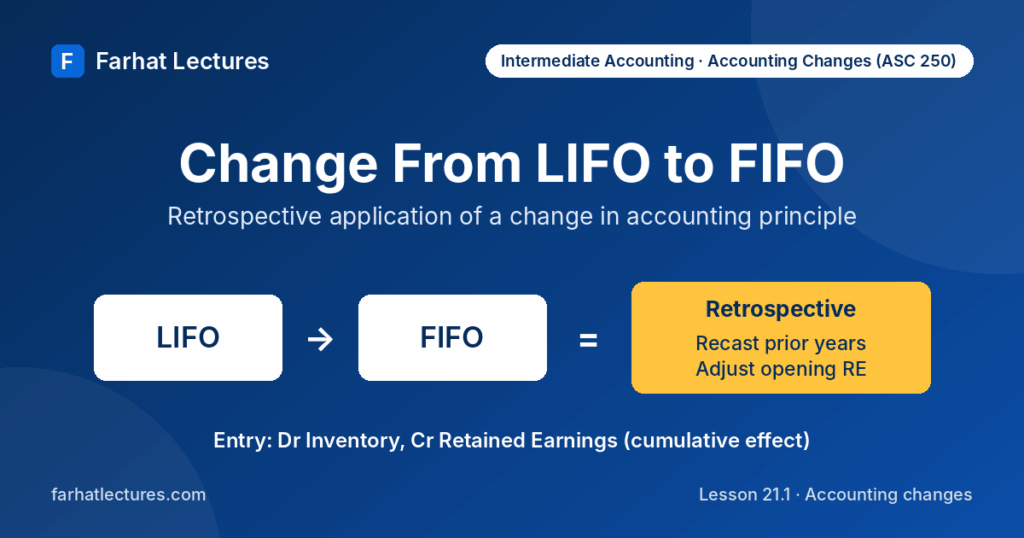
Retrospective application means applying the new method to prior periods as if it had always been used. The company recasts every prior year shown in the comparative statements. Any effect on years before the earliest year shown goes into the opening retained earnings balance of that earliest year.
2. Modified retrospective application
Under the modified retrospective approach, prior-year columns stay as originally reported. The company applies the new method in the current year and records the full cumulative effect as an adjustment to the current year’s opening retained earnings. You will see this method mainly in the transition rules of newer FASB standards, such as revenue recognition (ASC 606), leases (ASC 842), and credit losses (ASC 326). It is not the default rule in ASC 250.
3. Prospective application
Prospective application changes nothing in the past. There is no recast and no retained earnings adjustment. The new method simply applies to the current year and future years.
Retrospective vs. prospective application compared
| Feature | Retrospective | Modified retrospective | Prospective |
|---|---|---|---|
| Prior-year statements | Recast to the new method | Left as originally reported | Left as originally reported |
| Retained earnings adjustment | Opening balance of the earliest year presented | Opening balance of the current year | None |
| Comparability across years | Highest | Partial | Lowest |
| Cost and effort | Highest | Moderate | Lowest |
| Typical use | Change in accounting principle; change in reporting entity | Transition method allowed by some new FASB standards | Change in accounting estimate; impracticable changes |
Which accounting changes use which method?
ASC 250 recognizes three types of accounting changes. Error corrections are not an accounting change, but they are reported in a similar way, so students often group them together.
| Situation | Reporting method | Learn more |
|---|---|---|
| Change in accounting principle (for example, LIFO to FIFO) | Retrospective, unless impracticable | LIFO to FIFO example |
| Change in accounting principle when the effect on individual prior years cannot be determined | Apply the new method from the earliest practicable period, with the cumulative effect in that period’s opening retained earnings | Impracticability rules |
| Change in accounting principle when the cumulative effect on all prior years cannot be determined | Prospective from the earliest practicable date | Impracticability rules |
| New FASB standard with its own transition rules | Whatever the standard specifies (often modified retrospective) | Change in accounting principle |
| Change in accounting estimate | Prospective | Change in accounting estimate |
| Change in depreciation, amortization, or depletion method (a change in estimate effected by a change in principle) | Prospective | Change in depreciation method |
| Change in reporting entity | Retrospective | Change in reporting entity |
| Correction of an error in prior statements | Restatement of prior periods | Prior period adjustment |
One detail is easy to miss. When the FASB issues a new standard, the standard’s own transition section controls. ASC 250’s default rules apply only when that transition guidance is silent.
Exam tip: Before you pick a method on a FAR question, name the type of change first: principle, estimate, reporting entity, or error. Once the type is right, the method usually follows.
Example: one change, three methods
Hypothetical example. Maple Company changes an accounting principle in 2027 and presents comparative statements for 2026 and 2027. Ignore income taxes. Maple computes these effects of the new method:
| Period | Effect of the new method on net income |
|---|---|
| All years before 2026 | $4,000 increase |
| 2026 | $1,500 increase |
| Total through December 31, 2026 | $5,500 increase |
The table shows how each method would present the same facts. On a FAR question, the applicable guidance determines which method Maple uses.
| Method | 2026 column | Retained earnings adjustment | 2027 column |
|---|---|---|---|
| Retrospective | Net income recast upward by $1,500 | +$4,000 to January 1, 2026 balance | New method |
| Modified retrospective | Unchanged (old method) | +$5,500 to January 1, 2027 balance | New method |
| Prospective | Unchanged (old method) | None | New method |
Notice that the retrospective and modified retrospective approaches both capture the full $5,500. They only differ in where it shows up. Under retrospective application, $1,500 appears in the recast 2026 income and $4,000 appears in the earliest opening balance. Prospective application never books the $5,500 as an adjustment. The new method simply shapes income from 2027 forward, and the 2026 column stays on the old method.
Why the FASB prefers retrospective application
Retrospective application makes every column follow the same rules. A reader comparing 2026 to 2027 sees a true trend, not a jump caused by switching methods. That is why ASC 250 requires it for a change in accounting principle unless it is impracticable. The trade-off is cost: the company must rebuild prior-year numbers. To see the full mechanics, including the journal entry, work through the change from LIFO to FIFO example.
Key takeaways
- Retrospective application recasts every prior year presented and puts earlier effects into the opening retained earnings of the earliest year shown.
- Modified retrospective application leaves prior years alone and puts the full cumulative effect into the current year’s opening retained earnings.
- Prospective application changes nothing in the past. The new method applies to the current and future years only.
- Change in accounting principle: retrospective, unless impracticable. Change in estimate, including a change in depreciation method: prospective. Change in reporting entity: retrospective. Error correction: restatement.
- When a new FASB standard has its own transition rules, those rules win over ASC 250’s defaults.
Common mistakes
- Adjusting the wrong retained earnings balance. Under retrospective application, the adjustment goes to the opening balance of the earliest year presented, not the current year.
- Treating a change in estimate retrospectively. A new useful life or a revised bad debt percentage is applied prospectively. No prior year is recast.
- Treating a change in depreciation method as a change in principle. Switching from straight-line to double-declining-balance is a change in estimate effected by a change in principle, so it is applied prospectively. See change in depreciation method.
- Calling an error correction a change in principle. Switching from a method that was never acceptable (such as the cash basis) to GAAP is an error correction.
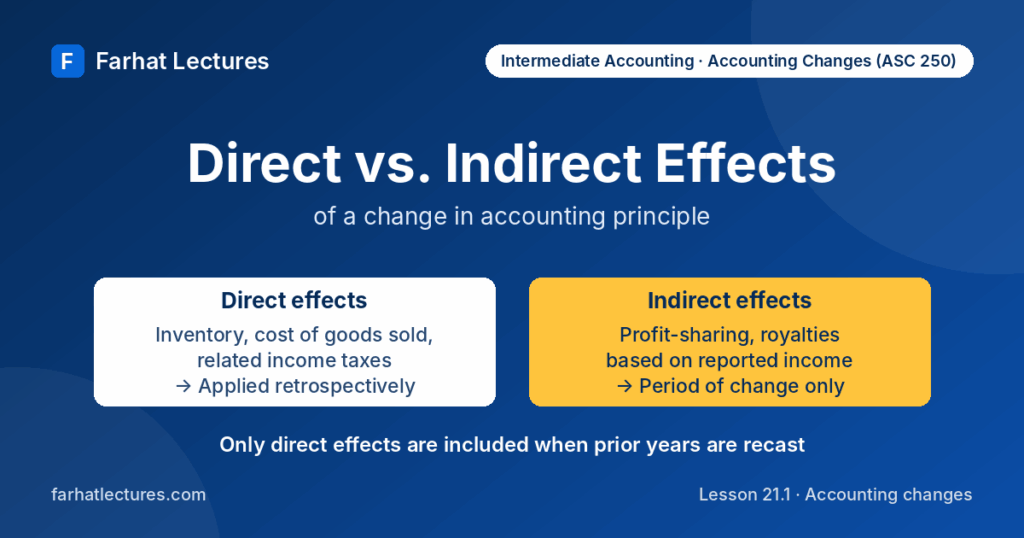
- Recasting indirect effects. Retrospective application includes only the direct effects of the change. See direct and indirect effects.
Practice questions
1. A company revises the useful life of its equipment from 10 years to 8 years. Which reporting method applies?
Show answer
Prospective. A revised useful life is a change in accounting estimate. The company spreads the remaining book value, less any salvage value, over the new remaining life and does not recast prior years.
2. A company changes an accounting principle in 2027 and presents 2026 and 2027. The effect on years before 2026 is $7,000, and the effect on 2026 is $2,500. Under retrospective application, what is the adjustment to January 1, 2026 retained earnings?
Show answer
$7,000. The $2,500 belongs in the recast 2026 income statement. Only the effect on periods before the earliest year presented goes into that year’s opening retained earnings.
3. Using the same facts, what adjustment would the modified retrospective approach record, and where?
Show answer
$9,500 to January 1, 2027 retained earnings. Prior years are not recast, so the whole cumulative effect through December 31, 2026 ($7,000 + $2,500) goes into the current year’s opening balance.
CPA FAR quiz on retrospective vs. prospective application
Choose one answer per question. Use the Summit scenarios to decide when to recognize a revised estimate. Use the Ridge scenarios to determine which comparative periods to recast, how to adjust opening retained earnings, and what to disclose.
Frequently asked questions
What is the difference between retrospective and prospective application?
Retrospective application recasts prior-year financial statements as if the new method had always been used and adjusts the earliest opening retained earnings. Prospective application leaves prior years unchanged and applies the new method only to the current and future years.
Is modified retrospective the same as retrospective?
No. Modified retrospective application does not recast prior-year columns. It records the full cumulative effect in the current year’s opening retained earnings. It is mainly used when a new FASB standard allows it as a transition method.
Which accounting changes are applied prospectively?
Changes in accounting estimates are applied prospectively, and so are changes in depreciation, amortization, or depletion methods, because ASC 250 treats them as a change in estimate effected by a change in principle. A change in accounting principle is applied prospectively only when its cumulative effect on all prior periods cannot be determined. In that case, the new method starts at the earliest date that is practicable.
Is an error correction reported retrospectively?
An error correction is reported by restating the prior-period financial statements. The mechanics look like retrospective application, but ASC 250 calls it a restatement, and it is not an accounting change.
Why does retrospective application improve comparability?
Every year presented follows the same accounting method, so changes in the numbers reflect real performance rather than a switch in methods.
Is a change in depreciation method retrospective or prospective?
Prospective. ASC 250 treats a change in depreciation, amortization, or depletion method as a change in accounting estimate effected by a change in accounting principle. The company applies the new method to the remaining book value going forward and does not recast prior years.
What is the cumulative effect of an accounting change?
It is the total difference the new method would have made to income in all years before the change. Under retrospective application, the part that belongs to years before the earliest year presented goes into that year’s opening retained earnings. Under modified retrospective application, the whole amount goes into the current year’s opening retained earnings.
What was the old “currently” approach?
Before ASC 250 (originally FASB Statement No. 154, issued in 2005), most voluntary changes in accounting principle were reported by including the cumulative effect in the current year’s net income. Some textbooks still list this as reporting a change currently. Today, a change in accounting principle is applied retrospectively unless impracticable.
Sources
- Deloitte DART: FASB ASC 250, Accounting Changes and Error Corrections
- Deloitte DART: ASC 250-10-20 Glossary (retrospective application and related terms)
- Journal of Accountancy: The Change Game, a review of FASB Statement No. 154
- KPMG Handbook: Accounting changes and error corrections (US GAAP)
Written by Mansour Farhat, CPA, CIA, DBA, for accounting students and CPA candidates studying with Farhat Lectures. Last reviewed against FASB ASC 250 in November 2026. Read more about Professor Farhat.
Continue learning with Farhat Lectures
Accounting changes are easier when you can watch each step worked out. Start with the free sample course to try our lectures, practice questions, and exam-style exercises at no cost.
Explore the free sample course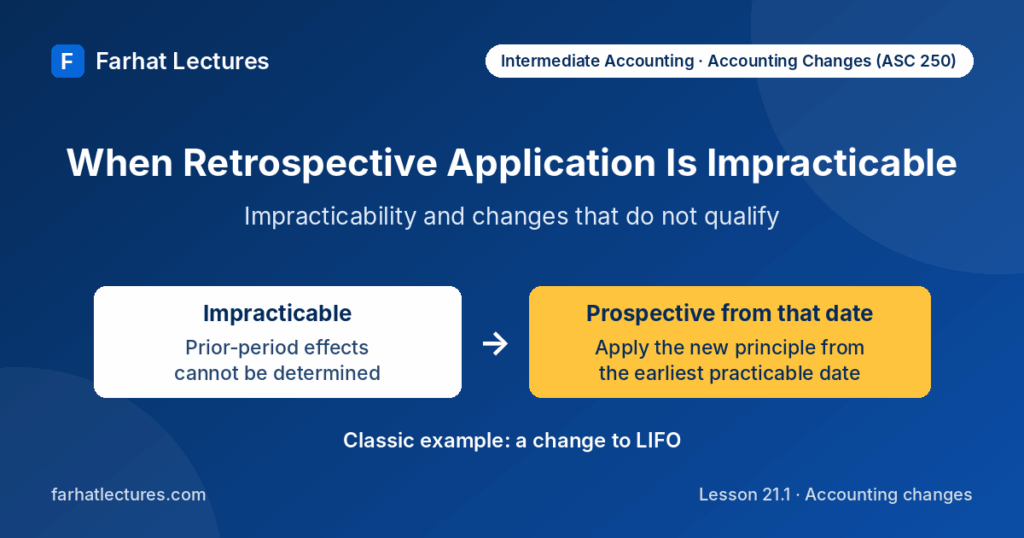
Responses