
Change in Depreciation Method: Why It’s a Change in Estimate (With Example)

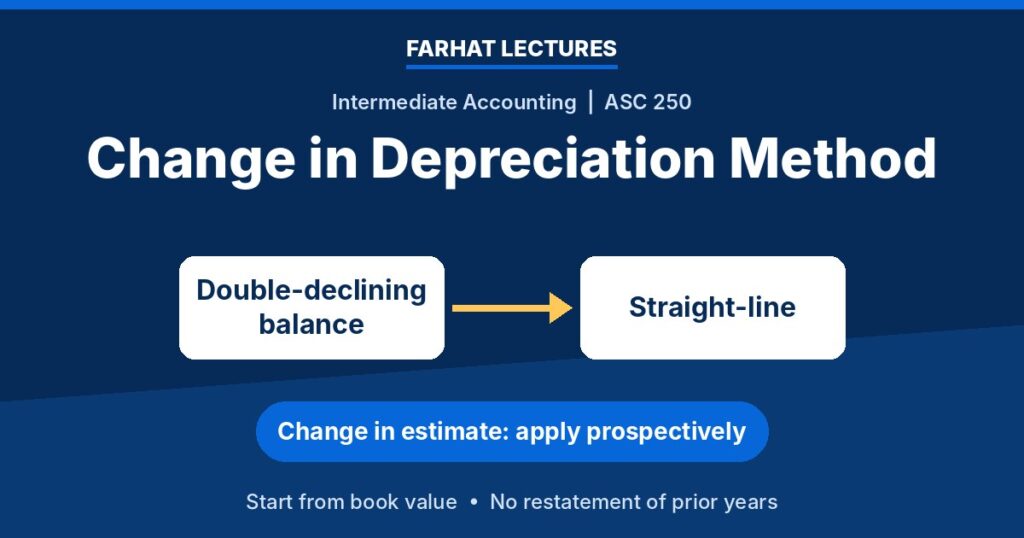
A change in depreciation method, such as double-declining balance to straight-line, is a change in accounting estimate effected by a change in accounting principle (ASC 250-10-45-18). It is applied prospectively: prior years are not restated. When switching to straight-line, subtract estimated salvage value from book value on the change date, then divide by the remaining useful life. The company must justify why the new method is preferable.
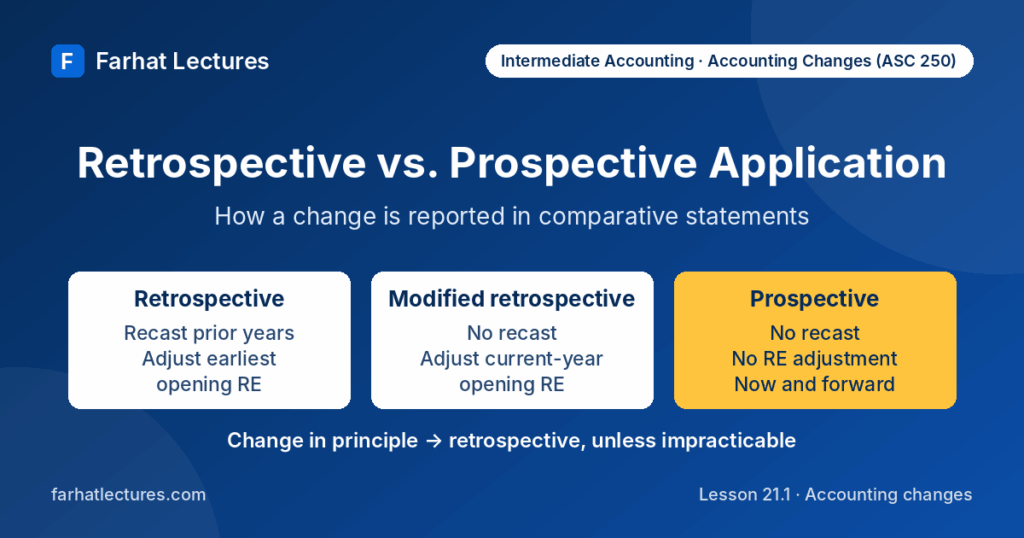
This idea matters because it breaks the pattern students expect. Most changes in accounting principle are applied retrospectively, which means prior statements are adjusted as if the new method had always been used. A depreciation method change is the best-known exception, and it is a favorite exam question in Intermediate Accounting and in the FAR section of the CPA exam, where accounting changes and error corrections fall under Area III, Select Transactions.
If you are new to accounting changes, start with the overview of accounting changes and error corrections, then come back here for the depreciation details.
Watch Professor Farhat explain it. This lecture starts at the segment on why a change in depreciation method is treated as a change in estimate (8:09).
Watch “How to Account for a Change in Accounting Estimate” on YouTube
Why is a change in depreciation method treated as a change in estimate?
Depreciation spreads an asset’s cost over the periods that benefit from it. The method you pick, whether straight-line, declining balance, or units-of-production, reflects your estimate of the pattern in which those benefits are used up.
So when a company switches methods, it is usually because its expectations changed. For example, a machine may now be used evenly instead of heavily in its early years. The new method and the new estimate are tangled together, and you cannot separate one from the other. ASC 250 handles that situation directly: when the effect of a change in principle is inseparable from the effect of a change in estimate, the change is treated as a change in estimate.
The Financial Accounting Standards Board (FASB) gives this case its own name in Accounting Standards Codification (ASC) 250-10-45-18: a change in accounting estimate effected by a change in accounting principle. The same rule applies to changes in amortization and depletion methods.
Two rules apply at once. The accounting follows the change-in-estimate rules (prospective). The justification and disclosures follow the change-in-principle rules (the new method must be preferable).
How do you calculate depreciation after the change?
Use the same three steps for any change in depreciation method.
Steps for a change in depreciation method
| Step | What you do |
|---|---|
| 1. Find book value | Cost minus accumulated depreciation recorded under the old method, as of the date of the change. |
| 2. Confirm the remaining inputs | Remaining useful life and salvage value. Update them too if your estimates changed. |
| 3. Apply the new method | Depreciate book value (less salvage value, where the method requires it) over the remaining life. Record only the current-year entry. |
Example: switching from double-declining balance to straight-line
Hypothetical example. Northgate Printing buys a press on January 1, 2026, for $250,000. It estimates a 10-year life and a $25,000 salvage value, and it uses double-declining balance, so the rate is 20% (2 ÷ 10). At the start of 2028, Northgate decides straight-line better matches how evenly the press is now used.
Step 1: Book value on January 1, 2028
Depreciation recorded under the old method
| Year | Calculation | Depreciation | Book value at year end |
|---|---|---|---|
| 2026 | $250,000 × 20% | $50,000 | $200,000 |
| 2027 | $200,000 × 20% | $40,000 | $160,000 |
Accumulated depreciation is $90,000, so book value on January 1, 2028, is $160,000.
Step 2 and Step 3: New straight-line depreciation
Eight years remain. Straight-line depreciation for 2028 and each later year is ($160,000 − $25,000) ÷ 8 = $16,875.
Journal entry for 2028 (December 31)
| Account | Debit | Credit |
|---|---|---|
| Depreciation Expense | $16,875 | |
| Accumulated Depreciation | $16,875 |
Notice what Northgate does not do. Straight-line would have produced $45,000 of depreciation in 2026 and 2027, which is $45,000 less than the $90,000 actually recorded. That difference is never booked. There is no catch-up entry and no adjustment to retained earnings.
Method change vs. useful-life change vs. principle change
Students often mix these three up. The table shows where a depreciation method change sits.
How three common changes are reported
| Change | Classification | Prior years adjusted? | Must justify as preferable? |
|---|---|---|---|
| New useful life or salvage value | Change in accounting estimate | No (prospective) | No |
| New depreciation method (e.g., declining balance to straight-line) | Change in estimate effected by a change in principle | No (prospective) | Yes |
| New inventory method (e.g., FIFO to weighted-average) | Change in accounting principle | Yes (retrospective) | Yes |
A pure useful-life revision is covered with its own example in the change in accounting estimate guide. A depreciation method change follows the same arithmetic, plus the preferability requirement.
Practice classifying changes in accounting estimates and principles
Choose one answer per scenario. Determine how to classify an accounting change when a revised estimate of future benefits and a change in accounting method are inseparable.
What must be disclosed?
Because the change affects several future periods, the notes in the year of change should explain:
- The nature of the change and the reason for it.
- Why the new method is preferable.
- The effect on income from continuing operations, net income, and related per-share amounts for the current period.
In the Northgate example, 2028 depreciation under the old method would have been $32,000 ($160,000 × 20%). The new method gives $16,875, so pretax income is $15,125 higher. That is the kind of effect the note describes.
A few more rules round this out. The income effect disclosure is required when the effect is material. Because a depreciation method is also an accounting principle, the change-in-principle disclosures in ASC 250-10-50-1 through 50-3 apply as well. Management must explain why the new method better reflects how the asset’s economic benefits are consumed. The SEC Financial Reporting Manual, section 4230.2, exempts this type of change from the Exhibit 18 preferability letter requirement.
Common mistakes
- Restating prior years. A method change is prospective. Prior statements stay as reported.
- Restarting from cost. Depreciate the book value on the date of change, not the original cost.
- Using the original life. Use the remaining useful life (8 years in the example, not 10).
- Treating a computing mistake as a method change. If prior depreciation was simply calculated wrong, that is an error correction, not a change in estimate.
- Skipping the justification. Even though the accounting is prospective, the company must still explain why the new method is preferable.
Practice questions
Question 1
A machine cost $120,000, has no salvage value, and was depreciated straight-line over 6 years. After 2 years, the company switches to double-declining balance for the 4 remaining years. What is depreciation in Year 3?
Show answer
Answer: $40,000.
Book value after 2 years is $120,000 − $40,000 = $80,000. The double-declining rate on the remaining 4-year life is 2 ÷ 4 = 50%. Year 3 depreciation is $80,000 × 50% = $40,000. Prior years are not adjusted.
Question 2
A delivery truck cost $90,000, with a $10,000 salvage value and an 8-year straight-line life. After 3 years, the company revises the total life to 6 years and the salvage value to $6,000. The method stays straight-line. What is Year 4 depreciation, and is a preferability justification required?
Show answer
Answer: $18,000, and no.
Accumulated depreciation after 3 years is 3 × $10,000 = $30,000, so book value is $60,000. Year 4 depreciation is ($60,000 − $6,000) ÷ 3 = $18,000. This is a pure change in estimate because the method did not change, so no preferability justification is needed.
Question 3
While switching to straight-line, a company discovers its accountant used a 30% declining-balance rate in prior years when company policy called for 20%. Is the old over-depreciation part of the change in estimate?
Show answer
Answer: No. It is an error.
Careful estimates that later prove wrong are changes in estimate. A rate applied incorrectly is a mistake in applying the company’s own policy, so it is corrected as an error. If the error is material, restate depreciation in each affected comparative year presented. Adjust opening retained earnings of the earliest year presented only for the cumulative effect of over-depreciation from years before that year. See the prior period adjustment guide for that treatment. Then apply straight-line depreciation prospectively from the corrected book value on the change date.
Key takeaways
- A change in depreciation method is a change in accounting estimate effected by a change in accounting principle (ASC 250-10-45-18).
- It is applied prospectively. There is no restatement of prior years, no catch-up entry, and no retained earnings adjustment.
- Start from the book value on the date of the change and use the remaining useful life.
- The new method must be preferable, and the notes must explain why.
- A change in useful life or salvage value alone is a pure change in estimate. A rate that was applied incorrectly is an error.
- Under IFRS (IAS 16 and IAS 8), a method change is also a prospective change in estimate.
Frequently asked questions
Is a change in depreciation method a change in accounting principle?
Under U.S. GAAP it is both, in a sense. A depreciation method is an accounting principle, so the company must justify the new method as preferable. But the change is accounted for as a change in accounting estimate, so it is applied prospectively. ASC 250 calls this a change in estimate effected by a change in accounting principle.
Do you record a cumulative-effect adjustment when you change depreciation methods?
No. Prior years stay as reported and retained earnings is not adjusted. You start from the asset’s book value on the date of the change and depreciate that amount over the remaining life using the new method.
Can a company switch from straight-line to an accelerated method?
Yes, as long as the accelerated method better reflects how the asset’s benefits are being used and management can justify it as preferable. The accounting is the same in either direction: prospective, starting from book value.
How does IFRS treat a change in depreciation method?
IAS 16 requires companies to review the depreciation method at least at each year end. A change is accounted for as a change in accounting estimate under IAS 8, so it is also prospective. IAS 8 will be renamed Basis of Preparation of Financial Statements when IFRS 18 takes effect for annual periods beginning on or after January 1, 2027, but this treatment stays the same. IFRS does not use the separate label “change in estimate effected by a change in principle.”
Is the tax treatment the same as the book treatment?
Not necessarily. Tax rules are separate from GAAP. For U.S. federal income tax, a change in depreciation method is generally a change in method of accounting that follows IRS procedures, usually by filing Form 3115, Application for Change in Accounting Method. This article covers financial reporting only.
What if the depreciation method changes in the middle of the year?
Record depreciation under the old method up to the date of the change. Then depreciate the book value on that date over the remaining useful life using the new method. Depreciation already reported for earlier quarters is not restated. Most exam problems place the change at the start of a year to keep the math simple.
What makes a new depreciation method preferable?
The company must show that the new method better reflects how the asset’s economic benefits are used up. A typical reason is that the asset is now used evenly instead of heavily in its early years. Wanting lower expense or higher earnings is not a valid reason, and the company carries the burden of justifying the change.
Must an SEC registrant file an Exhibit 18 preferability letter for a change in depreciation method?
No. A change in depreciation method that reflects a revised estimate of how the asset’s benefits are consumed is exempt from the Exhibit 18 letter requirement. Management must still explain why the new method is preferable.
Sources
- FASB Accounting Standards Codification, Topic 250: Accounting Changes and Error Corrections (ASC 250-10-45-17 to 45-19 and 250-10-50)
- Journal of Accountancy: The change game (FASB Statement No. 154)
- Deloitte Roadmap: IFRS and U.S. GAAP comparison of accounting changes
- IFRS Foundation: IAS 16 Property, Plant and Equipment
- 26 CFR 1.446-1: General rule for methods of accounting (tax)
Mansour Farhat, CPA, CIA, DBA, teaches accounting through Farhat Lectures, an online platform for CPA, CMA, and EA candidates and accounting students, and on the Farhat Lectures YouTube channel. Read more about Professor Farhat.
Continue learning with Farhat Lectures
Strengthen your accounting understanding with clear explanations and guided practice.
Explore the free sample course
Responses