
Hardest CPA Exam Section: 5 Smart Study Tips

The hardest CPA Exam section is the one you are least prepared for. In the video below, Professor Farhat explains why Financial Accounting and Reporting (FAR) is often a smart first section: it builds financial accounting knowledge you can use when studying Auditing and Attestation (AUD) and Taxation and Regulation (REG).
Watch: Why take FAR first?
What Is the Hardest CPA Exam Section for You?
There is no single answer that fits every candidate. FAR may feel hardest if your financial accounting foundation is weak. AUD may be more challenging if you struggle to apply audit concepts to a fact pattern. REG can demand extra work when tax rules and business law are unfamiliar. Professor Farhat’s point is practical: identify the gaps in your own preparation before labeling a section easy or hard.
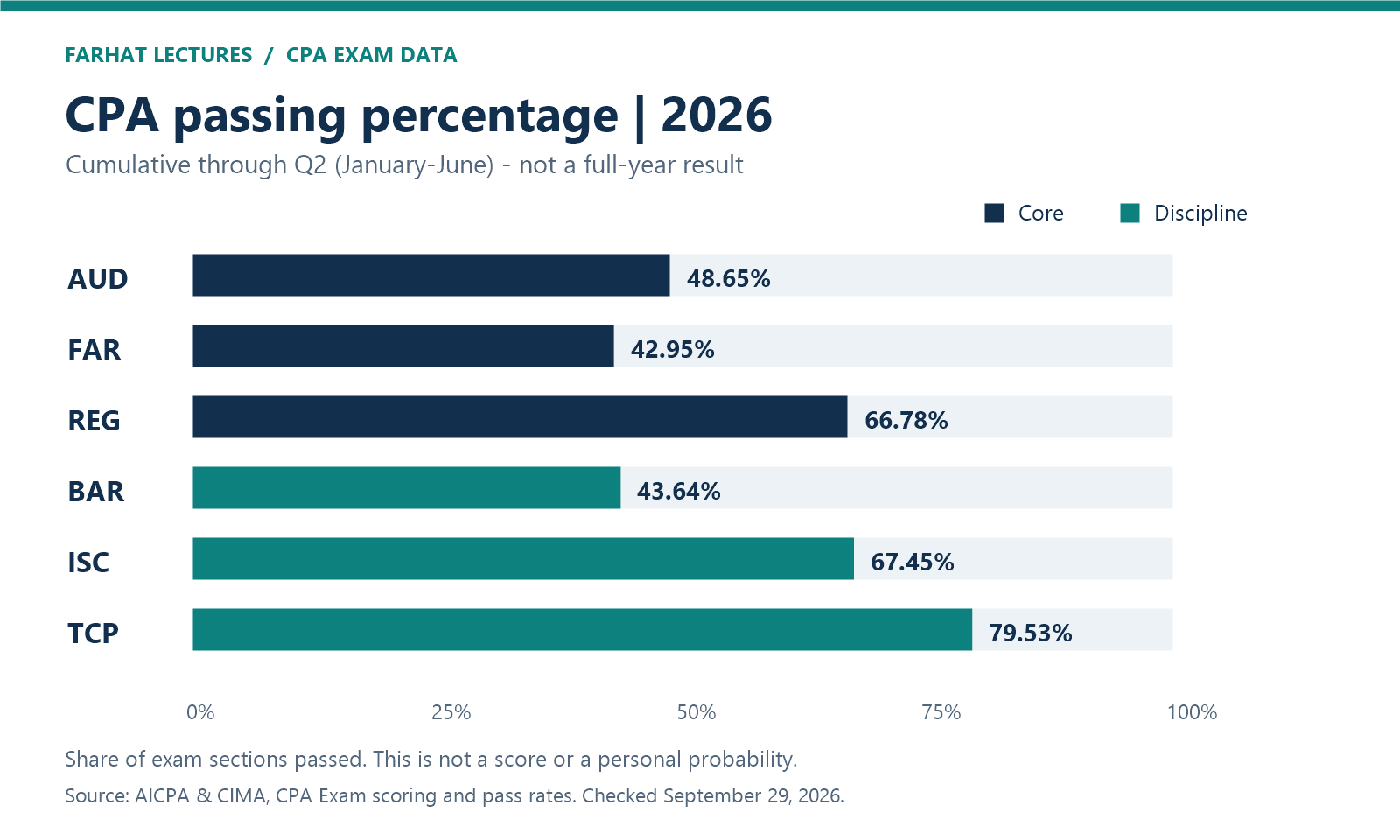
Pass rates add context, but they describe groups of candidates. They are not your personal probability of passing and do not isolate exam difficulty from candidate preparation or experience.
| Section | Type | Pass rate |
|---|---|---|
| FAR | Core | 42.95% |
| AUD | Core | 48.65% |
| REG | Core | 66.78% |
| BAR | Discipline | 43.64% |
| ISC | Discipline | 67.45% |
| TCP | Discipline | 79.53% |
FAR has the lowest cumulative pass rate in this period. These figures cover Q1–Q2, not the full year. Source: AICPA CPA Exam scoring and pass rates, checked October 20, 2026. For quarterly comparisons and an explanation of the passing score, see Farhat Lectures’ CPA passing percentage guide.
Compare the Challenges of All Six CPA Exam Sections
To identify your hardest CPA Exam section, compare the work each section asks you to do with the skills you already use. The following study-planning guide describes possible challenges, not an official ranking of difficulty.
| Section | Possible challenge | Preparation approach |
|---|---|---|
| FAR · Core | Connecting accounting rules, journal entries, and financial statement effects. | Explain the transaction, record the entry, and trace its effect through the statements. |
| AUD · Core | Distinguishing similar procedures and deciding which evidence addresses the stated objective. | Identify the risk or assertion first, then explain why the selected procedure is appropriate. |
| REG · Core | Applying tax and business-law rules to specific facts and exceptions. | Separate the rule, relevant facts, and conclusion; use materials for your testing date. |
| BAR · Discipline | Combining analysis, calculations, and reporting judgments. | Work multistep problems and explain what each calculated result means. |
| ISC · Discipline | Connecting systems, risks, and controls in an unfamiliar scenario. | Describe the system, identify the risk, and explain how a relevant control addresses it. |
| TCP · Discipline | Comparing tax-planning alternatives and their consequences. | State the assumptions, compare alternatives, and explain how a changed fact affects the outcome. |
Use the Farhat Lectures course catalog to find explanations for your section. Candidates take all three Core sections and one Discipline. A higher group pass rate should not replace an assessment of your own knowledge and interests.
Why should you take FAR first?
FAR gives you a framework for understanding financial statements, transactions, and U.S. generally accepted accounting principles (GAAP). In the video, Professor Farhat compares this to building accounting knowledge in college before moving into auditing and taxation. The benefit is a connected learning sequence: later material has something familiar to build on.
How FAR supports AUD
Auditing financial statements is easier to understand when you already know how those statements are prepared. For example, knowing how a sale affects revenue and accounts receivable helps you understand what an auditor is testing. FAR develops the accounting context; AUD adds the audit procedures, evidence, and professional judgment.
How FAR supports REG
Financial accounting also provides a starting point for understanding differences between income reported in the financial statements and income determined under tax rules. Professor Farhat uses deferred taxes and Schedule M-1 as examples of that connection. The underlying lesson is to understand book income before trying to explain book-to-tax adjustments. REG still requires its own focused study of taxation, law, and professional responsibilities.
What is the best CPA Exam section order for you?
For a fuller discussion of exam sequencing, read Professor Farhat’s guide to which CPA exam to take first.
Start with FAR when building your accounting foundation is your main priority. A different starting section can make sense if your recent coursework, work experience, or testing schedule gives you a clear reason. NASBA’s CPA Exam Candidate Guide confirms that you may take the sections in any order. Check your jurisdiction’s credit rules and your Notice to Schedule before booking.
The current exam requires all three Core sections—AUD, FAR, and REG—plus one Discipline: Business Analysis and Reporting (BAR), Information Systems and Controls (ISC), or Tax Compliance and Planning (TCP). See the AICPA’s CPA Exam overview. The video focuses on the three Core sections; include your chosen Discipline in your full plan.
- Need a stronger accounting base? Consider FAR first and allow time to rebuild the fundamentals.
- Have recent audit or tax experience? Compare your readiness for AUD or REG with your FAR readiness before deciding.
- Choosing a Discipline? Consider your interests, background, and its content relationship to the Core sections. Do not choose solely by pass rate.
- Already studying for a section? Evaluate your progress and deadlines before changing direction just because another section has a reputation for being harder.
5 Smart Study Tips for Your Hardest CPA Exam Section
- Map what you need to know. Use the current AICPA Exam Blueprints for your testing date.
- Diagnose the gap. Work a short set of unfamiliar practice questions and a simulation. Record whether errors come from missing concepts, misreading, or time pressure.
- Repair the concept. Study a focused explanation, then work an example without looking at the solution.
- Check transfer. Try a new problem with different facts. Explain why the correct answer works and why the alternatives fail.
- Review cumulatively. Revisit earlier topics while learning new ones so your foundation stays usable.
Your hardest CPA Exam section can become more manageable when each study session addresses a specific weakness. Use unfamiliar questions to check whether you can apply what you learned. For a worked practice example and guidance on reviewing mistakes, read how preparation affects CPA Exam difficulty.
For additional explanations, explore the Intermediate Accounting course or the FAR Becker Supplemental Course. Start with the free sample lessons to see Professor Farhat’s teaching approach.
Video highlights
- 0:00 — Rethinking FAR’s reputation
- 0:06 — FAR as an accounting foundation
- 0:27 — Connections to auditing and tax
- 0:57 — Preparation determines your hardest section
Frequently asked questions
Is FAR the hardest CPA Exam section?
FAR has the lowest cumulative pass rate in the AICPA’s 2026 data through Q2, but your hardest section depends on your preparation and background. Professor Farhat emphasizes identifying your own knowledge gaps.
Do I have to pass FAR before AUD or REG?
No. NASBA permits candidates to take the CPA Exam sections in any order. Taking FAR first is a learning strategy, not a prerequisite for taking AUD or REG.
Why does Professor Farhat recommend FAR first?
FAR builds financial accounting and GAAP knowledge that helps you understand the statements studied in AUD and the accounting concepts connected to REG. The recommendation is based on developing that foundation.
Does passing FAR make the other sections easy?
No. A stronger foundation can make related ideas easier to connect, but every section has its own content and skills. Prepare separately for each Core section and your selected Discipline.
Ready to put it into practice?
Pick a topic in the free sample course and experience Professor Farhat’s step-by-step teaching.
✓ No registration required✓ No credit card required
About the educator: Professor Mansour Farhat, DBA, CPA, CIA, MAcc, is the founder of Farhat Lectures. His lessons explain accounting concepts through practical examples and step-by-step instruction. Learn about Professor Farhat’s background and teaching approach.
This article builds on Professor Farhat’s linked video. Study guidance and Farhat Lectures resources updated October 20, 2026. Pass-rate figures rechecked against the linked AICPA source on October 20, 2026; they cover Q1–Q2 2026. Exam structure and section-order references were originally checked September 15, 2026.




Responses