
CPA Passing Percentage 2026: Pass Rates & Passing Grade

The CPA passing percentage in 2026 ranges from 42.95% for FAR to 79.53% for TCP, using the AICPA’s cumulative results through Q2. There is a separate CPA exam pass rate for each section. The CPA passing grade is 75 on a 0–99 scale; that score does not mean 75% correct.
This guide brings the latest public CPA pass percentage data into one place, with quarterly results, charts, a 2025 comparison, and a practical way to use the numbers in your study plan. Whether you are starting FAR, reviewing AUD, or choosing a Discipline, use the statistics as context for preparation.
CPA passing percentage 2026: latest results by section
The table separates quarterly results from the published cumulative CPA passing percentage. Q1 covers January–March; Q2 covers April–June. Use the cumulative column for the first-half picture, and the quarterly columns to see how the reported rates changed.
| Section | Type | Q1 | Q2 | 2026 through Q2 |
|---|---|---|---|---|
| AUD | Core | 47.80% | 49.38% | 48.65% |
| FAR | Core | 43.46% | 42.47% | 42.95% |
| REG | Core | 66.65% | 66.87% | 66.78% |
| BAR | Discipline | 41.30% | 45.62% | 43.64% |
| ISC | Discipline | 66.79% | 67.98% | 67.45% |
| TCP | Discipline | 79.28% | 79.75% | 79.53% |
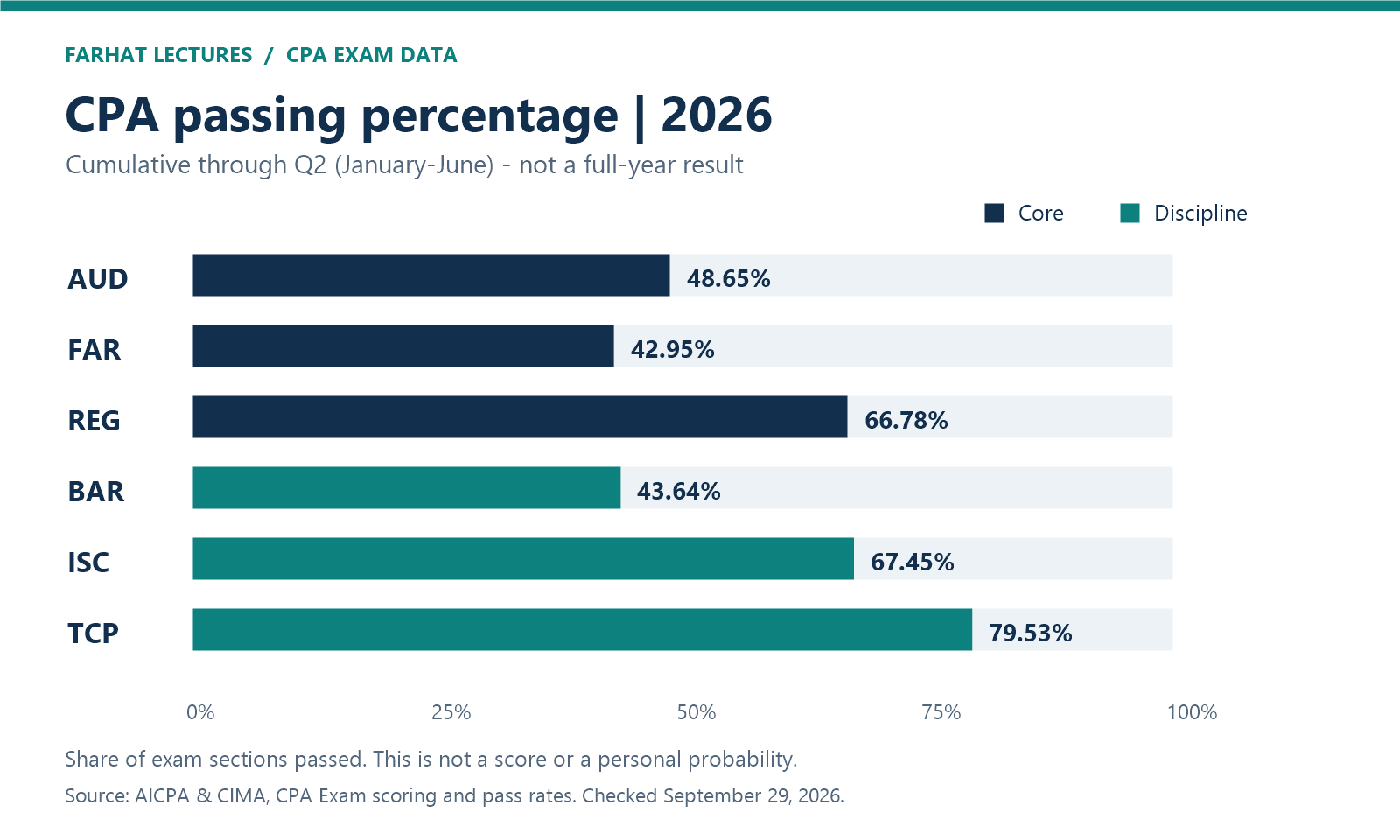
Section names: AUD is Auditing and Attestation; FAR is Financial Accounting and Reporting; REG is Taxation and Regulation; BAR is Business Analysis and Reporting; ISC is Information Systems and Controls; and TCP is Tax Compliance and Planning. Candidates take the three Core sections and one Discipline, according to the AICPA CPA Exam overview.
CPA exam pass rate chart: Q1 vs. Q2 2026
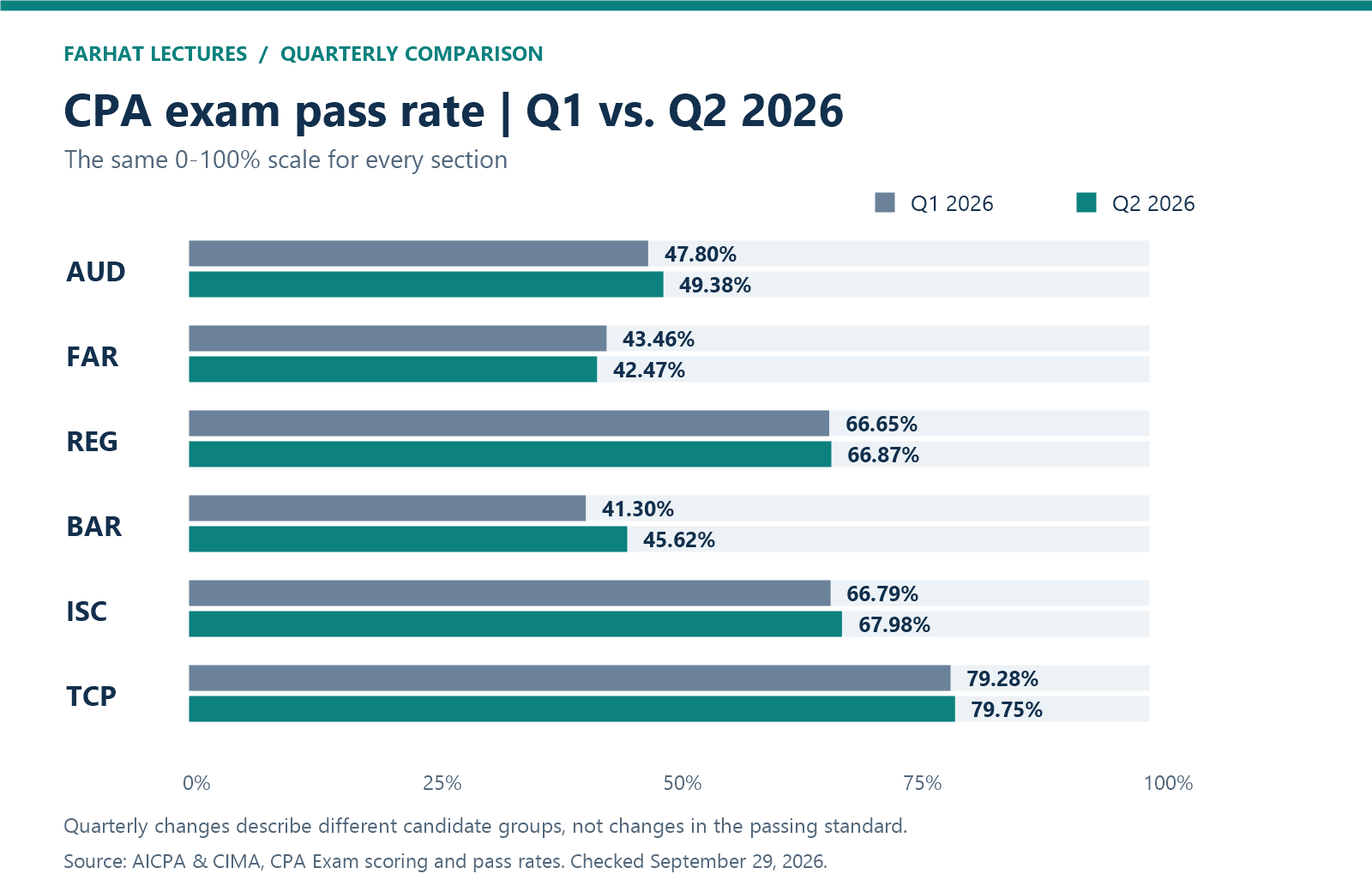
Calculated from the published figures, BAR had the largest Q1-to-Q2 increase: 4.32 percentage points. FAR decreased by 0.99 percentage points. The other four sections increased. These changes describe the tested groups; they do not tell you how your own result will change if you move an appointment.
For example, a move from 41.30% to 45.62% is an increase of 4.32 percentage points. Keeping that distinction clear makes a CPA passing percentage comparison easier to interpret.
CPA pass rate comparison: 2025 and 2026
The 2025 results provide a recent full-year reference. The periods differ: 2025 includes four quarters, while the available 2026 total includes two. Treat this as historical context, rather than a matched first-half comparison or a forecast for December.
| Section | Q1 | Q2 | Q3 | Q4 | 2025 full year |
|---|---|---|---|---|---|
| AUD | 44.30% | 49.05% | 50.03% | 48.78% | 48.21% |
| FAR | 41.67% | 43.52% | 43.07% | 40.20% | 42.12% |
| REG | 62.03% | 63.58% | 66.05% | 60.73% | 63.12% |
| BAR | 37.64% | 47.26% | 39.46% | 39.71% | 41.94% |
| ISC | 61.23% | 71.96% | 66.91% | 66.75% | 67.79% |
| TCP | 74.94% | 80.63% | 76.68% | 76.72% | 77.65% |
Five sections have a higher 2026 cumulative result through Q2 than their 2025 full-year result; ISC is slightly lower. That observation does not establish why performance changed. A useful personal comparison is whether your recent practice shows stronger reasoning, fewer repeated errors, and better pacing than your earlier work.
CPA passing grade: does 75 mean 75% correct?
No. The CPA passing grade is a scaled score of 75, and the reporting scale runs from 0 to 99. A pass percentage describes a group’s exam results. A passing score is the threshold applied to your individual section. The AICPA also confirms that scores are not curved in its CPA Exam scoring FAQs.
CPA passing percentage / CPA pass rate: the share of section attempts that pass in the reported group and period.
CPA passing grade: the minimum scaled score of 75 for each section.
Practice-question accuracy: the percentage you answer correctly in a practice set; it is not an official CPA score conversion.
A practice result can help you identify what to study next. It cannot, by itself, guarantee a 75. Track whether you can explain unfamiliar problems, apply the concept to a new fact pattern, and complete a simulation without depending on a memorized answer. For a fuller explanation, read CPA Exam score of 75 explained.
What the CPA passing percentage can—and cannot—tell you
There is no single “all four sections on the first try” percentage in these quarterly tables. Nor should you take a simple average of the six section rates and call it the overall CPA passing percentage: sections can have different testing volumes, and candidates choose one of three Disciplines.
Multiplying section rates is also not a reliable estimate of an individual’s chance of passing all four. That calculation would require assumptions about the tested populations and the independence of results that these tables do not establish. The figures are useful benchmarks, but your preparation deserves its own assessment.
TCP’s high rate is not a reason to choose it automatically. The AICPA’s discussion of Discipline selection recommends considering education, experience, and interests. Its early CPA Evolution analysis also highlighted differences in candidate preparedness. A tax background may make TCP a natural fit; another candidate’s strengths may align better with BAR or ISC.
Turn the CPA passing percentage into a stronger study plan
Start with the question the numbers cannot answer: what is preventing you from solving the next problem correctly? Use the following process to turn general statistics into specific work.
- Choose current material. Consult the AICPA Exam Blueprints for your testing date. They describe the content, skills, and task types to prepare for. Avoid building a 2026 study plan entirely around an older video or outline.
- Take a diagnostic set. Work unfamiliar multiple-choice questions and a simulation. Label each error: missing concept, calculation mistake, misreading, or time pressure. A specific error category is more actionable than “I am bad at FAR.”
- Repair the underlying concept. Study a focused explanation, write out an example, then solve a different problem with no notes. If you can only repeat the original solution, spend more time on the reasoning before adding speed.
- Practice application and pacing. Schedule both question sets and simulations. Review why incorrect choices fail, and reserve time to work through exhibits carefully. Increase timed practice as your understanding becomes more consistent.
- Review cumulatively. Revisit earlier topics while learning new ones. Keep a short error log and test whether a weakness stays fixed a week later. Use progress across several unfamiliar sets to guide your next study block.
For exam order, see Professor Farhat’s explanation of why taking FAR first can build your accounting foundation. If you need extra conceptual support, explore the Intermediate Accounting course or the FAR Becker Supplemental Course. Match your study resources to your current section and testing date.
After an unsuccessful attempt, use any available Candidate Performance Report to help plan your review. The AICPA cautions that content-area indicators are less reliable than the total score and recommends reviewing all areas when preparing to retest. Do not let one “stronger” label become a reason to stop reviewing that topic.
CPA passing percentage: frequently asked questions
What is the CPA passing percentage for 2026?
The latest published cumulative rates through Q2 are AUD 48.65%, FAR 42.95%, REG 66.78%, BAR 43.64%, ISC 67.45%, and TCP 79.53%. These are section-specific first-half figures, not a full-year result or a first-attempt completion rate.
Which section has the lowest CPA exam pass rate?
FAR has the lowest cumulative rate through Q2 2026 at 42.95%; BAR follows at 43.64%. Your most difficult section may differ. Compare the content with your coursework, work experience, and diagnostic results.
Is the CPA passing grade 75 or 75%?
It is a scaled score of 75 on the 0–99 scale. The score is not a percent-correct grade. A 75% practice result and an official score of 75 measure different things.
Does a higher CPA pass percentage mean the exam is easier?
A group pass rate alone cannot isolate difficulty from preparedness or candidate selection. Do not use a high rate as a substitute for reviewing the section’s content and testing your own readiness.
Can I use the CPA passing percentage to predict my score?
No. The rate describes a group, while your score depends on your performance. Use the tables to understand the testing context and use fresh practice problems, simulations, and an error log to evaluate your preparation.
Where should I check for new 2026 CPA pass-rate data?
Check the AICPA’s pass-rate page for later quarters. For application and jurisdiction information, start with NASBA’s CPA Exam resources.
Historical video: the 2024 exam transition
This article originally covered the 2024 results. The original Professor Farhat video is preserved below as historical context; use the 2026 tables above for current pass rates.
Build understanding, one topic at a time
Choose a lesson in the free sample course and experience Professor Farhat’s step-by-step teaching before planning your next study session.
✓ No registration required
✓ No credit card required




Responses