
Control Number in EPS: Why Income from Continuing Operations Decides Dilution

Part of the Farhat Lectures Intermediate Accounting course.
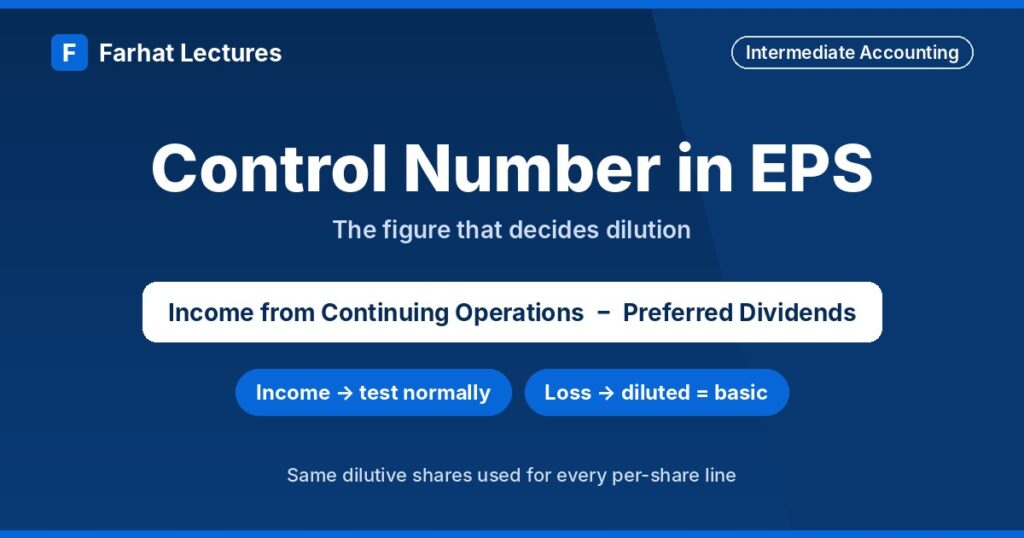
The control number in EPS is income from continuing operations, minus preferred dividends. Under U.S. GAAP (ASC 260), companies test each potentially dilutive security against this figure, then use the same shares for every diluted EPS line, including discontinued operations and net income or net loss.
Quick definitions: potential common shares are securities, such as stock options, convertible bonds, and convertible preferred stock, that could become common stock. A security is dilutive if including it lowers earnings per share or increases loss per share. It is antidilutive if it does the opposite.
This matters whenever a company reports a discontinued operation. Its bottom line and its ongoing business can point in opposite directions: income from continuing operations but a net loss, or the reverse. Without one agreed test figure, the same company could reach different dilution answers on different lines of the income statement.
This guide supports the diluted EPS lessons in intermediate accounting and the EPS topics on the CPA FAR exam. If you need a refresher on the basics, start with our earnings per share guide. It assumes you know how per-share effects are ranked, which is covered in the guide to antidilutive securities. For the general method, see how to calculate diluted EPS.
Watch: How Discontinued Operations Are Reported on the Income Statement
This Farhat lesson covers the income statement layout behind the control number. The video starts at the segment on presenting discontinued operations net of tax, below income from continuing operations.
What is the control number in EPS? The rule in plain words
Under U.S. GAAP, ASC 260-10-45-18 and 45-19 require a company that reports a discontinued operation to use income from continuing operations, adjusted for preferred dividends, as the control number, and to use the same potential common shares for every other diluted per-share amount, even if one of those amounts turns out antidilutive. ASC 260-10-45-20 adds that a similar line item above net income can serve as the control number if one appears on the income statement. Deloitte’s roadmap reproduces paragraph 45-20 and explains why a loss from continuing operations generally results in diluted EPS equaling basic EPS (Deloitte DART, ASC 260 Roadmap 8.7). The original standard adds that the figure is adjusted for preferred dividends (FASB Statement No. 128, paragraph 15). IAS 33 uses profit or loss from continuing operations attributable to the parent (IAS 33, paragraph 42).
Real filers state this in their notes. For example, Pitney Bowes says in a 2024 quarterly report that it uses the control number concept with income from continuing operations as the control number (Form 10-Q on SEC EDGAR).
Why isn’t net income the control number?
Discontinued operations are reported separately, net of tax, below income from continuing operations. If a large discontinued loss creates a net loss, every potential share would reduce the loss per share and look antidilutive. Basic and diluted EPS would then be identical, even though the continuing business is profitable and the securities really would dilute it.
Worked example: income from continuing operations but a net loss
Lakeshore Inc. (hypothetical) has no preferred stock and 900,000 weighted-average common shares. In-the-money options add 100,000 incremental shares under the treasury stock method. Options change only the share count, not the earnings figure (the numerator).
| Line item | Amount |
|---|---|
| Income from continuing operations | $1,800,000 |
| Loss from discontinued operations, net of tax | (2,700,000) |
| Net loss | $(900,000) |
Test with the control number: $1,800,000 ÷ 1,000,000 = $1.80, which is lower than basic EPS from continuing operations of $2.00. The options are dilutive, so the 1,000,000-share denominator is used on every diluted line.
| Per-share amount | Basic (900,000 shares) | Diluted (1,000,000 shares) |
|---|---|---|
| Income from continuing operations | $2.00 | $1.80 |
| Loss from discontinued operations | (3.00) | (2.70) |
| Net loss | $(1.00) | $(0.90) |
Diluted net loss per share of $(0.90) is smaller than basic $(1.00), which looks antidilutive. It is still reported, because consistency with the control number overrides the line-by-line test.
What happens when continuing operations show a loss?
Now flip the facts. Ridgeway Co. (hypothetical) has a $400,000 loss from continuing operations, a $1,000,000 gain from discontinued operations, and net income of $600,000. It has 800,000 weighted-average shares and options worth 100,000 incremental shares.
The control number is a loss, so adding shares would shrink the loss per share. The options are antidilutive and diluted EPS equals basic EPS on every line: continuing operations $(0.50), discontinued operations $1.25, and net income $0.75. A student who tests against net income would wrongly report diluted net income per share of $0.67 ($600,000 ÷ 900,000).
ASC 260 update: A loss from continuing operations generally makes additional shares antidilutive. For certain contracts that can be settled in cash or shares and are accounted for as assets or liabilities, evaluate the combined effect of the earnings adjustment and the added shares. The contract can still be dilutive if including it increases the loss per share. ASU 2025-12 clarifies this for annual reporting periods beginning after December 15, 2026, and interim periods within those years. Early adoption is permitted.
How do preferred dividends change the control number?
The control number is measured after preferred dividends. If income from continuing operations is $150,000 but cumulative preferred dividends are $200,000, the result is a $50,000 loss available to common stockholders. Diluted EPS is then computed the same way as basic EPS. (See how cumulative dividends work in the preferred stock features guide.)
How does the control number show up on the CPA exam?
Basic and diluted EPS are tested in the Financial Accounting and Reporting (FAR) section of the CPA exam. A control number question rarely uses the words “control number.” Instead, the trap sits in the facts:
- A large loss from discontinued operations that turns the bottom line into a net loss.
- A gain from discontinued operations that hides a loss from continuing operations.
- Cumulative preferred dividends that push income from continuing operations below zero for common stockholders.
Before you rank a single security, write down income from continuing operations, subtract preferred dividends, and label the result income or loss. That one step decides the rest of the problem.
Need a refresher on the share math? Review the treasury stock method for options, the if-converted method for convertible securities, and weighted average shares outstanding. For exam-style practice, try the Farhat Lectures FAR test bank.
Summary: which way does dilution go?
| Control number (continuing operations, after preferred dividends) | Bottom line | Diluted EPS treatment |
|---|---|---|
| Income | Net income | Test on continuing operations; same shares used on all lines |
| Income | Net loss | Test on continuing operations; same shares used on all lines |
| Loss | Net income | Diluted generally equals basic on all lines |
| Loss | Net loss | Diluted generally equals basic on all lines |
Key takeaways
- The control number is income from continuing operations minus preferred dividends.
- If it is income, test each security against it. Use the same share count on each diluted line and adjust earnings on the lines the security affects.
- If it is a loss, diluted EPS generally equals basic EPS on every line, even when the company reports net income.
- When a discontinued operation is reported, never test dilution against net income or net loss.
Common mistakes
- Testing dilution against net income or net loss.
- Using different share counts for continuing operations and net income.
- Forgetting to subtract preferred dividends before deciding whether the control number is a loss.
- Dropping potential shares from the net loss line just because that line becomes less negative. For the full ranking process, see the diluted EPS example.
Practice questions with answers
1. Income from continuing operations is $500,000, the loss from discontinued operations is $800,000, and there are 250,000 weighted-average shares. Convertible bonds would add $20,000 after tax and 50,000 shares. Compute diluted EPS for each line.
Answer: Basic continuing EPS is $2.00. The bonds’ effect is $0.40, so they are dilutive. Diluted continuing EPS = $520,000 ÷ 300,000 = $1.73. Discontinued = $(800,000) ÷ 300,000 = $(2.67). Net loss = $(280,000) ÷ 300,000 = $(0.93). Use 300,000 shares on each diluted EPS line. Add the $20,000 of after-tax interest to continuing operations and net loss. The discontinued-operations numerator remains a loss of $800,000. (The lines differ by one cent because of rounding.)
2. A company reports a loss from continuing operations of $(300,000) and net income of $200,000 because of a discontinued gain. Options would add 40,000 shares. Are the options included?
Answer: No. The control number is a loss, so the options are antidilutive. Diluted EPS equals basic EPS on every line.
3. Income from continuing operations is $90,000 and cumulative preferred dividends are $120,000. Does dilution testing proceed normally?
Answer: No. After the preferred dividends, there is a $30,000 loss from continuing operations available to common stockholders, so diluted EPS is computed the same way as basic EPS.
Diluted Earnings per Share: Ranking and Testing Securities
Use this four-question exercise to practice ranking and testing potential common shares for diluted earnings per share (EPS). When a company reports discontinued operations, apply the same ranking process using earnings per share from continuing operations, adjusted for preferred dividends, as the starting point.
Frequently asked questions
What is the control number in EPS?
It is the figure used to decide whether potential common shares are dilutive: income from continuing operations, adjusted for preferred dividends. The same dilutive shares are then used for every diluted per-share amount the company reports.
Why not use net income as the control number?
A company can earn income from continuing operations but report a net loss because of discontinued operations. Testing against the net loss would make every potential share antidilutive, hiding real dilution in the ongoing business.
What happens to diluted EPS when there is a loss from continuing operations?
Diluted EPS generally equals basic EPS when adding potential common shares reduces the loss per share. For certain contracts settleable in cash or shares, also consider the earnings adjustment. The combined effect can be dilutive if it increases the loss per share.
Can a diluted per-share amount be antidilutive and still be reported?
Yes. Once the control number shows the shares are dilutive, those same shares are used for discontinued operations and net income or loss, even if one of those amounts becomes less negative.
Is the control number the same under IFRS?
Almost. IAS 33, paragraph 42, uses profit or loss from continuing operations attributable to the parent entity as the control number. It is adjusted for preference dividends and excludes anything related to discontinued operations, so the logic matches U.S. GAAP.
What is the control number if a company has no discontinued operations?
When nothing is reported between income from continuing operations and net income, the two numbers are the same. The dilution test then simply runs on net income or net loss available to common stockholders, after preferred dividends.
Is the control number tested on the CPA exam?
Yes. Basic and diluted EPS are part of the FAR section of the CPA exam. A question that includes discontinued operations or cumulative preferred dividends is really testing whether you start from the right control number.
Sources: Deloitte DART, ASC 260-10-45-20; FASB Statement No. 128, Earnings per Share; IFRS Foundation, IAS 33 Earnings per Share.
About the author: Mansour Farhat, CPA, CIA, DBA, teaches accounting and CPA exam topics through Farhat Lectures, including the Intermediate Accounting course and the lessons on the Farhat Lectures YouTube channel.
Continue learning with Farhat Lectures
Practice diluted EPS problems like these with clear explanations and guided practice.
Explore the free sample course



Responses