
Target Profit Formula: Examples & Interactive Practice

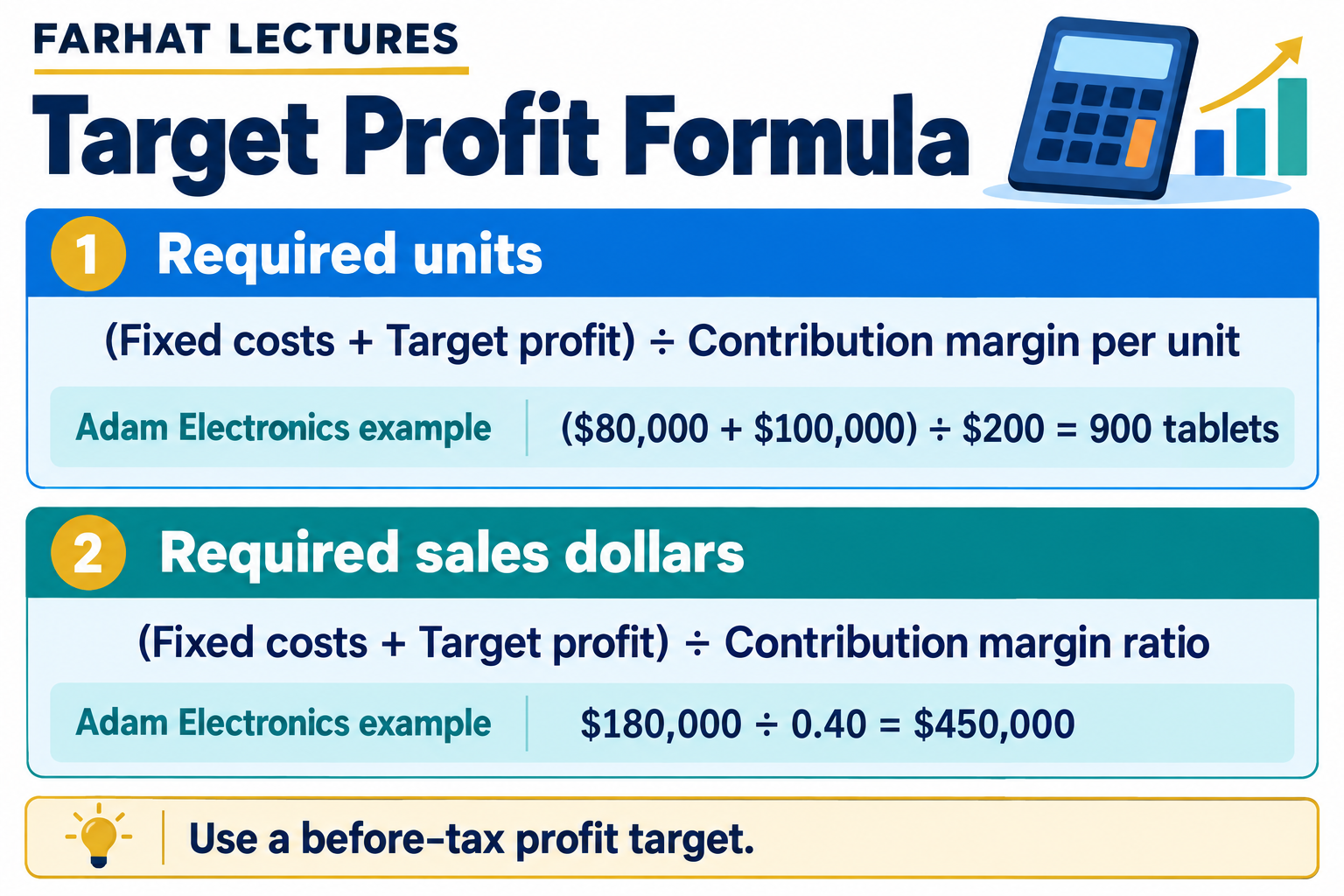
The target profit formula tells you how many units—or how much sales revenue—you need to earn a desired profit. Required unit sales = (Fixed costs + Target profit) ÷ Contribution margin per unit. This is an extension of cost-volume-profit (CVP) and break-even analysis.
For sales dollars: Required sales revenue = (Fixed costs + Target profit) ÷ Contribution margin ratio. Use a before-tax profit target in these formulas; convert an after-tax target first, as shown below.
Learn the target profit formula through two worked examples, then test your understanding with an interactive exercise covering contribution margin, break-even sales, and target profit.
Worked Example: How Many Tablets Must Adam Sell?
Adam Electronics sells tablets for $500 each, incurs $300 of variable costs per tablet, and has $80,000 in monthly fixed costs. It wants to earn $100,000 in monthly operating profit before tax.
- Find contribution margin: $500 − $300 = $200 per tablet. The contribution margin ratio is $200 ÷ $500 = 40%.
- Calculate required units: ($80,000 + $100,000) ÷ $200 = 900 tablets.
- Calculate required sales: ($80,000 + $100,000) ÷ 0.40 = $450,000. This also equals 900 tablets × $500.
Check the answer: $450,000 sales − $270,000 variable costs − $80,000 fixed costs = $100,000 operating profit. The sales must cover both fixed costs and the desired profit after variable costs have been paid.
Target Profit Practice Problems: Interactive Exercise
Use the operating data below to calculate contribution margin, break-even sales, and the units and sales revenue needed to reach the target profit.
Watch: Target Profit Analysis and CVP
In this Farhat lecture, follow the same Adam Electronics example, calculate target sales in units and dollars, and then adjust the profit target for income taxes.
Jump to a worked example: 3:21 — before-tax target profit · 7:40 — after-tax target profit · 11:37 — practice question.
Understanding the Components of Target Profit Analysis
- Sales: Units sold × selling price per unit. Adam’s selling price is $500 per tablet.
- Variable expenses: Costs that change in total with sales volume. Adam incurs $300 per tablet; at 900 tablets, total variable expenses are $270,000.
- Contribution margin: Sales minus variable expenses. Each tablet contributes $200 toward fixed expenses and then profit. Contribution margin is not the same as gross profit.
- Fixed expenses: Costs that remain constant in total within the relevant range and time period. Adam’s monthly fixed expenses are $80,000.
Target Profit Formula in Units and Sales Dollars
Start with the CVP equation: Operating profit = (Selling price per unit − Variable cost per unit) × Units sold − Fixed costs. Rearranging it gives the target profit analysis formula:
Required unit sales = (Fixed costs + Target operating profit) ÷ Contribution margin per unit.
When the question asks for sales dollars, divide by the contribution margin ratio instead. Contribution margin ratio = Contribution margin per unit ÷ Selling price per unit. Use the ratio as a decimal: 40% = 0.40.
Required sales revenue = (Fixed costs + Target operating profit) ÷ Contribution margin ratio. For Adam: $180,000 ÷ 0.40 = $450,000.
Dividing only the $100,000 profit target by 40% gives $250,000 of sales, which is insufficient. At that sales level, contribution margin is $100,000 and operating profit is only $20,000 after the $80,000 fixed costs. Always include fixed costs in the numerator.
Break-Even vs. Target Profit
Break-even analysis uses the same formulas with a target profit of zero. Adam breaks even at $80,000 ÷ $200 = 400 tablets, or $80,000 ÷ 0.40 = $200,000 in sales.
At 400 tablets, sales of $200,000 minus variable expenses of $120,000 leave $80,000 of contribution margin—exactly enough to cover fixed expenses. To move from break-even to $100,000 of operating profit, Adam needs another 500 tablets: $100,000 ÷ $200 = 500.
After-Tax Target Profit Formula with Example
If the goal is profit after income taxes, first calculate the required pretax profit: Pretax profit target = After-tax profit target ÷ (1 − Tax rate). The tax rate here is hypothetical, and the simplified example assumes no interest or other nonoperating items.
Suppose Adam wants to keep $100,000 after tax and the assumed tax rate is 20%. The required pretax profit is $100,000 ÷ (1 − 0.20) = $125,000. This is pretax profit, not sales revenue and not gross profit.
- Required units: [$80,000 + ($100,000 ÷ 0.80)] ÷ $200 = 1,025 tablets.
- Required sales dollars: [$80,000 + ($100,000 ÷ 0.80)] ÷ 0.40 = $512,500.
| Income statement item | Amount |
|---|---|
| Sales: 1,025 × $500 | $512,500 |
| Less variable expenses: 1,025 × $300 | ($307,500) |
| Contribution margin | $205,000 |
| Less fixed expenses | ($80,000) |
| Pretax profit | $125,000 |
| Less income tax: $125,000 × 20% | ($25,000) |
| After-tax profit | $100,000 |
Adam therefore needs 125 more tablets to earn $100,000 after tax than it needs to earn $100,000 before tax. The extra contribution margin covers the $25,000 tax expense in this example.
Tips for Using the Target Profit Formula
- Round required units up. If the result is 900.2 whole products, sell at least 901 to meet the target.
- Match the denominator to the question. Use contribution margin per unit for units and the contribution margin ratio for sales dollars.
- Keep the time period consistent. Monthly fixed costs must be paired with a monthly profit target.
- Check the assumptions. Selling price and variable cost per unit are constant, fixed costs stay constant within the relevant range, and unit contribution margin is positive. For multiple products, use a consistent sales mix and an appropriate weighted-average contribution margin.
For additional accounting instruction and practice, explore the Farhat Lectures Managerial Accounting course or try the free sample course.



Responses