
Diluted EPS: How to Calculate Diluted Earnings per Share


Diluted EPS (diluted earnings per share) is what each common share would have earned if every dilutive security, such as convertible bonds, convertible preferred stock, stock options, and warrants, had become common stock. The formula is: (net income − preferred dividends + after-tax interest and preferred dividends on dilutive convertibles) ÷ (weighted-average common shares + dilutive potential common shares).
Securities that would raise EPS from continuing operations are antidilutive and are left out.
Why does this matter? Basic EPS only counts shares that exist today. If a company has $50 million of bonds that holders can swap for stock, today’s shareholders could soon be sharing earnings with many more owners. Diluted EPS shows investors the effect of assumed dilution under ASC 260. For accounting students, it is a core calculation in intermediate accounting and on the FAR (Financial Accounting and Reporting) section of the CPA exam.
This guide supports the Diluted Earnings per Share lesson in the Farhat Lectures Intermediate Accounting course. It covers when a company reports diluted EPS, the formula, a five-step process with a full example, contingent shares, and how EPS is presented and disclosed. If you need a refresher on basic EPS and weighted-average shares first, start with the earnings per share guide, then review weighted-average shares outstanding and preferred dividends in EPS.
Watch: Basic and Diluted Earnings Per Share Comprehensive Example
Watch this Farhat lesson on YouTube
In this 24-minute lesson, Professor Farhat works through a full example that computes basic EPS and then diluted EPS, step by step, the way it is tested in intermediate accounting and on the CPA exam.
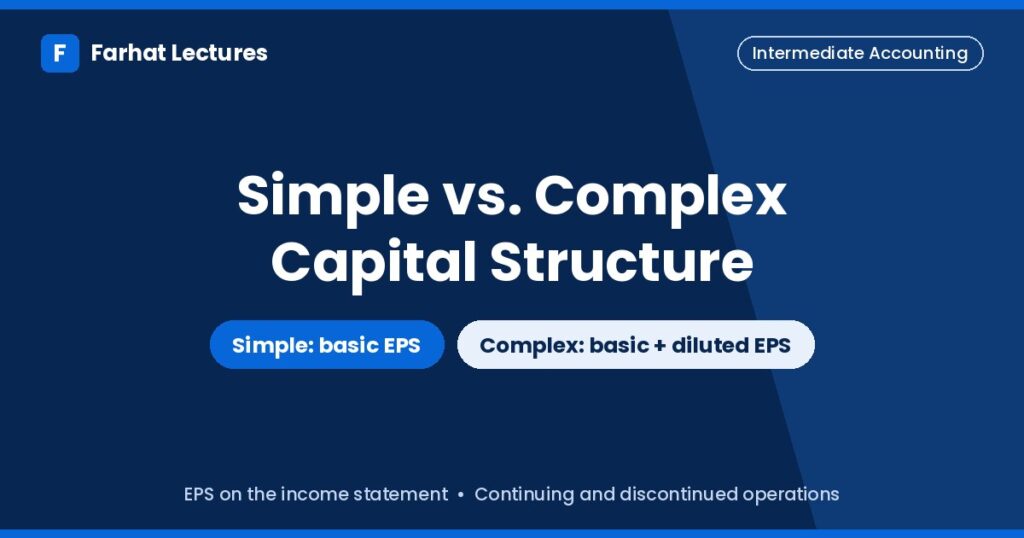
Simple vs. complex capital structure
A company’s capital structure is the mix of securities it has issued. For EPS purposes, the question is simple: does the company have anything outstanding that could become common stock?
| Simple capital structure | Complex capital structure | |
|---|---|---|
| What the company has | Only common stock and nonconvertible preferred stock | Convertible securities, options, warrants, or other rights that could become common stock |
| EPS reported | Basic EPS only | Basic EPS and diluted EPS |
| Diluted EPS compared with basic | Not applicable | Equal to or lower than basic EPS for income from continuing operations |
Securities that could become common stock are called potential common shares. Securities that would lower EPS from continuing operations are dilutive securities. Those that would raise that EPS (or shrink a loss per share from continuing operations) are antidilutive securities and are left out. If every potential common share is antidilutive, diluted EPS is the same as basic EPS.
For more on classifying a company’s capital structure, see simple vs. complex capital structure.
The diluted EPS formula
Under U.S. GAAP, the rules for diluted EPS come from FASB ASC 260, Earnings per Share. Companies reporting under IFRS follow IAS 33, which uses the same basic approach.
| Part | Basic EPS | Diluted EPS |
|---|---|---|
| Numerator | Net income − preferred dividends | Same, plus after-tax interest on dilutive convertible bonds and dividends on dilutive convertible preferred stock |
| Denominator | Weighted-average common shares outstanding | Same, plus shares from dilutive convertibles, options, warrants, and contingent shares |
Two methods produce those adjustments:
- The if-converted method handles convertible bonds and convertible preferred stock. It changes both the numerator and the denominator.
- The treasury stock method handles stock options and warrants. It only changes the denominator. For how warrants are issued in the first place, see stock warrants vs. stock rights.
Both methods assume the conversion or exercise happened at the beginning of the year, or on the day the security was issued if that was later. Deloitte’s ASC 260 roadmap on diluted EPS summarizes the U.S. GAAP rules, and the IFRS Foundation’s IAS 33 Earnings per Share page covers the international standard, which follows the same basic approach.
How to calculate diluted EPS in 5 steps
- Compute basic EPS. Subtract preferred dividends from net income and divide by weighted-average common shares.
- List every potential common share. Look for convertible bonds, convertible preferred stock, options, warrants, and contingent share agreements.
- Measure each security’s effect. Use the if-converted method for convertibles and the treasury stock method for options and warrants. For each one, note the change to the numerator and the extra shares.
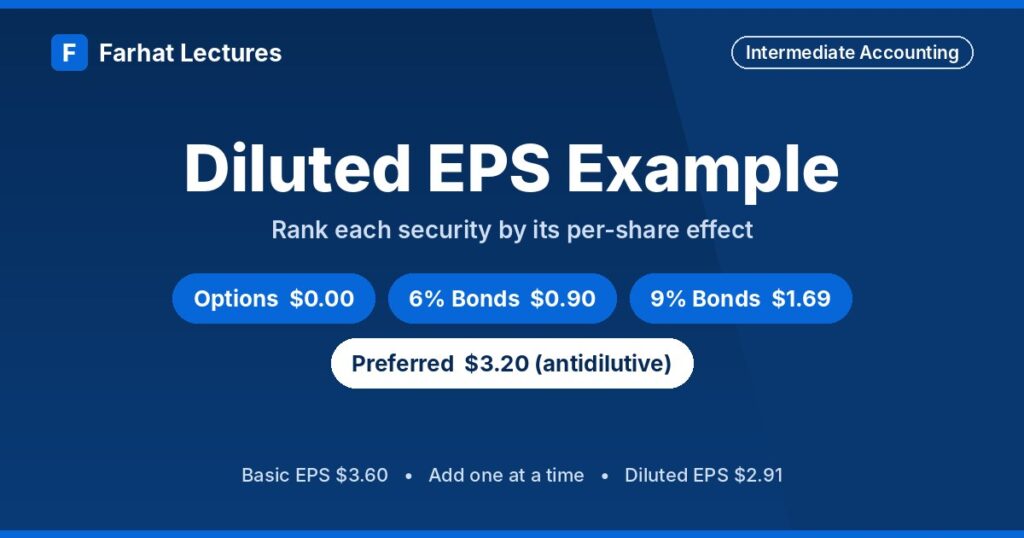
- Drop antidilutive securities. Any security that would raise EPS stays out. Run this test on income from continuing operations (called the control number), not on net income. With several securities, add them one at a time, starting with the most dilutive, and compare each one with the running EPS figure.
- Compute and report diluted EPS. Divide the adjusted numerator by the adjusted denominator, and show it on the income statement next to basic EPS.
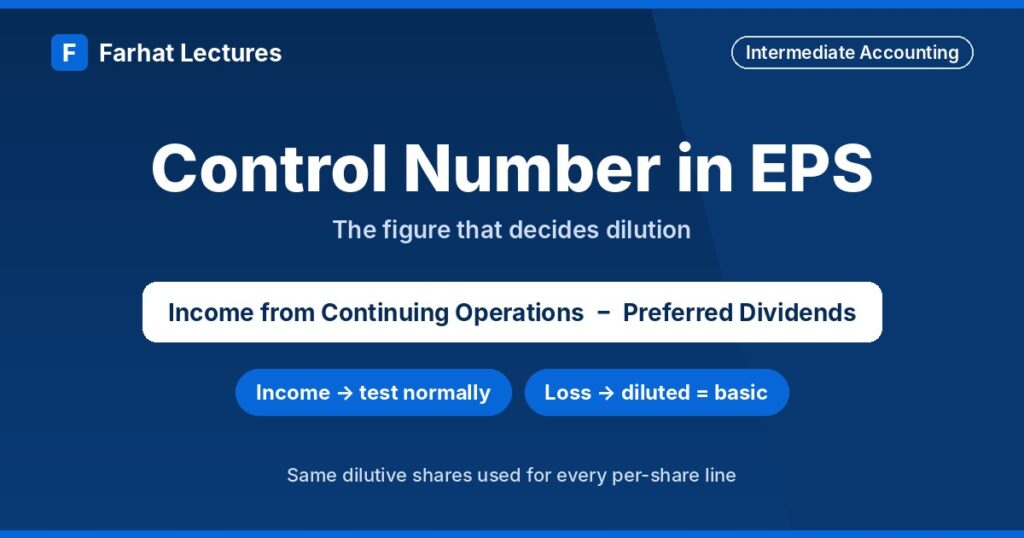
What is the control number?
When a company reports discontinued operations, it shows EPS for more than one line: income from continuing operations, discontinued operations, and net income. The antidilution test is run only on income from continuing operations (after preferred dividends). This figure is called the control number.
If a security is dilutive to the control number, it is included in every diluted EPS line, even if it makes the discontinued operations or net income figure look better. If the company has a loss from continuing operations, every security is left out, and each diluted EPS line equals its basic EPS line, even if net income is positive.
Worked example: diluted EPS with a convertible bond and options
Example (hypothetical). Brightline Co. reports net income of $600,000. It has no preferred stock, and its weighted-average common shares outstanding were 200,000. The tax rate is 25%. Two securities were outstanding all year:
- $1,000,000 of 5% bonds, issued at par in a prior year and convertible into 40,000 common shares.
- 20,000 stock options with an exercise price of $30. The average market price of the stock during the year was $40.
Step 1, basic EPS: $600,000 ÷ 200,000 = $3.00.
Steps 2 and 3, the effect of each security:
| Security | Numerator change | Extra shares | Effect per extra share |
|---|---|---|---|
| Options (treasury stock method) | $0 | 20,000 − ($600,000 ÷ $40) = 5,000 | $0.00 |
| 5% convertible bonds (if-converted method) | $50,000 × (1 − 25%) = $37,500 | 40,000 | $37,500 ÷ 40,000 = $0.94 |
Step 4, test for antidilution one security at a time, starting with the most dilutive. The options have the lowest effect per extra share ($0.00), so add them first: $600,000 ÷ 205,000 = $2.93. Next, the bonds: their $0.94 effect per extra share is below $2.93, so adding them lowers EPS again. Both securities are dilutive.
Step 5, diluted EPS: ($600,000 + $37,500) ÷ (200,000 + 5,000 + 40,000) = $637,500 ÷ 245,000 = $2.60.
Brightline reports basic EPS of $3.00 and diluted EPS of $2.60. The $0.40 gap tells investors how much per-share earnings could shrink if the bondholders converted and the option holders exercised.
Ready for a harder problem? The diluted EPS example with multiple securities works through options, convertible bonds, and convertible preferred stock together.
Contingently issuable shares
Sometimes a company promises to issue extra shares later if a condition is met. This often happens when it buys another business: it may promise the sellers more shares if the acquired company hits an earnings target or if the stock price reaches a set level. These are called contingently issuable shares (or contingent shares).
One thing that does not count: shares the company must issue just because time passes. Time passing is not a real condition, since nothing can stop it, so those shares are not contingently issuable. They are generally treated as outstanding and counted in basic EPS.
For diluted EPS, treat the reporting date as the end of the contingency period. Include the shares that would be issuable under the agreement on that basis if their effect is dilutive. Count them from the beginning of the reporting period or the date of the agreement, whichever is later.
Basic EPS works differently. Contingent shares enter basic EPS only from the date all the conditions are actually met, because that is when issuing them is no longer in doubt.
Example (hypothetical). At the start of the year, Orion Corp. agreed to give the former owners of a company it bought 10,000 more shares if the acquired company earned at least $500,000 that year. The acquired company earned $540,000. The condition is met at year-end. Assume the shares are dilutive, so Orion includes all 10,000 in its diluted EPS denominator for the whole year. Because the target is measured over the full year, it is only satisfied when the year ends, so the shares enter basic EPS starting from that date. Had the acquired company earned only $460,000, the shares would be left out of both.
How diluted EPS is presented and disclosed
A company with a complex capital structure shows both figures on the face of the income statement, usually right below net income:
| Earnings per common share | Amount |
|---|---|
| Basic earnings per share | $3.00 |
| Diluted earnings per share | $2.60 |
A few more presentation rules apply:
- Discontinued operations: if the company reports a discontinued operation, it shows per-share amounts for income from continuing operations, discontinued operations, and net income, for both basic and diluted EPS. The discontinued operations amount can be on the face of the income statement or in the notes.
- All periods: EPS is shown for every period presented. If diluted EPS is reported for any period, it is reported for all periods, even when it equals basic EPS.
- Restatements: prior-period EPS is restated for stock dividends and stock splits, and for prior-period adjustments caused by errors or changes in accounting principle.
The notes must also include:
- A description of the rights and privileges of the securities outstanding.
- A reconciliation of the numerators and denominators of basic and diluted EPS for income from continuing operations, showing each security’s effect on income and shares.
- The effect of preferred dividends on income available to common stockholders.
- Securities left out of diluted EPS because they were antidilutive but could dilute EPS in the future.
- A description of any transaction after year-end, but before the financial statements are issued, that would have materially changed the number of common shares or potential common shares outstanding (for example, a large conversion or a new share issuance).
Using the Brightline numbers, the reconciliation would look like this:
| Income (numerator) | Shares (denominator) | Per share | |
|---|---|---|---|
| Basic EPS | $600,000 | 200,000 | $3.00 |
| Stock options | — | 5,000 | |
| 5% convertible bonds, net of tax | 37,500 | 40,000 | |
| Diluted EPS | $637,500 | 245,000 | $2.60 |
Investors also use EPS in ratios. The price-earnings (P/E) ratio divides the market price per share by EPS, and comparing EPS with dividends per share shows how well earnings cover the dividend. Because share buybacks shrink the denominator, EPS can rise even when net income does not, so it is best read alongside other profitability measures.
Want more practice? Work through the diluted EPS CPA exam simulation in the Intermediate Accounting course.
Key takeaways on diluted EPS
- Companies with a complex capital structure report both basic and diluted EPS.
- Diluted EPS adds the income and shares that dilutive securities would create, assuming conversion or exercise at the start of the year or at issuance.
- Convertibles use the if-converted method; options and warrants use the treasury stock method.
- Antidilutive securities are excluded, so diluted EPS from continuing operations is never higher than basic EPS.
- The notes reconcile basic to diluted EPS and list antidilutive securities that were left out.
Common mistakes
- Adding the conversion shares for a convertible bond but forgetting to add back its after-tax interest.
- Adding back interest before tax instead of net of tax.
- Adding back the bond’s cash coupon instead of its interest expense when the bond was issued at a discount or premium. The add-back is the after-tax interest expense, including the discount or premium amortization.
- Including options whose exercise price is above the average market price.
- Counting a full year of shares for a security issued partway through the year.
- Reporting a diluted EPS from continuing operations that is higher than basic EPS. If that happens, something antidilutive slipped in.
- Including contingent shares that would not be issuable if the reporting date were the end of the contingency period, or that would be antidilutive.
Interactive basic vs. diluted EPS practice
Answer three multiple-choice questions on earnings available to common shareholders, weighted-average common shares outstanding, and the effect of dilutive securities on earnings per share. Then use the worked questions below to practice calculating EPS.
Practice questions with answers
1. Net income is $450,000 and weighted-average shares are 150,000. There are 10,000 options outstanding all year with an exercise price of $20, and the average market price was $25. What are basic and diluted EPS?
Answer: Basic EPS is $450,000 ÷ 150,000 = $3.00. Under the treasury stock method, the assumed proceeds of $200,000 (10,000 × $20) buy back 8,000 shares at $25, so the options add 2,000 shares. Diluted EPS is $450,000 ÷ 152,000 = $2.96.
2. A company has a loss from continuing operations and has convertible bonds outstanding. What is its diluted loss per share?
Answer: It equals the basic loss per share. Adding shares to a loss would make the loss per share smaller, which is antidilutive, so the bonds are excluded.
3. A company agreed to issue 5,000 shares if an acquired subsidiary earns $300,000 in a year. This year the subsidiary earned $280,000. Are the shares included in diluted EPS?
Answer: No. Treating year-end as the end of the contingency period, the $300,000 target has not been met, so the contingent shares are left out of diluted EPS.
Frequently asked questions
What is the difference between basic and diluted EPS?
Basic EPS divides income available to common stockholders by the weighted-average common shares actually outstanding. Diluted EPS also assumes that dilutive convertible securities, options, and warrants became common stock, so it adds their income effect and their extra shares.
Can diluted EPS be higher than basic EPS?
Yes, diluted EPS for net income can exceed basic EPS for net income. Securities that reduce EPS from continuing operations are included in every diluted EPS line, even if they increase EPS for net income or reduce a net loss per share. Diluted EPS from continuing operations is always equal to or lower than basic EPS from continuing operations.
Which companies have to report diluted EPS?
Under FASB ASC 260, companies whose common stock or potential common stock trades publicly, or that are filing to go public, must report EPS. Those with a complex capital structure, meaning convertible securities, options, warrants, or other rights that could become common stock, report both basic and diluted EPS. Companies with a simple capital structure report only basic EPS. Private companies do not have to report EPS, but if they choose to, they must follow ASC 260.
Why do we assume conversion at the beginning of the year?
Diluted EPS shows the result as if the securities had been common stock for the whole period. If a security was issued during the year, the assumption starts on its issue date instead, so its shares are weighted for the part of the year it was outstanding.
Is diluted EPS tested on the CPA exam?
Yes. Basic and diluted EPS are part of the AICPA’s FAR (Financial Accounting and Reporting) blueprint, so expect questions that combine the if-converted method, the treasury stock method, and antidilution tests.
What is the control number in diluted EPS?
The control number is income from continuing operations, after preferred dividends. The antidilution test is run on this figure. A security that is dilutive to it is included in every diluted EPS line. If it is a loss, no security is included, and diluted EPS equals basic EPS on every line.
Are shares issued after the passage of time contingently issuable?
No. Shares a company must issue just because time passes are not contingently issuable, because nothing can stop the issuance. They are generally treated as outstanding and counted in basic EPS.
About the author
Mansour Farhat, CPA, CIA, DBA, teaches intermediate accounting and CPA exam topics through Farhat Lectures courses and the Farhat Lectures YouTube channel. His lessons focus on worked examples like the ones on this page, so students can see each step before trying it on their own.
Continue learning with Farhat Lectures
Strengthen your accounting understanding with clear explanations and guided practice.
Explore the free sample course

Responses