
Simple vs. Complex Capital Structure: How EPS Is Presented on the Income Statement

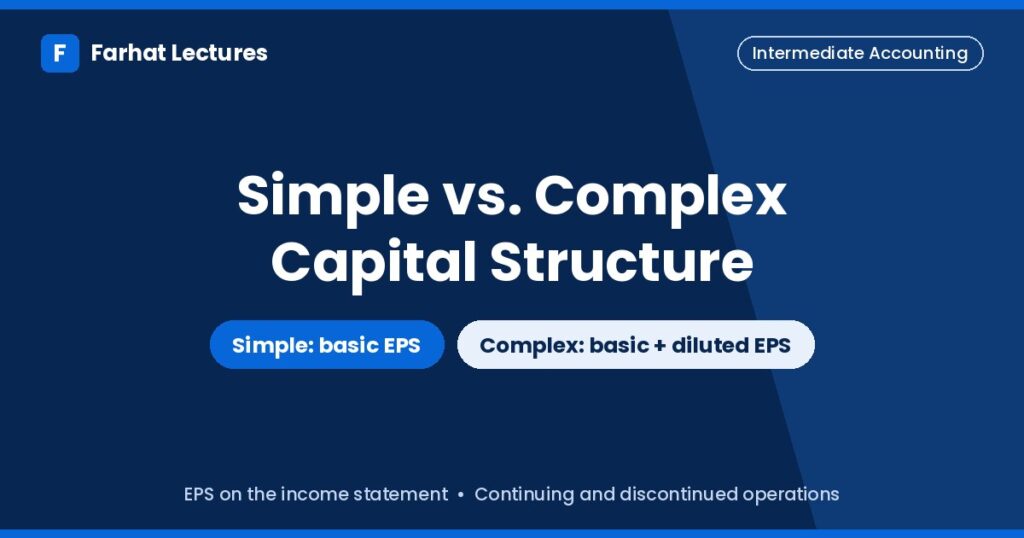
A simple capital structure has only common stock outstanding (nonconvertible preferred stock and ordinary bonds are fine), so the company reports basic EPS only. A complex capital structure includes potential common stock, such as convertible bonds, convertible preferred stock, options, or warrants, so the company reports both basic and diluted EPS with equal prominence.
It’s the first thing to identify in any EPS problem, because the capital structure tells you which per-share figures the income statement needs. This lesson covers the classification and the presentation rules. For the full picture, start with earnings per share (EPS): basic and diluted EPS explained; for the diluted calculation itself, see how to calculate diluted EPS.
Watch: Earnings per share and capital structure (starts at 4:35, simple vs. complex capital structures)
What is the difference between a simple and complex capital structure?
A potentially dilutive security (the standard calls it potential common stock) is anything that could add common shares if it were converted or exercised, which could reduce EPS. Its mere presence makes the capital structure complex, even in a year when it turns out to be antidilutive, meaning it would raise EPS instead of lowering it.
| Feature | Simple capital structure | Complex capital structure |
|---|---|---|
| What is outstanding | Common stock, and possibly nonconvertible preferred stock | Common stock plus at least one potentially dilutive security |
| Examples of securities | Common stock; nonconvertible preferred stock; nonconvertible bonds | Convertible bonds, convertible preferred stock, stock options, stock warrants |
| EPS reported on the income statement | Basic EPS | Basic and diluted EPS, with equal prominence |
| Shares in the denominator | Weighted average common shares | Basic: weighted average common shares; diluted: also dilutive potential common shares |
How do you classify a company’s capital structure?
Ask one question: does the company have anything outstanding that could become common stock? If yes, the structure is complex. If no, it is simple.
| Company has outstanding | Capital structure |
|---|---|
| Common stock only | Simple |
| Common stock and nonconvertible cumulative preferred stock | Simple |
| Common stock and ordinary (nonconvertible) bonds payable | Simple |
| Common stock and convertible preferred stock | Complex |
| Common stock and employee stock options | Complex |
| Common stock and stock warrants | Complex |
Nonconvertible preferred stock does not make the structure complex, but it still affects EPS through the numerator. See preferred dividends in EPS.
Each type of potential common stock enters diluted EPS its own way. Convertible bonds and convertible preferred stock use the if-converted method, and options and warrants use the treasury stock method.
How is EPS presented on the income statement?
EPS appears below net income on the face of the income statement. Under FASB ASC 260-10-45-2, a company with a simple capital structure presents basic per-share amounts for income from continuing operations and for net income. All other companies present basic and diluted amounts for both lines, with equal prominence. Deloitte’s EPS Roadmap presentation chapter reproduces this guidance.
If the company reports a discontinued operation, it must also present per-share amounts for that line (basic, plus diluted if the structure is complex), either on the face of the income statement or in the notes (ASC 260-10-45-3). Showing each component helps readers separate results that will continue from those that will not.
Do you still show diluted EPS if it equals basic EPS?
Yes. Once a company has a complex capital structure, it presents diluted EPS for every period shown on the income statement, even in a year when diluted EPS turns out to equal basic EPS. If the two amounts are the same for all periods presented, the company can show them together on one line (ASC 260-10-45-7).
Worked example: Alder Co.
Hypothetical example. Alder Co. has common stock and nonconvertible cumulative preferred stock, so its capital structure is simple. Its annual preferred dividend is $40,000, and its weighted average shares outstanding are 160,000.
| Item | Amount |
|---|---|
| Income from continuing operations | $680,000 |
| Loss from discontinued operations, net of tax | ($80,000) |
| Net income | $600,000 |
| Earnings per common share | Calculation | Amount |
|---|---|---|
| Income from continuing operations | ($680,000 − $40,000) ÷ 160,000 | $4.00 |
| Loss from discontinued operations, net of tax | ($80,000) ÷ 160,000 | (0.50) |
| Net income | ($600,000 − $40,000) ÷ 160,000 | $3.50 |
The components add up: $4.00 − $0.50 = $3.50. If Alder also had convertible bonds outstanding, it would show a second column for diluted EPS beside each line.
What is the control number in EPS?
When a company with a complex capital structure also reports a discontinued operation, the control number is income or loss from continuing operations attributable to the parent, adjusted for applicable preferred dividends. You test each security for dilution against that line only. Then you use the same share count for the discontinued operations and net income lines, even if the result looks antidilutive there (ASC 260-10-45-18 through 45-20).
Hypothetical example. Juniper Corp. has 100,000 weighted average common shares, and its stock options add 25,000 incremental shares under the treasury stock method. It reports income from continuing operations of $100,000, a loss from discontinued operations of ($300,000), and a net loss of ($200,000).
| Earnings per common share | Basic (100,000 shares) | Diluted (125,000 shares) |
|---|---|---|
| Income from continuing operations | $1.00 | $0.80 |
| Loss from discontinued operations | (3.00) | (2.40) |
| Net loss | (2.00) | (1.60) |
The options are dilutive for continuing operations ($0.80 is lower than $1.00), so they’re used on every line. That’s why diluted net loss per share, ($1.60), is smaller than basic net loss per share, ($2.00). It’s not a mistake; it’s the control number rule at work. For more, see antidilutive securities in diluted EPS.
Who must report EPS?
Public companies, meaning those whose common stock or potential common stock trades in a public market, or that are filing to issue such securities, must report EPS. Nonpublic companies are exempt because the cost of preparing EPS outweighs the benefit for their users.
Common mistakes
- Calling any preferred stock “complex.” Among preferred stock, only the convertible kind creates a complex structure.
- Thinking a complex structure always lowers EPS. Diluted EPS can equal basic EPS when securities are antidilutive.
- Dropping basic EPS for a complex structure. Both basic and diluted EPS are presented.
- Forgetting the continuing operations line. Per-share amounts for continuing operations and net income both go on the face of the statement.
- Ignoring preferred dividends in the continuing operations line. Subtract them from that line too.
Exam tip: Before you calculate anything, scan the facts for convertibles, options, warrants, or contingently issuable shares. If you find even one, the question needs both basic and diluted EPS. If you find none, stop at basic EPS.
Interactive EPS Concept Check
Earnings per Share (EPS): Simple vs. Complex Capital Structure
Test whether convertible preferred stock and stock options create potential common shares. Then identify how preferred dividends and weighted-average common shares enter the basic earnings per share (EPS) formula. Try these four questions before reviewing the worked answers below.
Practice questions with answers
Question 1: Classify the structure
Birchwood Inc. has common stock, 7% nonconvertible cumulative preferred stock, and bonds payable that cannot be converted. Is its capital structure simple or complex?
Answer:
Simple
None of these securities can become common stock. Birchwood reports basic EPS only, after subtracting the preferred dividends in the numerator.
Question 2: Options outstanding
Crestline Corp. has only common stock and an employee stock option plan with options outstanding. Which EPS figures must it present?
Answer:
Basic and diluted EPS
Stock options are potentially dilutive securities, so Crestline has a complex capital structure and presents basic and diluted EPS with equal prominence.
Question 3: Per-share components
Fernhill Co. has a simple capital structure, no preferred stock, and 120,000 weighted average shares. It reports income from continuing operations of $450,000 and a $30,000 gain from discontinued operations, net of tax. Compute each per-share amount.
Answer:
Continuing operations $3.75; discontinued operations $0.25; net income $4.00
$450,000 ÷ 120,000 = $3.75. $30,000 ÷ 120,000 = $0.25. Net income of $480,000 ÷ 120,000 = $4.00.
Want more practice like this? Work through Basic Earnings Per Share (EPS) in the Farhat Lectures Intermediate Accounting course. If the share count changed because of a split, see stock splits and EPS.
Key takeaways
- Simple capital structure: no securities that could become common stock; report basic EPS.
- Complex capital structure: any potential common stock, such as convertible securities, options, warrants, or contingently issuable shares; report basic and diluted EPS with equal prominence for every period presented.
- Nonconvertible preferred stock keeps the structure simple but reduces the numerator.
- Per-share amounts for continuing operations and net income go on the face of the income statement; discontinued operations can be on the face or in the notes.
- Nonpublic companies are not required to report EPS.
Frequently asked questions
Does nonconvertible preferred stock make a capital structure complex?
No. Preferred stock that cannot be converted into common stock cannot increase the number of common shares, so the company still has a simple capital structure. It affects only the EPS numerator through preferred dividends.
Do private companies have to report EPS?
No. EPS reporting under FASB ASC Topic 260 applies to entities whose common stock or potential common stock trades in a public market, or that are filing to issue it. Nonpublic companies are exempt for cost-benefit reasons, although they may choose to present EPS.
Is diluted EPS always lower than basic EPS?
No. Diluted EPS can equal basic EPS. Antidilutive securities (ones that would increase EPS) are left out, so diluted EPS from continuing operations is never higher than basic EPS. On other lines it can look higher: when a company has income from continuing operations but a net loss, the same diluted share count is used for every line, so diluted net loss per share is smaller than basic net loss per share.
Where does EPS for discontinued operations go?
Basic (and, if required, diluted) EPS for income from continuing operations and net income must appear on the face of the income statement. The per-share amount for discontinued operations can appear either on the face of the income statement or in the notes.
Are the labels basic EPS and diluted EPS required?
No. Companies may use captions such as earnings per common share and earnings per common share, assuming dilution.
What is potential common stock?
Potential common stock is any security or contract that could give its holder common shares, such as convertible bonds, convertible preferred stock, options, warrants, and contingently issuable shares. If a company has any, its capital structure is complex.
Do you still report diluted EPS if it equals basic EPS?
Yes. A company with a complex capital structure reports diluted EPS for every period presented, even when it equals basic EPS. If the two are the same for all periods, it can show them on one line (ASC 260-10-45-7).
Is simple vs. complex capital structure tested on the CPA Exam?
Yes. Basic and diluted EPS are tested in the Financial Accounting and Reporting (FAR) section of the CPA Exam, and identifying the capital structure is the first step in those questions.
Sources
- Deloitte Roadmap: Earnings per Share, Section 9.1 Presentation (ASC 260-10-45-2 and 45-3)
- FASB Accounting Standards Codification, Topic 260: Earnings Per Share (scope and presentation)
- PwC Viewpoint: Types of EPS computations (Section 7.3) (presentation and one-line dual presentation)
- Deloitte Roadmap: Earnings per Share, Section 8.7 Discontinued Operations (control number, ASC 260-10-45-20)
About the author
Mansour Farhat, CPA, CIA, DBA, teaches accounting and CPA exam review at Farhat Lectures and on the Farhat Lectures YouTube channel. His lessons cover intermediate accounting and CPA, CMA, and EA exam topics, built around worked examples and practice questions. Read more about Mansour.
Continue learning with Farhat Lectures
Strengthen your accounting understanding with clear explanations and guided practice.
Explore the free sample course




Responses